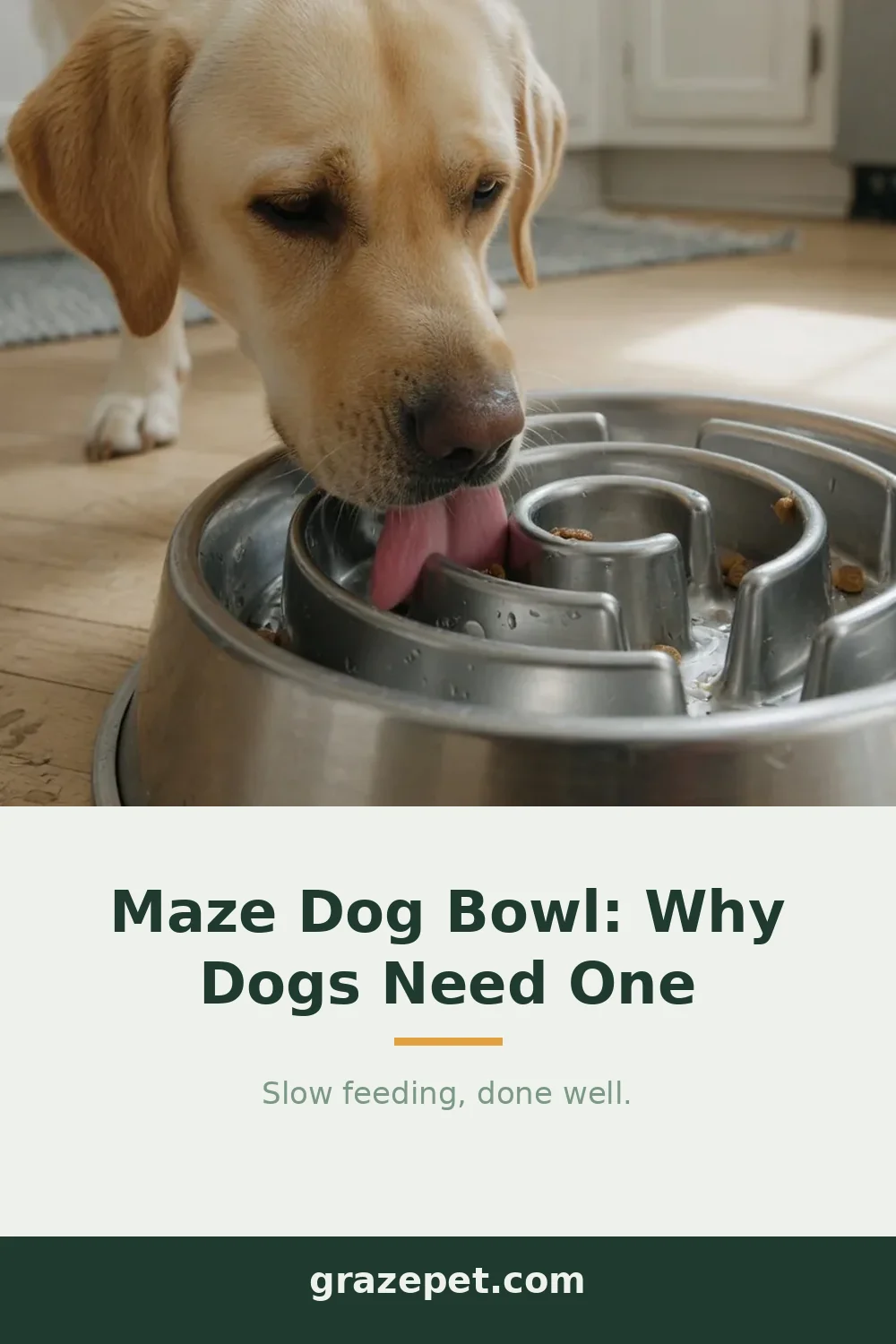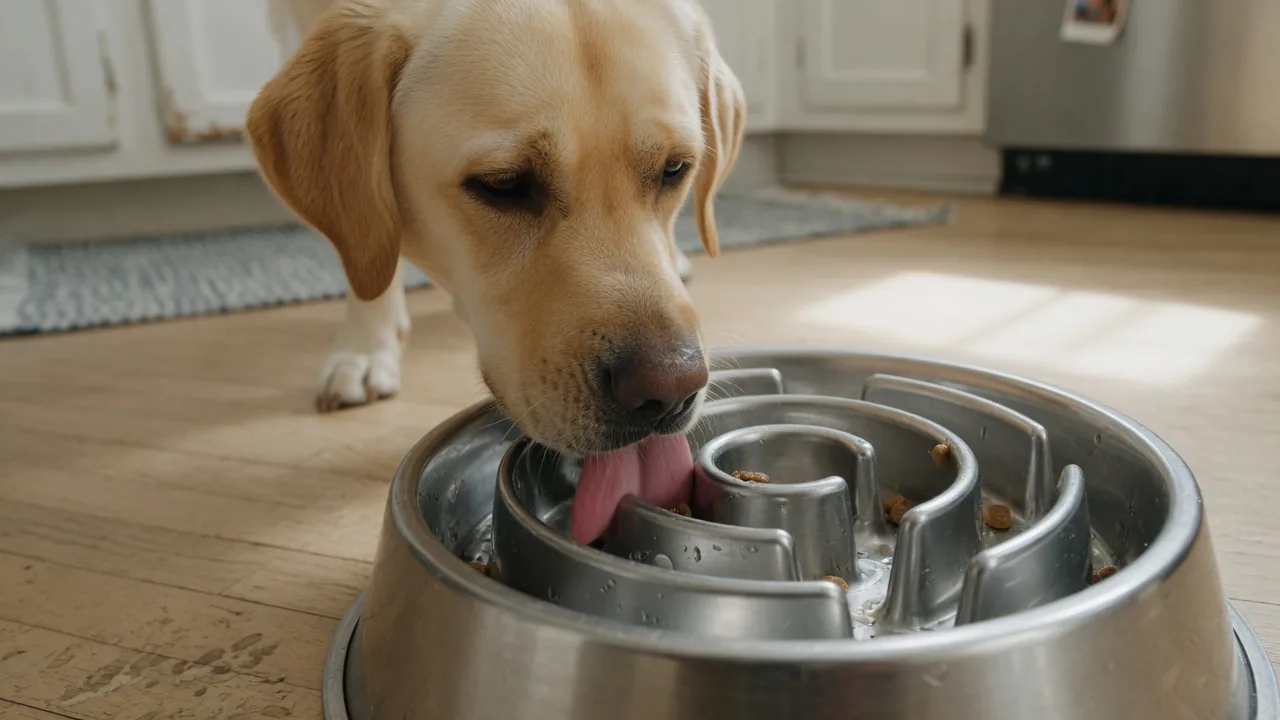
Maze Dog Bowl: What It Is and How to Choose One
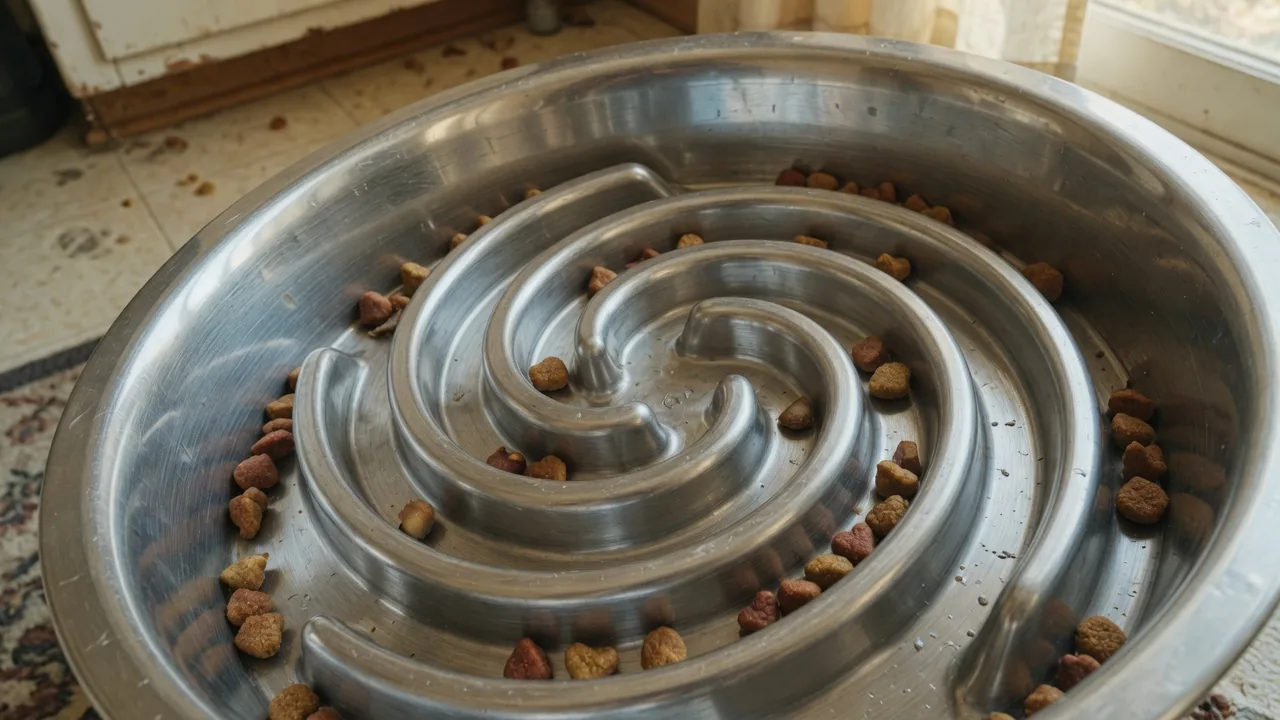
A maze dog bowl is a slow feeder with raised walls arranged in a pattern (spirals, waves, petals or pegs) so a dog has to lick and nudge food through channels instead of scooping it up in big mouthfuls. The pattern and its depth decide how hard the bowl is, so the right maze depends on your dog's muzzle, food and eating style, and on how easily you can clean it.
"Maze bowl" and "slow feeder" are used interchangeably in shops, and for practical purposes they are the same product. If you want the plain-English basics of the category, see what a slow feeder dog bowl is. This page goes a level deeper on the maze itself: what it does and does not do, the pattern types, how to judge difficulty and size before you buy, how it compares with other feeder styles, and how to keep it clean.
What does a maze dog bowl actually do?
The mechanism is simple. The obstacles make a dog work around barriers to reach food, which slows gulping and adds some mental stimulation, according to veterinarian Lauren Jones, VMD, writing for Chewy. That is the benefit worth buying one for: a slower meal and a little puzzle-solving at every feeding.
It helps to be clear about what a maze bowl is not:
- It is not a bloat preventer. The same Chewy guide says no bowl can fully prevent gastric dilatation-volvulus (GDV, or bloat). The ACVS lists eating quickly only as a possible contributor, and a 2016 RCVS Knowledge review of six studies concluded there was not enough evidence to say either way whether fast eating raises GDV risk. Slowing a meal is a sensible habit; it is not a guarantee. If you have a large, deep-chested dog, talk to your vet about bloat risk. Our guide to dog bloat and GDV symptoms lists the emergency signs.
- It is not for every dog. Chewy's guide cautions that some dogs get frustrated, refuse to eat or become stressed, that resource guarding may intensify, that heavy chewers can damage plastic models, and that dogs who are losing weight or have a poor appetite may eat less. Check with your vet first if your dog has a medical condition.
- It is not a treatment. Vomiting, weight change, constant hunger or a swollen belly are vet questions, not bowl questions.
We have not run lab tests on maze bowls, and we do not claim a specific "x times slower" figure. For how much slowing to expect and when a bowl will not do it, see do slow feeder dog bowls work.
What exactly makes a bowl a "maze" bowl?
Three features, and they are what you are comparing when you shop.
- Walls (ridges). The raised parts. Their height sets how far your dog has to reach down.
- Channels. The gaps between walls where the food sits. Their width sets how much tongue or muzzle fits in.
- Layout. Whether channels are long and connected (food can be pushed along them) or broken into separate pockets (each one has to be emptied individually).
A normal bowl is one big open pocket. A maze bowl divides the same volume into many small ones. Your dog can still reach all of the food; they just cannot get much of it per mouthful. That is why the maze matters more than almost anything else about the bowl: two bowls of the same size and material can be very different to eat from.
What are the main maze patterns, and how do they differ?
Manufacturers use all sorts of names, but most designs fall into a handful of families. Chewy's guide lists the same broad types: maze patterns with winding ridges, central pillars or posts, and flower or petal shapes. The difficulty ratings below are our own descriptive grouping of common designs, not an industry standard or a test result.
| Pattern | What it looks like | Typical difficulty | Suits | Less suited to |
|---|---|---|---|---|
| Spiral / swirl | One or two curved walls winding out from the centre | Easy to moderate | Beginners, most medium and large dogs, kibble | Dogs that need a serious challenge |
| Wave / ripple | Parallel curved ridges across the bowl | Easy | Puppies, flat-faced dogs, wet food | Determined gulpers |
| Flower / petal | Rounded lobes radiating from a central hub | Moderate | Medium muzzles, mixed kibble sizes | Very broad muzzles (tight inner corners) |
| Concentric rings | Circular walls inside one another | Moderate | Long-muzzled dogs, small kibble | Short-faced dogs |
| Pegs / posts | Separate bumps or pillars the dog eats around | Easy to moderate | Broad muzzles, large kibble | Small kibble (rolls freely between pegs) |
| Tight labyrinth | Many narrow, angular channels and dead ends | Hard | Experienced, long-nosed speed eaters | Puppies, flat faces, anxious dogs, wet food |
Two rules of thumb sit behind the table. Curves are easier than corners, because a tongue sweeps along a curve but has to dig into a corner. And connected channels are easier than isolated pockets, because a dog can push food along to where it is convenient.
Difficulty levels. Many brands sell the same bowl in several levels (easy, medium, hard). Chewy's guide advises introducing slow feeders gradually, starting with a simple pattern before moving to complex ones, and notes that simpler designs suit puppies, seniors and dogs with cognitive changes. If you are torn between two bowls, pick the easier one. A moderate maze your dog uses happily at every meal beats a brutal one that ends up in a cupboard.
How do you judge a maze's difficulty before buying?
Product photos make every bowl look similar, so check these four things in the listing or in your hand.
- Wall height relative to bowl depth. Walls that rise to the rim make a deep maze. Walls that stop halfway are forgiving.
- Channel width. Compare it with your dog's muzzle. If the narrowest channel is slimmer than the tip of the nose, your dog will be eating with tongue alone, which is slower but is also the point where some dogs give up.
- Number of dead ends. More enclosed pockets means more difficulty.
- Edges. Rounded tops and smooth transitions are easier on noses and far easier to wash. Avoid sharp or thin-edged ridges.
Which maze fits your dog?
The muzzle and eating-style notes below are our practical guidance from how these bowls are built; they are not veterinary rules. Chewy's guide does not address muzzle shape specifically, so treat these as starting points and adjust for your dog.
By muzzle shape
- Long, narrow muzzles (sighthound and collie types) reach into almost anything. Deeper mazes and rings work well; shallow ones may barely slow them.
- Medium muzzles (most retrievers, spaniels, mixed breeds) usually do well with spirals and petals of moderate depth.
- Broad or short muzzles (bulldog and pug types, mastiff types) need wide, shallow channels. Chewy's guide notes that flat-faced breeds such as Bulldogs and Pugs may struggle with deep ridges or narrow spaces, and some brands make a flat-face version.
- Tiny muzzles (toy breeds, young puppies) need a small-diameter bowl with low walls. A big-dog maze is a wall they cannot see over.
By food
- Dry kibble works in most patterns. Match channel width to kibble size: very small kibble falls to the bottom of narrow channels; large kibble can wedge.
- Wet, raw or soaked food smears. Choose open waves or wide spirals and avoid tight labyrinths unless you enjoy scrubbing. Chewy notes that some designs suit kibble better than wet food. We go further in slow feeders for wet food.
By eating style
- The vacuum (fast, relentless, unbothered by obstacles): moderate maze and a heavy bowl with a non-slip base.
- The flipper (solves problems by tipping the bowl): needs weight, a grippy base or a mat, and usually an easier pattern, not a harder one.
- The worrier (hesitant, gives up easily): the easiest maze you can find, introduced gradually.
- The chewer (attacks the ridges): Chewy warns heavy chewers can damage plastic models, so look for a sturdy material and take the bowl away if it is being chewed.
What size maze bowl do you need?
Size by meal volume, not by the dog's weight class alone.
Put your dog's normal portion in a measuring jug and note the volume. The bowl should hold that amount with the food sitting below the top of the walls. If the food is piled above the maze, your dog will eat the top layer at full speed and only slow down for what is left. The opposite problem hits small dogs: a few pieces lost in a huge maze they have to climb into.
Then check the diameter against your dog's head. They should be able to reach the centre and the far side without stepping into the bowl or straining their neck over a high rim.
Listings do not always state usable capacity clearly. If one does not, ask the seller or look for buyer photos with food in it. Not sure how much to feed? That is a question for your vet, and our guide to how much to feed your dog explains the factors. For a quick shortlist across bowl types, see our hub on the best slow feeder dog bowls.
How does a maze bowl compare with other feeder styles?
A maze bowl is one of several ways to slow a meal. Here is how they differ in practice.
| Style | How it slows eating | Good for | Trade-offs |
|---|---|---|---|
| Maze / slow feeder bowl | Ridges and channels break up each mouthful | Everyday kibble meals, minimal effort | Can be tricky to wash; some dogs get frustrated |
| Snuffle mat | Food hidden in fabric strips, found by sniffing | Foraging enrichment, calm sniffing time | Needs washing and drying; not for dogs that eat fabric |
| Lick mat | Food spread on a textured surface and licked off | Wet food, spreads, short calm sessions | Not a bowl for a full dry-kibble meal |
| Puzzle feeder | The dog manipulates a toy or device to release food | Mental challenge; higher effort | Takes learning; more setup |
| Raised bowl | Changes height only; does not slow eating | Dogs who need a specific height on vet advice | Chewy advises large, deep-chested dogs not use elevated slow feeders because of GDV risk; ask your vet |
Closer comparisons: snuffle mat vs slow feeder bowl, dog puzzle feeders, lick mats for dogs and raised bowl vs slow feeder.
Why does the material matter more in a maze bowl than a plain one?
Because a maze multiplies surface area and corners. Every wall is another edge where food film collects.
Chewy's guide summarises the materials this way: plastic is affordable but can scratch and trap bacteria; stainless steel is durable and easy to clean; silicone is flexible and travel-friendly; ceramic is less likely to scratch. Steel mazes also tend to be smoother, moderate-difficulty patterns, because steel cannot be moulded into the very intricate labyrinths plastic can. For most dogs that is the right difficulty anyway.
That is the thinking behind our own stainless steel maze bowl: a raised maze pattern to pace the meal, a non-slip base, and a rust-proof, dishwasher-safe surface. Check the care label on whichever bowl you buy, since dishwasher safety varies by product. The detailed material comparison is in stainless steel vs plastic slow feeders.
Disclosure: we sell the bowl linked above, and the buy button leads to Amazon, where we earn a commission on qualifying purchases at no extra cost to you. See our affiliate disclosure.
How do you clean a maze dog bowl?
More often than a plain bowl, because of the extra ridges and corners. Chewy's guide recommends washing most slow feeders daily with warm, soapy water, notes that dishwasher-safe models are easiest for bowls with deep grooves, and says to replace scratched or cracked bowls to prevent bacterial or mould growth.
A practical routine:
- Rinse straight after the meal so food does not dry into the channels.
- Wash with hot, soapy water and a bottle or detail brush that reaches into each channel and corner. A sponge alone skips the narrow spots.
- Use the dishwasher only if the care label allows it (top rack for many plastic models). Dishwasher-safe is the easiest route for deep mazes.
- Dry fully before the next meal.
- Check for damage. Replace a bowl that is scratched, cracked or chewed.
- Wet and raw food needs washing after every meal. Wide, open patterns are far easier to clean.
Our full routine, including weekly deep cleans and fixing smells, is in how to clean a slow feeder bowl.
What if the maze is too hard, too easy, or keeps getting flipped?
Too hard (barking at the bowl, pawing, walking off, food left behind): Scatter the food across the tops of the ridges rather than pushing it into the channels. Put half the meal in the maze and half in a plain bowl for a week. If none of that helps, the pattern is wrong for your dog; go shallower, or go back to a plain bowl and ask your vet if a feeding problem is behind it.
Too easy (meal still gone in under a minute): Press the kibble down into the channels, add a little water so it has to be licked, or split the meal between the maze bowl and a snuffle mat. Only then consider a harder pattern.
Flipped or pushed around the room: Check the base, since rubber feet can wear and collect grease, so wash them. Put the bowl on a grippy mat or in a corner. A dog that flips repeatedly is often telling you the maze is too difficult.
Dog bites the walls: Common in the first few meals. If it continues, drop the difficulty, make sure the ridges are rounded and stop using the bowl if it is being damaged.
Food left in the corners: Either the channels are too narrow for your dog's tongue or the food is too sticky for the pattern. Go wider.
Whether a maze bowl is appropriate at all for a dog with dental problems, a poor appetite or a medical condition is a separate question; we cover who should avoid them in are slow feeder bowls good for dogs.
The bottom line
A maze dog bowl is only as good as the match between its pattern and your dog. Read the maze, not the marketing: wall height, channel width, corners, edges. Fit it to the muzzle, the food and the temperament, size it to the meal, start with an easier pattern, and choose a material you can get properly clean. Treat it as a way to slow a meal, not as a medical device.
👉 See the Stainless Steel Slow Feeder Dog Bowl →
Sources
Health and product-guidance statements on this page rely on the following. Accessed 27 October 2026. The muzzle-shape and pattern-difficulty guidance is our own, as stated above.
- Chewy, Lauren Jones, VMD, "Slow-Feeder Dog Bowls: How They Help and How To Choose One" (updated 3 August 2026): https://www.chewy.com/education/dog/food-and-nutrition/does-your-fast-eater-need-a-slow-feeder-bowl
- American College of Veterinary Surgeons, "Gastric Dilatation-Volvulus": https://www.acvs.org/small-animal/gastric-dilatation-volvulus/
- RCVS Knowledge, Buckley L., "Are dogs that eat quickly more likely to develop a gastric dilatation (+/- volvulus) than dogs that eat slowly?", Veterinary Evidence 1(4), 2016: https://doi.org/10.18849/VE.V1I4.53
Frequently Asked Questions
What is a maze dog bowl? A maze dog bowl is a slow feeder with raised walls arranged in a pattern, such as a spiral, waves or petals. The walls split the meal into narrow channels, so a dog has to lick and nudge food out in small amounts instead of gulping large mouthfuls.
Is a maze bowl the same as a slow feeder? In practice, yes. Slow feeder is the general category and maze bowl describes the most common design, where a raised pattern does the slowing. Shops use the two names for the same products, along with anti-gulp bowl.
What are the benefits of a maze bowl? It slows gulping and adds some mental stimulation by making your dog work around obstacles to reach food. It is not a guaranteed way to prevent bloat, and some dogs get frustrated, so start with an easy pattern and ask your vet if your dog has a medical condition.
Which maze pattern is best for dogs? There is no single best pattern. Spirals and waves are easiest and suit beginners, puppies and flat-faced dogs. Petal and ring designs are moderate. Tight labyrinths with narrow channels are hardest and only suit long-muzzled, experienced fast eaters.
Are maze bowls good for flat-faced dogs? They can be, if the pattern is wide and shallow. Veterinary guidance notes that breeds such as Bulldogs and Pugs may struggle with deep ridges or narrow spaces, so choose low ridges and open channels, or a bowl made for flat-faced breeds.
Can you use a maze bowl with wet food? Yes, with the right pattern. Pick wide, open channels and smooth curves, because wet and raw food smear into tight corners, and wash the bowl after every wet meal. A dishwasher-safe bowl makes this much easier.
How do I clean a maze dog bowl? Rinse it after the meal, wash with hot soapy water and a brush that reaches into each channel, dry it fully, and replace it if it is scratched or cracked. Use the dishwasher only if the care label allows it.
How do I know if a maze bowl is too hard for my dog? Signs include barking at the bowl, pawing or flipping it, biting the ridges, walking away, or leaving food behind. Make it easier by scattering food on top of the ridges or splitting the meal with a plain bowl, and switch to a shallower pattern if it continues.
What size maze dog bowl should I get? Choose a bowl that holds your dog's normal meal with the food sitting below the top of the ridges. If food is heaped above the maze, it will not slow the first half of the meal. Your dog should also be able to reach the centre comfortably.
Save this guide