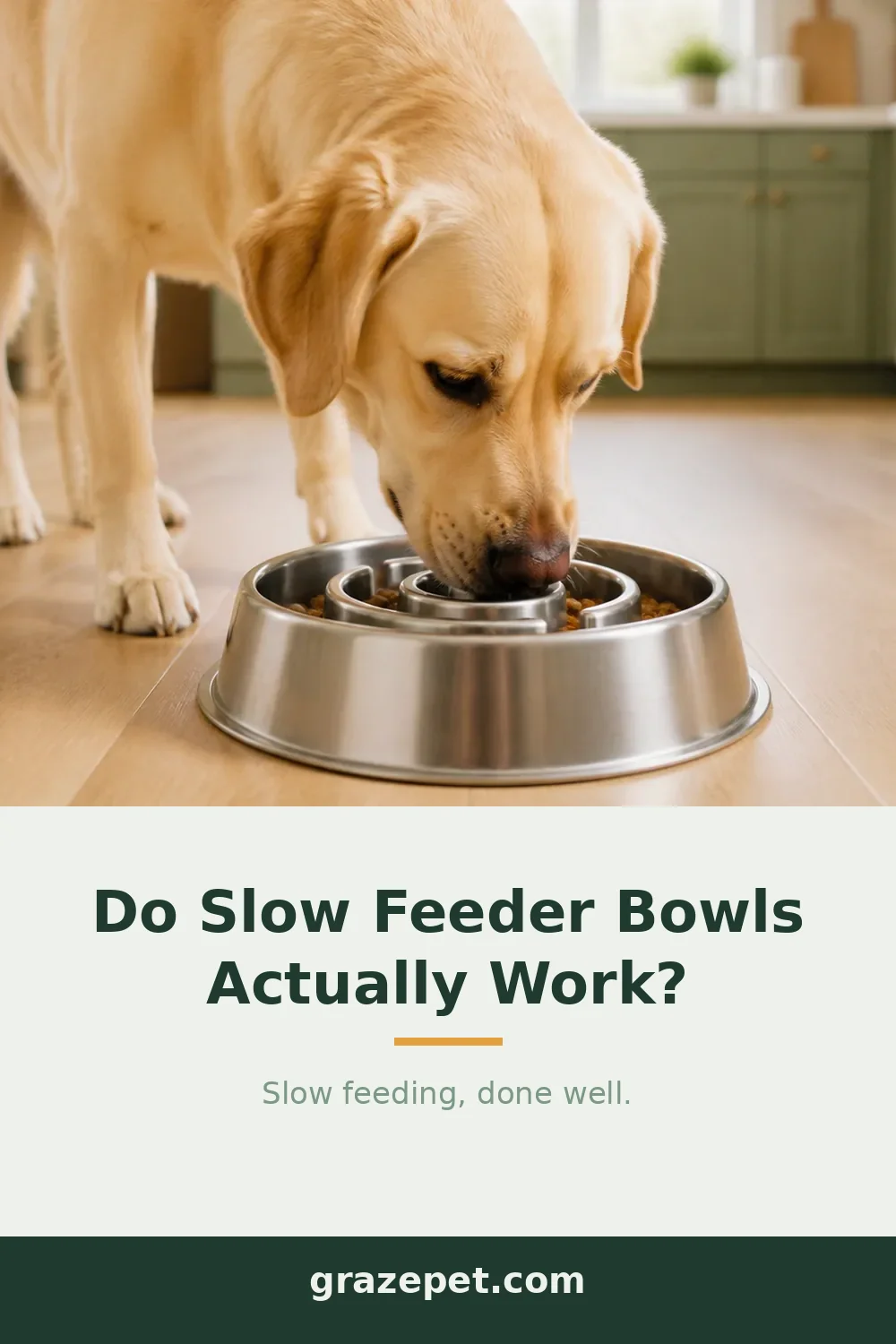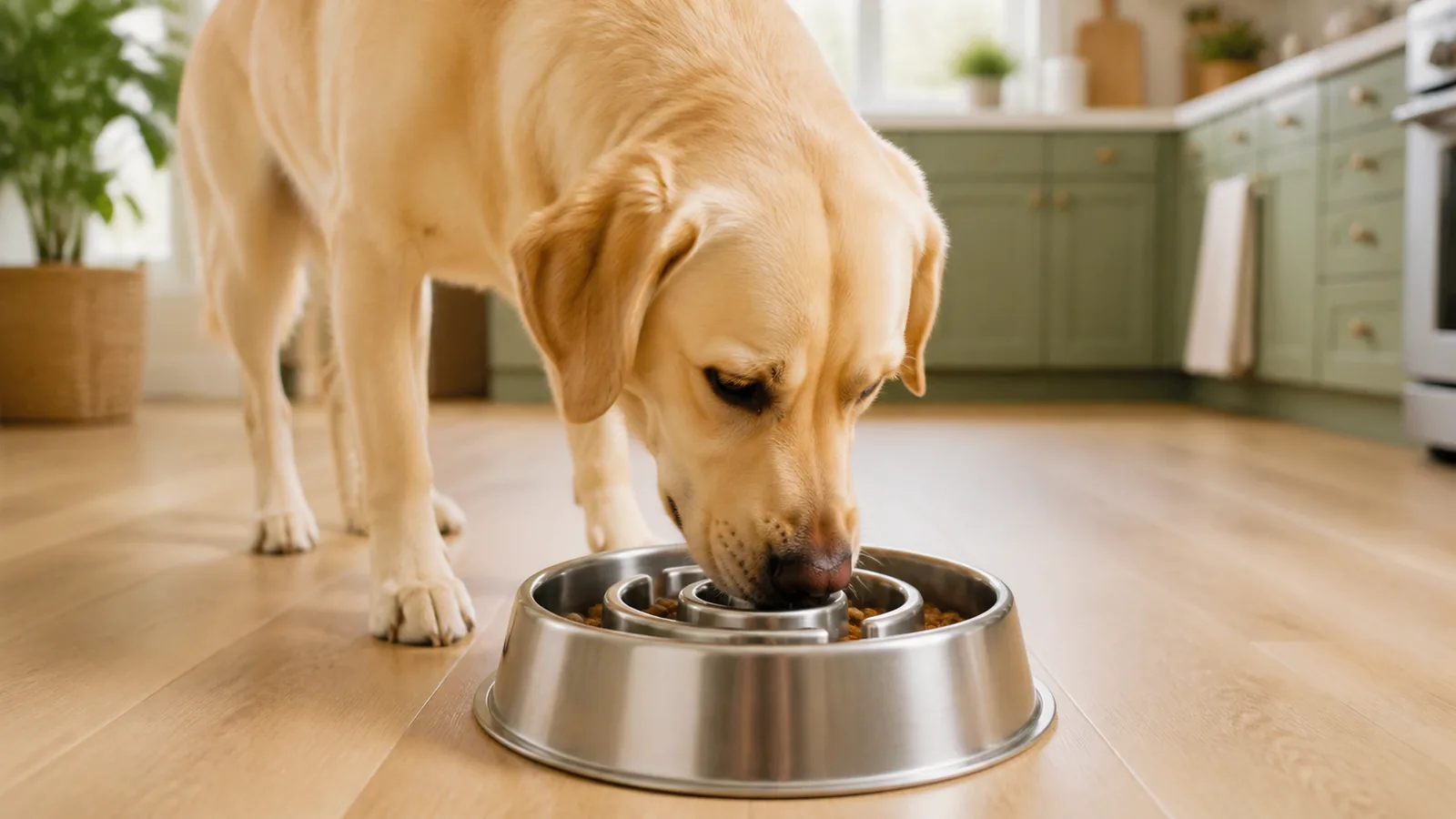
What Is the Purpose of a Slow Feeder Dog Bowl? Does It Work?
Short answer: A slow feeder dog bowl has ridges, posts or mazes built in so a dog can only take a little food at a time. Its purpose is to slow fast eating. For most dogs it does that, from the first meal. Slower meals may mean less gulping, less regurgitation and a calmer mealtime. It does not cut calories, cause weight loss, treat illness or prove to prevent bloat (GDV), and dogs respond differently, so some barely slow down and a few get frustrated.
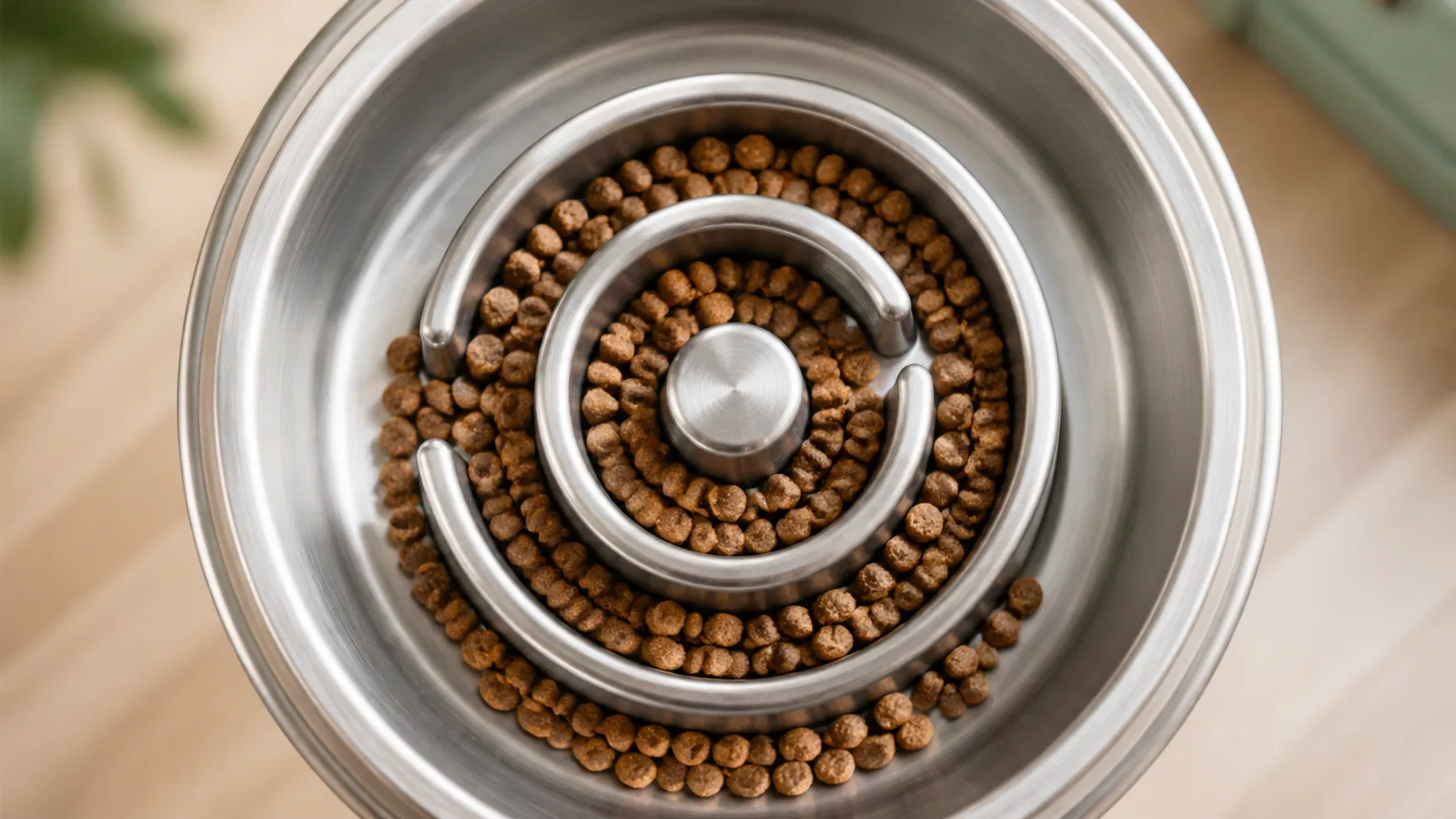
The purpose of a slow feeder bowl is to stop a dog gulping its meal. By changing how the food is reached (small pockets instead of one open pile), it forces smaller bites and short pauses. That matters most for dogs that eat so fast they gag, bring food back up or swallow a lot of air.
Skepticism is reasonable here. The pet aisle is full of products with confident claims and no evidence. So this page separates three things: what a slow feeder reliably does, what it probably helps with, and what's oversold. We sell one, and we've still tried to write the page we'd want to read before buying. Whether a slow feeder is safe and suitable for your dog is a separate question, covered in are slow feeder bowls good for dogs.
How does a slow feeder change the way a dog eats?
Mechanically, not psychologically. The ridges split one open pile into narrow pockets, so each bite is smaller, each mouthful takes tongue-and-nose effort, and the dog has to reposition between pockets. None of this depends on the dog choosing to cooperate, which is why the effect shows up at the first meal. The parts of the bowl and the full list of designs are in what a slow feeder dog bowl is; this page is about whether that slowdown is worth having.
What does the evidence actually show?
Here's the honest state of it, claim by claim.
| Claim | How strong is the support? | The fair summary |
|---|---|---|
| Slows eating | Strong | Mechanical and easy to see; you can time it yourself |
| Less regurgitation after meals | Reasonable | Widely reported and makes physiological sense; not well studied |
| Less swallowed air, gas and burping | Plausible | Follows from slower eating; little direct research |
| Mental enrichment | Modest | Real for the first weeks, fades as the dog learns the pattern |
| Reduces bloat (GDV) risk | Weak and mixed | Fast eating is a possible risk factor; no proof bowls prevent GDV |
| Causes weight loss | Not supported | Calories are unchanged |
Eating speed. This is the solid one. There isn't a large body of published trials on slow feeder bowls specifically, but you don't need one for this claim, because you can measure it at home in two meals (method below). How much slower varies a lot: by the dog, the pattern, the kibble size and how full the bowl is. Be wary of any brand quoting a precise multiple such as "10x slower". Some dogs do slow that much. Many don't.
Regurgitation. Dogs who bolt food and bring it back up minutes later, largely undigested, often improve when meals are slowed. This is a standard piece of veterinary advice. It's based on experience and common sense more than controlled trials, and it only applies when speed is the cause.
Bloat (GDV). This is the claim most often overstated. The best-known research is a set of Purdue University studies from around 2000 that followed large and giant breed dogs. They found faster eating was associated with higher GDV risk in large breeds, but not clearly in giant breeds. A later evidence review in the journal Veterinary Evidence concluded that most studies found no effect of eating speed on GDV risk; where an effect did appear, fast eating was the risk, and no study found that slow eating increased it. In plain terms: slowing meals may help, is very unlikely to hurt, and has not been shown to prevent bloat. Anyone selling a bowl as bloat prevention is ahead of the evidence. The real risk factors and warning signs are in our dog bloat (GDV) guide.
Weight. A slow feeder delivers exactly the same calories. A longer meal may leave some dogs less frantic afterwards, which helps owners stick to a measured ration, but the popular line that dogs "feel full" because eating took longer is borrowed from human research and hasn't been established in dogs.
How can you test whether it works for your dog?
You don't need to take anyone's word for it, including ours.
- Time a baseline. Feed a normal meal in the old bowl and time from first bite to empty. Do it twice.
- Switch bowls, same food, same amount. Time the first slow feeder meal.
- Time it again at one week and at three weeks. Dogs improve with practice, so the first meal flatters the bowl.
- Watch what you actually care about. Count regurgitation episodes, burping and post-meal discomfort across the same weeks.
What counts as working? As a rough guide, a meal that used to take under a minute should now take at least three or four. Our guide on how long it should take a dog to eat gives more context. If the three-week time is barely above baseline, that bowl isn't working for that dog.
Which bowl design, size and food type suit your dog?
Whether a slow feeder works for a given dog depends mostly on fit.
- Pattern and pace. Tighter, deeper channels slow a dog more; wide, shallow ones barely slow a big-mouthed dog. Start easier than you think you need and step up. A harder pattern is not automatically better: if a dog gives up, the bowl has stopped being a slow feeder and become a source of stress. Our maze dog bowl guide explains how depth and spacing change difficulty.
- Size and muzzle. The meal should sit in a single layer below the ridge tops, and the muzzle should reach the bottom of each channel. Flat-faced dogs usually need shallow, wide patterns (see best slow feeder for bulldogs), while big dogs that scoop with the whole jaw often need taller ridges (see best slow feeder for Labradors).
- Dry vs wet food. Kibble is what most mazes are designed for. Wet or fresh food is pressed in and licked out, and deep narrow mazes are hard to empty. Shallow, smooth designs suit it, as covered in slow feeders for wet food.
- Cleaning. Food film in the corners puts some dogs off and is a hygiene issue, especially with wet food. Wash after every meal; how to clean a slow feeder bowl has the routine.
- Choosing between models. If you are ready to pick one, best slow feeder dog bowls compares options, and raised bowl vs slow feeder covers the stand question.
Why do slow feeders sometimes fail?
When a slow feeder "doesn't work", the cause is usually one of these.
| What you see | Likely reason | Fix |
|---|---|---|
| Still done in under two minutes | Pattern too shallow or wide for this dog | Deeper or tighter maze; add water to kibble |
| Slower at first, then speeds up | Dog has learned the pattern | Rotate with a second pattern or a snuffle mat |
| Food eaten from the top, fast | Bowl overfilled above the ridges | Bigger bowl, or split the meal |
| Bowl flipped or pushed around | No grip; frustrated dog | Non-slip base or mat; easier pattern |
| Dog paws, barks, or walks away | Pattern too hard, or muzzle can't reach | Shallower, wider design |
| Kibble swept out in clumps | Kibble much smaller than channels | Tighter pattern, or dampen the food |
| Dog refuses the bowl | Smell, new object, or scratched plastic | Introduce gradually; clean thoroughly; try steel |
Two of these deserve a comment. Adaptation is normal and rarely discussed: most dogs get more efficient over weeks, so expect some of the first-day effect to wear off. It usually settles well above open-bowl speed. And fit matters more than brand. A pattern that slows a Labrador may do nothing for a terrier and be unusable for a Pug.
Who does a slow feeder not help?
This is the part most product pages leave out.
- Dogs who already eat at a sensible pace. Nothing to fix. You'd be adding an obstacle for no benefit.
- Dogs gulping for a medical reason. If appetite has surged because of medication, diabetes, Cushing's disease, parasites or a problem absorbing food, the bowl treats the symptom and delays the diagnosis. A sudden change in eating speed is a vet matter.
- Dogs who vomit for reasons other than speed. True vomiting (heaving, digested food or bile, happening hours after meals) isn't caused by gulping. Slowing the meal won't stop it.
- Dogs racing another pet. The bowl helps a little. Feeding in separate rooms helps far more, because competition is the cause.
- Dogs who are genuinely underfed. A hungry dog needs the portion checked, not the meal stretched.
- Reluctant or underweight eaters. Making food harder to get is the wrong direction.
- Owners hoping for weight loss or guaranteed bloat protection. It does neither on its own.
If you're not sure why your dog bolts food in the first place, why does my dog eat so fast helps you pin down the cause before you spend money.
How do you get the most out of one?
- Keep the portion the same. Only the pace changes.
- Make the first meals easy, with some kibble resting on top, then push it into the channels.
- Add water for extra slowing. Damp kibble sticks; frozen soaked kibble or wet food lasts much longer.
- Rotate. Alternating with a snuffle mat or a second pattern keeps the dog from getting too practised. To decide which of the two suits your dog, see snuffle mat vs slow feeder bowl.
- Wash it properly. Food film in the corners puts some dogs off. This is the practical argument for steel: our stainless steel slow feeder dog bowl goes in the dishwasher and doesn't scratch the way plastic does.
One honest note on our own product: steel mazes are generally simpler than the deepest moulded plastic ones. For a typical fast eater that's enough. For an extreme gulper, use the water or freezing trick with it, or look at a deeper pattern. For every other method of slowing a dog, see how to stop your dog eating too fast.
When should you ask a vet instead?
A bowl is the wrong tool, and a vet visit the right one, if you see any of the following:
- Your dog's eating speed or appetite changed suddenly.
- Vomiting that continues after meals are slowed, or happens hours after eating.
- Weight loss despite eating well, or excessive thirst.
- Gagging or coughing that doesn't settle as meals slow.
- Any sign of a swollen, hard or painful belly, repeated unproductive retching, restlessness or drooling. These can be signs of bloat (GDV), which is an emergency; seek veterinary care immediately.
Your vet can also tell you whether your dog is in a higher-risk group for GDV (deep-chested, large breeds especially) and what feeding routine suits them. A slow feeder is a feeding aid, not a substitute for that conversation.
The bottom line
Slow feeder bowls aren't a gimmick. They do one job, slowing a meal, and they do it by simple physics that you can verify with a stopwatch. That often means less regurgitation and a calmer mealtime. They are not proven bloat prevention, they don't cause weight loss, and they won't help a dog whose fast eating comes from illness, hunger or competition. Buy one for the right reason and it's good value.
👉 See the Stainless Steel Slow Feeder Dog Bowl →
Frequently Asked Questions
What is the purpose of a slow feeder dog bowl? To slow down dogs that gulp their food. Raised ridges, posts or mazes split the meal into small pockets so the dog takes smaller bites and eats over a longer time. That may reduce gulping, swallowed air and regurgitation after meals. It doesn't change calories and isn't a treatment for medical problems.
Do slow feeder dog bowls really work? Yes, for slowing down eating. The raised ridges physically stop a dog taking large mouthfuls, so most dogs take several times longer to finish a meal, starting from the first use. They are less proven for other claims, such as preventing bloat, and they don't cause weight loss.
How much do slow feeders slow eating down? It varies with the dog, the maze pattern, kibble size and how full the bowl is. A meal that took under a minute commonly takes three to ten minutes. Be cautious about fixed claims like "10x slower". Time your own dog's meals before and after to see the real effect.
Do slow feeder bowls prevent bloat? There's no proof they do. Some research has linked fast eating to higher bloat (GDV) risk in large breeds, while other studies found no effect. Slowing meals is a sensible precaution that's unlikely to do harm, but it's not a guarantee. Know the emergency signs and discuss risk with your vet.
Why isn't my slow feeder working? Usually the pattern is too shallow for your dog, the bowl is overfilled so food sits above the ridges, or your dog has learned the pattern over time. Try a deeper maze, a larger bowl, adding water to the kibble, or rotating with a snuffle mat.
Do dogs get used to slow feeders and speed up again? Most get somewhat faster over the first few weeks as they work out a technique, but they rarely return to open-bowl speed. If your dog speeds up a lot, alternate between two different patterns, dampen or freeze the food, or use a snuffle mat for some meals.
Will a slow feeder stop my dog throwing up after eating? It often helps when a dog brings food back up within minutes of bolting a meal, because speed is the cause. It won't help vomiting that has another cause. If your dog still vomits after meals are slowed, or vomits hours later, see a vet.
Can you use wet food in a slow feeder? Yes, but pick a shallow, smooth design. Wet food is pressed into the channels and licked out, and deep narrow mazes are hard for a dog to empty and harder to clean. Wash the bowl after every meal.
Are slow feeder bowls just a gimmick? No. The slowing effect is mechanical and easy to verify by timing meals. The gimmick is in some of the marketing around them: precise "10x" figures, bloat-prevention promises and weight-loss claims go beyond what the evidence supports.
Save this guide