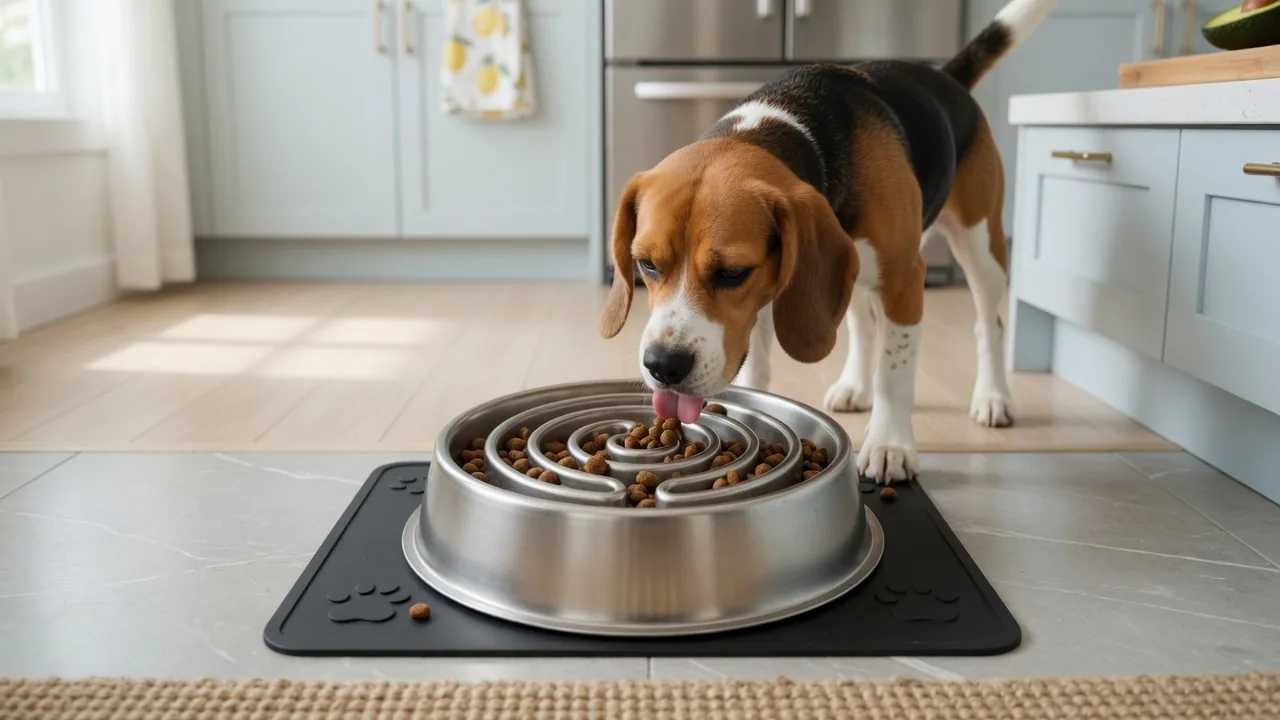
Best Slow Feeder for Beagles
The best slow feeder for a Beagle is a medium, wide-topped maze bowl in stainless steel with ridges roughly 2–3 cm high, channels a medium muzzle can reach into, and a non-slip base. Pair it with a snuffle mat for part of the daily ration: Beagles are scent hounds, and making them sniff for food slows them more than any bowl.
Beagles don't eat so much as make food disappear. If yours finishes dinner before you've put the scoop away and then looks at you as if nothing happened, that's the breed working as designed. This guide covers why Beagles do it, what actually fits a Beagle's face and ears, how much to put in the bowl, and what to do when your hound outsmarts the maze. For the general case for and against slow feeders, see are slow feeder bowls good for dogs.
Why do Beagles eat so fast?
Three things stack up in this breed.
They were bred to live and eat in packs. Beagles are pack hounds. For most of the breed's history, dinner was a shared trough and the slow eater went hungry. Eating fast wasn't a bad habit; it was the winning strategy. A Beagle in a quiet kitchen with a private bowl still eats as if eleven other hounds are closing in.
Their world runs on smell. A Beagle's nose is among the best in the dog world, and food is the most interesting smell there is. That's why they counter-surf, raid bins and find the one dropped crisp under the sofa. The nose keeps reporting "food nearby" long after the bowl is empty.
They rarely act full. Many Beagles will keep eating well past what they need if given the chance, which is why free-feeding almost never works for the breed. If your dog seems genuinely ravenous all the time — losing weight, drinking heavily, or suddenly hungrier than usual — that's worth a vet check; our guide to why a dog is always hungry covers the medical causes.
Put those together and you get a dog that swallows kibble whole, sometimes brings it straight back up, and then begs. A slow feeder doesn't change the drive. It changes how long the meal lasts, and it gives that nose a job.
What size and shape of slow feeder fits a Beagle?
Beagles come in two size varieties under the AKC standard — 13 inches and under, and 13 to 15 inches at the shoulder — and most adults weigh somewhere around 20 to 30 pounds. That puts them firmly in medium bowl territory. The mistakes go both ways: a small-breed bowl overflows and the maze stops working, while a large-breed bowl has channels so wide a Beagle just scoops.
| Feature | What suits a Beagle | Why |
|---|---|---|
| Capacity | Holds a full meal (roughly 1–2 cups) in a single layer | Kibble piled above the ridges gets gulped |
| Ridge height | About 2–3 cm | Tall enough to block scooping, short enough to reach the bottom |
| Channel width | A little wider than the muzzle tip | Too narrow frustrates; too wide doesn't slow |
| Top diameter | Wide and open, roughly 20 cm or more | Lets ears fall outside the bowl, not into it |
| Base | Full non-slip ring or rubber feet | Beagles shove and paw a bowl that moves |
| Material | Stainless steel | Stands up to scraping and determined licking |
The ear problem nobody mentions. Beagle ears are long enough to reach the end of the nose, and at a deep, narrow bowl they end up in the food. With dry kibble it's merely annoying. With wet or soaked food it means dirty, damp ear leather after every meal, and Beagles are already a breed that needs regular ear checks. A wide, fairly shallow bowl helps; so does feeding wet food in a thin layer rather than a deep one. If ears keep landing in dinner, a soft snood or simply wiping the ear tips after meals solves it.
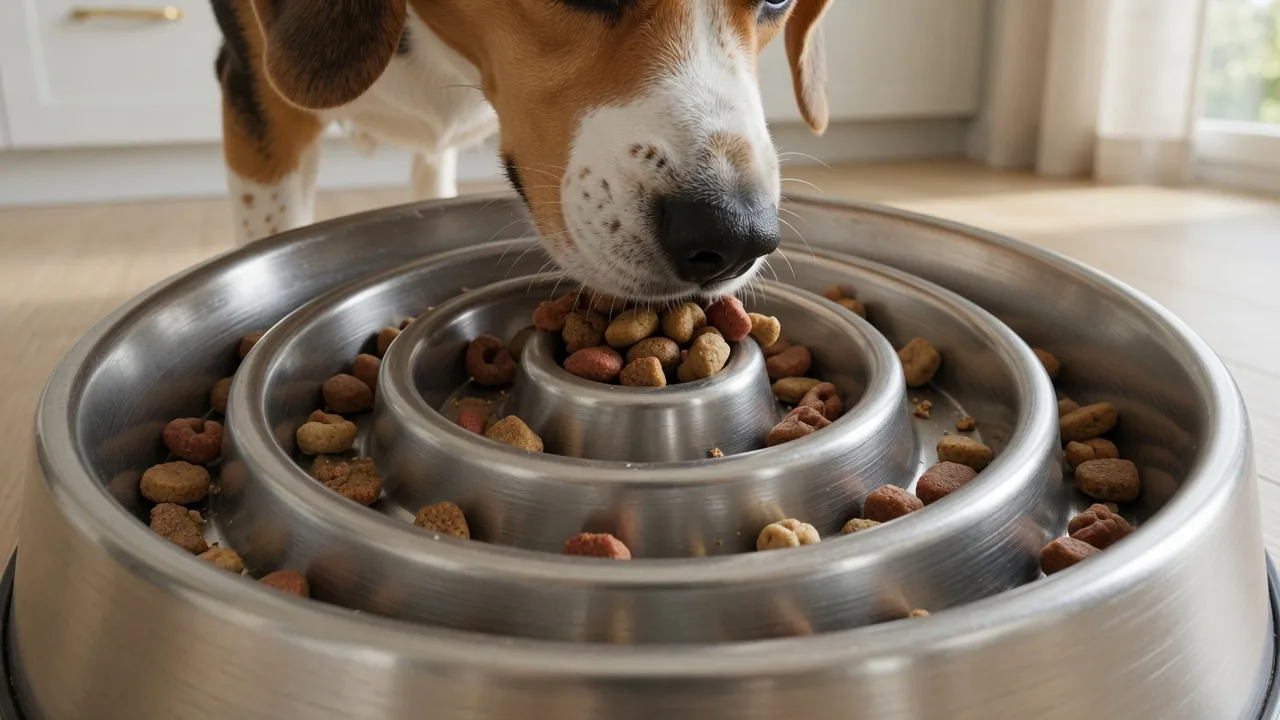
Muzzle fit. A Beagle's muzzle is medium length and fairly square, so most standard maze patterns work — you don't need the shallow, wide-set ridges a flat-faced breed needs. Spirals and flower patterns suit them well. Very tight, deep mazes designed for long narrow noses can leave food a Beagle can smell but can't reach, and a Beagle who can smell unreachable food will let the whole street know.
Why stainless steel for a Beagle specifically?
Because Beagles are hard on bowls in a particular way. They don't just eat from the bowl; they lick it for another five minutes, push it across the floor, and some pick it up and carry it. Plastic mazes scratch under that treatment, and scratched plastic holds on to the food film a Beagle's nose finds irresistible — which only encourages more gnawing. A chewed plastic ridge is also something you don't want swallowed.
Steel shrugs that off and goes through the dishwasher. Our stainless steel slow feeder dog bowl has a raised maze and a non-slip base; we haven't published its capacity or ridge height, so check the retailer listing against your Beagle's measured meal (the 2-3 cm ridge height above is a rule of thumb, not a spec of our bowl). The honest caveat: steel mazes are generally simpler than the deepest moulded plastic ones, so for a truly extreme Beagle you may need to combine it with the tactics below. The trade-offs are laid out in stainless steel vs plastic slow feeders.
How much should a Beagle eat from a slow feeder?
The bowl slows the meal. It doesn't decide the portion, and with this breed the portion is the bigger issue. Beagles gain weight easily, and vets see a lot of overweight ones.
There's no single correct number of cups, because calorie density varies a lot between foods. A workable process:
- Start with the feeding guide on your food, using your Beagle's ideal weight, not their current weight if they're heavy.
- Weigh the food on kitchen scales. Scoops are surprisingly inaccurate, and on a 25-pound dog a small daily overshoot adds up quickly.
- Split it into two meals, morning and evening. One large meal encourages the frantic eating you're trying to fix.
- Count everything else. Training treats, chews and table scraps come out of the daily total. A common rule of thumb is to keep treats to about 10% of daily calories.
- Check body condition every couple of weeks. You should be able to feel the ribs under a thin layer without pressing hard, and see a waist from above. If you can't, cut back slightly and talk to your vet about a target weight.
For the full method, including life-stage adjustments, see how much to feed your dog. A slow feeder helps here in one real way: a meal that lasts five to ten minutes instead of thirty seconds tends to leave a food-driven dog calmer afterwards. It won't cause weight loss on its own.
How do you introduce a slow feeder to a Beagle?
Most Beagles need no persuading. Still, a rough start can teach bad habits, so:
- First meal: make it easy. Scatter the kibble loosely so some sits on top of the ridges. Let them win quickly.
- By day three or four, push the food down into the channels.
- Stay in the room for the first week. You're watching for flipping, chewing the ridges, or frustrated barking.
- Feed dogs separately. In a multi-dog home, the pack instinct kicks in hard. A Beagle who can see another dog eating will race. Different rooms, or at least a few metres and a barrier, makes a real difference.
- Keep the portion the same as before. The only thing changing is the pace.
A reasonable target: a meal that used to take under a minute should now take several. Our guide to how long it should take a dog to eat gives a fuller picture of what's normal.
What if your Beagle still eats too fast, or beats the bowl?
It happens. Beagles are persistent and clever about food. Work through these in order:
| Problem | What to try |
|---|---|
| Flips or tips the bowl | Non-slip mat underneath; a heavier bowl; feed in a corner so it can't be nosed along |
| Still done in under two minutes | Add a splash of water to the kibble, or soak and freeze it in the maze |
| Barks or paws in frustration | Drop back to an easier fill for a few days; check the channels aren't too narrow |
| Chews the bowl | Switch to steel; pick the bowl up as soon as the food is gone |
| Loses interest (rare) | Rotate between the bowl and a snuffle mat |
Use the nose. This is the Beagle-specific trick. Scatter half the meal into a snuffle mat and put the other half in the slow feeder. Sniffing out individual pieces of kibble is the closest thing to hound work you can offer indoors, and it's slower than any maze because each piece has to be found before it can be eaten. If you're choosing between the two, snuffle mat vs slow feeder bowl compares them directly. Many Beagle owners end up using both.
When is fast eating a vet problem rather than a bowl problem?
A slow feeder handles ordinary greed. It doesn't handle illness. Call your vet if:
- Your Beagle vomits or regurgitates regularly even after you've slowed meals down.
- There's a swollen, tight belly, repeated unproductive retching, drooling or obvious distress after eating. That's an emergency in any breed, including when a dog has broken into a food bag and gorged.
- Appetite changes suddenly, up or down.
- Your dog is gaining weight on measured portions, or losing weight while eating normally.
- Guarding the bowl turns into growling or snapping. Food-driven breeds can develop this, and it's worth addressing early; see our guide to food aggression in dogs.
The bottom line
For a Beagle, pick a medium, wide, stainless steel maze bowl with a base that doesn't slide, weigh the food, split it into two meals, and let that nose do some work with a snuffle mat. The bowl stretches the meal; the measuring protects the waistline.
👉 See the Stainless Steel Slow Feeder Dog Bowl →
Frequently Asked Questions
Why do Beagles eat so fast? Beagles were bred as pack hounds that ate together, so eating quickly was how a dog got its share. Add an exceptional nose and a strong food drive, and many Beagles swallow a meal in under a minute with barely any chewing, even when there's no competition in the room.
What size slow feeder does a Beagle need? A medium bowl. It should hold a full meal of roughly one to two cups in a single layer, with ridges about 2–3 cm high and channels slightly wider than the muzzle tip. A wide, open top helps keep a Beagle's long ears out of the food.
Can a slow feeder help my Beagle lose weight? Not by itself. A slow feeder changes how fast a meal is eaten, not how many calories are in it. It can make a measured portion feel more satisfying, which helps you stick to the plan, but weight loss comes from weighed portions, counted treats and a target agreed with your vet.
Is a snuffle mat or a slow feeder bowl better for a Beagle? Both suit the breed, and they work well together. A slow feeder bowl is the tidy, everyday option and handles wet food. A snuffle mat makes a Beagle use its nose to find each piece, which is usually slower and more tiring. Splitting a meal between the two works well.
Do Beagles get frustrated with slow feeders? Some do if the maze is too tight or deep for their muzzle. Signs are barking at the bowl, pawing or flipping it. Make the first few meals easy by leaving kibble on top of the ridges, and choose a pattern with channels a medium muzzle can reach into.
Are Beagles at risk of bloat? Beagles aren't among the deep-chested giant breeds most associated with bloat (GDV), but any dog can become dangerously distended, particularly after gorging on stolen food. A tight, swollen belly with retching and nothing coming up is an emergency. Go straight to a vet.