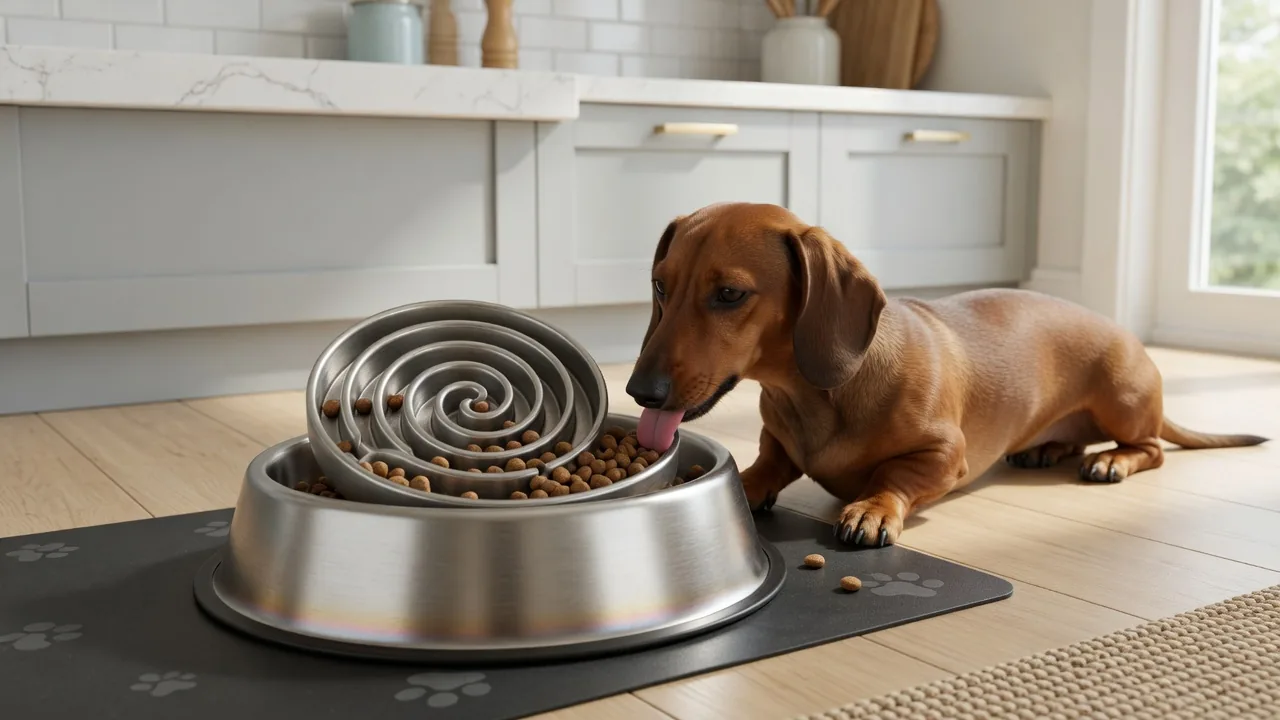
Best Slow Feeder for Dachshunds
The best slow feeder for a Dachshund is a small, low-rimmed bowl with a shallow-to-moderate maze: channels wide enough for a narrow muzzle and no deeper than the dog can comfortably reach, on a non-slip base. Miniatures need a smaller bowl than standards, and for either, portion control matters as much as pace.
Dachshunds are an awkward fit for most slow feeders, which are designed around a medium or large dog. A Dachshund is a scent hound with a long, narrow muzzle on a small head, a deep chest on very short legs, so the belly sits close to the floor, and an appetite out of all proportion to its size. Get the bowl wrong and one of two things happens: the dog can't reach the food and gives up, or the maze is so undemanding that dinner still disappears in twenty seconds.
This guide sticks to what's specific to the breed: sizing for miniatures and standards, what the long back does and doesn't mean for feeding, why weight is the bigger issue, and how to tell if a bowl fits. For a general comparison of bowl types, see our best slow feeder dog bowls guide.
Why do Dachshunds need a different kind of slow feeder?
Four breed traits drive the choice.
A narrow muzzle on a small head. Unlike a flat-faced breed, a Dachshund can get its nose into a channel. The problem is depth and scale. In a bowl built for a Labrador, the ridges are tall and the channels deep, so a small dog ends up pressing its face against the ridge tops with the kibble out of tongue's reach.
A low-slung body. With legs this short, the rim height of the bowl matters. A tall-sided bowl forces a Dachshund to crane up and over the edge, pressing its throat against the rim. A low rim lets the dog eat with its head in a natural, slightly lowered position.
Long ears. Dachshund ears swing forward into the bowl. With dry food it's a nuisance; with wet food it's a daily cleaning job and a route to grubby, smelly ear leather. A smaller-diameter bowl, where the ears fall outside the rim, helps a great deal.
A hound's appetite. Dachshunds were bred to follow scent and work independently underground. That persistence shows up at mealtimes as speed and at all other times as scavenging. Many are fast, determined eaters who will also solve a too-easy maze in days.
What size slow feeder does a Dachshund need?
The breed comes in two sizes, and they don't share a bowl comfortably. Miniatures are typically 11 lb (5 kg) or under; standards usually fall between 16 and 32 lb (roughly 7–14.5 kg), with plenty of in-between "tweenies."
| Miniature Dachshund | Standard Dachshund | |
|---|---|---|
| Typical adult weight | Up to ~11 lb / 5 kg | ~16–32 lb / 7–14.5 kg |
| Meal volume (per meal) | Small: often a few tablespoons to ~⅓ cup | Moderate: often ~½ to 1 cup |
| Bowl size to look for | Small / extra-small | Small to medium |
| Maze depth | Shallow | Shallow to moderate |
| Kibble | Small-breed kibble; needs narrow-ish channels to be slowed | Small or medium kibble |
| Biggest risk | Bowl too big: food spreads thin, no challenge, can't reach centre | Bowl too deep: pressing face into ridges |
Meal volumes here are rough illustrations only; the right amount depends on the food and the individual dog, so go by the feeding guide on your food and your vet's advice. The useful point is the relationship: the meal should fill the channels roughly to half the ridge height. If a mini's dinner barely dusts the bottom of the bowl, the bowl is too large to slow anything.
A quick fit test at home:
- Put a normal meal in the bowl. Is the food sitting in the channels, with ridges standing clear above it?
- Watch the first minute. Can your dog reach the bottom of every channel with its tongue without jamming its muzzle against the ridges?
- Check the last few pieces. If kibble is stranded in a spot your dog can't reach, the pattern is too deep or tight.
- Time it. A meal that used to take under a minute should now take a few; for typical ranges see how long it should take a dog to eat.
Our stainless steel slow feeder dog bowl has a raised maze and a non-slip base; we don't publish a bowl capacity or ridge-depth figure for it, so measure your dog's muzzle and a typical meal against the dimensions on the retailer listing before buying, particularly for a miniature. If a bowl's listed size or depth is not given, treat the fit as unconfirmed.
Does feeding posture matter for a Dachshund's back?
This is the question every Dachshund owner asks, so here is a straight answer.
Dachshunds are the breed most associated with intervertebral disc disease (IVDD). Breed health surveys put the lifetime risk of some degree of disc-related back trouble at roughly one in five to one in four, depending on the survey. The cause is largely genetic: the same trait that gives the breed short legs also causes the discs to degenerate early.
A bowl won't prevent IVDD, and there's no good evidence that floor feeding causes it. Anyone telling you a particular bowl protects a Dachshund's spine is selling something. What you can reasonably do is avoid adding awkward strain at mealtimes:
- Stop the bowl sliding. A dog chasing a skating bowl across a hard floor twists and lunges. A non-slip base or a rubber mat solves it.
- Keep the rim low so the dog isn't arching over a tall edge.
- Feed on a non-slip surface. Short legs on polished tile splay out; a mat under the dog's front feet gives grip.
- Don't feed on furniture or at the top of steps. Jumping down afterwards is a far bigger load on the spine than anything that happens at the bowl.
What about raised bowls? For a healthy Dachshund, a floor-level bowl with a low rim is fine. For a dog with a diagnosed neck (cervical) disc problem, vets often recommend raising food and water so the dog doesn't have to lower its head; that's an individual medical instruction, and your vet or physio should set the height. If you've been told to raise the bowl, our elevated dog bowl height guide explains how to measure. A slow feeder that makes a sore dog work longer with its head down may not be appropriate during a flare-up, so ask.
Why does weight matter more than speed for this breed?
Dachshunds gain weight easily, and on a frame this long, extra weight is a real burden. Vets and breed health groups consistently advise keeping Dachshunds lean; excess weight is widely considered to add load to the spine and joints and to make recovery from back problems harder.
A slow feeder helps here indirectly. It doesn't reduce calories, but it does make a measured portion last, which makes a correct portion feel less mean, to dog and owner alike. To use it for weight control:
- Weigh the food. On a 5 kg dog, a "generous scoop" can be a 20% overfeed. Kitchen scales are more accurate than cups.
- Count everything. Treats, chews, and training rewards come out of the daily total.
- Feed part of the ration as enrichment. Dachshunds are scent hounds, and a snuffle mat puts that nose to work on the same kibble they'd have had in the bowl. It's also low-impact: no jumping, no twisting.
- Check body condition monthly. You should be able to feel ribs under a thin covering and see a waist from above.
If your Dachshund seems permanently starving on the correct amount, why is my dog always hungry covers the common reasons and when to involve a vet.
Which material is best for a Dachshund's bowl?
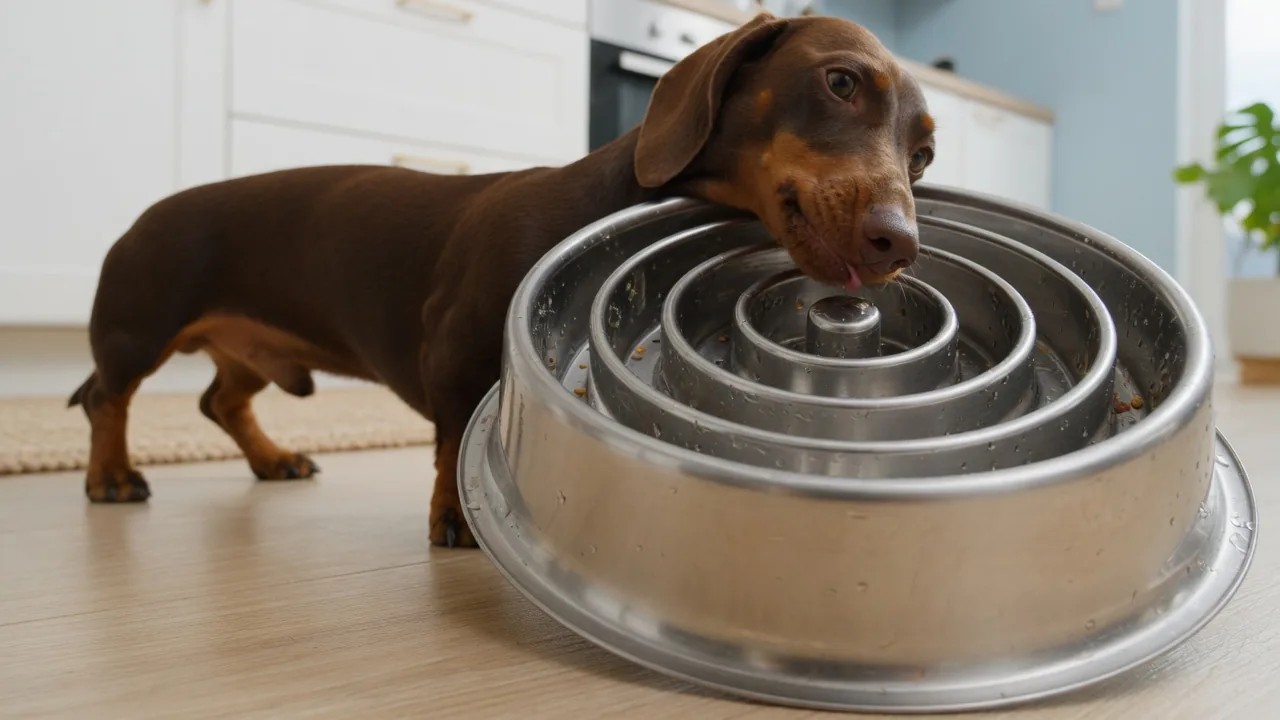
Stainless steel suits the breed well: it has enough weight to stay put under a small dog, doesn't get chewed, and cleans easily, which matters when ears and a long muzzle are in the food every day.
Heavy ceramic is stable and smooth but will chip if dropped; retire it if the glaze cracks.
Lightweight plastic is the most likely to slide and tip under a pushy Dachshund, and scratches over time. If you choose it, pick one with a proper rubber base.
Silicone lick mats are worth having for wet food or a portion of the meal, and they lie flat, so there's no rim at all. If wet food is the main meal, see slow feeding with wet food. A fuller comparison is in stainless steel vs plastic slow feeders.
How do you introduce a slow feeder to a Dachshund?
Dachshunds are clever and famously stubborn. Some attack a new bowl with enthusiasm; others stare at you as if you've made a mistake.
- Meal one: make it easy. Scatter part of the meal over the top of the ridges so there's an instant reward, with the rest in the channels.
- Stay nearby but don't fuss. Let the dog work it out.
- Watch for the fit signs above. Pawing at the bowl, flipping it, or barking at it usually means the pattern is too deep, not that the dog is being difficult.
- Keep the portion the same. The bowl changes pace, not quantity.
- Hold the ears back if needed. For wet food, a soft snood or simply a smaller bowl keeps ears out.
- Wash after meals. Small channels hold residue; our guide to cleaning a slow feeder bowl covers brushes and dishwasher care.
If you have a puppy, start with the gentlest pattern you can find; our best slow feeder for puppies guide covers the early months.
What mistakes do Dachshund owners make with slow feeders?
- Buying a "medium" because the dog is long. Length isn't the measure; head size and meal volume are.
- Choosing the most complex maze. Deep spirals strand small kibble out of reach.
- Assuming the bowl handles weight control. It slows eating. Only the portion controls calories.
- Raising the bowl "for the back" without advice. Height is a medical decision for dogs with neck or back disease, not a default.
- Ignoring dental discomfort. Small breeds are prone to dental disease. A Dachshund that suddenly eats slowly, drops kibble, or avoids the maze may have a sore mouth and needs a vet check, not a different bowl.
When should you speak to your vet?
Ask your vet before changing feeding set-up if your Dachshund has diagnosed IVDD, is recovering from a back episode, or is on crate rest. Seek urgent help for any sign of back pain or nerve trouble: yelping when picked up, a hunched back, reluctance to move or jump, wobbly or dragging hind legs, or loss of bladder control. Those are emergencies in this breed and have nothing to do with the bowl.
Also get advice for regular vomiting or regurgitation after meals, sudden changes in appetite, or weight gain you can't explain.
Frequently Asked Questions
What is the best slow feeder for a Dachshund? A small, low-rimmed bowl with a shallow-to-moderate maze and a non-slip base. The channels should be wide enough for a narrow muzzle and shallow enough that the dog's tongue reaches the bottom. Stainless steel or heavy ceramic stays put better than light plastic.
What size slow feeder does a miniature Dachshund need? A small or extra-small bowl with a shallow pattern. A miniature's meal is only a few tablespoons to about a third of a cup, so in a large bowl the food spreads too thin to be slowed. The meal should fill the channels to roughly half the ridge height.
Can a slow feeder help a Dachshund's back or prevent IVDD? No. IVDD in Dachshunds is largely genetic, and no bowl prevents it. A stable, low-rimmed, non-slip bowl simply avoids awkward lunging and twisting at mealtimes. Dogs with diagnosed back or neck problems should follow their vet's advice on feeding position.
Should Dachshunds eat from a raised bowl? Healthy Dachshunds are fine with a low-rimmed bowl on the floor. Vets sometimes recommend a raised bowl for dogs with neck disc problems so they don't have to lower their head. Because the right height depends on the dog's condition, ask your vet before raising it.
Do Dachshunds eat too fast? Many do. They are scent hounds with strong food drive and a tendency to scavenge, and plenty will bolt a meal in well under a minute. A properly sized slow feeder or a snuffle mat usually stretches that to several minutes.
Can a slow feeder help an overweight Dachshund lose weight? Not by itself. A slow feeder makes a measured portion last longer, which makes a diet easier to stick to, but weight loss comes from the right amount of food. Weigh meals, count treats, and ask your vet for a target weight.
Is a snuffle mat good for Dachshunds? Yes. Dachshunds were bred to hunt by scent, so foraging for kibble in fleece suits them well, and it involves no jumping or twisting. Use part of the daily ration, supervise, and choose dry food only.