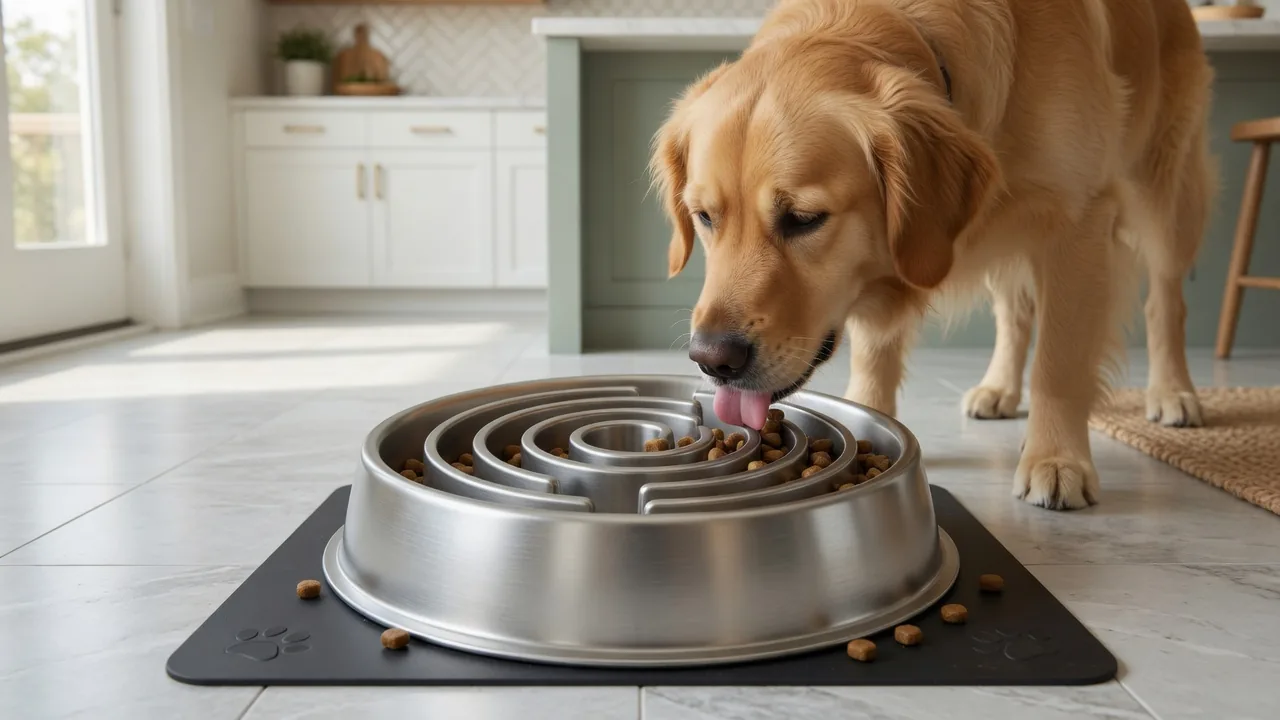
Best Slow Feeder for Golden Retrievers
The best slow feeder for a Golden Retriever is a large stainless steel maze bowl that holds a full meal in one layer, with ridges around 3–4 cm high, wide channels for a broad muzzle, and a non-slip base. Steel matters for this breed because Goldens mouth, carry and chew their bowls, and plastic rarely survives that.
Goldens are easy dogs in most respects. Mealtimes are the exception: the food goes down, there's a noise like a vacuum cleaner, and then a hopeful face asking whether there's more. This guide sticks to what's specific to the breed — the mouth, the coat, the waistline and the life stages — and what that means for the bowl you buy. For the general reasons dogs bolt food, see why does my dog eat so fast.
Why do Golden Retrievers gulp their food?
Start with the job they were bred for. Goldens are gundogs, developed to spend long days retrieving and to work closely with people for a reward. The dogs that did that best were intensely food-motivated and keen to please, and breeders kept selecting for it. The result is a dog who finds food deeply rewarding and has very little off-switch around it.
Then add the anatomy: a broad muzzle and a big, soft mouth designed to carry game. From an ordinary bowl, a Golden can take a huge mouthful and swallow it almost without chewing. Kibble is small, the mouth is large, and nothing in a flat bowl forces them to slow down.
Household life does the rest. Goldens are popular family dogs, and busy homes with children, other pets and dropped snacks teach a dog that food appears unpredictably and should be eaten immediately.
None of this is a behaviour problem to be trained out. It's a design feature that needs managing, and a slow feeder is the simplest management tool there is.
What size slow feeder does a Golden Retriever need?
Under the AKC standard, adult males typically weigh 65–75 pounds and females 55–65. That's a large dog with a large daily ration, and the most common buying mistake is a bowl that's too small. When a meal sits heaped above the maze, the top half gets gulped exactly as before.
| Feature | What suits a Golden | Why it matters for this breed |
|---|---|---|
| Capacity | A full meal spread in a single layer, often 1.5–2.5 cups per meal | Heaped food bypasses the maze |
| Ridge height | Roughly 3–4 cm | Low bumps don't register with a mouth this size |
| Channel width | Wide enough for a broad muzzle to reach the bottom | Narrow channels cause frustration and bowl-flipping |
| Diameter | Large, around 25 cm or more | Room for the muzzle and keeps ear feathering clear |
| Base | Full non-slip ring | A 70 lb dog pushing a light bowl sends it across the room |
| Material | Stainless steel | Survives mouthing and carrying |
| Edges | Smooth, rounded ridges | Goldens press hard; sharp edges rub noses and gums |
Per-meal amounts vary with the food's calorie density, your dog's age and how active they are, so treat the cup figure as a rough sizing guide for the bowl, not a feeding instruction. Our best slow feeder for large dogs guide goes deeper on sizing by weight if your Golden is at the big end of the range.
Why does material matter more for Goldens than most breeds?
Because retrievers retrieve. Plenty of Goldens pick up the empty bowl and carry it around the house, bring it to you as a hint, or lie down and work on the rim like a chew. Young Goldens are especially mouthy, and that stage can last well past the second birthday.
Plastic slow feeders don't do well with this. They pick up tooth marks, the ridges get gnawed, and a cracked or chewed bowl is both harder to clean and a source of swallowed fragments. Goldens are also a breed with a reputation for sensitive skin, and while a scratched plastic bowl isn't proven to cause chin or lip irritation, it's an easy variable to remove.
Our stainless steel slow feeder dog bowl has a raised maze, a non-slip base and goes in the dishwasher. Honest limits: steel mazes are usually less intricate than the deepest plastic ones, so an extreme gulper may need the extra tactics further down. The full material trade-off is in stainless steel vs plastic slow feeders.
What about the coat, the ears and the mess?
This is the part breed-generic guides miss. Goldens have feathering on the ears, chest and front legs, and a deep bowl of wet food leaves all of it damp and smelling of dinner.
- Dry kibble: no real issue. Any well-sized maze bowl works.
- Wet or soaked food: spread it thin across the maze rather than packing it deep, so the muzzle and ears don't go in as far. Wipe the ear tips and chin afterwards. Damp fur around the ears isn't something you want to leave on a breed that already tends toward ear trouble.
- Water afterwards: Goldens are messy, enthusiastic drinkers, and many go straight from the food bowl to the water bowl and gulp that too. If yours coughs or brings water back up, our guide on a dog that drinks water too fast has fixes.
- Put a mat under it. A washable mat catches the kibble a big muzzle flicks out of the channels.
How does a slow feeder fit with keeping a Golden lean?
Goldens gain weight easily, and extra weight is hard on a breed that's already prone to hip and elbow problems. The best-known evidence on this comes from a long-running Purina study in Labrador Retrievers — a close cousin, not the same breed — in which dogs kept lean lived a median of nearly two years longer than their heavier littermates and developed chronic conditions later. It's reasonable to think the lesson carries over to Goldens, though the study wasn't done in them.
A slow feeder doesn't remove a single calorie. What it does is make a correctly measured portion last longer, which makes it easier for you to hold the line when a Golden is giving you the look. The actual weight control comes from:
- Weighing food on kitchen scales instead of scooping.
- Feeding to ideal weight, not current weight, using the guide on your food as a starting point.
- Two meals a day for adults rather than one large one.
- Counting treats inside the daily total — training rewards add up fast with a dog this trainable.
- Checking ribs and waist every couple of weeks. You should feel ribs easily under a light covering.
The full method is in how much to feed your dog. If your Golden is gaining on measured portions, see your vet; the breed has a known tendency toward an underactive thyroid, which a bowl can't fix.
Does a slow feeder suit Golden puppies and seniors?
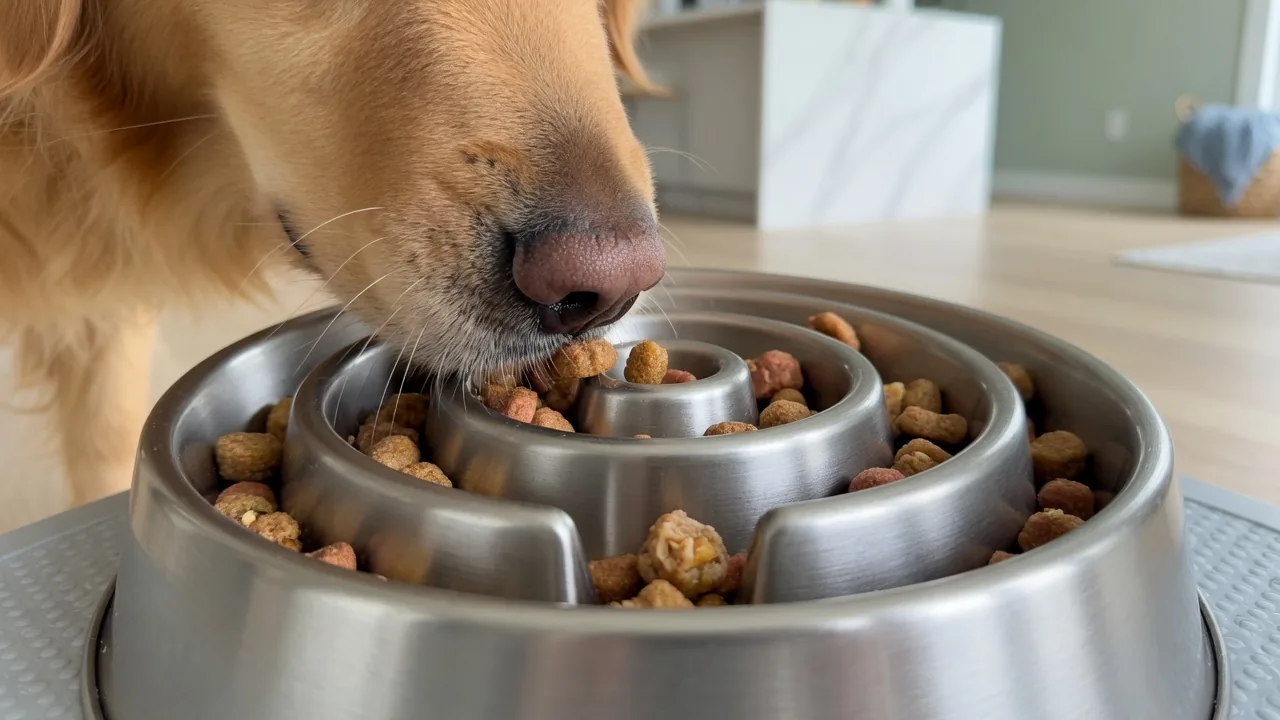
Puppies. Yes, and it's a good habit to start early. Golden puppies eat fast from the first day home, usually because they've been competing with littermates. Use a bowl with lower ridges while the muzzle is small, keep sessions calm, and feed the three or four small meals a day your vet or breeder recommends. Because Goldens are a large breed, most vets advise a large-breed puppy food and steady rather than rapid growth; that's a conversation for your vet, not a bowl decision. Our puppy eating too fast guide covers the puppy-specific side.
Seniors. Older Goldens often slow down on their own, and some develop stiff necks, elbows or worn teeth. Watch for a dog who starts leaving food in the maze or seems uncomfortable reaching down. At that point, switch to an easier pattern, soften the kibble with warm water, or ask your vet whether a slightly raised position is appropriate for your dog. A senior who suddenly eats more slowly or drops food may have dental pain and should be checked.
How do you introduce one, and what if it isn't enough?
Most Goldens work out a maze within one meal. Scatter the kibble loosely the first couple of times, then push it into the channels. Keep the portion the same and stay in the room for the first week.
If your dog is still finishing in under two minutes:
- Add water. A splash over the kibble makes pieces stick in the channels.
- Freeze it. Soaked kibble or wet food frozen into the maze can turn a two-minute meal into fifteen.
- Split the meal. Half in the slow feeder, half scattered in a snuffle mat. Goldens have excellent noses and most love the search.
- Hand-feed some of it as training rewards. This breed will happily work for dinner.
- Separate dogs at mealtimes. Competition speeds every dog up.
If the bowl gets flipped or carried off mid-meal, put it on a non-slip mat in a corner and pick it up as soon as it's empty.
Should Golden owners worry about bloat?
It's worth knowing about without panicking. Goldens are a large breed with a fairly deep chest, which is the body type associated with bloat (GDV), although they're not usually listed among the very highest-risk breeds such as Great Danes. Fast eating is one of several factors linked to it. Slowing meals is a sensible precaution; it isn't a guarantee.
What matters is recognising it: a swollen, tight belly, retching with nothing coming up, drooling, pacing or obvious distress. That's an emergency, day or night. Our dog bloat (GDV) guide covers the signs and the risk factors properly.
The bottom line
Buy for the dog you have: a large, mouthy, food-loving retriever with a feathered coat. That means a big stainless steel maze bowl with real ridges and a base that grips, measured meals twice a day, and a back-up plan (water, freezing, a snuffle mat) for the days your Golden treats the maze as a minor inconvenience.
👉 See the Stainless Steel Slow Feeder Dog Bowl →
Frequently Asked Questions
What is the best slow feeder for a Golden Retriever? A large stainless steel maze bowl that holds a full meal in a single layer, with ridges around 3–4 cm high, channels wide enough for a broad muzzle, and a non-slip base. Steel suits the breed because Goldens tend to mouth and carry their bowls, which damages plastic.
Do Golden Retrievers need a slow feeder? Not every Golden does, but most eat faster than is comfortable. If your dog finishes a meal in under a minute or two, gulps audibly, burps, or brings food back up shortly after eating, a slow feeder is a cheap, low-risk way to stretch the meal out.
What size slow feeder should I get for a Golden Retriever? Choose a large bowl, roughly 25 cm across or more, that fits one whole meal without heaping. Adult Goldens typically weigh 55–75 pounds and often eat around 1.5–2.5 cups per meal depending on the food, and kibble piled above the ridges gets gulped as if the maze weren't there.
Can a slow feeder prevent bloat in Golden Retrievers? It can't prevent it. Fast eating is one of several factors linked to bloat (GDV) in large, deep-chested dogs, so slowing meals is a sensible precaution. Know the emergency signs — a tight swollen belly and unproductive retching — and go straight to a vet if you see them.
Will a slow feeder help my Golden Retriever lose weight? Only indirectly. It doesn't change the calories in the meal, but a portion that lasts ten minutes instead of thirty seconds makes measured feeding easier to stick to. Weight loss comes from weighed portions, counted treats, and a target weight agreed with your vet.
Can Golden Retriever puppies use a slow feeder? Yes. Puppies often eat fast from competing with littermates, and starting early builds a calmer mealtime habit. Use a pattern with lower ridges while the muzzle is small, supervise, and replace it with a full-size bowl as your puppy grows.