Best Slow Feeder for Large Dogs (Size-Based Buying Guide)
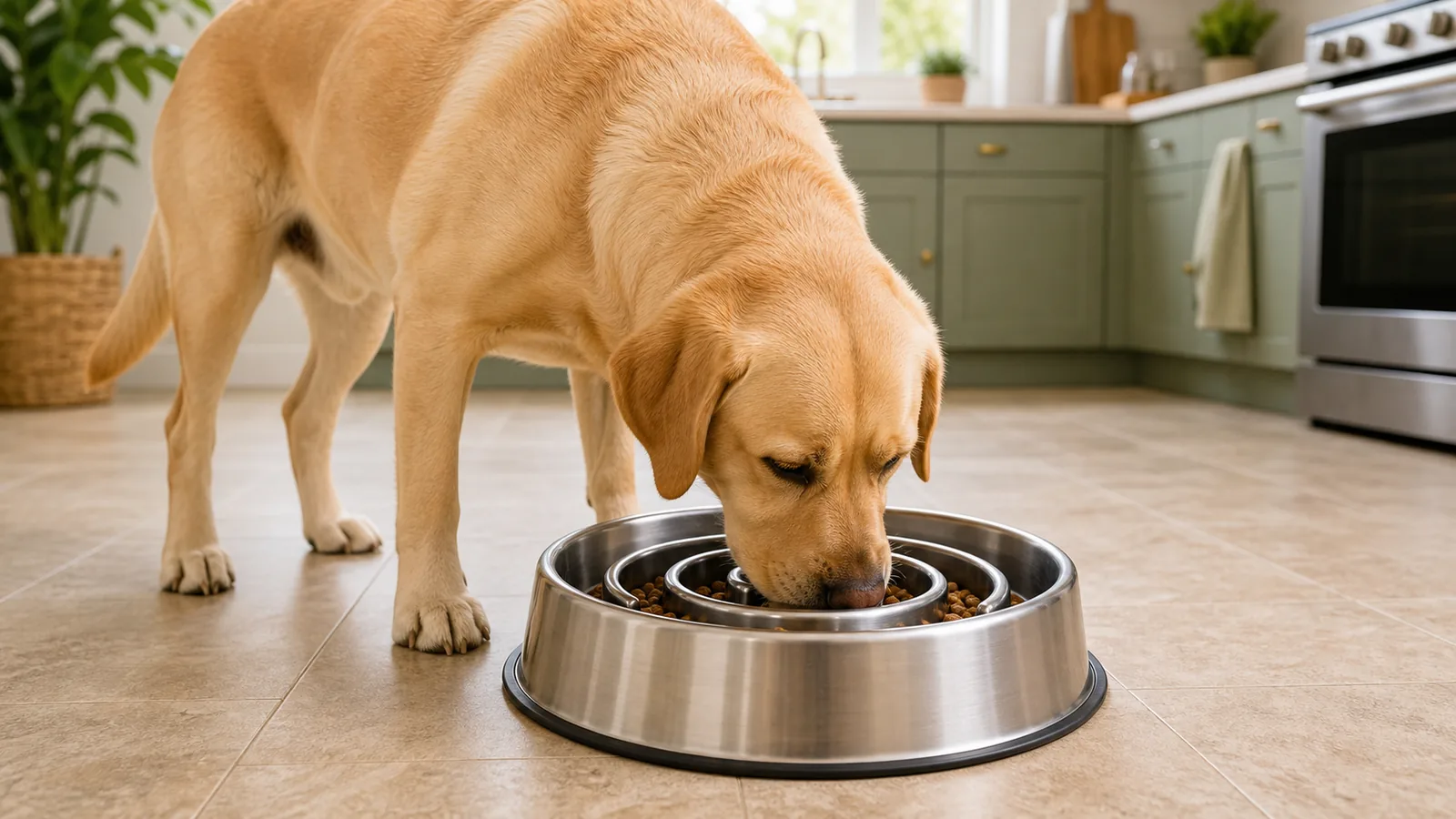
The best slow feeder for large dogs is a heavy, wide-based stainless steel bowl with a deep but open maze and enough capacity to hold a full meal with room to spare. For dogs over about 50 lb, size it to the meal volume, not the dog's weight, and prioritise stability and material over how clever the maze looks.
Big dogs break slow feeders in ways small dogs never do. They shove, flip, chew, and clear shallow mazes with one sweep of a large tongue. Most "best of" lists ignore that and recommend the same bowl whatever the dog weighs. This guide is organised by size and meal volume instead, so you can pick a feeder that matches the dog you actually have. For a general roundup across all sizes, see our best slow feeder dog bowls list; for a material-only comparison, see the best stainless steel slow feeder page.
What counts as a "large dog" for feeder sizing?
For feeding purposes, think in three bands rather than one:
| Band | Typical weight | Typical daily dry food* | What changes for the feeder |
|---|---|---|---|
| Large | 50-70 lb | roughly 2¾-3½ cups | Standard large bowl works; focus on base grip |
| Very large | 70-90 lb | roughly 3½-4½ cups | Needs real capacity and a wide, heavy base |
| Giant | 90 lb+ | often 4½ cups or more | Capacity is the main constraint; may need a bigger bowl or split meals |
*General ballparks only. Calorie density varies enormously between foods, so your food's feeding chart and your vet decide the real number. Our how much to feed your dog guide shows how to work it out.
Own a specific breed? Our breed guides cover the quirks of Great Danes and German Shepherds in more detail.
Divide the daily total by the number of meals. A dog on 4 cups a day fed twice gets about 2 cups per meal, and that single-meal volume is the number your feeder has to hold.
How much capacity does a large dog's slow feeder need?
Maze bowls hold less than their outer dimensions suggest, because the ridges take up space. Two checks save you from buying a feeder that is too small:
- Find the listed capacity in cups and compare it to one meal, not the daily amount. It should clearly exceed your meal volume, not just match it.
- Pour a dry run. Measure a meal of kibble into the bowl at home. If it overflows or buries the maze, the maze can't work, because food sitting on top of the ridges is food your dog can eat at full speed.
A feeder that is too small causes two problems at once. Either you split the meal into two refills (the second one gets inhaled), or you overfill and the obstacles stop doing anything. If your dog sits at the top of a size band, go up one size.
Which maze design actually slows a big dog?
A large dog's tongue and muzzle are bigger than the gaps in a toy-breed design. What tends to work:
- Wider channels with real depth. The channels need to be deep enough that the dog must curl its tongue and nose in, but wide enough that a big muzzle fits. Very narrow slots frustrate large dogs and invite pawing and flipping.
- Obstacles tall enough to matter. A low, shallow ridge is cleared in a lick. Taller pegs and walls force the dog to pick out individual pieces.
- Fewer sharp corners. Rounded shapes are easier to clean and kinder to a dog that likes to scrape its teeth across the bowl.
Whichever you choose, watch the first few meals. If the dog still clears the bowl in under a minute or two, the maze is too easy for that dog. If it gets angry, pushes the bowl across the floor or walks away, the maze is too hard. For a deeper look at maze patterns, see our maze dog bowl guide.
Why does the base matter more for big dogs?
Power is the difference. A 75 lb dog pushing a food bowl with its muzzle can send a light plastic bowl across a kitchen floor, and a bowl that moves teaches the dog to chase it, which speeds eating back up.
Look for:
- Weight. A stainless steel body has more mass than thin moulded plastic of the same size.
- A wide footprint. Wider than the bowl's top edge helps resist tipping.
- A grippy base. A rubber or silicone ring helps on tile and wood. On very slick floors, put a mat underneath.
A stable bowl also protects joints. A dog that has to chase a sliding bowl while eating is twisting and stretching in awkward positions, which is a bad habit for heavy dogs.
Which material survives large-dog jaws?
Material decides how long a feeder lasts and whether it is safe once it starts to wear.
| Material | Strong-chewer risk | Hygiene over time | Notes |
|---|---|---|---|
| Stainless steel | Not chewable; won't crack | Non-porous; easy to sanitise | Heavier, which helps stability |
| Hard plastic | Can be gnawed; may crack | Scratches can hold residue | Fine for gentle eaters; inspect often |
| Soft silicone | Can be torn or pieces chewed off | Generally washable | Better for licking than power eating |
Cracked or chewed plastic can produce sharp edges and swallowable fragments, which is the one scenario where a feeder meant to protect your dog creates a risk. If your dog chews bowls, choose steel. Our stainless steel vs plastic slow feeder comparison covers the trade-offs, and how to clean a slow feeder bowl explains upkeep for the maze, which is where residue collects.
If you want a steel option, the stainless steel slow feeder dog bowl is built with these points in mind: steel construction, a non-slip base and a maze design. Check the product page for current sizing before you order, and match it to the single-meal volume you measured above.
What if one bowl can't hold the whole meal?
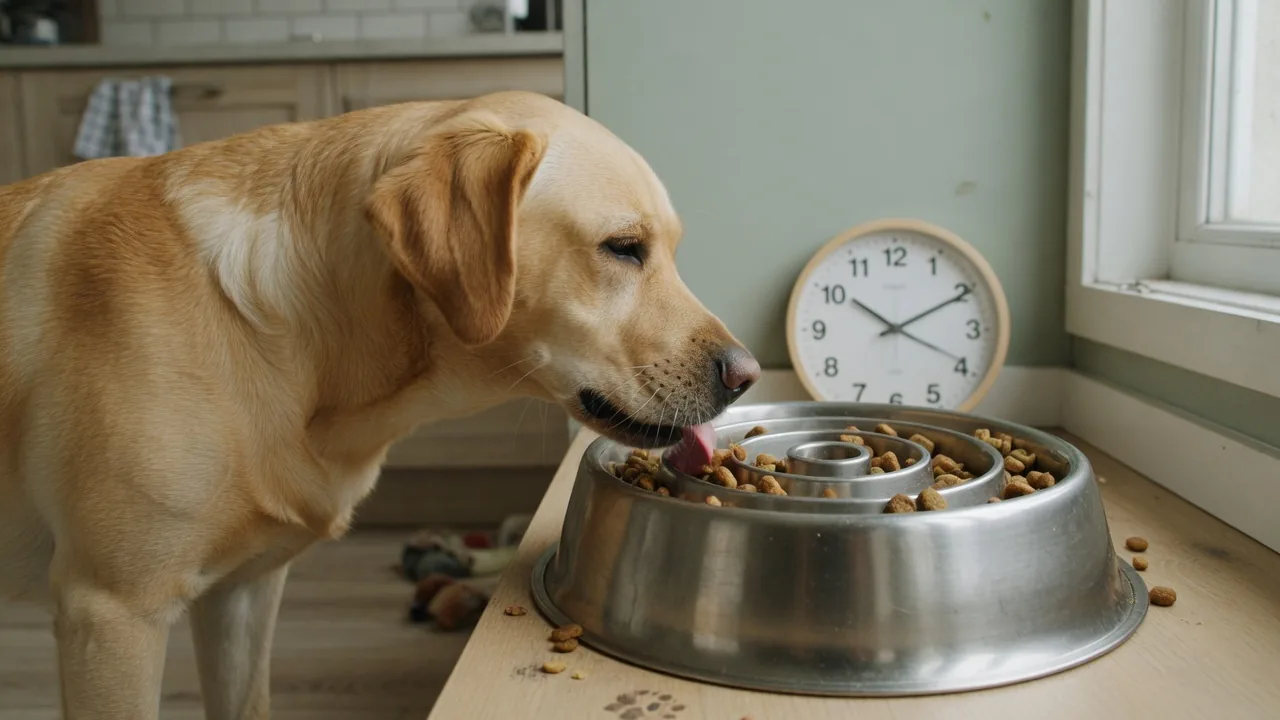
Giant dogs hit this problem first. Options, in order of preference:
- Move to the largest size available and re-test the dry run.
- Split the daily food into more meals. Three smaller meals, each in the feeder, also suit dogs at higher risk of bloat, because a smaller volume reaches the stomach at once. Ask your vet whether that suits your dog.
- Put part of the meal elsewhere. Hide some kibble in a snuffle mat so a single meal gets two forms of slowing. Subtract it from the bowl so the daily total stays the same.
Don't solve it by cramming the feeder or by pouring food on top of the maze.
Do slow feeders reduce bloat risk in big dogs?
This is the question most large-dog owners are really asking, so here's the careful answer.
Gastric dilatation-volvulus (GDV, "bloat") is a life-threatening emergency in which the stomach fills with gas and may twist. Large and giant dogs with deep chests are at higher risk, and veterinary sources list fast eating, one big meal a day and older age among the factors associated with it. Causes are not fully understood, and no bowl has been shown to prevent GDV.
What we can say honestly: slowing a fast eater may reduce how much air is swallowed, and it is one of the few risk-related habits an owner can change cheaply. It is a sensible precaution, not protection. Your vet can tell you how much risk applies to your dog and whether to discuss preventive options. Our dog bloat (GDV) symptoms and prevention guide goes deeper.
A related question is bowl height. Raised bowls for big dogs are debated, and some research has linked them to higher GDV risk, so don't raise your dog's bowl without reading raised dog bowl bloat risk and asking your vet.
How to set up a large dog's mealtime
- Measure the meal. Use a scale or measuring cup every time. Eyeballing 2 cups is how dogs gain weight.
- Put the feeder on a stable, non-slip surface away from other pets.
- Feed the whole meal in one go, not topped up.
- Keep it calm. In multi-dog homes, feed big eaters in separate rooms so nobody races.
- Rest after meals. Many vets advise avoiding hard exercise right before and after eating for dogs at risk of bloat; ask yours how long.
- Clean after each meal so residue doesn't harden in the maze.
When to call a vet urgently
Bloat can progress fast. Go to an emergency vet immediately if your dog has:
- A swollen, tight or distended belly
- Unproductive retching, trying to vomit with nothing coming up
- Restlessness, pacing or obvious distress
- Heavy drooling, panting or a hunched stance
- Sudden collapse or pale gums
Don't wait to see if it passes. A slow feeder doesn't replace any of this.
The bottom line
Buy for the meal and the muscle: capacity above one meal's volume, a wide heavy base, taller obstacles with channels a big muzzle fits into, and a material that can't be chewed apart. For most heavy eaters that points to stainless steel. Treat the bloat link as a reason to slow meals sensibly, not as a promise, and keep your vet in the loop.
👉 See the Stainless Steel Slow Feeder Dog Bowl →
Frequently Asked Questions
What is the best slow feeder for large dogs? A heavy, stainless steel bowl with a wide non-slip base, a deep maze with channels wide enough for a big muzzle, and capacity comfortably above one meal. Size it to your dog's meal volume, since foods differ in calories per cup.
What size slow feeder does a large dog need? Pick one that holds a single meal with room to spare. Dogs of 50-90 lb often eat roughly 1½-2¼ cups per meal on two meals a day, though it varies by food. Do a dry run with kibble before committing.
Do slow feeders help prevent bloat in big dogs? They may reduce swallowed air, but no bowl has been shown to prevent bloat. Fast eating is one associated factor among several. Treat a slow feeder as a precaution and ask your vet about your dog's individual risk.
Are stainless steel slow feeders better for large dogs? Generally yes. Steel can't be chewed into pieces, won't crack, is heavier so it resists being pushed, and cleans easily. Plastic can suit gentle eaters but needs regular inspection for cracks.
My large dog still finishes too fast. What now? The maze may be too easy or the dog may be flipping the bowl. Try a deeper design, put it on a non-slip mat, or hide part of the meal in a snuffle mat. If the dog is also vomiting or retching, see your vet.
How often should I feed a large dog? Many vets suggest two or more smaller meals rather than one large one, especially for deep-chested dogs. Your vet can tailor the schedule to your dog's age, weight and risk.