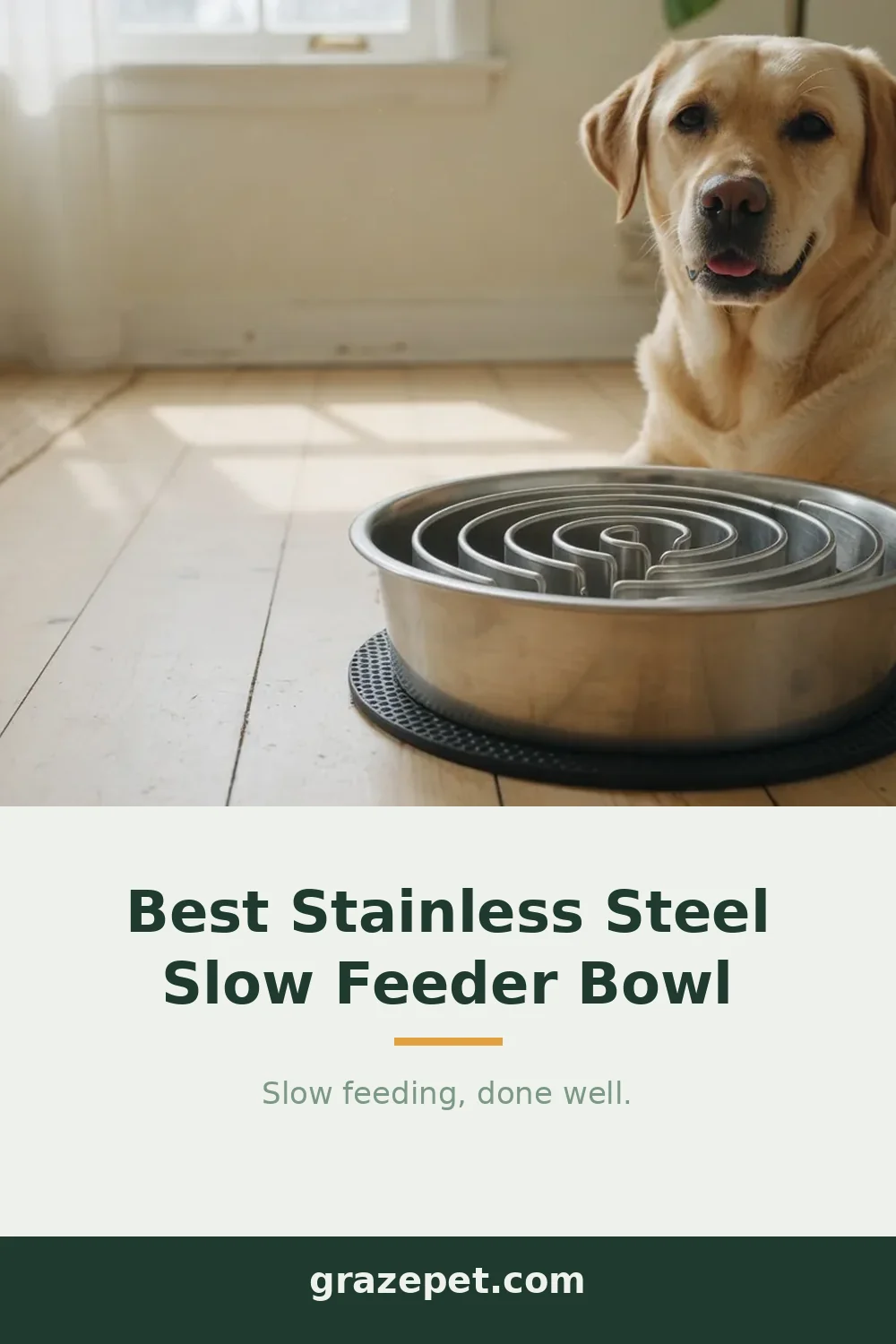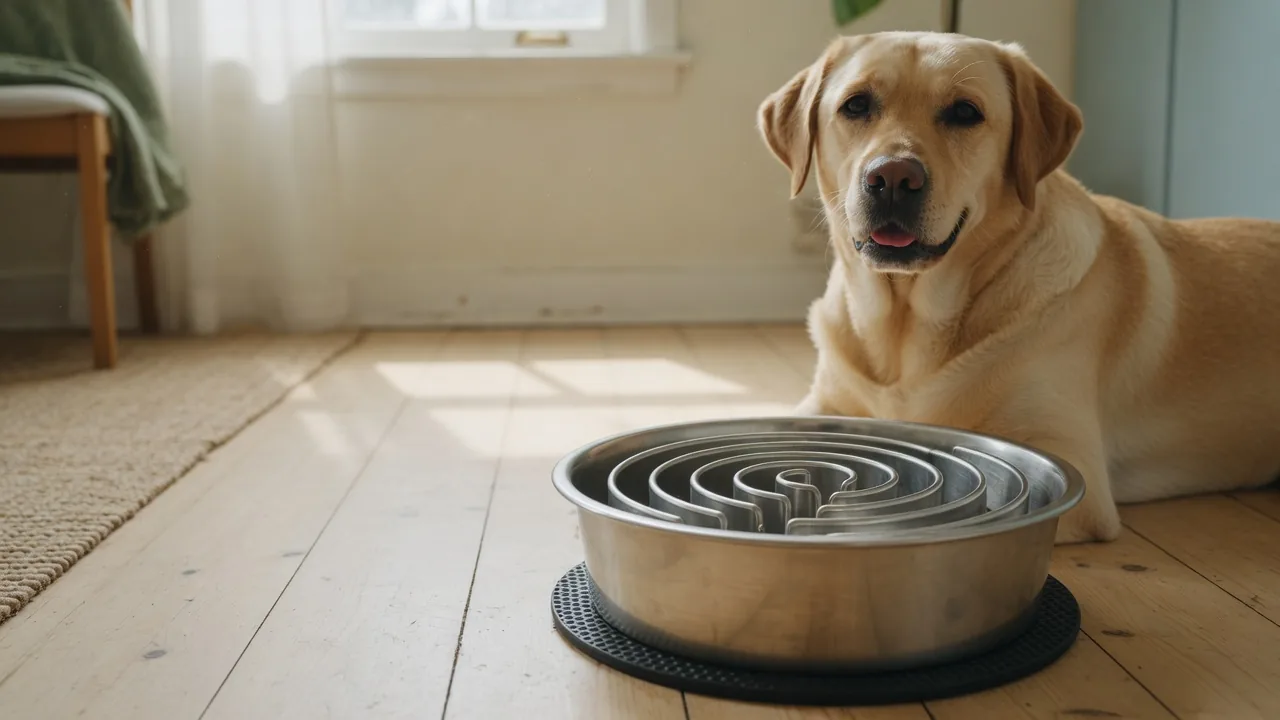
Best Stainless Steel Slow Feeder Dog Bowl (2026)
The best stainless steel slow feeder dog bowl has a deep, genuinely obstructive maze, food-grade steel (304 / "18/8" is the usual marker), a non-slip base, and walls thick enough not to dent or ring like a drum. Steel doesn't slow your dog any more than plastic does; the maze does that. What steel buys you is a bowl that stays clean and lasts for years.
This is the material-specific buying guide. It won't re-run the whole slow feeder market (that's our best slow feeder dog bowls roundup), and it won't relitigate the plastic argument at length (that's stainless steel vs plastic). It answers the narrower question: you've decided on steel, so which steel bowl is worth buying, and which listings should you walk away from?
What makes a stainless steel slow feeder worth buying?
Five things separate a good steel slow feeder from a shiny disappointment. Judge every listing on these, in roughly this order of importance.
- Maze depth and obstruction. The maze is the entire point. Look at the side profile: tall, closely spaced ridges or a deep spiral force a dog to work kibble out one piece at a time, while shallow bumps just rearrange the food and are cleared by a determined tongue in a few passes. If the product photos only show the bowl from above, that's a mild warning sign.
- Steel grade. "Stainless steel" covers a lot of ground. Food-grade grades such as 304 (often written 18/8) are the standard for food contact and resist rust and staining well. A listing that says only "metal" or "stainless-style" and names no grade is telling you something. Marketing copy is not a certificate, so treat any grade claim as a reasonable signal, not proof.
- Wall thickness and finish. Thin steel dents when a big dog pushes it into a table leg, and a dented maze is harder to clean. Check that seams are smooth, with no sharp welds or rough edges a tongue could catch on, and that the interior finish is polished rather than pitted.
- A non-slip base. Steel is slick on tile and wood, and lighter than ceramic. A bonded or fitted silicone ring is what keeps the bowl in place while your dog pushes at it. Without one, you'll spend every meal chasing it across the kitchen.
- Dishwasher-safe construction. The cleaning advantage of steel only counts if the bowl can actually take a hot cycle. Check that a rubber or silicone base is rated for the dishwasher too, or is removable.
If a bowl clears all five, price differences between listings matter much less than people expect. If it fails the first one, nothing else saves it.
Which type of stainless steel slow feeder fits your dog?
Steel slow feeders come in a handful of shapes. Rather than ranking invented brands, here is how the main designs compare and who each suits. Our own pick follows in the next section.
| Design | How it slows eating | Best for | Watch out for |
|---|---|---|---|
| Bowl with built-in raised maze | Ridges and channels fixed into the floor of the bowl | Most fast eaters on kibble or wet food | Check the ridge height; shallow ones barely slow anything |
| Bowl with a central dome or peg | Food sits in a ring around an obstacle | Mild gulpers, flat-faced dogs that struggle with deep channels | Determined eaters can still scoop the ring quickly |
| Spiral or concentric channel | Food is trapped in long grooves a tongue must trace | Medium and large muzzles; dry kibble | Narrow channels can frustrate small snouts |
| Steel insert in a stand or tray | A removable steel bowl sits in a frame | Households that want it elevated or swappable | Frames add parts to clean and can wobble |
| Flat steel bowl with a loose plastic maze insert | Plastic piece does the slowing | Not really a steel slow feeder | The part that slows your dog is still plastic |
That last row is the one to watch. Some listings put "stainless steel" in the title while the maze is a plastic insert sitting in a steel dish. You get the plastic hygiene problems back, in the part your dog actually licks. If the maze itself isn't steel, it's not what this article is about.
For a closer look at how maze patterns differ and how to judge difficulty before you buy, our maze dog bowl guide goes pattern by pattern.
Our pick: the Graze Stainless Steel Slow Feeder Dog Bowl
We make this one, so weigh our opinion accordingly. We built it to meet the criteria above rather than the other way round.
- A raised maze pattern in the steel itself, not a plastic insert, so there's nothing to separate, lose or scratch.
- Food-grade stainless steel with no plastic taste and nothing to leach.
- A non-slip base so it stays put under a pushy eater.
- Dishwasher-safe, with a smooth surface that doesn't develop the scratch grooves plastic does.
It works for dry kibble and for wet food. Capacity and exact dimensions are on the product page; check them against your dog's usual meal volume before ordering rather than guessing from the photos.
Two honest limits. First, a single fixed maze is one difficulty setting. A dog that solves it in a few weeks may need a harder layout, or a rotation with a snuffle mat. Second, it is a steel bowl, which means it is a little noisier on a hard floor than silicone or plastic. Most dogs and owners don't mind. A few noise-sensitive dogs do.
👉 See the Stainless Steel Slow Feeder Dog Bowl →
What are the downsides of a steel slow feeder?
Most pages on this topic skip this. You should know the trade-offs before you buy.
- Noise. Kibble against steel rings. Dogs that startle easily can be put off. Feeding on a mat or rug dampens it.
- Cost up front. Steel usually costs more than basic plastic at the till. It tends to win over a few years, but only if the plastic one would actually have been replaced.
- Sliding when the base fails. The silicone ring is the weak link. If it peels or tears, the bowl skates. Check it when you wash.
- Dents. A thin-walled bowl that gets stood on or thrown around dents, and a dented maze traps food.
- Visibility. You can't see through steel, so you can't spot leftover wet food in a channel until you look in. Rinse promptly.
- Not chew-proof against a determined bowl-chewer. Steel won't shatter into swallowable fragments the way brittle plastic can, but a dog that attacks the rim can still bend it or damage teeth. If your dog treats the bowl as a toy, address that behavior rather than hoping the material solves it.
None of these is a dealbreaker for most households. They're reasons to choose with open eyes, not reasons to avoid steel.
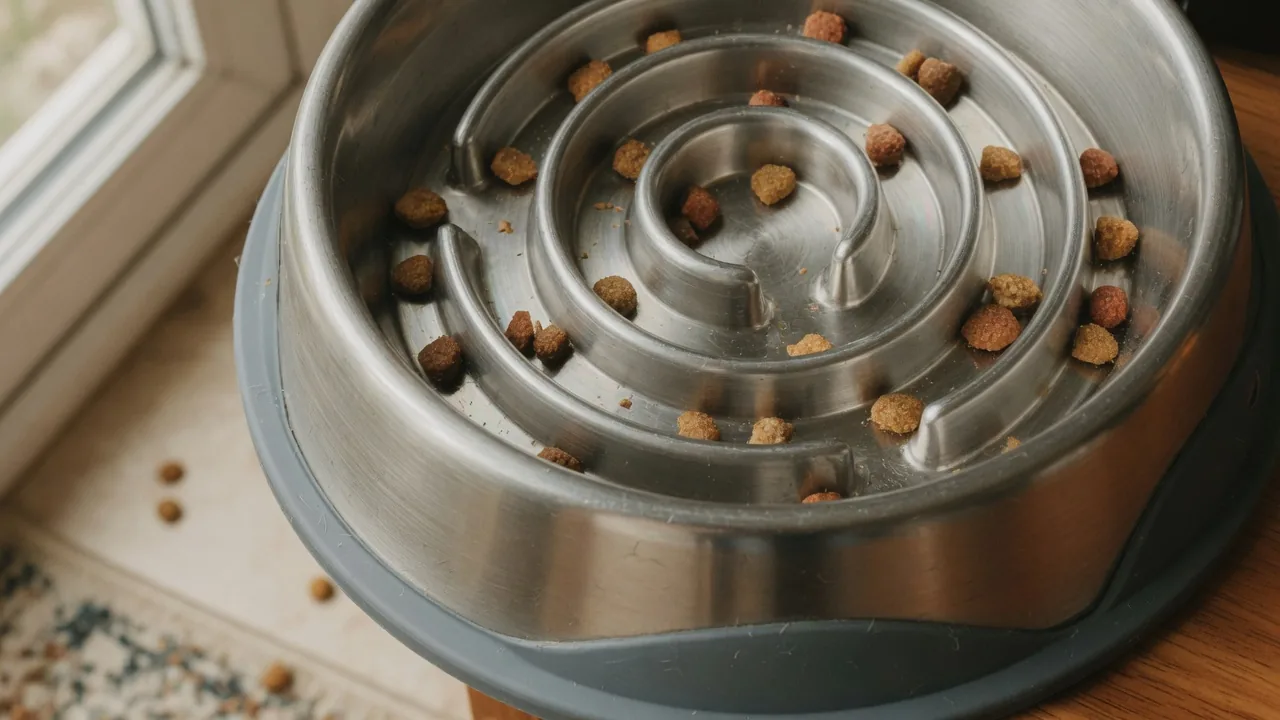
How do you size a stainless steel slow feeder?
Bowls are usually listed by capacity, and the correct size is driven by the meal, not the dog's weight on its own.
- Measure one meal. Use a measuring cup for your dog's actual portion of dry food.
- Check that the maze can hold it. The portion should fill the channels without piling over the top. A bowl that's too small tips food onto the floor, which defeats the purpose.
- Check the maze scale against the muzzle. A tiny snout needs narrower channels it can reach into; a big muzzle needs space to fit.
- Account for two meals a day. Many vets and breed guides favor splitting the daily ration, which also means each meal is smaller. Size for one meal, not the day.
Large and giant dogs are better served by weight, depth and base grip than by raw capacity alone, so see our guide to slow feeders for large dogs. A growing puppy also outgrows channels that suit a tiny muzzle, so size for the adult muzzle you're heading toward.
How do you keep a steel slow feeder clean and rust-free?
Steel is forgiving, but not maintenance-free.
- Rinse after every meal. Dried-on food is harder to shift from channels than fresh food.
- Use a bottle brush or a soft brush in the channels. The dishwasher usually handles it, but a quick brush stops residue building up in tight corners.
- Dry it fully before storing, especially around the base seam where water can sit.
- Skip steel wool and harsh abrasives. They scratch even steel, and scratches are exactly what you bought steel to avoid.
- Watch for rust spots or pitting. Good steel resists rust, but chlorine-heavy cleaners and long soaks can mark lower-grade steel. A rust-colored spot that returns after cleaning is a sign to replace the bowl.
- Wash the silicone base separately now and then. Moisture can hide between the ring and the steel.
Our full routine, including wet and raw food, is in how to clean a slow feeder bowl.
How should you introduce a steel slow feeder?
Introduce it like any slow feeder. Our general guide to stopping a dog eating too fast covers the full plan; here is the steel-specific part.
- Keep the portion the same. Change the bowl, not the amount.
- Let the clatter happen. A first-time dog may spook at the noise. Put the bowl on a mat, and give the first meal at a calm time.
- Start by scattering kibble across the top. Let your dog find food easily at first, then let it work into the channels.
- Stay nearby for the first few meals. A frustrated dog may flip or chase the bowl. If your dog walks away from it, make the first few meals easier rather than forcing it.
A slow feeder cuts the speed of a meal and the air gulped with it. It doesn't diagnose why your dog gulps. If a dog is suddenly ravenous, vomiting repeatedly or losing weight, that's a vet question first. And for deep-chested breeds, remember that bloat (GDV) is multi-factorial: slower eating is a sensible precaution, not a guarantee, and no bowl prevents it.
The bottom line
Buy the maze first, the material second, and the price last. A stainless steel slow feeder is worth choosing when the maze is cast into the steel, the grade is named, the base grips, and the bowl can take a dishwasher cycle. Avoid listings with a plastic insert, shallow bumps or no stated grade. Our own bowl is built to that standard, with the honest limits above.
👉 Shop the Stainless Steel Slow Feeder Dog Bowl →
Frequently Asked Questions
What is the best stainless steel slow feeder dog bowl? The best one has a maze formed in the steel itself, a named food-grade steel such as 304 (18/8), a non-slip base, and dishwasher-safe construction. Deep, closely spaced ridges matter most, because shallow bumps barely slow a determined eater whatever the material.
Is a stainless steel slow feeder better than plastic? For hygiene and lifespan, generally yes. Steel doesn't scratch and trap residue the way plastic can, and it won't crack or warp. Slowing is equal, because the maze does that job. Plastic's advantages are lower upfront price and quieter eating.
What grade of stainless steel is safe for a dog bowl? Food-grade stainless such as 304, often labeled 18/8, is the usual standard for food contact and resists rust well. Be cautious with listings that name no grade at all. A claim on a product page is a reasonable signal, not independent proof.
Are stainless steel slow feeders dishwasher-safe? Usually yes, but check the base. The steel itself handles a hot cycle, while a bonded silicone ring or rubber foot needs to be rated for it too. A quick brush through the channels still helps if residue builds up.
Why does my stainless steel dog bowl slide around? Steel is smooth and fairly light, so without a grippy base it skates on tile and wood. Choose a bowl with a bonded or fitted silicone ring, and replace the bowl or ring if the base peels or tears.
Do stainless steel slow feeders work for wet food? Yes. Smooth steel rinses clean, and a maze with wide enough channels can hold wet food. Rinse promptly, since dried wet food is much harder to remove.
Can a stainless steel slow feeder prevent bloat? No bowl can. Gulped air is one of several factors linked to bloat, and slowing a meal may reduce it a little, but risk also depends on breed shape, age, genetics and more. If your dog is a deep-chested breed, talk to your vet about prevention.
Save this guide