Crate Rest Activities for Dogs: Calm Enrichment During Recovery
The safest crate rest activities are ones a dog can do lying down: licking a frozen stuffed toy or lick mat, chewing a vet-approved chew, sniffing food from a flat mat, and gentle nose-and-eyes training such as "touch" or "watch me". Check each one with your vet first, and take the food from your dog's daily ration.
Crate rest is hard. Your dog feels better long before they're healed, and a bored dog in a small space will find something to do — usually barking, chewing the bars or bouncing off the walls, which is exactly what the rest is supposed to prevent. Good enrichment makes rest easier to enforce.
One rule sits above everything on this page: your vet's instructions for your dog override anything written here. Restrictions differ a lot between a spay, a cruciate repair, a spinal injury and heartworm treatment. An activity that's fine for one can be harmful for another. Use this as a list of options to run past your vet, not as permission.
What do you need to ask your vet first?
Five minutes of questions saves weeks of guessing. Ask:
- Which movements are off limits? Standing, turning, bending the neck down, stretching the neck up, using the front paws.
- Is neck and head movement restricted? This decides whether sniffing mats and floor-level bowls are allowed. It's especially important with neck and back (spinal) problems.
- Are there food restrictions? After gut surgery, with pancreatitis, or on a prescription diet, many common fillings are out.
- Are chews allowed? Not after dental or jaw procedures, and not for every dog.
- Will my dog wear a cone? It changes which toys and bowls are usable.
- How much should I reduce food? A resting dog burns less.
- How many toilet breaks, how long, and on what kind of lead?
- Is my dog too anxious to cope? If your dog is frantic in the crate, tell your vet. They can advise on the setup and, where appropriate, prescribe something to help. Don't give human sedatives or supplements on your own.
Which activities suit which level of restriction?
Roughly sorted from least to most movement. Start at the top and only move down with your vet's agreement.
| Activity | Movement involved | Generally suits | Check with vet if |
|---|---|---|---|
| Quiet company, stroking, talking | None | Every stage | — |
| Calm background sound | None | Every stage | — |
| Lick mat, held or propped at nose height | Tongue only | Strict rest | Food restrictions; cone |
| Frozen stuffed rubber toy | Tongue, jaw, light paw hold | Strict rest | Food restrictions; front-leg or jaw surgery |
| Long-lasting chew | Jaw, paws | Strict rest | Dental work; gut issues; gulpers |
| Hand-feeding kibble one piece at a time | Head only | Strict rest | Food restrictions |
| "Watch me", "touch" (nose to hand), "chin rest" | Small head movements | Strict to moderate | Neck or spinal problems |
| Scent box: sniff a tub with a treat inside | Nose only | Strict to moderate | — |
| Snuffle mat, loaded shallowly, dog lying down | Head and neck, downward | Moderate | Neck or spinal problems; excitable dogs |
| Slow feeder bowl for meals | Head and neck, downward | Moderate | Neck or spinal problems; cone |
| Slow lead-walk sniffing, a few minutes | Walking | Later rehab only | Always |
How do you use licking and chewing to keep a dog calm?
These are the backbone of crate rest because they're stationary, they last, and repetitive licking and chewing settle most dogs.
Frozen stuffed toys. Fill a hollow rubber toy with part of your dog's normal food — soaked kibble mashed to a paste, or their usual wet food — and freeze it for a few hours. Freezing is what turns two minutes into twenty. Make a batch of three or four at once so there's always one ready.
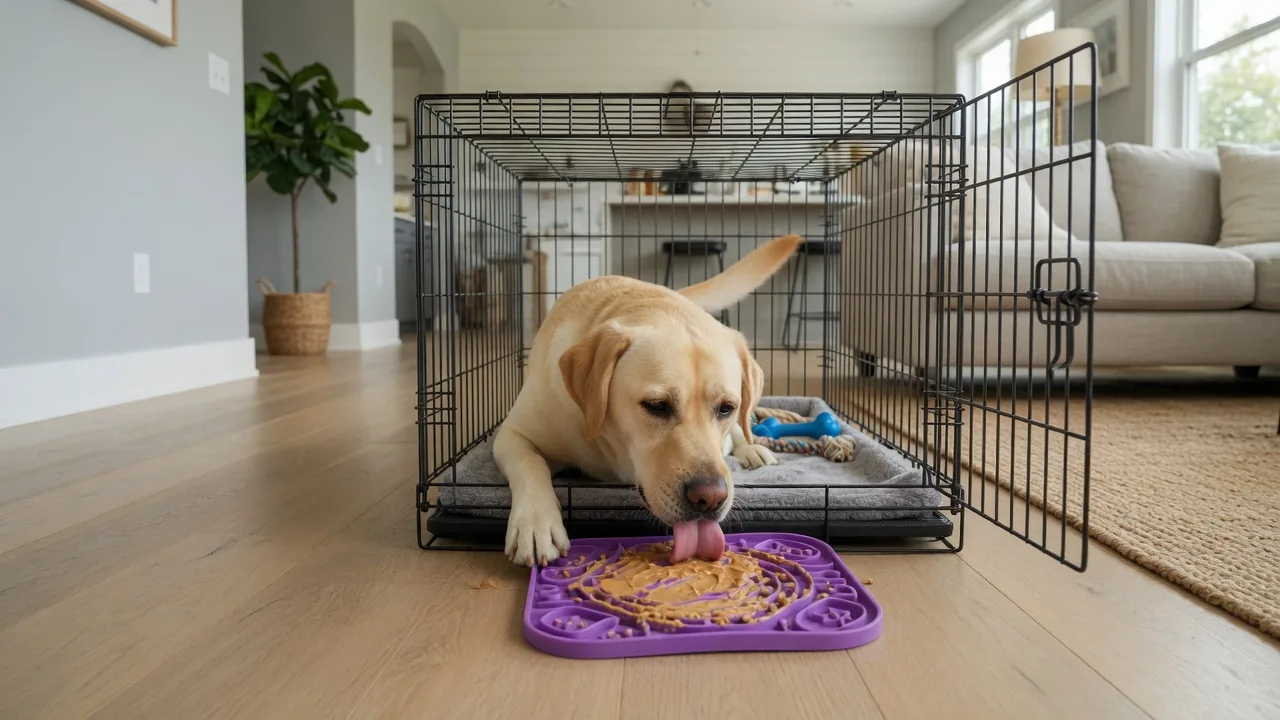
Lick mats. Spread a thin layer and freeze. For a dog who mustn't bend down, hold the mat or fix it to the crate side at nose height so they can lick lying on their chest. We don't sell a lick mat; our lick mat guide explains how to use one, and what to put on a lick mat lists safe fillings.
Chews. Choose one suited to your dog's size and chewing style, supervise, and remove it when it's small enough to swallow. Skip chews entirely if your vet says so.
Safety with food toys:
- Use the dog's own diet wherever possible. New, rich foods are a bad idea in a dog who's just had an anaesthetic or is on medication.
- Any peanut butter must be xylitol-free. Xylitol is toxic to dogs.
- If your dog is on a prescription or low-fat diet, only use that food.
- Remove toys when you're not there if your dog tends to chew pieces off.
Can a dog use a snuffle mat or slow feeder on crate rest?
Sometimes, and this is where we have to be careful, because we sell both.
A snuffle mat offers gentle scent work, and sniffing is calming. But it involves reaching the head and neck down and moving them side to side, and some dogs dig at mats with their front paws. That makes it unsuitable for many neck and spinal cases, for front-leg surgery, and for any dog who gets worked up by food games. If your vet agrees it's appropriate, lay the snuffle mat flat in front of your dog while they're lying down, tuck a small amount of kibble shallowly into the top of the fleece so it's easy, stay with them, and take it away when they finish. If they start pawing, standing or spinning, stop.
A slow feeder bowl asks for less: head down, tongue working. For a dog who's allowed to eat from the floor, a stainless steel slow feeder turns two meals a day into a few minutes of quiet occupation each, with no extra calories, and it stops a bored dog bolting food. It may not work with a cone, and it's not for dogs with restricted neck movement unless your vet says a raised position is acceptable.
If in doubt, leave both until your vet clears more movement. Licking and hand-feeding cover the same need with less risk.
What training can you do with a dog who can't move?
More than you'd think. Training is tiring mental work, and several behaviours need no body movement at all.
- Watch me: reward eye contact.
- Touch: dog bumps their nose to your palm held right in front of them.
- Chin rest: dog rests their chin in your hand. Useful later for vet checks.
- Name that toy: hold up two objects and reward a nose-touch on the named one.
- Calm for handling: reward stillness while you touch paws, ears and the area near (not on) the wound. It makes dressing changes easier.
- Settle on cue: reward a relaxed head-down position.
Keep sessions to two or three minutes, use kibble from the daily ration, and end before your dog gets excited. Avoid anything involving paws, rolling, sitting up and down repeatedly, or spinning.
What does a good crate rest day look like?
Routine does a lot of the work. Dogs settle better when they can predict what's coming. Adjust this to your vet's instructions and your dog's medication times.
| Time | What happens |
|---|---|
| Morning | Toilet break on lead as instructed. Breakfast from a slow feeder or hand-fed. Medication. |
| Mid-morning | Frozen stuffed toy. Then sleep. |
| Midday | Toilet break. Three minutes of nose-and-eyes training. |
| Afternoon | Chew or lick mat. Quiet time with the radio on low. |
| Early evening | Toilet break. Dinner, part hand-fed or in a snuffle mat if cleared. |
| Evening | Crate near the family, calm company and stroking. |
| Bedtime | Last toilet break. Lights down. |
Aim for a short activity every few hours with long sleeps between. Don't try to fill the whole day. Rest is the treatment.
How do you stop a resting dog gaining weight?
A dog on crate rest uses far less energy, and food-based enrichment adds up. Extra weight then loads healing joints.
- Ask your vet how much to cut the daily ration. A reduction is common; the right amount depends on the dog.
- Measure the day's food each morning and fill every toy, mat and training pocket from that container. When it's empty, that's it.
- Use low-calorie fillers if your vet agrees: plain pumpkin puree, or kibble soaked in water.
- Weigh your dog at check-ups and adjust.
How do you set up the crate itself?
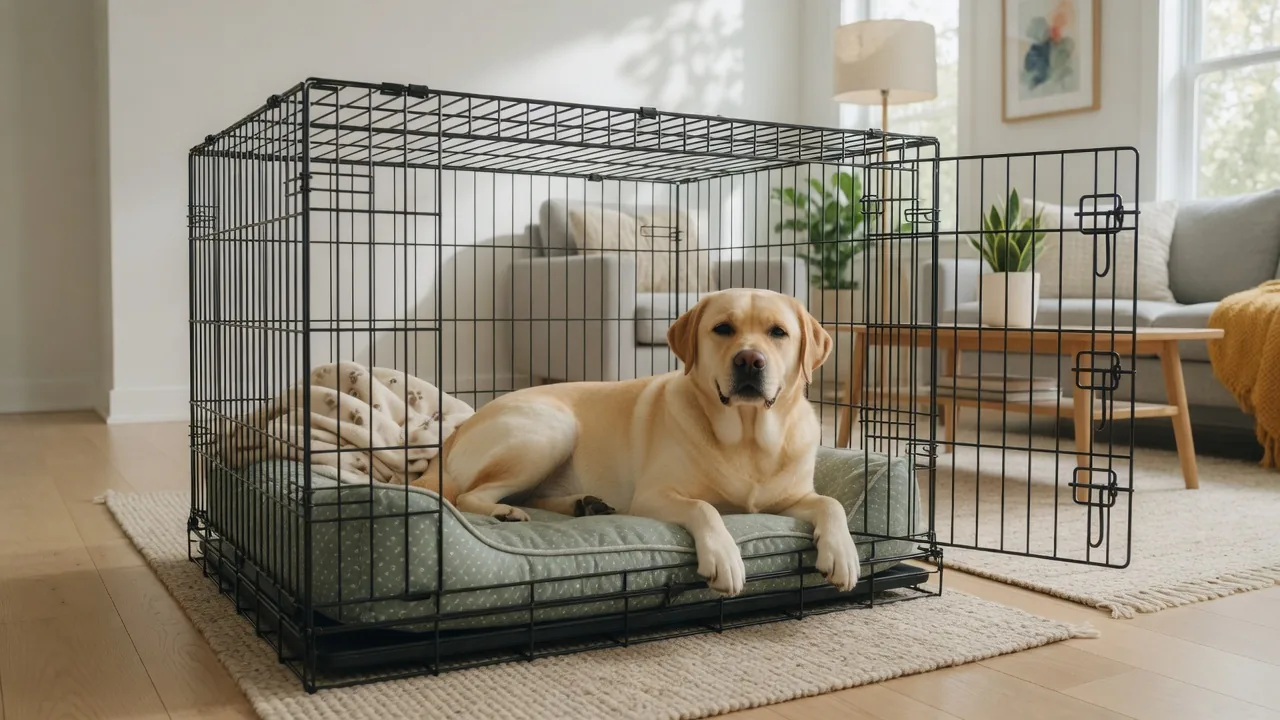
- Size: big enough to stand, turn and lie flat, and no bigger unless your vet prescribes a pen. Extra room invites bouncing.
- Flooring: non-slip, supportive bedding. Slippery surfaces are a risk for orthopaedic and spinal cases.
- Location: where the family is, but away from the front door and windows that trigger barking. A light cover over part of the crate helps some dogs.
- Lead on before the door opens, every time, including for the garden.
- Carry or support as instructed on steps.
- Rotate toys so each one stays interesting.
What should you avoid during crate rest?
- Anything that makes the dog stand up, jump, twist, dig or spin: tug, fetch, wobble toys, rolling treat balls, flirt poles.
- Exciting greetings and visitors who wind the dog up.
- Letting the dog out "just for a minute" off lead because they seem fine. Feeling fine is not the same as being healed, and this is when re-injuries happen.
- New or rich foods not cleared by your vet.
- Play with other pets.
- Hard puzzles that cause frustration. A frustrated dog thrashes.
- No enrichment at all. Total boredom raises stress and often leads to barking, bar-chewing and licking at the wound.
When should you call your vet?
Contact your vet promptly if you see:
- Swelling, heat, discharge, bleeding or an open wound
- New or worsening lameness, weakness or wobbliness
- Not eating, vomiting or diarrhoea
- Marked lethargy, or pain signs such as panting, trembling, crying or guarding an area
- Persistent licking or chewing at the surgery site
- Panic in the crate: frantic digging, biting the bars, drooling, self-injury
Loss of use of the legs, loss of bladder or bowel control, or collapse are emergencies.
The bottom line
Good crate rest enrichment is quiet, stationary and built around licking, chewing, gentle sniffing and tiny bits of training, all paid for out of the daily food ration. Agree the list with your vet, keep a routine, and let your dog sleep the rest of the time. When your dog is signed off, our dog enrichment ideas can help you build activity back up.
👉 Snuffle Mat for Dogs → for gentle scent work once your vet clears head and neck movement 👉 Stainless Steel Slow Feeder Dog Bowl → for slower, calmer mealtimes
Chewing or wrecking a crate pad is a common sign of stress; see why your dog is destroying everything for the causes and fixes.
Frequently Asked Questions
What can I give my dog to do during crate rest? Activities a dog can do lying down: a frozen stuffed rubber toy, a lick mat, a vet-approved chew, hand-fed kibble, and gentle training like "watch me" and nose-to-hand "touch". Check each with your vet first, since restrictions differ by injury, and take all food from the daily ration.
Is it safe to use a snuffle mat during crate rest? Only if your vet confirms your dog may lower and move their head and neck. It's often unsuitable for neck or spinal problems, front-leg surgery, and dogs who dig or get excited. If cleared, lay it flat, hide kibble shallowly, supervise, and stop if your dog stands or paws at it.
How do I keep my dog calm during crate rest? Keep a predictable routine with a short calm activity every few hours and long sleeps between. Use licking and chewing, which are settling, place the crate near the family but away from the door, and avoid exciting greetings. If your dog is panicking, ask your vet for help.
How long can a dog stay on crate rest? It depends entirely on the condition. Some recoveries need a couple of weeks; orthopaedic and spinal cases often need six to eight weeks or more, usually with activity added back in stages. Your vet sets the timeline. Don't shorten it because your dog seems better.
Should I feed my dog less during crate rest? Usually, yes. A resting dog burns fewer calories, and food used in toys and training adds up. Ask your vet how much to reduce the ration, measure the day's food each morning, and use that same allowance for meals, stuffed toys and training rewards.
Can I use puzzle toys for a dog on crate rest? Only stationary ones. Lick mats, stuffed toys and, if cleared, a slow feeder bowl or shallowly loaded snuffle mat are suitable. Avoid puzzles that need pawing, pushing or rolling, such as treat balls, wobblers and sliding boards, because they encourage standing, twisting and excitement.
What are warning signs I should call my vet about during crate rest? Swelling, discharge or bleeding at a wound, new or worse lameness or wobbliness, not eating, vomiting, marked lethargy, signs of pain, constant licking at the surgery site, or panic in the crate. Loss of leg use, loss of bladder control or collapse are emergencies.