7 Dog Enrichment Ideas to Beat Boredom
The best dog enrichment ideas give your dog a job their instincts already want: sniffing out food, chewing, licking, solving a simple puzzle, or learning something new. Pick one idea from each of a few categories, rotate them through the week, and feed at least one meal through a slow feeder or snuffle mat — that alone covers most dogs.
This page is the practical list. Each idea below comes with how to set it up, how to make it harder once your dog has it figured out, and what to watch for. If you want the background first — why a walked dog can still be under-stimulated, and roughly how much brain work a day is enough — that lives in our guide to mental stimulation for dogs.
What counts as enrichment, and why sort it by type?
Enrichment is anything that lets a dog do the things dogs are built to do — sniff, forage, chew, lick, dissect, chase, solve, socialise — in a way that's safe in a modern house. Owners usually think of it as "a puzzle toy." That's one slice.
Sorting ideas by type matters because dogs have favourites. A scenthound may ignore a puzzle board and spend twenty minutes nose-down in a towel. A terrier wants to rip something apart. A dog that's anxious about being left often settles best with licking. If you've tried one thing and your dog shrugged, the category was probably wrong, not the concept.
Here's the quick map before the detail:
| Enrichment type | What it satisfies | Typical session | Cost | Mess level | Good first pick for |
|---|---|---|---|---|---|
| Sniffing / foraging | Scent drive, searching | 5–15 min | Free–low | Low | Almost every dog |
| Food puzzles & slow feeders | Problem-solving at mealtime | 5–15 min per meal | Low | Low | Fast eaters, busy owners |
| Chewing | Jaw work, stress relief | 10–30 min | Low–medium | Medium | Adolescents, power chewers |
| Licking | Self-soothing | 10–20 min frozen | Low | Medium | Anxious dogs, grooming days |
| Dissecting / shredding | Ripping, digging | 5–10 min | Free | High | Terriers, young dogs |
| Training & tricks | Learning, focus | 3–5 min | Free | None | Every dog, any space |
| Novelty & environment | Curiosity, exploration | Varies | Free | Low | Dogs who get bored of toys |
1. Sniffing and scent games: where should most dogs start?
If you only do one thing from this list, make it a nose game. Sniffing is the activity dogs are most universally good at and most universally deprived of, and it costs nothing.
Level 1 — scatter feeding. Toss a handful of your dog's kibble across a clean patch of lawn or a rug and say "find it." That's the whole game. It turns a few seconds of eating into a few minutes of searching.
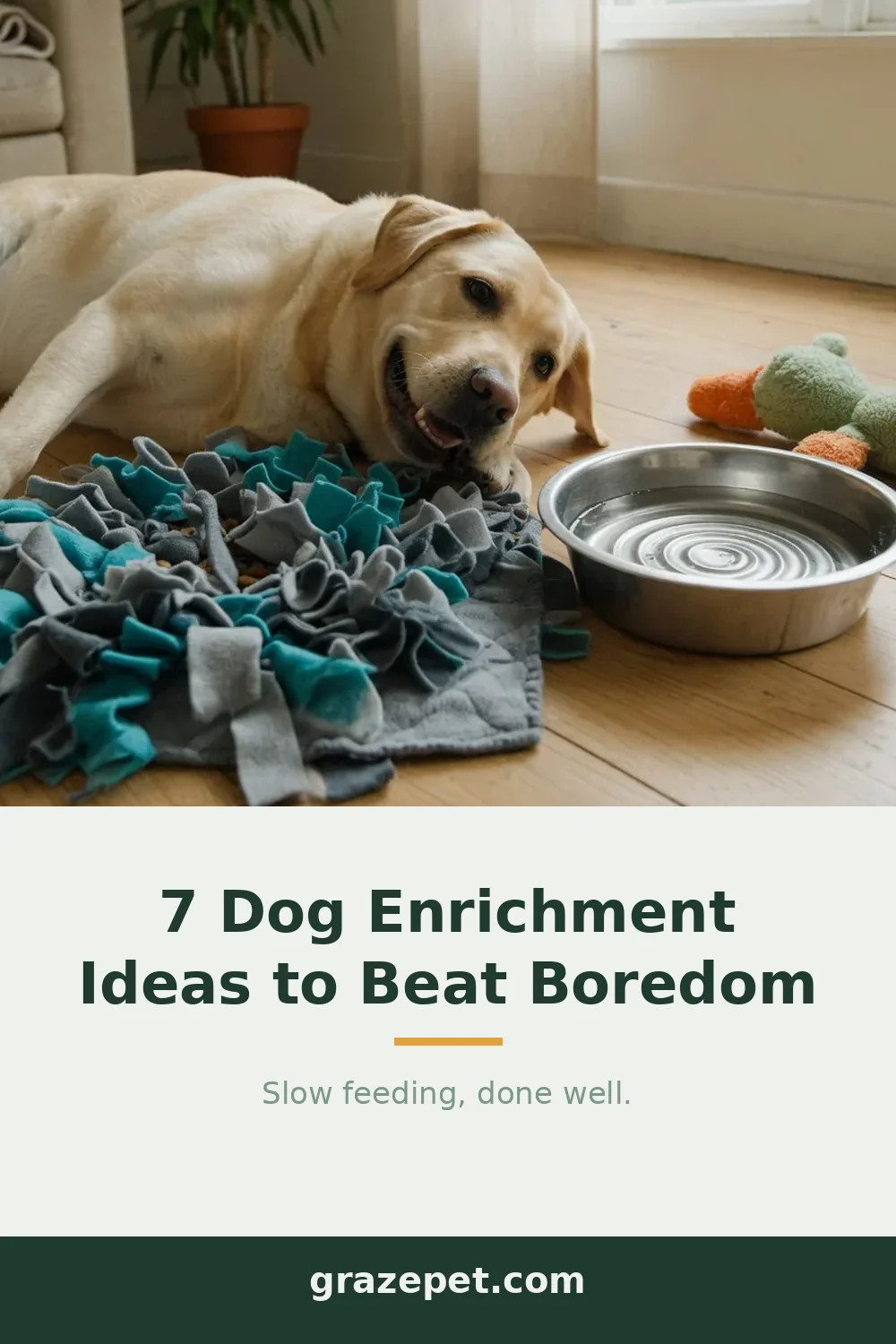
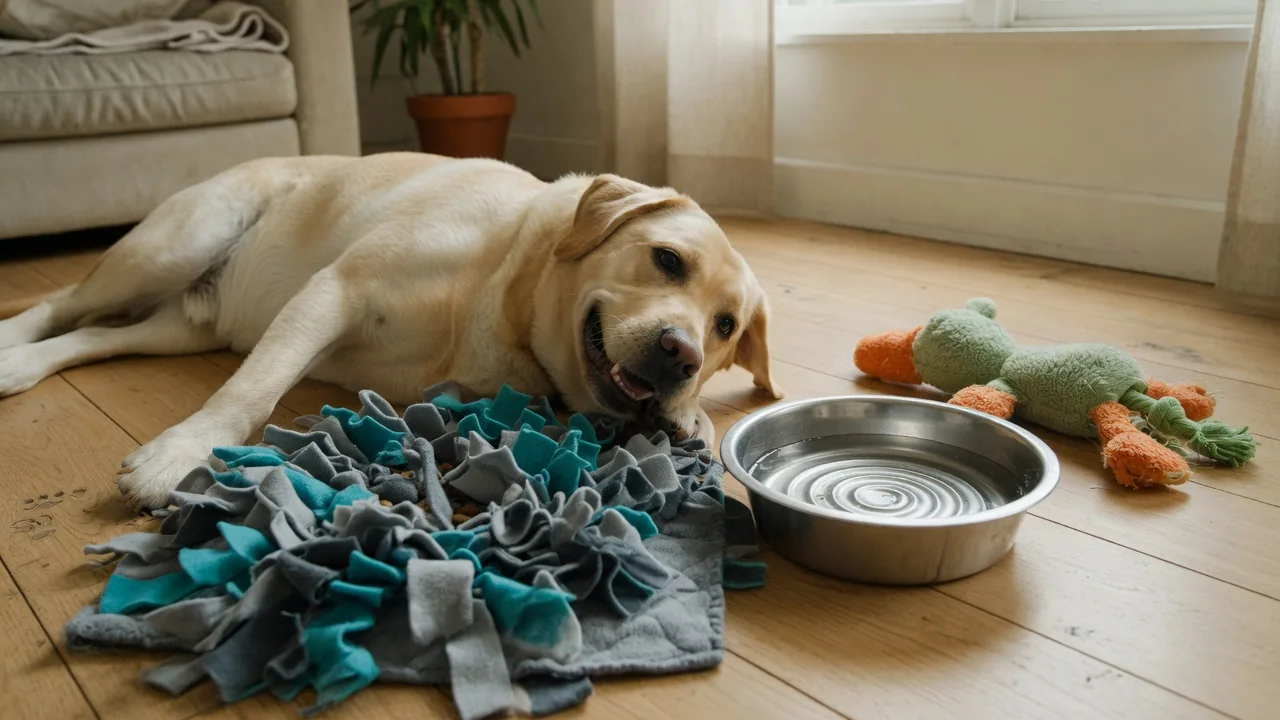
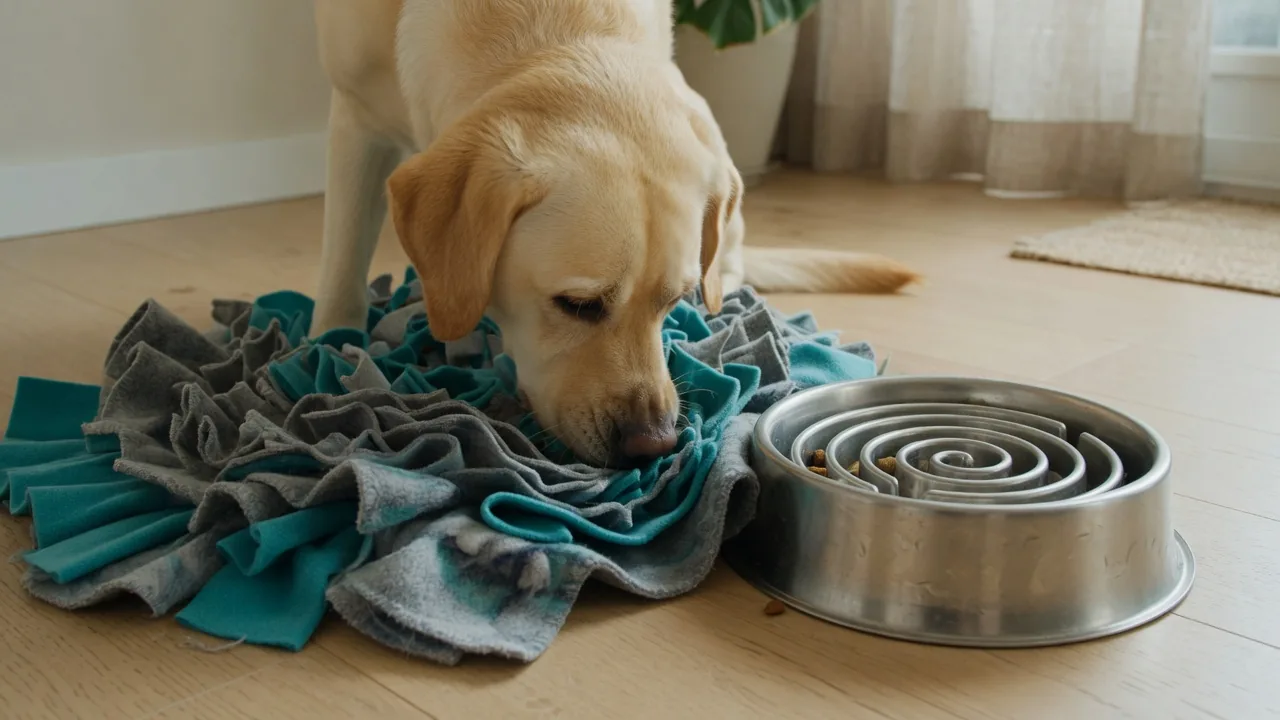
Level 2 — a snuffle mat. A snuffle mat hides kibble deep in fleece strips, so your dog has to push, nuzzle and sniff piece by piece. Start by sprinkling food on top so it's easy to find, then work it deeper into the strips over a few sessions.
Level 3 — hide and seek with food. Put your dog in a sit-stay (or have someone hold them), hide a few treats around one room — under a cushion corner, behind a chair leg — then release them. Start with visible hides, then progress to hidden ones, then to a second room.
What to watch for: dogs who guard food from other pets should do scent games separately.
2. Food puzzles and slow feeders: how do you turn meals into enrichment?
Your dog eats once or twice a day, every day. That's the easiest enrichment slot you have, because it's already scheduled.
Swap the flat bowl. A stainless steel slow feeder has raised ridges that make your dog nose and lick kibble out of channels instead of inhaling it. It's mild enrichment, not a brain-teaser — but it happens at every meal with no extra effort from you, and for fast eaters it slows the pace too.
Use a puzzle feeder for one meal a week, then more. Puzzle toys with sliding lids, flaps or spinning compartments ask more of a dog than a slow bowl does. They come in difficulty levels; most dogs should start at the easiest one, and our breakdown of dog puzzle toy levels explains when to step up.
DIY version. A muffin tin with kibble in some cups and tennis balls on top, or a towel rolled up with kibble inside.
What to watch for: frustration. If your dog starts barking at the puzzle, pawing it hard, or walks away, it's too hard. Drop back a level and let them win easily for a few days.
3. Chewing: what's a safe chew-based enrichment?
Chewing is self-rewarding for dogs and tends to settle them. Adolescent dogs, roughly six months to two years, often need far more of it than owners expect.
Stuffed rubber toys. Pack a hollow rubber toy with soaked kibble or a mix of kibble and wet food. Easy version: loose stuffing, served fresh. Harder version: pack it tightly and freeze it overnight.
Appropriate chews. Choose chews sized so your dog can't fit the whole thing in their mouth, and supervise. Avoid cooked bones, which can splinter, and anything so hard you couldn't dent it with a thumbnail — very hard chews are a known cause of fractured teeth. If your dog is a determined gulper of chew pieces, ask your vet what they'd recommend for that particular dog.
What to watch for: swallowing large chunks. Take away a chew once it's small enough to swallow whole.
4. Licking: how does a lick mat help an anxious dog?
Licking is soothing for many dogs, which is why lick mats have become the go-to tool for nail trims, baths, storms and the first ten minutes after you leave the house.
Spread a thin layer of plain yogurt, pumpkin or wet food into the grooves of a lick mat, freeze it for 20–30 minutes, and hand it over. Thin and frozen lasts far longer than a thick blob at room temperature. Our lick mat for dogs guide covers fillings and cleaning.
What to watch for: rubber mats with a chewer. If your dog starts eating the mat rather than licking it, pick it up.
5. Dissecting and shredding: is it OK to let a dog rip things up?
Yes, on your terms. Some dogs have a strong urge to tear things apart, and giving them a legal outlet beats having them find their own (usually your couch cushion).
The box game. Put a few treats inside scrunched paper in a cardboard box, close the flaps loosely, and let your dog get in. Next time, put that box inside a second box.
Smaller versions. A cardboard tube with the ends folded over a few pieces of kibble, or an egg carton with kibble in the cups.
What to watch for: eating rather than shredding. Most dogs spit cardboard out; some swallow it. Supervise every session, clear up the debris afterwards, and don't use anything with tape, staples, glossy inks or plastic windows. If your dog eats paper, skip this category entirely.
6. Training and tricks: how much does five minutes really do?
More than people expect. A short, focused session where your dog has to work out what earns a reward is real mental effort, and it doesn't need any space.
Good starter tricks that build on each other:
- Touch — dog bumps your palm with their nose. Foundation for many other tricks.
- Spin — lure a circle with a treat, then fade the lure to a hand signal.
- Go to mat — dog goes to a specific bed or towel and lies down. Genuinely useful in daily life.
- Find it — the scent-game cue from idea #1, now on command.
- Leave it — the cue that saves dropped-food emergencies.
Keep sessions to three to five minutes and stop while your dog is still keen. Two short sessions beat one long, frustrated one. If your dog is stuck, make the step smaller rather than repeating the same request.
7. Novelty and environment: how do you keep the same toys interesting?
Novelty is enrichment in itself. A basket of ten permanent toys becomes furniture.
- Rotate toys. Keep three or four out, put the rest away, and swap weekly. The "old" toy coming back feels new.
- Change the walk. A new route, or a slow "sniff walk" on a long line where your dog decides when to stop, does more for the brain than another lap of the block at speed.
- New surfaces and objects. A cardboard tunnel, a crinkly tarp, a low plank on the ground. Nervous dogs should get these slowly and never be forced.
How do you build a weekly enrichment routine without burning out?
The mistake is trying to do everything every day. A rough plan most households can keep:
| When | What | Time it costs you |
|---|---|---|
| Every meal | Slow feeder or snuffle mat instead of a flat bowl | ~0 extra minutes |
| Most days | One 3–5 minute training session | 5 minutes |
| 3–4 times a week | Frozen stuffed toy or lick mat | 2 minutes to prep, can batch |
| 2–3 times a week | A scent game or a box to shred | 5 minutes |
| Weekly | Toy rotation, one new walking route | 5 minutes |
Batch-prep frozen toys and lick mats once a week. On a day when nothing goes to plan, the mealtime slot still happens.
Puppies need shorter sessions and easier puzzles, and older dogs often prefer nose work to anything physical. For stuck-indoors days, we've collected indoor dog activities that work in a small space.
What enrichment mistakes should you avoid?
Adding calories on top of meals. Enrichment food should come out of the daily allowance, not on top of it. Weigh out the day's kibble in the morning and use it for puzzles, scatter games and training rewards.
Starting too hard. A puzzle your dog can't solve in the first session teaches them that puzzles are frustrating. Make the first few wins almost free.
Leaving dogs alone with new items. Supervise anything new until you know how your dog treats it — especially cardboard, rubber toys and chews.
Ignoring signs that it's not boredom. Sudden destructiveness, pacing, compulsive licking or a change in appetite can have medical or anxiety-related causes. If a change is new or getting worse, see your vet before assuming more puzzles will fix it.
The bottom line
Most "bad behaviour" is an under-stimulated dog looking for a job. Start with the slot you already have — mealtime — then add one idea from a second category your dog seems to love. Rotate, keep the food inside the daily ration, and increase difficulty slowly.
👉 Snuffle Mat for Dogs → for daily foraging and scent work 👉 Stainless Steel Slow Feeder Dog Bowl → to turn every meal into light enrichment
Frequently Asked Questions
What are the main types of dog enrichment? The main types are sniffing and foraging, food puzzles, chewing, licking, dissecting or shredding, training, and novelty such as new routes, surfaces and rotated toys. Most dogs have a favourite type, so if one idea does not land, try a different category rather than giving up on enrichment.
What is the easiest dog enrichment idea to start with? Scatter feeding: toss a handful of your dog's normal kibble across a clean lawn or rug and say "find it." It costs nothing, takes no setup and suits almost every dog. A snuffle mat is the indoor, tidier version of the same game.
How much enrichment does a dog need each day? Most dogs do well with at least one dedicated enrichment activity a day on top of exercise, and feeding meals through a slow feeder or snuffle mat makes that easy. High-energy and working breeds usually need more. Watch your dog's behaviour: a settled, resting dog is getting roughly enough.
Can enrichment replace walks? No. Enrichment complements exercise but does not replace it. Mental work tires dogs in a different way and can make a short walk day much calmer, but most dogs still need daily physical activity and time outdoors unless a vet has advised rest.
Do enrichment treats make dogs gain weight? They can if you add them on top of meals. Measure out the day's food in the morning and use part of it for puzzles, scatter games and training. If you use extra treats or fillings, reduce meal portions to match.
Is cardboard safe for dogs to shred? Plain cardboard is generally fine for shredding under supervision, as long as your dog spits it out rather than swallowing it. Avoid tape, staples, glossy print and plastic windows, clear up afterwards, and skip this game entirely if your dog eats paper.
Save this guide