Dog Puzzle Toy Levels Explained
Dog puzzle toy levels describe how many steps a dog must work out to reach the treat. Level 1 is usually one obvious action, such as lifting a lid; the top level combines several moves in sequence. There is no industry standard, so judge a toy by its mechanism, not its number, and start one level lower than you think.
Some brands use four levels, some use five, some say "beginner" to "expert", and some give no label at all. A "level 3" from one maker can be a "level 1" from another. That's how owners end up with a puzzle solved in ten seconds or one their dog walks away from. This guide translates the labels into what the dog actually has to do, gives you a way to place your dog, and shows how to move up without losing their confidence. For types of feeder, see our dog puzzle feeder guide; for the scent-based alternative, see snuffle mat vs puzzle feeder.
Why aren't puzzle toy levels standardised?
Difficulty scales are set by each manufacturer. Some well-known puzzle lines use a four-level scale, others use more or fewer. A scale of 1-4 and a scale of 1-5 can't be compared number for number, and the labels are written by people who have never met your dog.
Three things also change real difficulty and aren't in the number:
- How visible the treat is. A treat you can see is easier than one hidden.
- What you put inside. Sticky, large or soft food is harder to get out than small dry kibble.
- Your dog's habits. A dog that has spent a year pawing and nosing things has a head start.
So treat the level as a hint and the mechanism as the truth.
What does each puzzle level usually mean?
Across most product lines, the pattern looks like this:
| Level (1-5 scale) | What the dog does | Typical mechanism | Skill being built |
|---|---|---|---|
| 1 Beginner | One obvious action | Lift a flap, knock off a lid, tip a cup | "This object contains food" |
| 2 Easy | Find the treat, one type of motion | Slide a cover, spin a wheel, pull a lever | Basic search and manipulation |
| 3 Intermediate | Repeat the motion across several spots | Multiple sliders or compartments | Persistence, memory |
| 4 Advanced | Do steps in order | Unlock one part to reach another | Cause and effect |
| 5 Expert | Combine different mechanisms | Slide, twist, press and lift across rounds | Planning, sustained focus |
On a four-level scale, the middle tiers are usually squeezed together, so a brand's level 2 may cover both the hidden-treat and repeat-compartment rows above. When unsure, read the product description for words like "single step", "multiple steps" and "in sequence".
Level 1: one clear action
The treat is visible or nearly so, and one movement releases it. The goal is confidence and teaching that the toy equals food. A dog that solves it in seconds isn't "too smart for it", they've just understood the game.
Level 2: hidden treat, one motion
Searching becomes part of the job, but once the dog finds the pocket the action is the same. This is the level where most adult dogs spend their first weeks.
Level 3: repetition across compartments
Several spots hold food, and the dog has to keep going without losing interest. It builds persistence, and the dog must remember which spots are done.
Level 4: ordered steps
One move unlocks the next. This is real problem solving, and it is where frustration first appears if the dog was moved up too fast.
Level 5: compound mechanisms
Different mechanisms are combined, sometimes across several rounds. It suits dogs that have mastered the earlier tiers and still seek more challenge. It is not a starting point.
Where should my dog start?
Start at level 1 or 2, whatever the breed. Intelligence matters less than whether the dog has learned how puzzle toys work and how much they want the food.
Use a short placement test:
- Show it first. Put a high-value treat in the toy while your dog watches, in a quiet room.
- Give two minutes. Don't help. Note what they do: sniff, paw, nudge, mouth, or leave?
- Score the result.
- Solved in under a minute and still interested: move up one step next time.
- Solved after real effort, within a few minutes, and eager for more: right level.
- Gave up, barked or tried to chew the toy: too hard, so step down.
- Solved instantly and lost interest: too easy.
- Repeat on three different days. One session shows mood, three show the dog.
Dogs new to food puzzles often need a very easy start, even if they're clever. A confident dog can step up quickly. A nervous or older dog may need to stay at one level for weeks.
How do I step up without losing my dog?
A simple ladder works for most dogs:
- Week 1: Level 1-2. Visible treats, a few minutes per session, high-value food.
- Week 2: Same toy, treats hidden. Move to level 2 if your dog solves it within a couple of minutes.
- Week 3 onward: Move up only after a few easy successes on the current level. Aim for sessions where your dog works for several minutes but still wins.
- Always: Stay close at first, help a little if they're stuck (tilt the toy, reveal a treat), then pull back.
You can make a toy harder without buying a new one: use bigger or stickier pieces, cover the opening a bit, or hide it under a towel. You can make it easier by loosening the cover, using small slippery treats and keeping the first piece visible. For other low-cost options, see dog enrichment ideas and mental stimulation for dogs.
What if the level is right but my dog still quits?
Look at everything except the number:
| Problem | Likely cause | Fix |
|---|---|---|
| Barks or paws at the toy and walks off | Too hard, or tired | Drop a level, shorten the session |
| Ignores the toy altogether | Treats aren't tempting enough | Use something smellier and smaller; try before a meal |
| Solves it once, never again | Too easy | Move up or hide it differently |
| Chews the toy instead | Frustration or toy not suited | Remove, supervise, try a different format |
| Only works when you watch | Needs confidence | Start with you present, fade slowly |
| Shows no interest in any mechanism | Prefers scent to manipulation | Try a snuffle mat |
If your dog is reluctant, a lot of the time the issue is motivation. A dog that has just eaten may have no reason to try.
Do different kinds of dog need different levels?
- Puppies. Keep sessions short and easy, and avoid anything with small parts. See when puppies can have lick mats for the sort of age-safety thinking that applies to any enrichment toy.
- High-drive and working types. They often move up quickly but also get frustrated quickly. Add difficulty slowly.
- Seniors. Choose floor-level, low-effort toys with big, easy mechanisms. Painful hips and sore teeth change what's comfortable.
- Anxious dogs. Easy wins build confidence. A hard toy can make worry worse.
- Flat-faced dogs. Check that the toy lets them reach food comfortably.
- Dogs with a strong sense of smell but little interest in objects. Scent work may suit them better than any mechanism.
How do I use puzzle toys safely?
More complicated toys usually have more moving parts. A frustrated dog may start chewing rather than solving, and small pieces can break off.
- Supervise, especially at higher levels, and check the toy for damage before every use.
- Remove any toy that is cracked, chewed or missing parts.
- Count the food as part of the meal. Use the daily allowance, not extra on top; see how much should I feed my dog.
- Wash after use. Food residue spoils.
- Put it away between sessions. A toy left out all day becomes background clutter.
Where do slow feeders, lick mats and snuffle mats sit on the ladder?
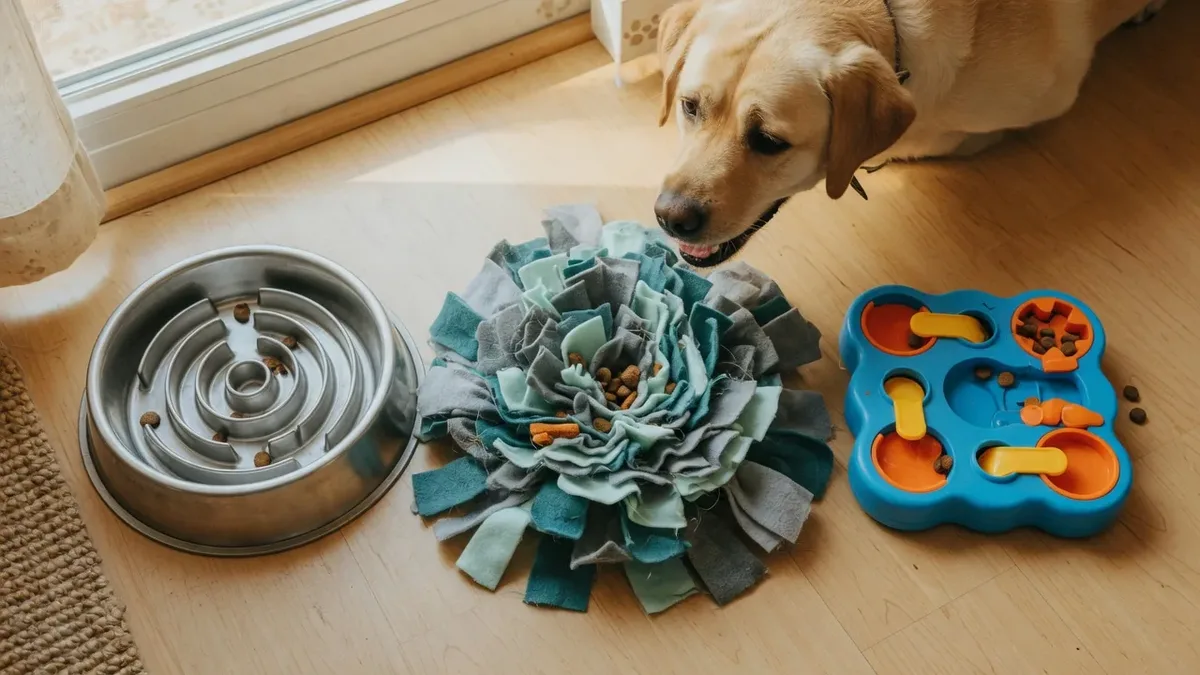
Not every food toy has a numbered level, but you can place most of them by how much thinking they ask for. This is our own rough comparison, not an industry scale:
| Food toy | Roughly equivalent to | What it asks of the dog | Good for |
|---|---|---|---|
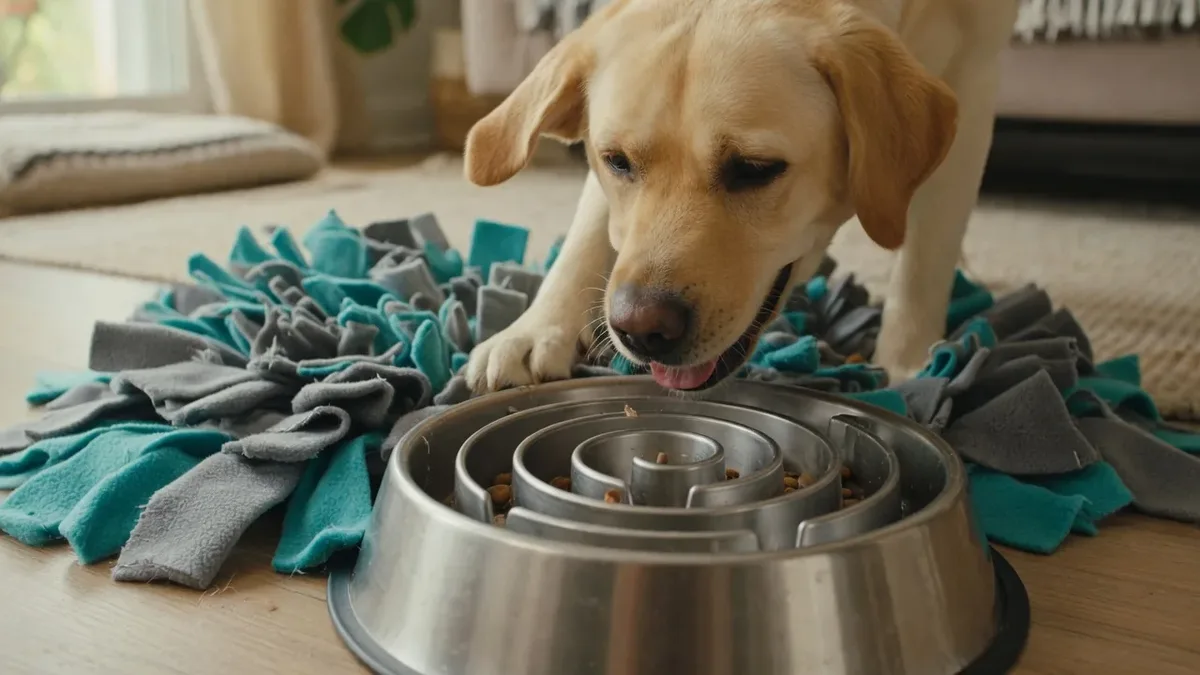
| Slow feeder bowl | Level 1 | Work kibble out of ridges by tongue and nose | Fast eaters, daily meals |
| Lick mat | Level 1 | Lick soft food from a textured surface | Calming, wet food, grooming time |
| Snuffle mat | Level 1 to 2 | Scent search through fleece folds | Dogs who prefer nose to gadgets |
| Treat ball | Level 2 | Roll to release kibble | Active dogs |
| Sliding or lid puzzle | Level 2 to 3 | Manipulate a cover or lever | Confident problem-solvers |
| Multi-step puzzle | Level 4 to 5 | Sequence several actions | Experienced puzzle dogs |
If you want to see how these types compare in more depth, our dog puzzle feeder guide covers six types, and snuffle mat vs puzzle feeder compares the two most common choices directly.
A two-week starter plan
This assumes a healthy adult dog who has never used a food puzzle. Adjust the pace for your dog, and stop any session early if your dog seems stressed.
| Days | Toy and level | Session length | Goal |
|---|---|---|---|
| 1 to 3 | Level 1, treats visible | 2 to 3 minutes | Dog learns that the toy equals food |
| 4 to 6 | Level 1, treats partly hidden | 3 to 5 minutes | Dog searches, still wins every time |
| 7 to 9 | Level 2, a few treats | 5 minutes | One new motion, quick success |
| 10 to 12 | Level 2, a full portion | 5 to 10 minutes | Persistence across several spots |
| 13 to 14 | Try one step up, or keep level 2 | 5 to 10 minutes | Check for calm effort, not frustration |
Run one session a day at most, and use the meal's own kibble where you can. If your dog is a puppy, a senior or has health problems, ask your vet what is suitable. Senior dog enrichment has gentler ideas, and enrichment for anxious dogs explains why easy wins matter.
Common mistakes with puzzle levels
- Buying the hardest toy first. It feels like a good value and usually produces a frustrated dog.
- Believing the number. Two brands' "level 3" can be very different toys.
- Using low-value treats. If the reward isn't worth the work, even an easy toy gets ignored.
- Skipping the helping hand. Tilt the toy or reveal a treat on the first few tries, then pull back.
- Leaving the toy out all day. Novelty fades, and so does interest.
- Treating failure as stubbornness. A dog that quits is telling you the task is too hard or the reward is too small.
If your dog seems bored in general, our signs your dog is bored page helps you check whether the issue is the toy or the day.
When is a snuffle mat a better choice than a higher level?
Mechanism puzzles reward dogs that like manipulating objects. Many dogs love food more than gadgets. A snuffle mat skips the levels problem: scatter kibble into fleece folds, and the dog hunts by nose. Make it harder by packing the folds more tightly, easier by leaving some kibble on top. Our how to use a snuffle mat guide has the steps. Many households keep both, a puzzle for problem-solving days and a mat for quick, calm feeds.
👉 See the Snuffle Mat for Dogs →
The bottom line
Levels are a rough language, not a measurement. Read the mechanism, start low, and let your dog's behaviour set the pace: calm effort and success mean you can step up; barking, avoidance or chewing mean step back. If objects don't interest your dog, switch to scent.
👉 See the Snuffle Mat for Dogs → 👉 See the Stainless Steel Slow Feeder Dog Bowl →
Frequently Asked Questions
What does level 1 mean on a dog puzzle toy? Level 1 usually means one obvious action releases the treat, such as lifting a flap or nudging off a lid. It teaches that the toy holds food rather than testing problem-solving.
What is the hardest dog puzzle toy level? The top level, usually 4 or 5 depending on the brand, combines several actions in sequence, such as sliding a panel to unlock one that then needs twisting. It suits experienced, food-motivated dogs.
What level should I start my dog at? Start at level 1 or 2, whatever the breed. If your dog solves it calmly in a minute or two and wants more, try one step up. If they quit or get frustrated, go back a level.
How do I know if a puzzle is too hard? Common signs are giving up within a minute or two, barking or pawing frantically, chewing the toy, or avoiding it later. Step down and rebuild confidence with easier wins.
Is a level 3 from one brand the same as level 3 from another? No. Brands set their own scales, so check the mechanism and number of steps rather than the number.
What if my dog won't use any puzzle toy? Check motivation first: use smellier treats and try before a meal. If objects still don't interest them, a scent-based snuffle mat often works better.
Should I supervise puzzle toys? Yes, especially at higher levels. Frustrated dogs can chew parts off, so check for damage and remove damaged toys.
How long should a puzzle toy session last? Aim for 5 to 10 minutes of working time for most dogs, and stop before your dog loses interest. Start shorter with new dogs, puppies and seniors.
Can puppies use puzzle toys? Many can, with easy, large-part toys and supervision. Avoid anything with small pieces a puppy could swallow, and ask your vet about timing for your puppy.
Do puzzle toys replace walks? No. They add mental work and make mealtime slower, but dogs still need exercise, sniffing and time with you. See our mental stimulation guide.
Are puzzle toys good for fast eaters? They can be, because the dog has to work for food, but a slow feeder bowl is simpler for daily meals. See how to stop your dog eating too fast.
Save this guide