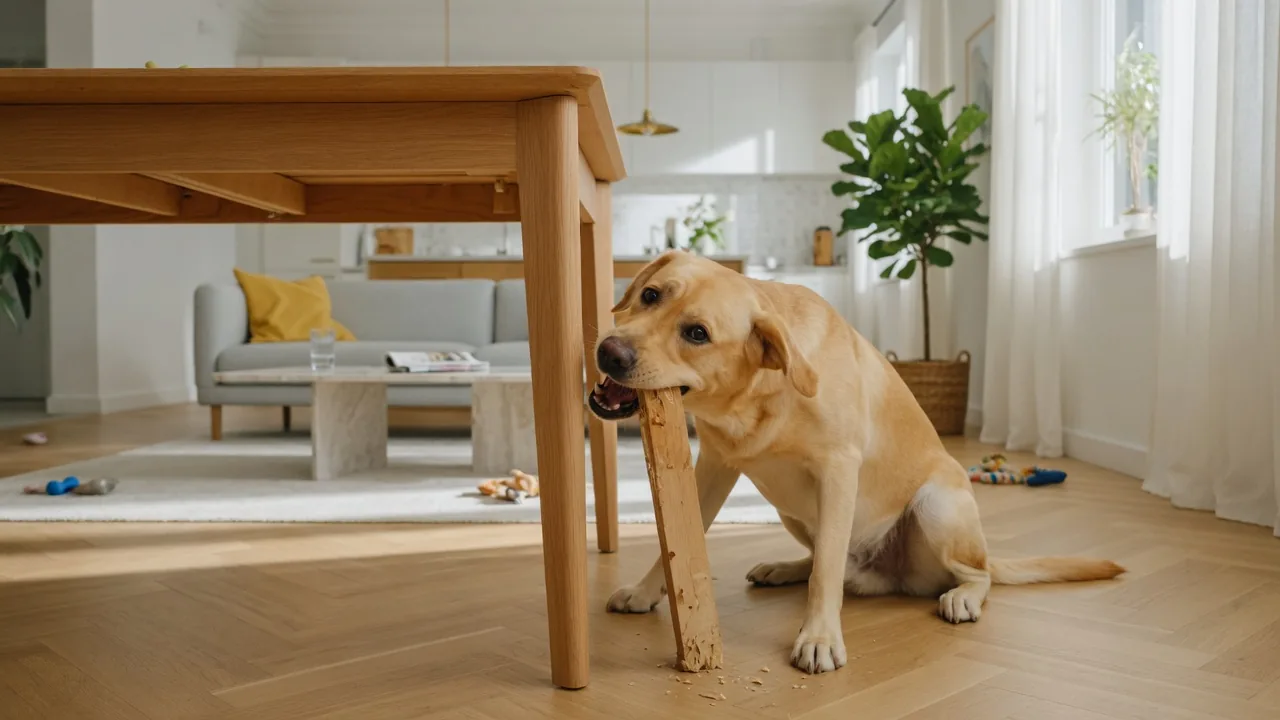
8 Signs Your Dog Is Bored (and What to Do About It)
The main signs your dog is bored are destructive chewing, digging, barking at nothing, restlessness, shadowing you, demanding attention, gulping meals, and trying to escape. Boredom is the likely cause when these happen on quiet, low-activity days and ease off within a week or two of adding daily mental work.
That second sentence matters as much as the list. Every behaviour below can also come from anxiety, pain, or plain lack of exercise, and the fix is different for each. So this guide does two jobs: it shows you what the eight signs look like in real life, and it helps you work out whether boredom is really what you're looking at.
Why does boredom look like bad behaviour?
Most dog breeds were developed to do something for hours a day: herd, retrieve, hunt, guard, pull. A modern pet dog gets two walks and two bowls of food that take a minute each to finish. That leaves a lot of waking hours with nothing in them.
A dog can't pick up a book. So the unused energy goes into whatever is available, and what's available is your skirting board, your garden, the window, and you. None of it is spite. It's a capable animal making its own entertainment.
Boredom is most common in adolescent dogs (roughly 6 months to 2 years), working and herding breeds, terriers, and dogs whose routine has recently shrunk: a new job for you, an injury that cut walks short, a long stretch of bad weather.
8 signs your dog is bored
1. Destructive chewing
Looks like: damage spread around the house, to random objects such as shoes, cushions, remote controls or the post. Often on days with less exercise or attention.
Probably not boredom if: the damage is focused on doors, window frames and exit points, and only happens when you're out. That pattern points towards separation distress. Our guide to why your dog is destroying everything goes through each cause.
2. Digging, indoors or out
Looks like: craters in the lawn, scratched-up carpet corners, a rearranged bed. Digging is foraging behaviour with nowhere to go. Terriers and dachshunds are especially keen.
Probably not boredom if: it's a cool hole in hot weather (temperature), along a fence line (escape), or a pregnant or nesting female.
3. Barking at nothing obvious
Looks like: barking at passers-by from the window for long stretches, at small sounds, or just into the room. Monotonous and repetitive, and it stops quickly if you offer something to do.
Probably not boredom if: it comes with pacing, drooling or howling when left alone, or the dog is hard to interrupt and seems frightened.
4. Pacing and not settling
Looks like: wandering from room to room, lying down and getting up again, sighing, picking toys up and dropping them. Typically in the evening or after a walk that was all marching and no sniffing.
Probably not boredom if: the restlessness is at night in an older dog, or comes with panting, stiffness or licking at a joint. Pain and age-related confusion both look like this.
5. Following you everywhere
Looks like: a shadow that perks up every time you move, in case something interesting is about to happen. Relaxed body, hopeful face.
Probably not boredom if: your dog panics when a door closes between you, or can't be left alone at all.
6. Demanding attention
Looks like: nudging your elbow, pawing, barking directly at you, dropping a toy on your laptop again and again, stealing a sock and parading it past you. This is the clearest sign of all, because your dog is asking outright.
Worth knowing: if stealing things reliably starts a chase, your dog has invented a game. It works, so it'll continue.
7. Eating too fast
Looks like: meals gone in seconds from a dog whose day has little else in it. When dinner is the only event, it gets full intensity. This one has many other causes too, so read it alongside the other signs; why dogs eat so fast covers them.
8. Escaping and fence-testing
Looks like: digging under, climbing over, or finding the gap, then trotting off to explore. The dog is going towards something more interesting.
Probably not boredom if: an unneutered dog is roaming after scents, or the escapes happen during fireworks and storms.
A less obvious ninth pattern: some bored dogs go quiet instead. Sleeping far more than usual, little interest in toys, a flat mood. In an adult dog that can be under-stimulation, but it's also how illness looks, so get it checked if it's new.
Is it boredom, anxiety, pain, or not enough exercise?
The same behaviour can mean four different things. Timing and body language are how you tell them apart.
| Clue | Boredom | Anxiety | Pain or illness | Under-exercised |
|---|---|---|---|---|
| When it happens | Quiet, empty parts of the day | When alone, or around triggers (noise, visitors) | Any time; often worse at night or after rest | Evenings, after missed walks |
| Body language | Loose, playful, looking at you | Tense, panting, wide eyes, tucked tail | Stiff, guarding a body part, licking one spot | Bouncy, "zoomies", mouthy |
| Can you interrupt it? | Easily, with a toy or task | With difficulty | Briefly | Yes, but it comes straight back |
| Onset | Gradual, or after routine shrinks | After a change or scare, or always present | Often sudden | Tracks activity levels |
| What helps | Mental work: sniffing, puzzles, training | Behaviour plan, sometimes vet support | Vet treatment | More physical exercise |
Two quick checks help. First, set up a phone camera when you go out. A bored dog mooches about, finds something to chew, and naps. An anxious dog paces, whines, drools or howls, usually starting within the first half hour. Second, ask whether anything changed. Sudden behaviour change in a previously settled adult dog is a vet question first.
How can you test whether it's boredom?
Run a simple two-week trial. Keep exercise the same and add mental work only, so you know what made the difference.
Days 1–3: feed from something other than a plain bowl. Scatter breakfast in a snuffle mat so your dog sniffs out each piece, and serve dinner in a stainless steel slow feeder bowl. That turns two one-minute meals into roughly 15 to 25 minutes of work a day, with no extra time from you.
Days 4–7: add five minutes of training. One short session a day. A new trick, a hand target, a "find it" game. Stop while your dog still wants more.
Week 2: change the walk and rotate the toys. Make at least one walk a "sniff walk," where your dog chooses the pace and where to stop. Put most toys away and bring out two at a time, swapping every few days.
Keep a one-line daily note: what was chewed, how much barking, how quickly they settled in the evening.
If it's boredom, you'll usually see a real difference inside two weeks: quicker settling, less pestering, fewer casualties. If nothing has shifted, or things are worse, boredom isn't the main driver and it's time to look at the other columns in the table above.
For more ideas at each step, see our dog enrichment ideas and, for days stuck indoors, indoor dog activities.

How much stimulation does a dog need?
There's no fixed number, and it varies a lot by breed, age and individual. As a loose guide, most adult dogs do well with a couple of walks plus 20 to 30 minutes of deliberate mental work spread across the day. A young collie or spaniel may want far more. An older pug may be content with less.
Mental work tires dogs out surprisingly well. Ten minutes of sniffing or problem-solving often settles a dog more than the same time spent walking on a short lead. That's useful if you're short of time, have a dog on restricted exercise, or own a breed you'll never out-walk. Our guide to mental stimulation for dogs explains the idea further.
What mistakes make boredom worse?
Only adding more exercise. More running builds fitness. A fitter dog with the same empty day is a bored athlete. Add thinking, not just miles.
Punishing the symptom. Telling a dog off for chewing or barking doesn't give them anything else to do, and for some dogs, being shouted at still counts as attention.
Leaving every toy out. A toy that's always on the floor is furniture. Rotation keeps things new.
Chasing the stolen sock. You've just become the entertainment. Swap it calmly for a treat or toy instead.
Relying on another dog. A second dog can help, but two under-stimulated dogs often just get into trouble together.
Making puzzles too hard. A dog who can't win gives up and goes back to the skirting board. Start easy and build.
When is it more than boredom?
Talk to your vet if:
- the behaviour started suddenly in an adult dog
- there's also a change in appetite, thirst, weight, toileting or sleep
- your dog licks, chews or bites at their own body, or spins or chases their tail compulsively
- destruction or noise only happens when they're alone
- there's any new aggression or guarding
- an older dog is pacing at night, getting stuck in corners or seems confused
If it looks like anxiety, a qualified behaviourist working alongside your vet is the right route. Enrichment still helps, and our guide to enrichment for anxious dogs covers how, but it won't resolve real separation distress alone.
The bottom line
Chewing, digging, barking, pestering and escaping are what an under-occupied dog does with spare capacity. Check the timing and body language to rule out anxiety and pain, then run the two-week test: meals from a snuffle mat and slow feeder, five minutes of training, sniff walks, rotated toys. If the signs fade, you've found the cause and the fix.
👉 Snuffle Mat for Dogs → for daily sniffing work 👉 Stainless Steel Slow Feeder Dog Bowl → to make meals last
Frequently Asked Questions
What are the most common signs a dog is bored? Destructive chewing, digging, barking at nothing obvious, pacing, following you around, demanding attention, gulping meals and trying to escape. They tend to show up on quiet, low-activity days and ease when the dog is given something to do.
How do I know if my dog is bored or anxious? Look at timing and body language. A bored dog is loose and playful, acts up during empty parts of the day and is easy to distract. An anxious dog is tense, pants or drools, struggles when left alone and is hard to interrupt. Filming your dog while you're out is the quickest way to tell.
Can a dog be bored even with lots of walks? Yes. Exercise and mental stimulation are different needs. A dog who walks for two hours on a short lead with no sniffing, training or problem-solving can still be bored. Adding puzzle feeding, scent games and short training sessions often helps more than extra miles.
Do dogs sleep a lot when they're bored? Some do. Adult dogs normally sleep around 12 to 14 hours a day, so plenty of napping is normal. Sleeping much more than usual with a flat mood can be boredom, but it can also be illness, so see your vet if it's a new change.
How long does it take to fix boredom behaviours? If boredom is the real cause, most owners see a clear improvement within one to two weeks of daily mental work, such as puzzle feeding, sniffing games and short training sessions. If nothing changes after two weeks, look into anxiety, pain or other causes.
Can boredom cause a dog to eat too fast? It can contribute. When meals are the most exciting part of a dull day, some dogs rush them. Feeding from a slow feeder bowl or snuffle mat slows the meal and adds mental work. Fast eating has other causes too, including competition and hunger.
When should I see a vet about boredom-like behaviour? See your vet if the behaviour started suddenly, comes with changes in appetite, thirst, weight or toileting, involves self-chewing or compulsive spinning, includes aggression, or appears as night-time pacing or confusion in an older dog.