Why Is My Dog Destroying Everything? Common Causes & Fixes
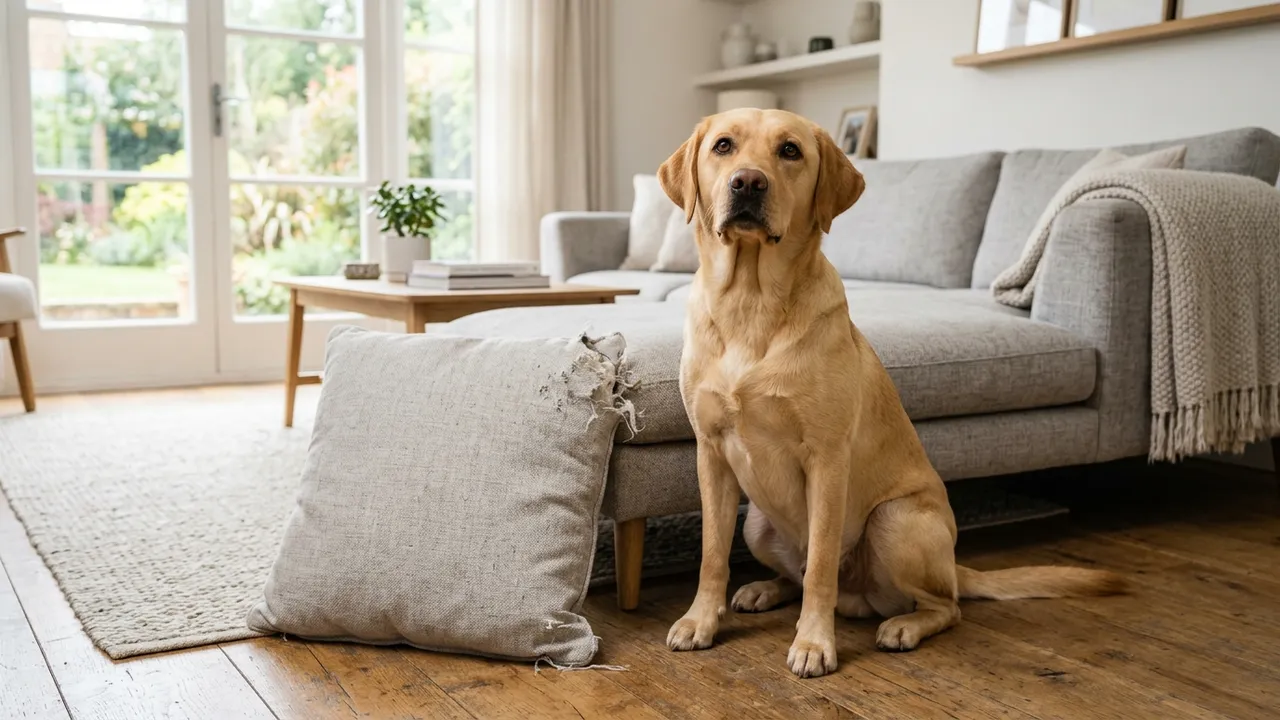
There's a specific sinking feeling that comes with opening the front door and finding foam stuffing across the carpet, or a chair leg gnawed to raw wood. It wasn't like that this morning — and the dog responsible is trotting over to greet you like it's any other Tuesday.
Dogs almost never destroy things out of spite. Destructive behavior usually traces back to one of five causes — boredom, separation anxiety, teething, unspent physical energy, or attention-seeking — and each one needs a completely different response. If it started suddenly in an adult dog, look first for a change — a new schedule, an empty house, pain, or fresh anxiety — and see your vet if nothing explains it. Which is why "he knows what he did" is such an expensive theory to hold onto: treat an anxiety problem like a discipline problem and you can spend months getting nowhere while the behavior quietly gets worse.
Why is my dog suddenly destroying things?
A dog who never touched the furniture and now shreds it has usually had a trigger, even if you can't see it yet. Run through this checklist before assuming a training problem:
- A change in your schedule. New work hours, a house move, a new baby or pet, or someone leaving the household can all tip a settled dog into stress chewing.
- Longer time alone. Eight quiet hours that were fine last month may feel very different after a stretch of working from home.
- Less exercise. Bad weather, an injury, or a busy fortnight can leave a dog with energy and nowhere to put it. Our indoor dog activities guide has rainy-day options.
- Pain or illness. Dental pain, nausea, or an upset stomach can all show up as sudden chewing, especially in older dogs.
- Adolescence. Dogs between roughly six and eighteen months often hit a second chewing phase after the puppy teething stage ends.
- New anxiety. Storms, building noise, or a frightening event can start separation-type behavior in a dog who coped before.
If two or three of these fit, change those first. If none do, book a vet check.
| Pattern you notice | Most likely cause | First thing to try |
|---|---|---|
| Random items, any time of day | Boredom | Daily foraging or licking, see the fixes below |
| Doors, windows, within 30 minutes of leaving | Separation anxiety | Vet or behaviorist |
| Puppy under ~7 months | Teething | Rotate chews, manage access |
| Young dog after confinement | Unspent energy | Exercise before enrichment |
| Only when you're watching | Attention-seeking | Reward calm, ignore the chewing |
| Sudden, with appetite or sleep changes | Pain or illness | Vet check |
It isn't spite
Genuine retaliation would require your dog to hold a grudge for hours, connect your absence to a decision to punish you, then pick a target they know you value. That kind of forward-planning, vengeful reasoning isn't something dogs are generally understood to be capable of.
The guilty look doesn't help your case, admittedly. But the flattened ears and the sudden fascination with the floor are far more likely a response to your face right now than a confession about something from three hours ago. Dogs are extraordinarily good at reading human body language, and not good at linking your anger back to a choice they made before lunch. Scolding after the fact teaches only that your homecoming is unpredictable — which, if anxiety is in the mix, makes things worse.
Read the scene before you diagnose the dog
The damage carries more diagnostic information than most owners realize. Before deciding why, note three things.
What got destroyed, and where. Household items scattered around the house — a raided bin, a dismantled cushion mid-room — point toward boredom or energy. Damage concentrated at exits, like a scratched front door or bent blinds, points elsewhere.
When it happened. Destruction that reliably starts in the first half hour after you leave is a different signal from damage done overnight or while you're in the next room.
How frantic it looks. The methodical demolition of a cushion is one thing; splintered wood, torn nails, and blood on a doorframe are another. The second is distress, not mischief, and deserves a vet's attention rather than a training plan.
The five causes, and how to tell them apart
1. Boredom
The usual explanation for an otherwise healthy adult dog. A bored dog destroys opportunistically: whatever's within reach, at no particular time of day, with no emotional charge to it. The shoe was there. The dog had eight empty hours. The rest follows. Chewing is only one item on a longer list of boredom signals, though, so check it against the full picture — pacing, barking at nothing, fence-testing, inhaling meals. Our signs your dog is bored guide has that checklist.
2. Separation anxiety
The one people most often misread as boredom, and where guessing wrong costs the most time. The pattern is distinctive: destruction clustered around doors, windows, and exit routes; onset within roughly the first thirty minutes of your departure; and distress signals bracketing it — drooling, howling, refusing food, agitation that starts the moment you pick up your keys. A dog escaping a crate hard enough to damage their mouth isn't bored. They're panicking.
Separation anxiety is a recognized behavioral condition, and not one to troubleshoot from a blog post. It typically needs a structured desensitization plan built around your dog, sometimes with veterinary support alongside it. If that pattern sounds like yours, the useful next step is your vet or a certified behaviorist — not more chew toys.
3. Teething, in puppies
Under about seven months old, there's a decent chance this isn't a behavior problem at all. Teething puppies chew because their gums hurt and pressure helps, which is why they go for table legs, skirting boards, and anything with a satisfying give to it. It resolves on its own timeline; your job for a few months is supply and management. If your puppy is also bolting their food, our guide on puppies eating too fast covers that.
4. Unspent physical energy
Worth separating from boredom, because the fix is different. A bored dog needs something to think about; an under-exercised working-breed adolescent needs to move, and puzzle feeding doesn't substitute for that. The tell is timing and profile: young dog, high-drive breed, destruction right after a stretch of confinement. If a hard hour outdoors visibly changes the evening, you've found your answer.
5. Attention-seeking
The subtlest of the five, and the one owners accidentally train into existence. The signature is that it happens in front of you, or within earshot, and reliably produces a reaction — your dog picks up the remote and pauses, watching you. A scolding is still engagement: eye contact, a raised voice, you crossing the room at speed.
Cause comparison at a glance
| Cause | Typical pattern | Where the damage is | First thing to try |
|---|---|---|---|
| Boredom | Random timing, home or away | Household items within reach | Daily scent and food work |
| Separation anxiety | Starts soon after you leave; drooling, howling, pacing | Doors, windows, exits | Vet or certified behaviorist |
| Teething (puppies, roughly the first months to around the first year) | Constant mouthing and chewing | Anything at mouth height | Rotating safe chews, cold options |
| Unspent energy | Worse on days with short walks | Everywhere, often with zoomies | Exercise first, then enrichment |
| Attention-seeking | Happens while you are watching or nearby | Items you react to | Reward calm, stop reacting |
Dogs can also have more than one at once, and breed matters. Retrievers, terriers and herding dogs tend to need more work than the average pet dog, so a Labrador left with nothing to do is a different problem to an elderly Shih Tzu with the same empty day. Anything sudden or out of character is worth running past your vet, because pain, dental trouble and some medical issues can all show up as chewing.
Matching the fix to the cause
- Boredom. Daily mental work, made routine rather than occasional. A snuffle mat turns a meal into fifteen minutes of foraging — the easiest place to start — and a lick mat smeared with plain yogurt gives a calm, absorbing ten-minute task for the moments you leave. Our dog enrichment ideas guide covers the wider toolkit.
- Separation anxiety. Vet or certified behaviorist first. Enrichment can support a treatment plan but shouldn't be mistaken for one; a lick mat is a common calming aid, and our guide to enrichment for anxious dogs explains how to use one alongside professional help.
- Teething. Rotate a few chews so novelty stays high, and manage access to everything else until the phase passes.
- Excess energy. Exercise before enrichment — a tired dog is far more receptive to mental work afterward.
- Attention-seeking. Stop paying for the behavior and start paying for the alternative: react as little as you safely can to the chewing, and give attention when your dog is settled and quiet — the moment most of us ignore them.
Damage control for tonight
None of that helps with the chair leg currently being eaten. While you're still working out the cause:
Move what matters — shoes, cables, remotes, anything with a real repair cost. This isn't defeat; it buys you the weeks you need to fix the actual problem.
Confine safely, but only if confinement is already normal for your dog. A crate introduced mid-crisis can easily make things worse, especially if anxiety turns out to be the cause.
Redirect in the moment, not after the fact. Catch your dog mid-chew and calmly swap the table leg for something they're allowed to have; find the damage an hour later and there's nothing useful left to do. And when in doubt, add exercise and enrichment before you've finished diagnosing — it helps with four of the five causes and harms none.
When to stop troubleshooting and call someone
Some destructive behavior is a puzzle to solve at home. Some isn't. Contact your vet or a certified trainer or behaviorist if:
- The destruction centers on exits and coincides with your departures, especially alongside drooling, howling, or pacing
- Your dog has injured themselves chewing or escaping: broken teeth, torn nails, bleeding paws
- It started suddenly in an adult dog with no change in routine to explain it
- It arrives with other changes — appetite, sleep, toileting, irritability — which can point toward pain or a medical issue
- You've addressed the likely cause for several weeks and nothing has shifted
A professional can watch your dog, assess the triggers in context, and build a plan around the animal in front of them — which no article can responsibly do.
A chew-proofing checklist for the next week
Whatever the cause, these steps lower the damage while you work on it:
- Walk the house at dog height. Anything within reach of a standing dog counts: cables, shoes, remotes, bin lids, soft furnishings.
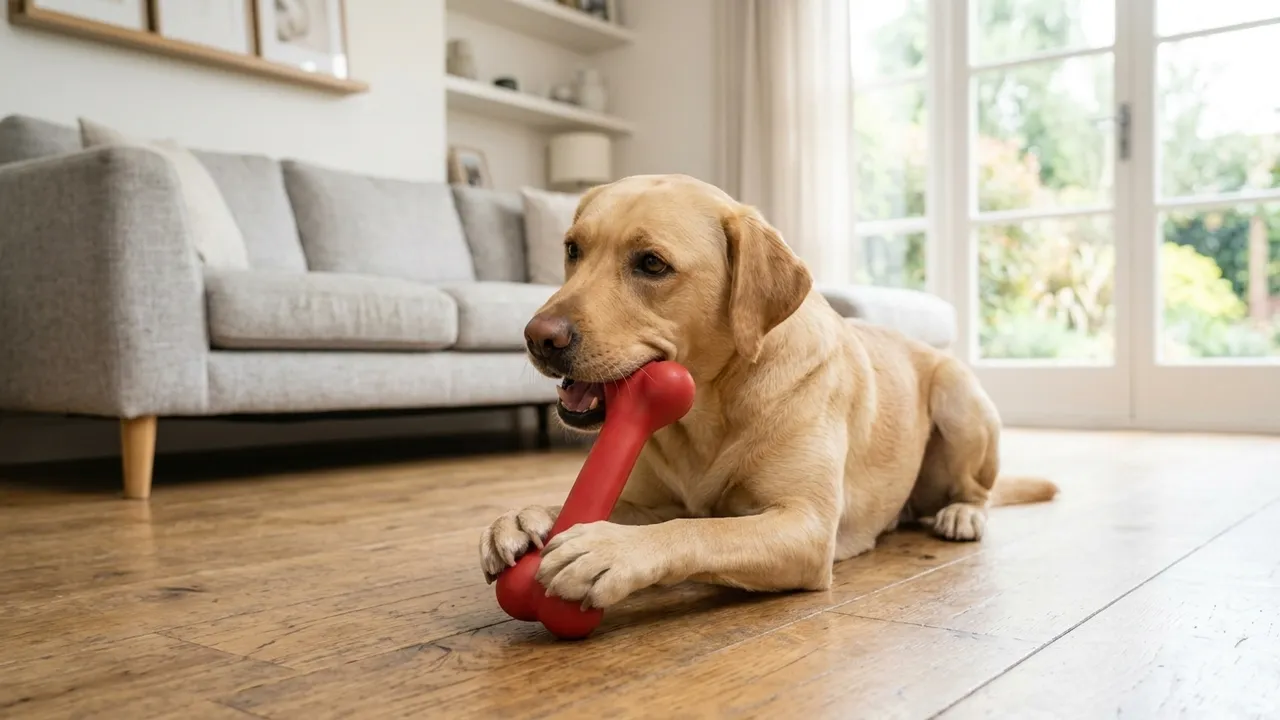
- Offer legal chews daily. Rotate three or four dog-safe options, and pick sizes that can't be swallowed whole. Supervise any new chew and remove it when it is down to a swallowable size.
- Feed from a toy, not a bowl. Put at least one meal a day through a slow feeder, snuffle mat or lick mat. Food puzzles are a reliable way to use up the part of the day that otherwise goes into your furniture. Our dog puzzle feeder guide explains which type suits which dog.
- Exercise before you leave. A sniff-heavy walk, a play session or a training game for 15 to 20 minutes can take the edge off before you go out. How much your dog needs depends on age, breed and health, so ask your vet if unsure.
- Give a settled-time habit. Reward lying calmly on a mat or bed, a few seconds at first, then longer.
- Make leaving boring. Say nothing dramatic when you go or return, and leave the enrichment item out as you exit.
- Keep a log. Write down what was chewed, when and what happened before. The pattern is what tells you which cause fits, and it is exactly what a vet or behaviorist will ask for.
What not to do
- Don't punish after the fact. Dogs don't reliably link a telling-off with something they did hours earlier, so the lesson they take is that you are unpredictable. For anxious dogs it can add to the distress.
- Don't rub their nose in it, or stage the "guilty look" photo. It teaches nothing and damages trust.
- Don't add more crate time to solve it. A crate helps dogs who like theirs, but for an anxious dog a crate can be a source of panic and injury. Ask a professional.
- Don't expect toys alone to fix anxiety. Enrichment helps with boredom and energy, but a dog panicking at your absence won't usually settle for a snack.
- Don't change everything at once. Alter one or two things for a week so you can tell what is helping.
What the right toys look like
| Need | Good options | Notes |
|---|---|---|
| Chewing urge | Durable rubber chew toys, appropriately sized | Replace when cracked or chunks come off |
| Food-driven dog | Snuffle mat, slow feeder, stuffable toy | Take the food out of the daily ration |
| Calming | Lick mat with a frozen filling | See what to put on a lick mat |
| Energetic dog | Tug and fetch, then a settle session | Do the energy part first |
| Puppy teething | A few chews of different textures, chilled | Check with your vet about safe options |
The range of mental games is much bigger than most owners expect. Mental stimulation for dogs lists five types of mental work, and indoor dog activities is useful when weather limits walks.
When it is anxiety, what a plan looks like
If the pattern suggests separation anxiety, a professional will usually build a gradual plan: practising very short absences your dog can cope with, lengthening them slowly, and avoiding the departures that trigger panic. Some dogs also benefit from veterinary support. Enrichment such as a lick mat or a calming enrichment routine can be part of that, as a way of making a short absence feel better, never as the fix itself. Because a plan that moves too fast can backfire, it is worth getting a vet's or certified behaviorist's guidance rather than guessing.
The bottom line
If you're asking why your dog is destroying everything, the honest answer is that "destructive dog" isn't one problem — it's five wearing the same costume. Where the damage is, when it happened, and how frantic it looks tell you far more than the chewed cushion itself. Match the fix to the cause, and manage the environment while you work.
👉 Snuffle Mat for Dogs → — fifteen minutes of daily foraging and mental work 👉 Lick Mat for Dogs → — a calm, frozen-filling activity for settle time
👉 Lick Mat for Dogs → — a calming ten-minute routine for anxious or restless dogs
Frequently Asked Questions
Why does my dog destroy things only when I leave? Destruction concentrated near exits, starting soon after you leave and paired with drooling or pacing beforehand, points toward separation anxiety rather than boredom. It's a genuine behavioral condition, so discuss it with your vet or a certified behaviorist rather than treating it with toys.
Is my dog destroying things out of spite? No — dogs aren't understood to plan retaliatory behavior. What reads as spite is almost always a stress response or an unmet need in the moment, and the "guilty look" afterward is usually a reaction to your body language rather than an admission of guilt.
Will punishing my dog stop the destructive behavior? Rarely, because dogs don't reliably connect a delayed consequence with something they did earlier. Redirecting in the moment and addressing the underlying cause works better than scolding once you've found the damage.
How do I know if it's boredom or separation anxiety? Look at location and timing. Boredom-driven destruction happens somewhat randomly, on household items, whether or not you're home. Separation-anxiety destruction clusters around doors and windows, begins shortly after you leave, and comes with other distress signs. Our signs your dog is bored guide has that checklist.
What is the best thing to give a dog who chews everything? There's no single best, but a mix works: a durable rubber chew sized for your dog, a food-based toy such as a lick mat or snuffle mat, and regular exercise. Supervise any new item and replace chews that crack or break into swallowable pieces.
At what age do dogs stop destroying things? It depends on the cause. Teething-related chewing typically eases as the adult teeth settle in, often by around the first year, but adolescent dogs can stay chewy for longer. Boredom and anxiety-driven destruction don't fade by themselves, so address the cause.
Should I crate my dog to stop the destruction? Only if your dog is already comfortable in a crate. Introducing one mid-crisis can raise stress, especially if separation anxiety is behind the destruction. Ask your vet or a certified behaviorist if you are unsure.
How long should I walk my dog to stop them destroying things? There is no universal number, because it depends on age, breed and health. Combine physical exercise with mental work, because 20 minutes of sniffing and foraging can tire a dog differently from a fast walk. Your vet can advise on how much exercise suits your dog.
Could my dog be destroying things because of a medical problem? Yes. Dental pain, gastrointestinal upset, nutritional issues and age-related cognitive changes can all show up as chewing or restlessness. If it starts suddenly or comes with changes in appetite, sleep or toileting, see your vet.
Why is my dog suddenly destroying things? A sudden start usually follows a change: a new schedule, longer time alone, less exercise, a new source of anxiety, or pain. Work through that list first, and see your vet if nothing explains it or if appetite, sleep, or toileting have changed too.
Why did my adult dog start chewing furniture? Adult dogs who start chewing furniture are most often bored, under-exercised, or stressed by a change at home. Dental pain and adolescence (roughly six to eighteen months) are also common. Adding daily exercise and foraging or licking enrichment helps with most of these.
What can I give my dog to stop destructive chewing? Offer something allowed and engaging in place of the target: a rotation of durable chews, a snuffle mat for foraging, or a lick mat for calm. Redirect in the moment and manage access to valuables.