Puppy Eating Too Fast? How to Slow Them Down Safely
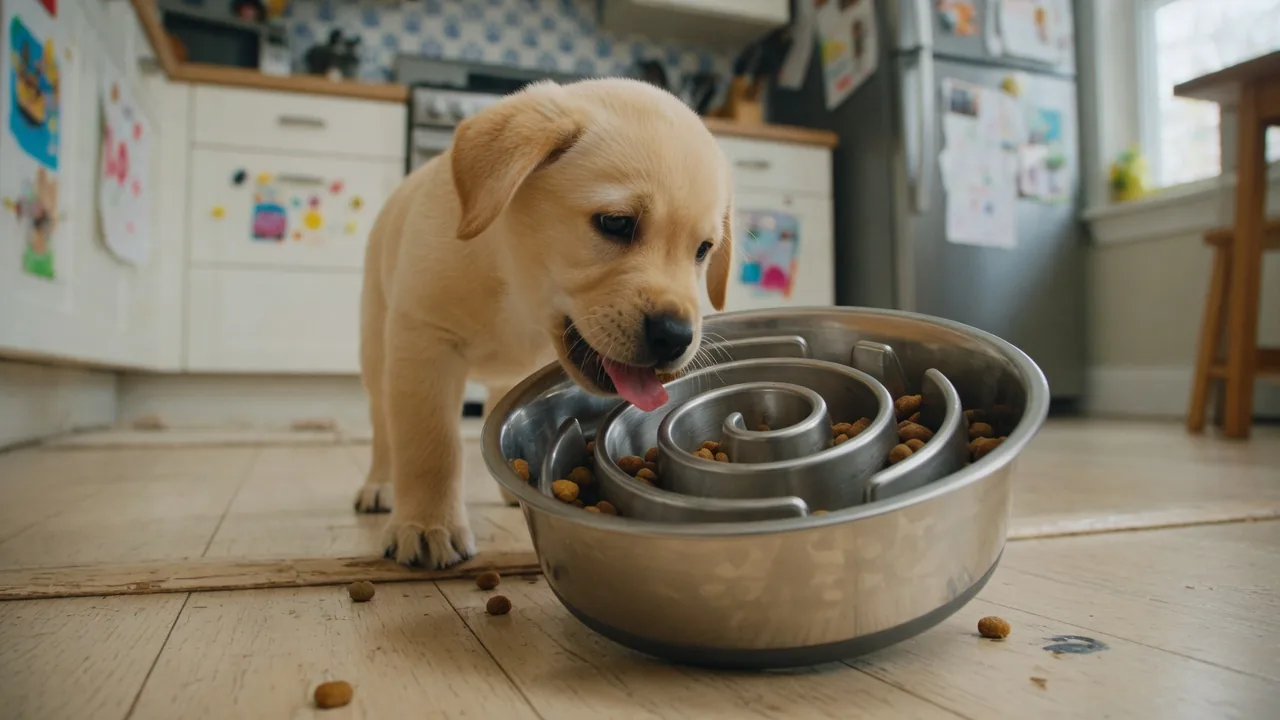
A puppy eating too fast is usually normal: it's leftover litter competition, real growth hunger and excitement. Slow them down by changing how the food is delivered — smaller, more frequent meals, a shallow puppy-sized slow feeder, scatter or hand feeding, and feeding away from other pets — never by cutting the amount a growing puppy needs.
That last part is the one rule that makes puppies different from adult dogs. An adult gulper can afford a skipped meal while you experiment. A ten-week-old can't. Everything below is built around keeping the full ration going in, just more slowly.
Why do puppies eat so fast?
Litter competition. For the first eight weeks of life your puppy ate alongside several brothers and sisters, often from one shared dish. Whoever ate fastest ate most. That lesson doesn't switch off the day they arrive in a home with a bowl of their own.
Genuine hunger. Puppies are growing fast and burning energy to do it. They arrive at the bowl properly hungry in a way most adult pets don't.
Excitement. Food is the high point of a puppy's day, and an over-excited puppy gulps.
A new home. The first week or two in a new place is unsettling. Some puppies eat as if the food might disappear.
Sometimes: worms or not enough food. Intestinal worms are very common in puppies and can leave them ravenous, often with a pot-bellied look. And a puppy that's being underfed for their age and expected adult size will eat frantically for the simple reason that they're hungry. Both are easy to rule out and worth ruling out — see the vet section below.
Most puppies slow down somewhat by themselves as they mature and the routine becomes predictable. Some, especially in famously food-driven breeds, stay enthusiastic for life and need management rather than patience.
Is it bad for a puppy to eat too fast?
It's rarely dangerous, but it isn't harmless either.
- Regurgitation. The classic: the whole meal reappears a minute or two later, barely changed, and the puppy tries to eat it again.
- Gas, hiccups and a tight round belly from swallowed air. Puppies hiccup a lot anyway; fast meals add to it.
- Choking or gagging on unchewed kibble.
- A habit that hardens. A puppy that practises frantic eating three times a day for months becomes an adult that eats frantically. In large and giant breeds, fast eating in adulthood is one of the factors associated with bloat, so the puppy months are the cheap time to change the pattern.
- Tension around food. Frantic eating and guarding sometimes travel together.
How fast is too fast? There's no official number. As a rough guide, if a puppy's meal is gone in well under a minute with no visible chewing, slowing it is worthwhile.
How do you slow a puppy down safely, step by step?
Work through these in order. Most puppies are sorted by step three.
1. Check the amount first. Look at the feeding guide on your puppy food for their current weight and expected adult weight, and compare it with what's actually going in the bowl. Weigh the food rather than guessing with a scoop. If you're unsure, your vet or vet nurse can check your puppy's body condition in a couple of minutes. Our guide to how much to feed your dog explains how to read those charts.
2. Split the day's food into more meals. Same total, smaller servings. A puppy that isn't desperately hungry gulps less. Typical meal frequency by age is in the table below, and the full routine is in our puppy feeding schedule.
3. Change the delivery. Pick whichever of these suits your puppy and your floor:
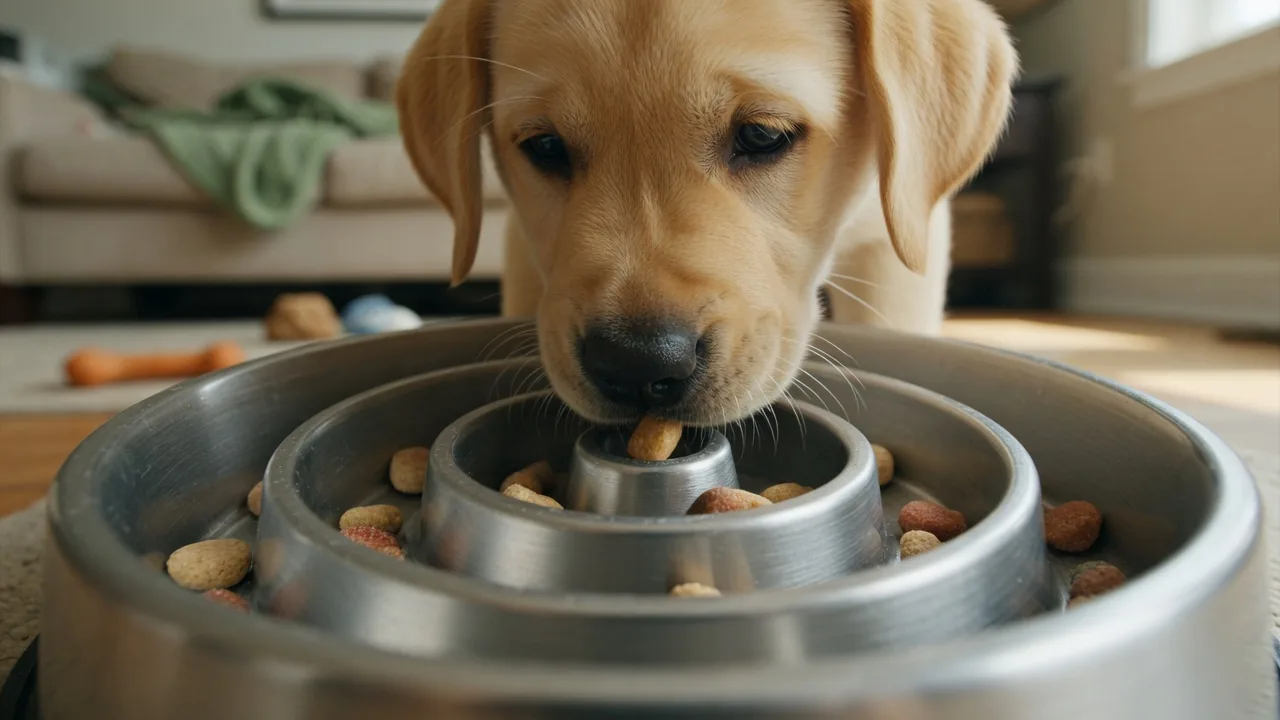
- A shallow slow feeder. The simplest everyday fix. Use one with low ridges and wide channels a small muzzle can reach into. We cover sizing and maze depth in the best slow feeder for puppies.
- Scatter feeding. Spread the meal across a clean floor, a tray or a towel so each piece has to be found.
- A snuffle mat. The tidier version of scatter feeding. A snuffle mat hides kibble in fleece so your puppy sniffs out one piece at a time — good for pace and for tiring out a busy brain. Supervise, since puppies will chew fabric.
- Hand feeding part of the meal. A handful at a time, given for a sit, eye contact or coming when called. It slows the meal, teaches manners and builds trust around food. For the first few weeks at home it's the best use of a puppy's kibble there is.
- A muffin tin or several small dishes. Divide the meal between cups so there's a pause between each.
4. Lower the excitement. Prepare food without fanfare. Ask for a sit, or just wait for four paws on the floor and a second of quiet, before the bowl goes down. Don't wind your puppy up with "Are you hungry? Dinner time!" It takes a week or so of consistency for a puppy to learn that calm makes the bowl appear.
5. Feed separately from other pets. A puppy who can see another dog eating will race. Use a different room, a crate or a baby gate, and lift bowls afterwards.
6. Keep the half hour after meals quiet. Toilet trip, then rest. Rough play on a full stomach is a common trigger for bringing food back up.
What works at each age?
Meal frequencies here are typical guidance, not a prescription — follow your vet and your food's feeding guide, particularly for toy and giant breeds.
| Age | Typical meals per day | Best ways to slow eating | Notes |
|---|---|---|---|
| 8–12 weeks | 4 | Hand feeding, scatter feeding on a towel, several small dishes, softened kibble | Muzzle is too small for most slow bowls; keep it very easy |
| 3–6 months | 3 | Shallow puppy slow feeder, snuffle mat, hand feeding during training | Teething: expect chewing on bowls and mats; supervise |
| 6–12 months | 2 | Slow feeder with a moderate pattern, snuffle mat, puzzle feeders | Size the bowl up as portions grow |
| Adult | 2 | Slow feeder suited to adult muzzle and portion | Large breeds: keep the slow habit for life |
For very young puppies, adding a little warm water to kibble and letting it soften for a few minutes makes pieces easier to manage and harder to inhale dry. Check with your breeder or vet about what your puppy has been used to.
What should you never do to slow a puppy's eating?
- Don't reduce the ration to make meals smaller. Split it; don't shrink it.
- Don't skip meals. Very small and toy-breed puppies in particular can run into low blood sugar if they go too long without food.
- Don't take the bowl away mid-meal or put your hand in it "to show who's boss." It teaches a puppy that people near the bowl are a threat, which is how guarding starts. If you want a puppy relaxed about people near food, walk past and drop something tastier in.
- Don't use an adult-difficulty maze. A puppy that can't reach the food learns to bite the bowl or give up.
- Don't put a small ball or stone in the bowl as an obstacle. Anything a puppy could swallow is a choking and obstruction risk.
- Don't leave a slow feeder, mat or puzzle with an unsupervised teething puppy.
- Don't scold gulping. It's instinct, not misbehaviour.
If you're already seeing stiffening, growling or freezing over the bowl, read our guide to food aggression in dogs and get help early. It's far easier to fix in a puppy.
When should a fast-eating puppy see the vet?
Puppies have less in reserve than adult dogs, so the threshold for a phone call is lower. We're not vets; treat this as a guide to when to ask one.
Book an appointment if your puppy:
- Regurgitates or vomits after meals more than occasionally
- Seems ravenous all the time, has a pot belly, a dull coat, or isn't gaining weight as expected (worms are a common, treatable cause — keep to the worming schedule your vet gives you)
- Has diarrhoea, is lethargic, or goes off food
- Coughs, gags or seems to struggle to swallow at most meals
Go straight to a vet if your puppy:
- Is choking — pawing at the mouth, struggling to breathe, gums turning blue or pale
- Has a swollen, hard belly, retches without producing anything, or is clearly distressed after eating
- Is weak, wobbly or collapses
An occasional post-meal regurgitation in a puppy who's bright and bouncing a minute later is usually just the price of eating too quickly. If it's becoming a pattern, the detail is in dog eats too fast and throws up.
What bowl should a fast-eating puppy use?
Three things matter at puppy stage: the pattern must be shallow enough to reach, the bowl must stay put when it's pounced on, and it has to survive both teeth and several washes a day.
That last point is why we prefer steel to plastic for puppies. Plastic scratches under puppy teeth and those scratches hold residue; a stainless steel slow feeder goes in the dishwasher and doesn't give a teething puppy much to gnaw on. Be realistic about size, though: a bowl that fits a four-month-old Labrador is the wrong bowl for a nine-week-old terrier. For the very young and the very small, start with hand and scatter feeding and bring in the bowl when the muzzle fits it.
👉 See the Stainless Steel Slow Feeder Dog Bowl →
The bottom line
A puppy eating too fast is doing what the litter taught them. Keep the full ration, divide it into more meals, make each one take a little work, and keep mealtimes calm and private. Most puppies settle within a few weeks. Repeated vomiting, constant hunger with poor weight gain, or a swollen belly are for your vet, not a new bowl.
Frequently Asked Questions
Why is my puppy eating too fast? Mostly habit and hunger. Puppies learn to eat quickly while competing with littermates, they are genuinely hungry because they are growing, and mealtimes are exciting. Worms or being underfed can also cause frantic eating, so check portions and keep up with worming.
Is it bad for a puppy to eat too fast? It is usually not dangerous, but it can cause regurgitation, gas, hiccups and occasionally choking, and it builds a habit that is harder to change later. Slowing meals early is easier on a puppy's stomach and sets up calmer eating for life.
How can I slow my puppy's eating down safely? Keep the full daily ration and change how it is delivered. Split it into three or four meals, use a shallow puppy-sized slow feeder, scatter feed or hand feed part of it, feed away from other pets and wait for calm before putting the bowl down.
Can an 8 week old puppy use a slow feeder bowl? Only a very shallow one with wide channels, and many are still too big for a muzzle that small. At 8 to 12 weeks, hand feeding, scatter feeding on a towel or dividing the meal between a few small dishes usually works better.
Will my puppy grow out of eating too fast? Many puppies slow down as they mature and learn that food arrives reliably. Some food-driven dogs stay fast eaters for life. Either way, building slow, calm meals during puppyhood makes the habit much easier to manage later.
Should I feed my puppy less if they eat too fast? No. Growing puppies need their full ration, and cutting food can affect growth and make them more frantic. Give the same daily amount in smaller, more frequent meals and use a slow feeder, snuffle mat or hand feeding to pace each one.
When should I worry about my puppy eating too fast? See your vet if your puppy regularly vomits or regurgitates, seems constantly starving, has a pot belly, is not gaining weight, or has diarrhoea or low energy. Choking, a swollen hard belly or unproductive retching need urgent veterinary care.