Raised Dog Bowl vs Slow Feeder: Do You Need Both?
A raised dog bowl and a slow feeder solve different problems. A raised bowl changes how far your dog bends to eat, while a slow feeder changes how fast the food disappears, so they aren't really rivals. Most dogs who need either one need the slow feeder; a raised bowl suits a smaller group with reach or joint issues, and some large breeds should skip it unless a vet advises it.
If you searched "raised dog bowl vs slow feeder" hoping for a single winner, the honest answer is that it depends on which problem you actually have. Below: what each is for, a side-by-side table, a decision guide by symptom, size and age, whether the two can be combined, the bloat caveat for big dogs, and the mistakes people make when they buy either one.
Quick comparison: what each one actually solves
| Factor | Raised dog bowl | Slow feeder bowl |
|---|---|---|
| Main problem it solves | Posture and reach: less bending to eat | Eating speed: less gulping |
| Best for | Tall dogs, stiff or arthritic dogs, some seniors, dogs with a vet-directed need | Fast eaters of any size or age |
| Changes how fast the dog eats? | No | Yes, that's its job |
| Bloat consideration | Debated; some research links raised feeders to higher GDV risk in large and giant breeds | Fast eating is a risk factor, so slowing it is the lower-controversy move, though not proven to prevent bloat |
| Sits where? | Elevated on a stand | Flat on the floor, or on a stand |
| Can you use both? | Yes | Yes, if height and fit work |
| Cleaning | Depends on the bowl or insert | Stainless rinses or goes in the dishwasher; mazes need a brush |
| Typical downside | Wrong height can make eating less comfortable; the bloat question | Wrong maze can frustrate a dog; some dogs can flip a lightweight bowl |
The short version: they aren't answering the same question. A raised bowl is about how your dog's body is positioned. A slow feeder is about how quickly food goes in.
What is a raised dog bowl actually for?
A raised (elevated) bowl sits on a stand, platform or built-in riser instead of directly on the floor. The idea is to reduce how far a dog has to lower their neck and head to eat, which can be more comfortable for very tall dogs, dogs with joint stiffness or arthritis, and some seniors. Dogs with certain swallowing or esophageal conditions are sometimes told by their vet to eat from a raised position, but that's a prescription from a vet, not a DIY decision.
It does not, on its own, change eating speed. A dog who gulps a meal in ten seconds from the floor will do it in ten seconds from a stand.
There's a caveat worth knowing before you buy one: a widely cited study of large and giant breeds found raised feeders associated with a higher rate of bloat (GDV), and the finding has been debated ever since, partly because association isn't proof of cause. We cover the evidence in do raised dog bowls cause bloat?, and if you do go this route, our elevated dog bowl height guide explains how to size one properly.
What is a slow feeder bowl actually for?
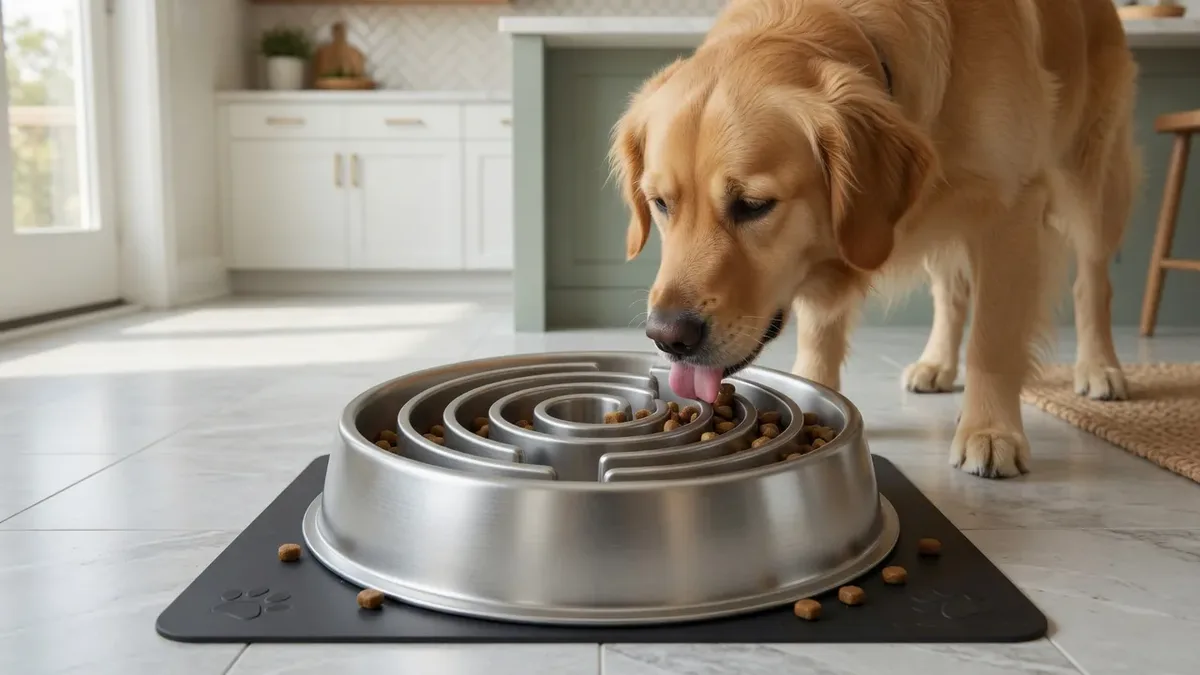
A slow feeder has a raised maze, ridge or spiral pattern moulded into the base. Instead of a single open pool of food your dog can inhale, the food sits between obstacles, so your dog has to nudge, lick and work each piece out. That makes the meal take longer.
This targets eating speed, which matters for a few reasons:
- Less swallowed air, which is associated with gas and discomfort
- Less regurgitation from a stomach that couldn't keep up. See dog eats too fast and throws up for how to tell regurgitation from vomiting
- A little mental work from the maze instead of a meal that's over before it started
- A simple, hands-off change that doesn't depend on training
What it can't do: fix posture, treat a medical cause of vomiting, or promise bloat prevention. A slow feeder sits flat by design, so it doesn't touch the reach question at all. For the full case on safety and fit, see are slow feeder bowls good for dogs?.
Our Stainless Steel Slow Feeder Dog Bowl is a non-porous, dishwasher-safe maze bowl with a non-slip base that keeps it steady on the floor.
👉 See the Stainless Steel Slow Feeder Dog Bowl →
Which one does your dog actually need?
Ask two separate questions. The answers are independent.
Question 1: Does my dog have trouble with posture or reach? Signs include stiffness after eating, reluctance to bend down, standing with the front legs splayed to reach the floor, a very tall build, or a vet-confirmed joint condition. If yes, a raised stand may help, but check the bloat consideration first if you have a large, deep-chested breed.
Question 2: Does my dog eat too fast? Signs include finishing a meal in under a minute, audible gulping, food coming back up shortly after, or racing other pets. If yes, the slow feeder is the more directly relevant fix, and it comes without the elevation debate. See how long a meal should take for a benchmark.
Then match your answers:
| Posture or reach problem? | Eats too fast? | What to do |
|---|---|---|
| No | No | Neither is necessary. A normal bowl is fine, and a slow feeder is optional enrichment |
| No | Yes | Slow feeder on the floor |
| Yes | No | Ask your vet; a raised bowl may suit, with the bloat caveat for large breeds |
| Yes | Yes | Slow feeder first; add height only if your vet agrees and the combined height suits your dog |
Notice that "yes to both" doesn't mean "buy both today." Fix the speed first, because it's cheap, low-risk and you'll see the result within a few meals. Then decide about height.
Does dog size or age change the answer?
Yes, a bit.
- Small and toy dogs. Rarely need height. Gulping is the common problem, and many toy-breed owners are better served by a shallow maze that fits a short muzzle. A raised stand that puts the bowl above a toy dog's shoulder makes eating harder, not easier.
- Medium dogs. The slow feeder is the default. Height is usually unnecessary unless there's a joint issue.
- Large and giant dogs. These are the breeds in the raised-bowl bloat research, and also often the ones who gulp. A slow feeder on the floor is the lower-controversy first step, and elevation should be a conversation with your vet.
- Puppies. Fast eating is common and a slow feeder is a reasonable fix. Raised bowls are rarely needed for a growing puppy, and a stand that's too high or too wobbly isn't safe. See puppy eating too fast.
- Seniors. This is where raised bowls are most often recommended, for dogs with stiff necks, arthritis or reluctance to bend. Choose a height that lets your dog eat with a relaxed neck, and ask your vet, particularly for a large breed.
Can you put a slow feeder on a raised stand?
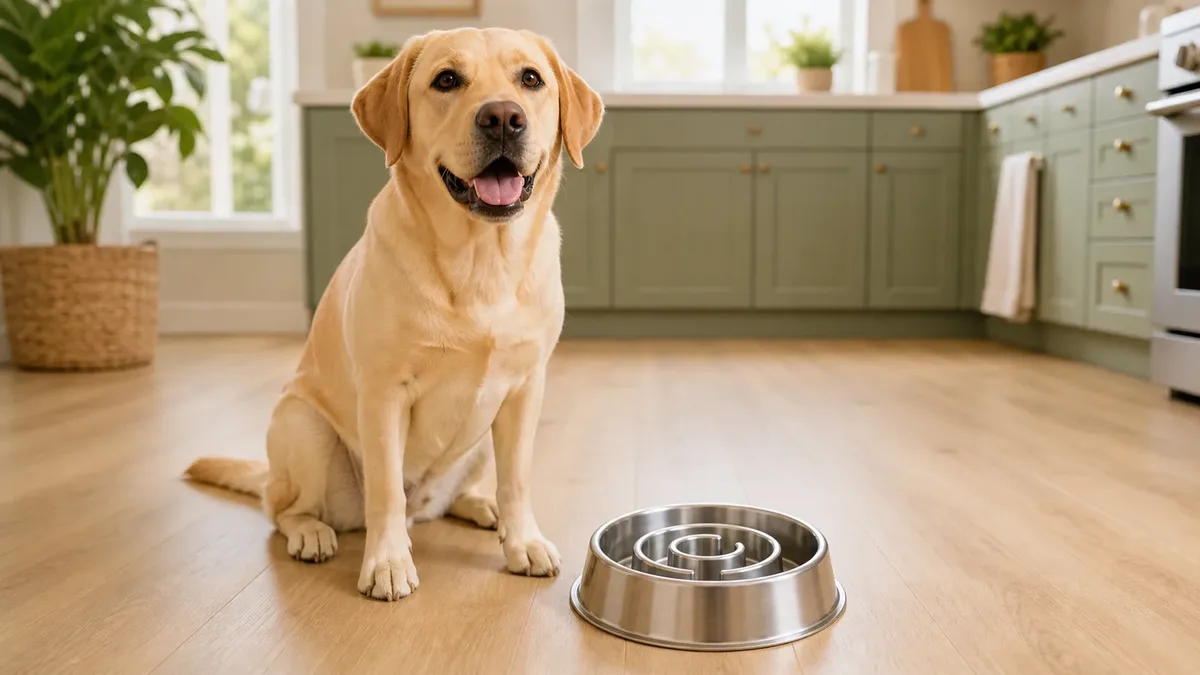
Often, yes. A slow feeder insert or maze bowl can sit on top of a raised stand if three things line up:
- Fit. The bowl must sit securely in the stand's opening, or on the platform, without wobbling or tipping. A loose fit is a hazard for a keen eater.
- Height. Work out the stand height from your dog's size, not the product listing. A common guideline for elevated bowls is to measure from the floor to about the lower chest or the point of the shoulder; the height guide goes through it. Adding a maze insert adds a little height too.
- Vet agreement for large, deep-chested breeds.
Check a few things in the first week: does your dog eat with a natural neck position, does the bowl stay put, and is the maze easy to reach without scraping the stand? If any answer is no, go back to the floor.
What if you have a large, deep-chested breed?
If your dog is a large or giant deep-chested breed, such as a Great Dane, German Shepherd, Standard Poodle or Boxer, and you can only do one thing, the case leans towards the slow feeder first. Here's why:
- Eating speed is a controllable factor that's often mentioned alongside bloat risk.
- A bowl that sits flat avoids the elevation debate entirely.
- It's the lower-controversy choice for the breeds where the raised-bowl research raises the most questions.
That doesn't mean these dogs can never use a stand. Some vets recommend one for comfort or a medical reason, case by case. But start with slowing eating, and treat elevation as a separate conversation. Bloat risk has several contributing factors, and no bowl prevents it. Know the emergency signs (a swollen, hard belly with unproductive retching) and read our guide on bloat (GDV) in dogs.
What mistakes do people make with each?
Raised bowls
- Picking a height by guesswork. Too high is as uncomfortable as too low.
- Buying one for a young puppy who will outgrow it in weeks.
- Assuming it will stop gulping. It won't.
- Using a stand that wobbles or tips.
- Adding one to a large breed without asking a vet.
Slow feeders
- Choosing a maze too deep or complex for the dog. A frustrated dog may push the bowl around, paw at it, or give up. Start with a gentler pattern.
- Using one for a dog who doesn't need it and then wondering why they seem stressed. A calm eater doesn't have to have one.
- Never washing the grooves. Food residue builds up and goes sour. Our guide on how to clean a slow feeder bowl has a routine.
- Skipping the transition. Some dogs need a couple of days to learn the new bowl; if yours is struggling, start by hand-scattering a few pieces of kibble on top of the ridges.
- Using a lightweight bowl with no base grip on a smooth floor.
The verdict
Raised dog bowl vs. slow feeder isn't a fair fight, because they aren't competing for the same job. A raised bowl is a posture and comfort tool; a slow feeder is an eating-speed tool. Most dogs benefit more directly and more often from slowing down, which is why a slow feeder is the safer "start here" pick if you can only choose one. Add a raised stand only if your dog has a real reach or joint problem, you've sized it properly, and for a large breed your vet is comfortable with it.
👉 See the Stainless Steel Slow Feeder Dog Bowl →
Frequently Asked Questions
Is a raised bowl or a slow feeder better for my dog? It depends on the problem. A raised bowl helps with posture and reach for tall or stiff-jointed dogs. A slow feeder helps with eating speed for fast eaters. They solve different problems, and some dogs can use both together.
Can I put a slow feeder bowl on a raised stand? Often yes, as long as the bowl or insert fits the stand securely and the combined height still suits your dog. This gives you both the posture benefit and the slowed-eating benefit. For large, deep-chested breeds, check with your vet first.
Which is safer for a large breed dog: raised bowl or slow feeder? A slow feeder on the floor is the lower-controversy choice for large, deep-chested breeds, since it avoids the debated link between raised bowls and bloat risk. A raised stand can still be appropriate for some dogs, but it's worth discussing with your vet first.
Do I need both a raised bowl and a slow feeder? Only if your dog has both issues: posture or reach difficulty and fast eating. If your dog only eats too fast, a slow feeder alone covers it. If your dog only struggles with reach and eats calmly, a raised bowl alone may be enough.
Does a raised bowl slow down eating? No. Height changes how your dog reaches the food, not how fast they eat it. A dog who gulps from the floor will usually gulp from a raised bowl too.
Do raised dog bowls cause bloat? Some research has associated raised feeders with higher bloat rates in large and giant breeds, but the finding is debated and association doesn't prove cause. If your dog is a deep-chested large breed, ask your vet before using one. See our full guide on raised bowls and bloat.
What height should a raised dog bowl be? A common rule of thumb is about lower-chest or shoulder height, so your dog can eat with a relaxed neck and without reaching up. The right height depends on your dog's size and any health issue, so see our elevated dog bowl height guide and ask your vet if unsure.
Save this guide