Slow Feeder Cat Bowls: Do Cats Need Them Too?
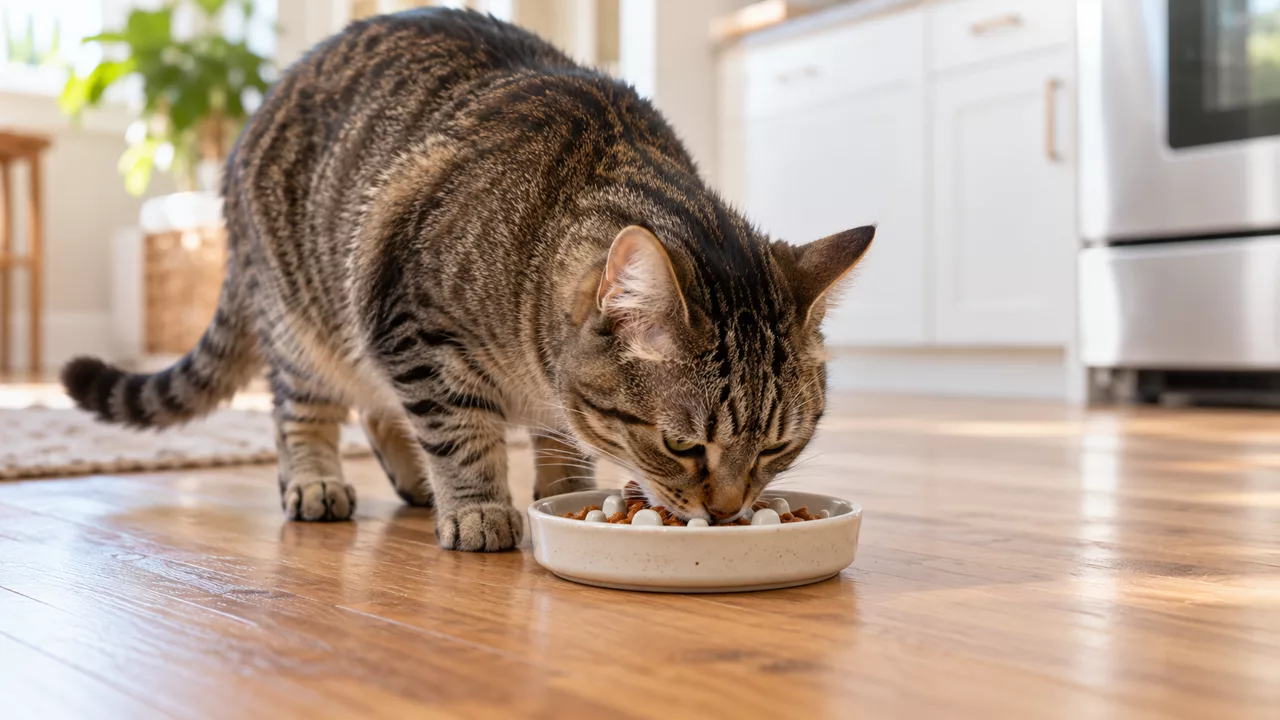
Some cats do. A slow feeder cat bowl helps cats that bolt their food and bring it straight back up, cats that compete at mealtimes, and bored indoor cats. Choose a shallow, wide design with low ridges. It won't fix frequent vomiting with a medical cause, so see a vet if it's regular.
Cats aren't small dogs, and that matters here more than usual. A cat's natural pattern is many tiny meals a day, caught one at a time. Two big bowls of food, eaten in ninety seconds next to a rival cat, is about as far from that as you can get. Slow feeding is one way of closing the gap.
One thing up front, since we're a dog-feeding brand: the bowl we sell is designed for dogs, and for most cats it isn't the right fit. There's a section on that below. The rest of this guide is simply what works for cats.
Why do some cats eat so fast?
- Competition. In multi-cat homes, a cat that feels its food might be taken eats faster. This is the most common cause, even when you never see an actual fight.
- Long gaps between meals. A cat fed twice a day can arrive at the bowl ravenous.
- History. Former strays and cats from large litters often keep the habit for life.
- Food motivation. Some cats are simply greedy.
- Medical causes. A cat that becomes newly ravenous, especially an older cat that's losing weight, needs a vet check. Conditions such as an overactive thyroid and diabetes can show up this way.
The classic consequence is "scarf and barf": the cat eats at speed, and within a few minutes brings up a tube-shaped pile of barely chewed food. Strictly, that's usually regurgitation, food returning from the oesophagus or stomach before digestion gets going, and it's often passive, without the heaving that comes with true vomiting.
Do cats actually need a slow feeder?
Not all of them. Plenty of cats graze sensibly from an ordinary dish and need nothing more.
A slow feeder is worth trying if your cat:
- Regurgitates undigested food shortly after eating fast
- Finishes its own food and then goes after another cat's
- Is on a calorie-controlled diet and acts frantic at mealtimes
- Lives indoors with little to do
It's the wrong tool, at least without veterinary advice, if your cat:
- Is underweight, elderly and frail, or has a poor appetite
- Is unwell or recovering from illness
- Has dental pain or a sore mouth
- Is a kitten that needs every calorie
- Is a nervous eater that's easily put off food
The reason for caution is specific to cats. A cat that stops eating can become seriously ill quickly; cats, particularly overweight ones, are prone to a liver condition called hepatic lipidosis when they go without food. Anything that makes eating harder must never tip a cat into not eating. If your cat hasn't eaten for 24 hours, call your vet.
What do feline vets say about making cats work for food?
Feline medicine has moved firmly in favour of it. The American Association of Feline Practitioners' consensus statement on feeding programmes recommends offering frequent small meals, using puzzle feeders and foraging opportunities, and giving each cat a separate feeding station out of sight of the others. The reasoning is that these let cats behave more like cats, which can reduce stress, inactivity, and overeating.
Note what that advice emphasises: small, frequent, separate. A maze bowl is one way to deliver it, and often not the first thing to try.
What should you look for in a slow feeder cat bowl?
| Feature | What suits a cat | Why |
|---|---|---|
| Depth | Shallow, almost plate-like | Cats prefer not to push their face into a deep container |
| Width | Wide and open | Many cats seem to prefer wide dishes; room for the whole face |
| Ridges | Low, rounded bumps or shallow channels | A cat's small tongue and jaw must reach the bottom |
| Size | Scaled to a cat's meal (a few tablespoons) | In a large bowl, the food just spreads out |
| Base | Non-slip | Light bowls skid when pawed |
| Material | Stainless steel, glazed ceramic, or food-grade silicone | Smooth, easy to clean properly |
| Cleaning | Dishwasher-safe or easy to scrub | Cat food residue is oily and smelly |
A word on "whisker fatigue." You'll see it mentioned on almost every cat bowl listing. The idea that whiskers touching the sides of a bowl causes stress is popular, but the evidence is thin; a small study comparing ordinary and "whisker-friendly" dishes found no clear difference in how cats ate. Wide, shallow dishes are still a sensible choice, simply because many cats appear to like them and they're easy to eat from. Just don't pay extra for the buzzword.
On material. Scratched, grubby plastic is often blamed for feline chin acne. The cause isn't settled, but vets commonly suggest switching to steel or ceramic and washing bowls daily, which costs nothing to try. The trade-offs between materials are covered in stainless steel vs plastic slow feeders.
What types of slow feeder work for cats?
Slow feeder bowls and plates. Shallow dishes with raised bumps or gentle channels. The simplest swap for a cat that eats kibble too fast.
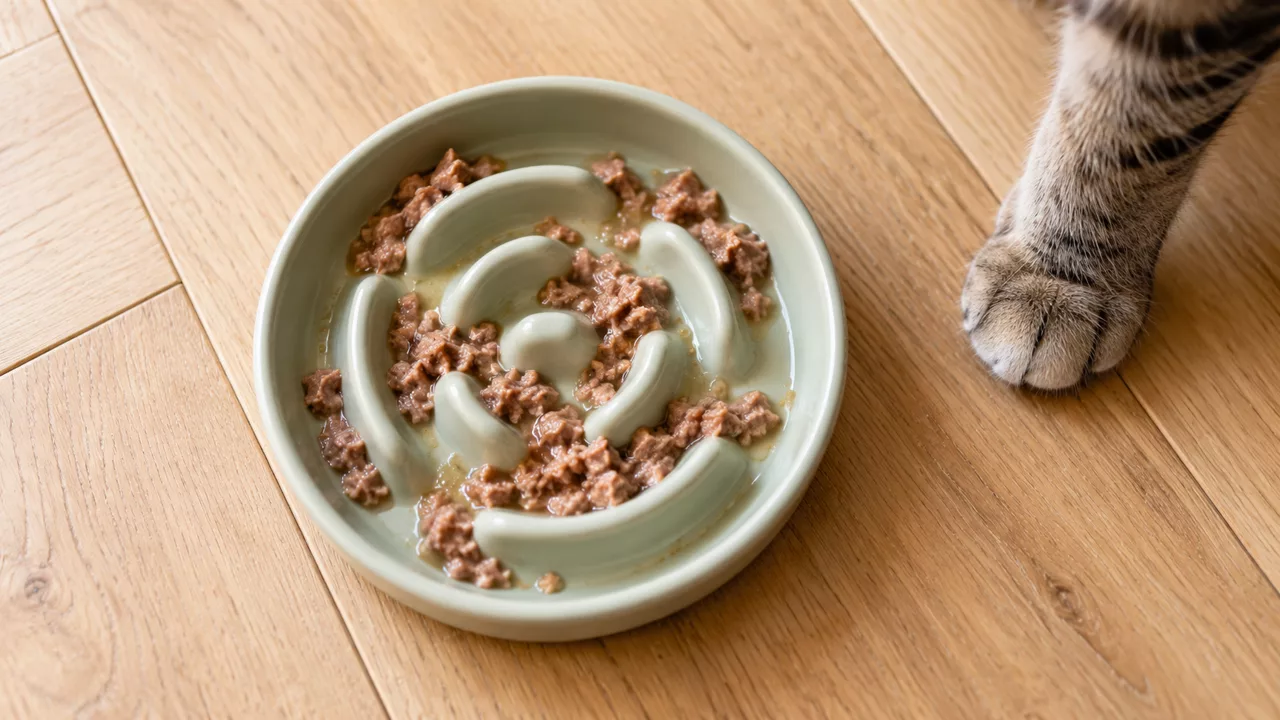
Lick mats. A flat textured mat with wet food spread thinly across it. For wet-fed cats this is often the best option: nothing to press a face into, and licking is naturally slow. The spreading technique is the same as for dogs; see using a slow feeder for wet food.
Puzzle feeders. Boards and towers where the cat hooks kibble out with a paw. These suit a cat's natural style, since cats use their paws far more than dogs do, and they're the best choice for bored indoor cats.
Rolling treat balls. Dispense a piece or two as the cat bats them. Good for active cats; less good on stairs.
Timed automatic feeders. These don't slow a meal, but they can deliver many small meals a day, which tackles the hunger that causes the gulping. Microchip-activated feeders go further and stop one cat eating another's food.
Free DIY options to test the idea:
- Spread kibble across a large flat plate or baking tray so it can't be taken in mouthfuls
- Drop kibble into the cups of a muffin tin or a clean egg carton
- Place a clean, smooth object too large to swallow in the middle of a regular dish, so the cat eats around it
- Scatter a meal across a clean floor, or toss pieces one at a time for the cat to chase
- Split the daily ration into four to six small meals
If the DIY version stops the regurgitation, you know slow feeding works for your cat before you spend anything.
Can a cat use a dog slow feeder?
Sometimes, and here's the honest position on ours. Our stainless steel slow feeder is a dog bowl: the maze and capacity are designed around dog muzzles and dog-sized meals. For an average cat, a typical dog slow feeder is too deep and too large. A cat's couple of tablespoons of kibble disappears into channels it can't comfortably reach, and a cat that finds eating awkward may simply walk away.
Where a dog bowl can work is with a large, confident, food-driven cat and a shallow pattern, or in a household where you already own one and want to test the concept with a watchful eye. If your cat hesitates, don't persist. Buy something made for cats.
We'd sooner say that plainly than sell a bowl that ends up in a cupboard. For dog owners in the house, our best slow feeder dog bowls guide is the place to start.
How do you introduce a slow feeder to a cat?
Cats dislike change, and they vote with their feet.
- Put the new feeder beside the old bowl for a day or two with a few treats on it. Let the cat investigate.
- Start with part of the meal. Offer a quarter of the food in the slow feeder and the rest in the usual dish.
- Make it easy. Food on top of the bumps and visible, not packed into the deepest spots.
- Keep everything else the same: same food, same place, same time.
- Increase gradually over one to two weeks until the full meal is in the feeder.
- Watch intake. You should know roughly how much your cat eats each day. If it drops, go back a step.
- Wash daily. Cats are quick to refuse a bowl that smells stale.
If your cat won't use it after a patient introduction, that's an answer. Try a different style, such as a lick mat or a flat tray, or stick with small frequent meals.
What about multi-cat homes?
Here the bowl matters less than the layout. Feed cats in separate places, ideally out of sight of each other: different rooms, different heights, or opposite sides of a door. Give each cat its own feeder, and pick bowls up afterwards so the fast eater can't finish everyone's meal. Many "greedy" cats slow down on their own once nobody is eating next to them.
When is vomiting a vet problem, not a bowl problem?
It's common to hear that cats "just vomit sometimes." Vets increasingly push back on that: regular vomiting isn't normal and deserves investigation. Book an appointment if your cat:
- Vomits or regurgitates more than occasionally, or it's becoming more frequent
- Vomits when it hasn't eaten fast, or hours after a meal
- Is losing weight, or has a changed appetite or thirst
- Has diarrhoea, seems lethargic, or is hiding
- Brings up blood, or retches repeatedly without producing anything
- Stops eating
A slow feeder is a fair first experiment for a healthy cat that bolts food and regurgitates within minutes. If slowing the meal doesn't stop it within a week or two, the speed wasn't the cause.
Frequently Asked Questions
Do cats need a slow feeder? Only some. A slow feeder helps cats that bolt food and regurgitate it, compete with other cats, beg constantly on a diet, or are bored indoors. Cats that eat calmly don't need one, and frail, underweight, or poorly cats shouldn't use one without veterinary advice.
Do slow feeders stop cats throwing up? They often help when the cause is eating too fast, where undigested food comes back within minutes of a meal. They won't help vomiting caused by hairballs, food intolerance, or illness. If it continues after a week or two of slower meals, or happens regularly, see your vet.
Can a cat use a dog slow feeder? Occasionally, if the cat is large and confident and the pattern is shallow. Most dog slow feeders are too deep and too big for a cat's small meal, and a cat that finds a bowl awkward may stop eating. A shallow feeder made for cats is the safer choice.
What is the best type of slow feeder for a cat? For kibble, a shallow, wide dish with low rounded bumps, or a puzzle feeder the cat can work with its paws. For wet food, a flat lick mat with the food spread thinly. Choose stainless steel, glazed ceramic, or food-grade silicone that washes easily.
Is whisker fatigue real? The evidence is weak. The claim that whiskers touching a bowl causes stress hasn't been clearly shown in research. Many cats do seem to prefer wide, shallow dishes, so choosing one is reasonable, but it isn't a proven medical issue.
How can I slow my cat's eating without buying anything? Spread the meal across a flat plate or baking tray, divide it between the cups of a muffin tin, or split the daily ration into four to six small meals. Feeding cats in separate rooms also removes the competition that drives many cats to bolt food.
Is it safe to make a cat work for its food? For a healthy adult cat, yes, and feline vets encourage puzzle feeding. Introduce it gradually and monitor how much your cat eats. Cats can become seriously ill if they stop eating, so call your vet if yours hasn't eaten for 24 hours.