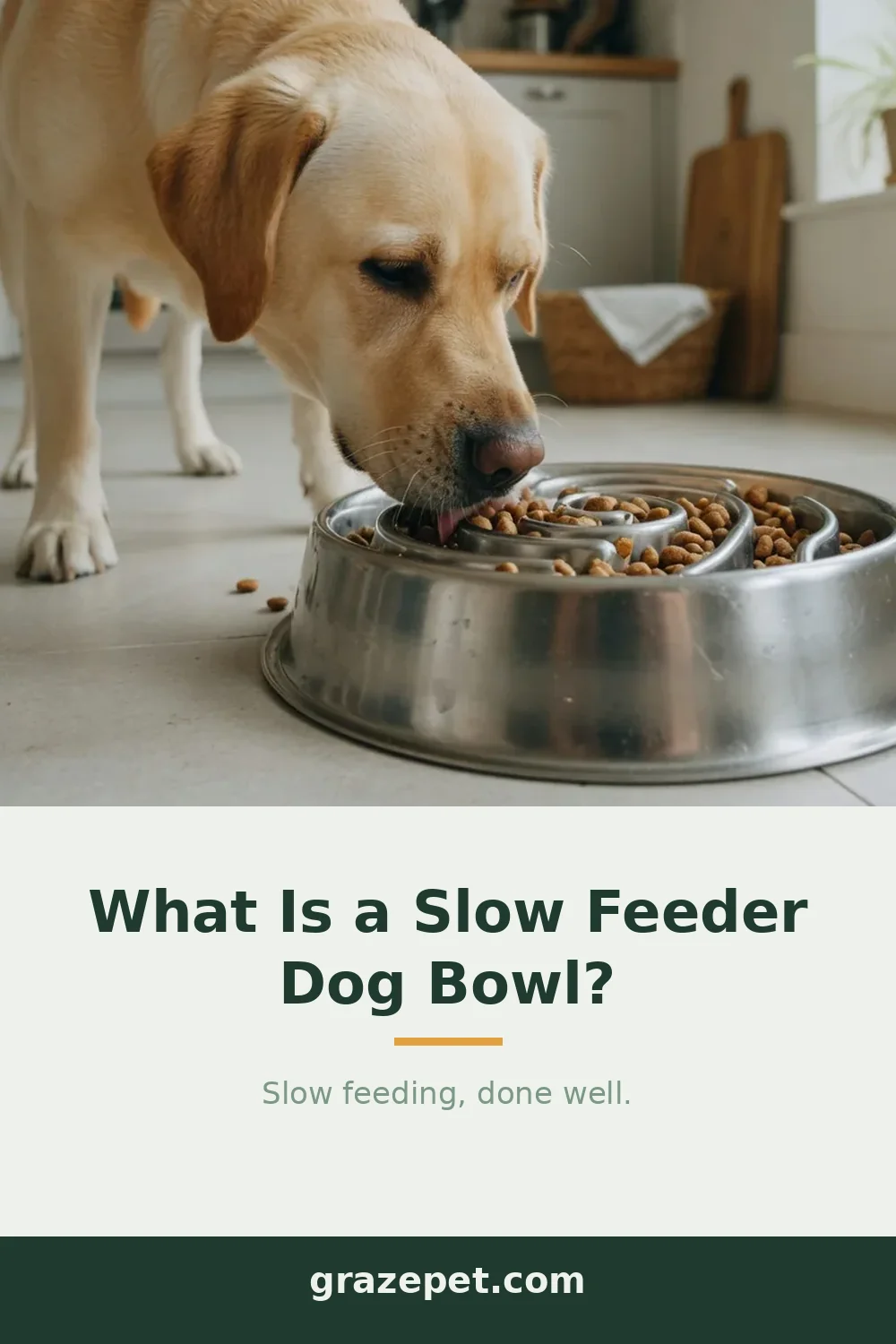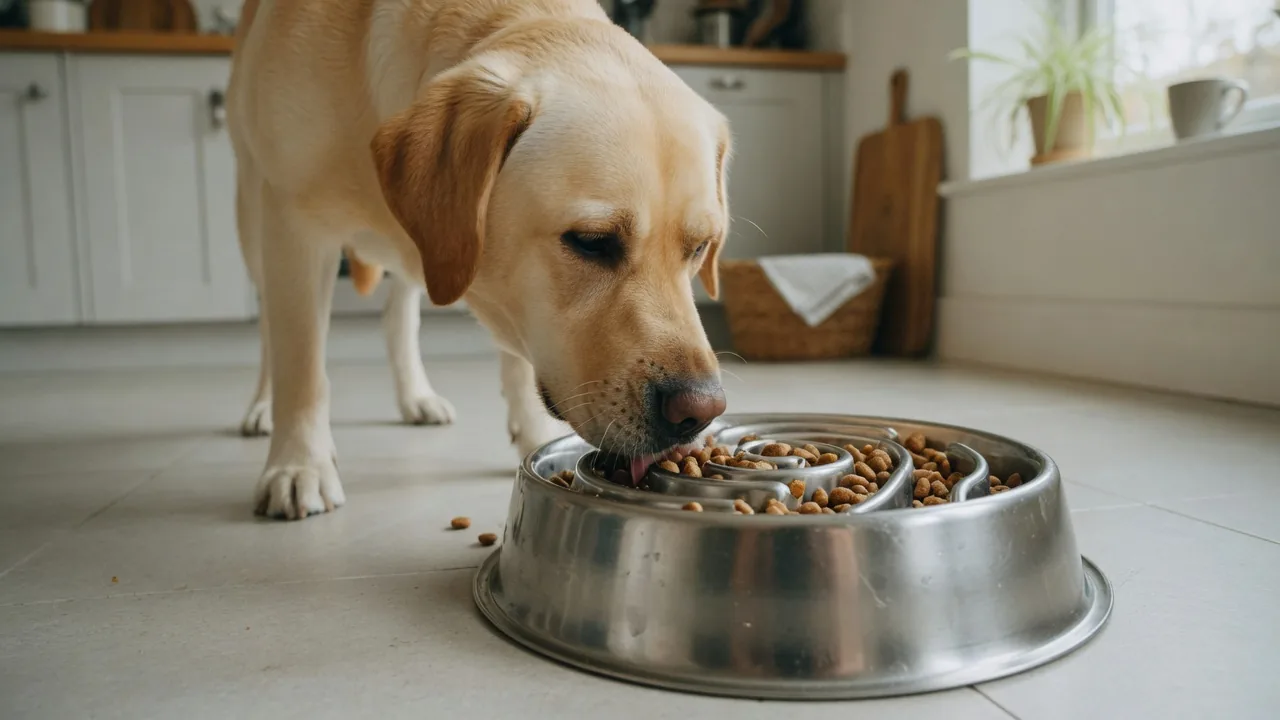
What Is a Slow Feeder Dog Bowl? (And How It Works)
A slow feeder dog bowl is a food bowl with raised ridges, posts or walls built into the inside. The obstacles split the meal into small pockets, so a dog can only take a little food at a time. A meal that takes seconds in a plain bowl typically takes several minutes in a slow feeder.
That's the whole concept: no moving parts, no batteries, no training. The shape of the bowl does the work. This page is a beginner's explainer. It covers the parts of a slow feeder, how the design slows eating, the main types you'll see for sale, the materials and sizes, and what the common terms mean.
What is a slow feeder dog bowl, in plain terms?
Picture a normal dog bowl. Food sits in one open pile, and a dog can push their whole muzzle in and take big mouthfuls.
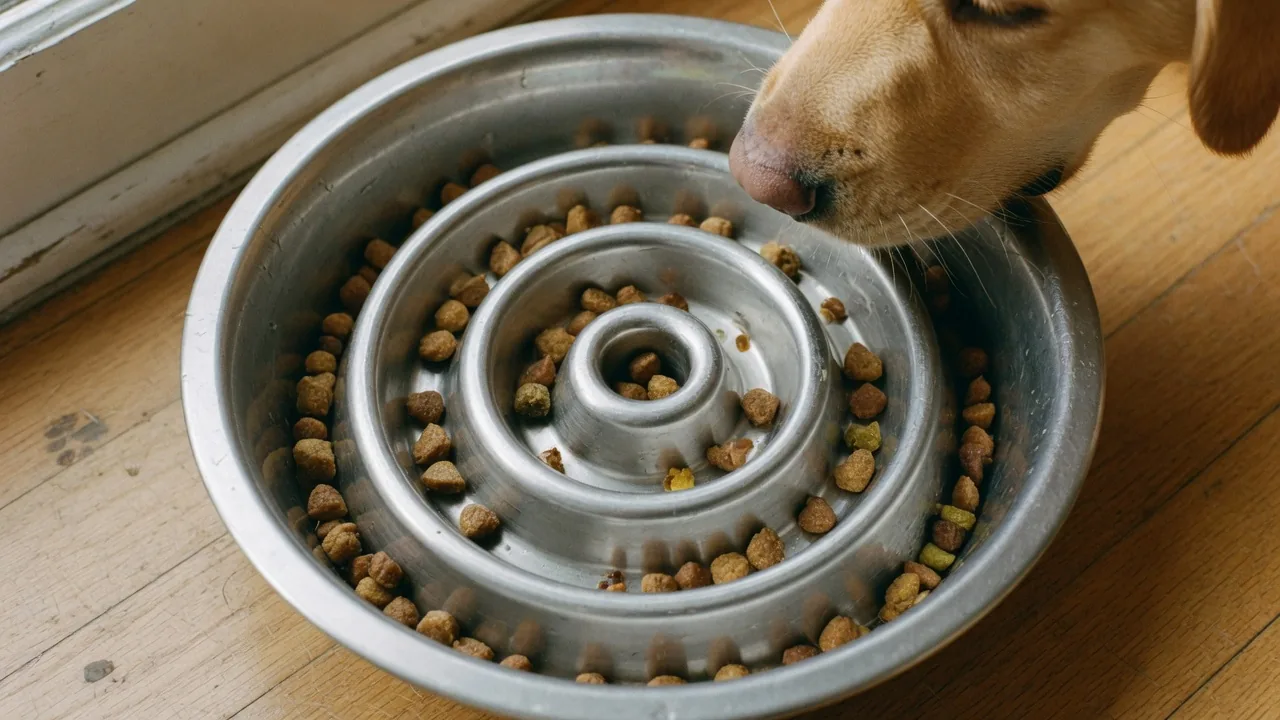
Now picture the same bowl with a pattern of raised shapes moulded into the bottom. The food falls into the gaps between those shapes. The dog's muzzle no longer fits into the pile, because there is no pile. They have to use their tongue and the front of their mouth to pick food out of narrow spaces, a few pieces at a time.
You'll see the same product sold under several names: slow feeder, slow feed bowl, slow bowl, maze bowl, anti-gulp bowl, anti-bloat bowl, puzzle bowl. They all describe a bowl with obstacles inside. "Anti-bloat" is a marketing label, not a medical claim you should rely on.
What are the parts of a slow feeder bowl?
Knowing the parts makes product listings much easier to read.
- Basin. The bowl itself: the outer wall and floor that hold the food.
- Obstacles. The raised parts inside. Depending on the design they're called ridges, walls, fins, posts, bumps or petals.
- Channels. The gaps between obstacles where food sits. Channel width and depth decide how hard the bowl is.
- Rim. The top edge. A higher rim keeps food from being pushed out.
- Base. The underside. Most have a rubber ring, rubber feet or a silicone bottom to stop sliding. Some have a suction base.
Three measurements matter when comparing bowls:
| Measurement | What it means | Effect |
|---|---|---|
| Channel width | Gap between obstacles | Narrower is harder; too narrow for the muzzle and the dog can't reach food |
| Ridge height | How tall the obstacles are | Taller is harder; short bumps barely slow a large dog |
| Capacity | How much food fits within the channels | Food heaped above the ridges isn't slowed at all |
How does a slow feeder bowl work?
The mechanism is physical. Three things happen at once.
Smaller mouthfuls. In an open bowl, a dog scoops with the whole lower jaw. Obstacles block that scooping movement, so each bite is a few pieces of kibble, not a mouthful.
More tongue and lip work. Food sitting in a channel has to be licked or nudged out. That takes longer per piece than grabbing from a pile.
Forced pauses. When one pocket is empty, the dog has to lift their head slightly and move to the next. Those small breaks interrupt continuous gulping.
The result is the same amount of food eaten over a longer time. How much longer depends on the dog, the food and the bowl design.
This page stops at how the design works. What a slow feeder is for, whether the slowdown makes a meaningful difference, and where it doesn't, is covered in the purpose of a slow feeder dog bowl and whether it works.
What types of slow feeder bowl are there?
Most slow feeders fall into a handful of patterns.
| Type | What it looks like | Typical difficulty | Usually suits |
|---|---|---|---|
| Spiral or maze | Curved walls forming winding channels | Medium to hard | Most adult dogs on kibble |
| Ridge or wave | Parallel or wavy raised lines | Easy to medium | Beginners, flat-faced dogs |
| Post or dome | One or several raised posts or a central hump | Easy | Mild fast eaters, large kibble |
| Flower or petal | Rounded lobes radiating from the centre | Easy to medium | Small dogs, puppies |
| Deep pocket or "honeycomb" | Many small separate cells | Medium to hard | Dry food, patient dogs |
| Shallow or lick-style | Low, wide texture across a flat dish | Easy to medium | Wet and fresh food |
| Bowl insert | A separate piece placed into an ordinary bowl | Easy to medium | Trying the idea without replacing the bowl |
A few notes on the less obvious ones.
Maze bowls are the most common and what most people picture. The channels connect, so food can be pushed along them. We describe that design in detail in our maze dog bowl guide.
Inserts are obstacles without a bowl: a weighted or suction-mounted shape you drop into the bowl you already own.
Raised slow feeders combine a slow bowl with a stand. The height is a separate choice with its own considerations, which we explain in raised bowl vs. slow feeder.
What are slow feeder bowls made of?
Four materials cover almost everything on the market.
Plastic. The most common and the cheapest. Light, available in the widest range of shapes and colours, and easy to mould into complex mazes. It's softer than the other materials, so it scratches and can be chewed.
Stainless steel. Pressed or formed metal, usually with a rubber base. Heavier, hard-surfaced and dishwasher-safe. Patterns tend to be smoother and more rounded because of how steel is shaped. Our stainless steel slow feeder dog bowl is an example of this type.
Ceramic. Glazed stoneware. Heavy, so it stays put, and smooth to clean. It can chip or break if dropped.
Silicone. Soft and flexible. Mostly used for shallow lick-style feeders, mats and inserts, and often has a suction base.
Each has trade-offs in weight, durability and cleaning. We compare the two most common in stainless steel vs. plastic slow feeders.
What sizes do slow feeders come in?
Sizing isn't standardised, so one brand's "medium" can be another's "large." Listings usually give some combination of diameter, depth and volume. As a rough orientation:
| Label | Rough diameter | Typical dog |
|---|---|---|
| Small | 5–7 inches | Toy and small breeds, puppies |
| Medium | 7–9 inches | Small to medium dogs |
| Large | 9–12 inches | Medium to large dogs |
| Extra large | 12 inches and up | Large and giant breeds |
Two things to check beyond the label. First, capacity: listed volume is often the bowl filled to the brim, while the usable amount is what fits down in the channels, which is less. Second, muzzle fit: a short-nosed dog needs shallow, wide channels, and a long-nosed dog can manage deeper ones.
For size-based recommendations, see our best slow feeders for large dogs or the full best slow feeder dog bowls guide.
What food goes in a slow feeder?
Dry kibble is what most slow feeders are designed around. It pours into the channels and the dog picks it out.
Wet, fresh and raw food can be used too, but behaves differently. It gets pressed or spread into the channels and licked out. Shallow, smooth, wide-channel designs suit it; deep narrow mazes become hard to empty and harder to clean. We explain the details in slow feeders for wet food.
Mixed meals, such as kibble with a topper or a little water, also work. Liquid pools in the bottom of the channels.
A slow feeder is a food bowl, not a water bowl, although some people use similar designs for dogs that gulp water.
How is a slow feeder different from a puzzle feeder, snuffle mat or lick mat?
These terms overlap and get mixed up constantly.
| Item | What it is | Food | Main action |
|---|---|---|---|
| Slow feeder bowl | Bowl with fixed obstacles | Mostly kibble | Eating around ridges |
| Puzzle feeder / puzzle toy | Board or toy with sliders, lids or compartments | Kibble, treats | Solving steps to reach food |
| Snuffle mat | Fabric mat with fleece strips | Dry kibble, treats | Sniffing and searching |
| Lick mat | Flat textured silicone mat | Soft, spreadable food | Licking |
| Treat ball / dispenser | Hollow toy that drops food when rolled | Kibble | Pushing and chasing |
The simplest way to separate them: a slow feeder is still a bowl. Nothing moves, there's nothing to solve, and the dog can see all the food. The others add searching, problem-solving or licking. "Puzzle feeder" is also used as an umbrella term that includes slow feeders; our dog puzzle feeder guide maps out the whole family, and snuffle mat vs. slow feeder bowl compares those two directly.
What do the difficulty levels mean?
Some brands label bowls as beginner, intermediate or advanced, or level 1 to 3. There's no shared standard, but the labels follow the measurements above.
- Easy: wide channels, low rounded obstacles, few of them. A post, dome or gentle wave.
- Medium: a connected maze or spiral with moderate ridge height.
- Hard: narrow channels, tall walls, many separate pockets.
Difficulty is relative to the dog. A pattern that's easy for a long-muzzled collie can be hard for a pug, and a bowl that's hard for a small dog can be trivial for a large one whose tongue reaches everything.
Where to go next
This page explains what a slow feeder is. For the questions that usually come next:
- What is it for, and does it work? Purpose of a slow feeder dog bowl: does it work?
- Is it safe and right for my dog? Are slow feeder bowls good for dogs?
- Which one should I buy? Best slow feeder dog bowls
- Have a cat that gulps too? Slow feeder cat bowls: do cats need them?
Looking for one? Browse our Stainless Steel Slow Feeder Dog Bowl in the shop.
Frequently Asked Questions
What is a slow feeder dog bowl? A slow feeder dog bowl is a food bowl with raised ridges, posts or walls inside. The obstacles divide the food into small pockets so the dog can only take a little at a time, which stretches a meal from seconds to several minutes.
How does a slow feeder bowl work? It works physically. The obstacles stop the dog scooping big mouthfuls, the food has to be licked or nudged out of narrow channels, and moving between pockets creates short pauses. The dog eats the same amount over a longer time.
What's the difference between a slow feeder and a maze bowl? A maze bowl is one type of slow feeder. "Slow feeder" covers any bowl with obstacles inside, including posts, waves and petals. A maze bowl specifically has walls forming connected, winding channels.
What is the difference between a slow feeder and a puzzle feeder? A slow feeder is a bowl with fixed obstacles; nothing moves and the food is visible. A puzzle feeder has sliders, lids or compartments the dog must work out. Some people use "puzzle feeder" as a general term that includes slow feeder bowls.
What are slow feeder bowls made of? Most are plastic, stainless steel, ceramic or silicone. Plastic is the lightest and most varied in shape. Steel and ceramic are heavier and harder-surfaced. Silicone is soft and mainly used for shallow lick-style feeders and inserts.
Can you put wet food in a slow feeder bowl? Yes. Wet, fresh or raw food is pressed into the channels and licked out. Shallow designs with wide, smooth channels suit it best, because deep narrow mazes are hard for the dog to empty and harder to clean.
What size slow feeder do I need? Sizes aren't standardised, so check the diameter and capacity, not just the label. The full meal should fit down inside the channels, and the channels should be wide enough for your dog's muzzle to reach the bottom.
Save this guide