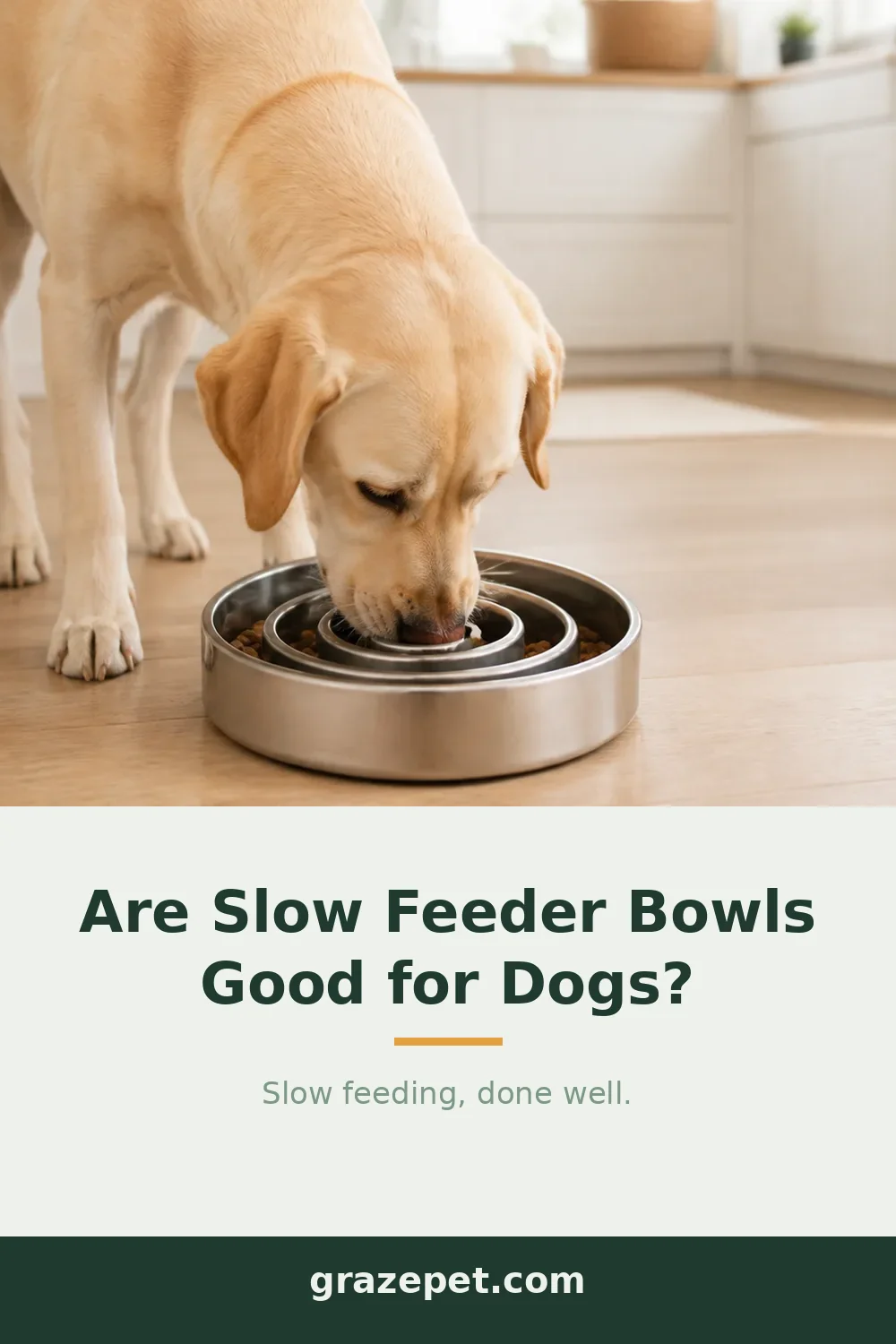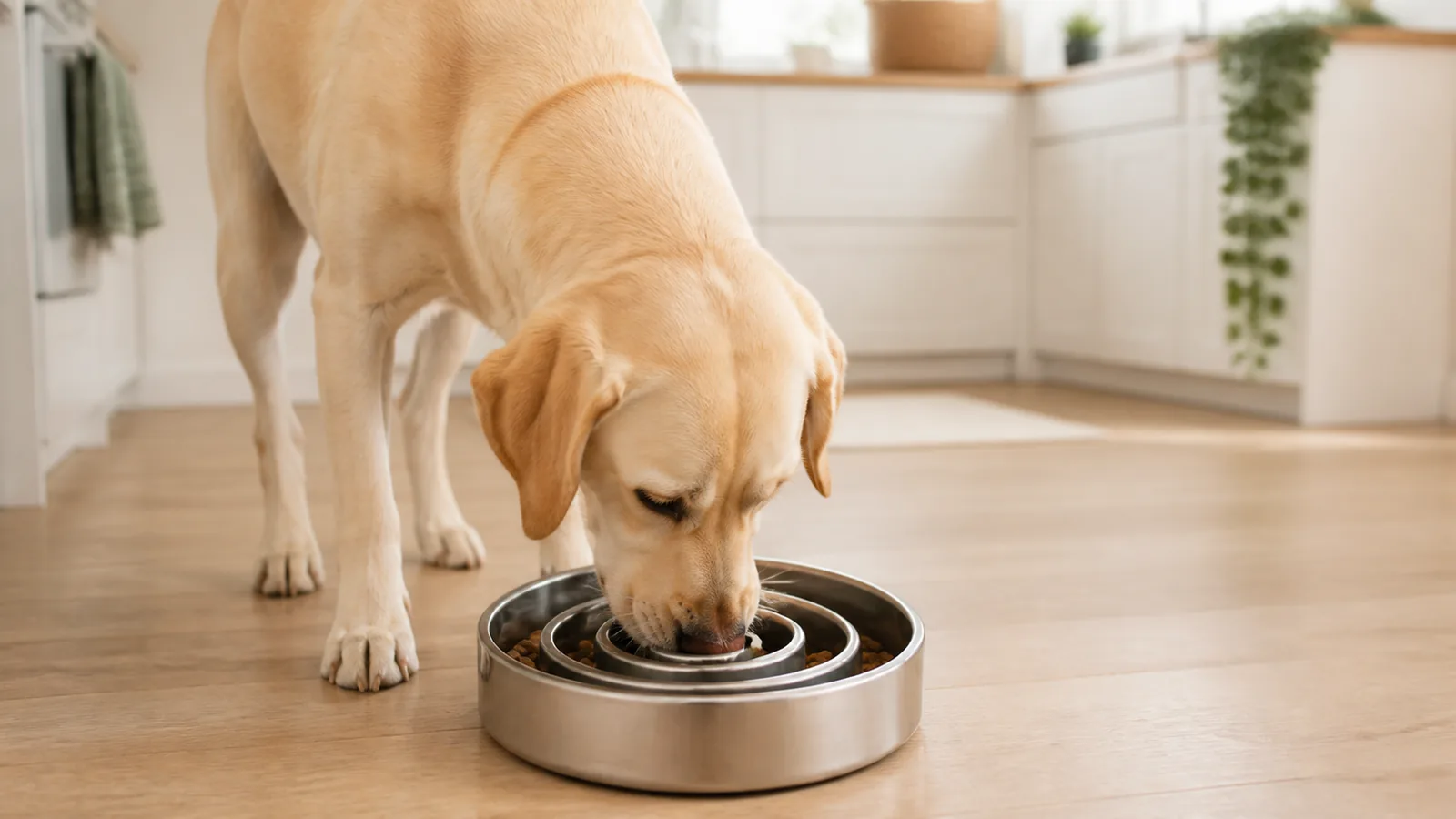
Are Slow Feeder Bowls Good for Dogs?
Slow feeder bowls are good for most healthy dogs that eat fast: they are a low-risk way to cut gulping and add a little mental work to meals. They are a poor fit for dogs that are underweight, unwell, in dental pain or easily frustrated, and the wrong material or maze depth creates its own problems.
So the honest answer is "yes, with conditions." This page is about those conditions — the benefits you can reasonably expect, the real risks, the dogs that shouldn't use one, and how to pick a material and fit that's safe for your particular dog.
Two related questions have their own pages. If you're new to these bowls and want the anatomy and types explained, start with what a slow feeder dog bowl is. If you want to know how well they slow eating and where they fall short, read do slow feeder dog bowls work.
What are slow feeder bowls actually good for?
Strip away the marketing and a slow feeder does one physical thing: it stops a dog taking huge open-mouthed scoops of food. Everything else follows from that.
- Less swallowed air. Big gulps carry air down with the food. Smaller mouthfuls mean less of it, which is why many owners see less burping and post-meal discomfort.
- Less "scarf and barf." Dogs that eat a whole meal in seconds sometimes bring it straight back up. Pacing the meal gives the stomach a fairer chance.
- Lower choking risk from bolted kibble. A dog picking pieces out of a channel isn't inhaling a mouthful.
- A few minutes of engagement. Working food out of a pattern is mild enrichment. It's not a puzzle toy, but it beats ten seconds at a flat bowl.
- Calmer mealtimes in multi-dog homes, as long as dogs are fed apart.
One claim needs more care than it usually gets: bloat. Eating fast has been associated with a higher risk of gastric dilatation-volvulus (GDV) in large and giant dogs, so slowing meals is a sensible precaution. But nobody has shown that a slow feeder bowl prevents bloat, and anyone who tells you it does is overselling. Treat it as one reasonable habit alongside the others your vet recommends for an at-risk dog, and learn the warning signs in our guide to dog bloat and GDV.
What are the risks and downsides of slow feeder bowls?
None of these are common with a well-chosen bowl, but all of them are real, and most "my dog hates the slow feeder" stories trace back to one.
Frustration. A maze that's too tight or too deep can turn dinner into a fight. Signs include barking at the bowl, pawing or flipping it, biting the ridges, or walking away from food. For a dog with any tendency to guard food, added frustration at mealtime is the last thing you want.
Under-eating. Some dogs simply give up and leave part of the meal. In a healthy, well-covered dog that's an annoyance. In a puppy, a senior, a thin dog or one recovering from illness, it matters.
Mouth and tooth wear. Dogs that attack hard ridges with their teeth, or scrape at them for a long time, can irritate their gums or lips. Owners occasionally report chipped teeth on very hard, sharp-edged designs. It isn't typical, but rounded ridges and a dog that licks rather than bites are what you're aiming for.
Nose and face rubbing. Flat-faced dogs pushing into narrow channels can rub their nose and the skin folds around it, and may struggle to breathe comfortably with their face pressed into a deep bowl.
Hygiene. More ridges mean more corners for food film to hide in. Scratched plastic is the worst for this, because the scratches hold residue a sponge can't reach. A bowl that isn't cleaned properly is a bowl growing things. (Our guide to cleaning a slow feeder bowl covers the routine.)
Chewing the bowl. Lightweight plastic and silicone bowls can be picked up, chewed and swallowed in pieces by determined dogs.
False reassurance. A slow feeder manages a behaviour. If the fast eating comes from a medical cause — parasites, a hormonal condition, a diet that isn't meeting the dog's needs — the bowl hides the symptom and fixes nothing.
Slow feeder pros and cons at a glance
| Pros | Cons | |
|---|---|---|
| Eating speed | Smaller mouthfuls, less gulped air | Too-hard mazes cause frustration or refusal |
| Digestion | Often less burping and regurgitation after meals | Won't fix gas or vomiting with a dietary or medical cause |
| Bloat | Slowing down is a reasonable precaution for at-risk dogs | No proof it prevents GDV; not a substitute for vet advice |
| Behaviour | Light daily enrichment | Can raise tension in dogs that guard food |
| Health edge cases | Fine for most healthy adults | Risky for thin, sick, very old or sore-mouthed dogs |
| Upkeep | Steel versions go in the dishwasher | Grooves need more cleaning than a flat bowl |
| Cost | Cheap, one-off purchase | Poor plastic ones need replacing as they scratch |
Which dogs should avoid a slow feeder bowl?
Speak to your vet before using one — or skip it — if your dog falls into any of these groups.
- Underweight dogs and poor eaters. If getting calories in is the goal, don't add obstacles.
- Dogs that are ill, nauseous or recovering from surgery. Appetite is fragile; make food easy.
- Dogs with dental disease, a sore mouth or recent dental work. Scraping at ridges hurts. Sort the mouth out first.
- Dogs with megaesophagus or other swallowing disorders. These dogs need specific feeding positions and food textures set by a vet. A standard slow feeder isn't the tool.
- Very young puppies. Tiny muzzles and tiny portions get lost in an adult-sized maze. Use a shallow, puppy-sized pattern, or wait.
- Frail seniors and dogs with poor vision or cognitive decline. If the maze confuses them or they tire before finishing, go back to an easy bowl or a very shallow pattern.
- Dogs with neck or back pain. Prolonged head-down eating can be uncomfortable; ask your vet about bowl height.
- Dogs with serious resource guarding. Work with a qualified behaviour professional before changing how food is delivered.
- Dogs that already eat at a sensible pace. There's no problem to solve. If you want the enrichment, a snuffle mat is the friendlier way to add it.
And one group that needs a specific kind of slow feeder, not avoidance: flat-faced breeds. They gulp a lot of air and often benefit from slower meals, but only with wide, shallow channels they can reach without jamming their face in. We go through that fit in detail in the best slow feeder for bulldogs.
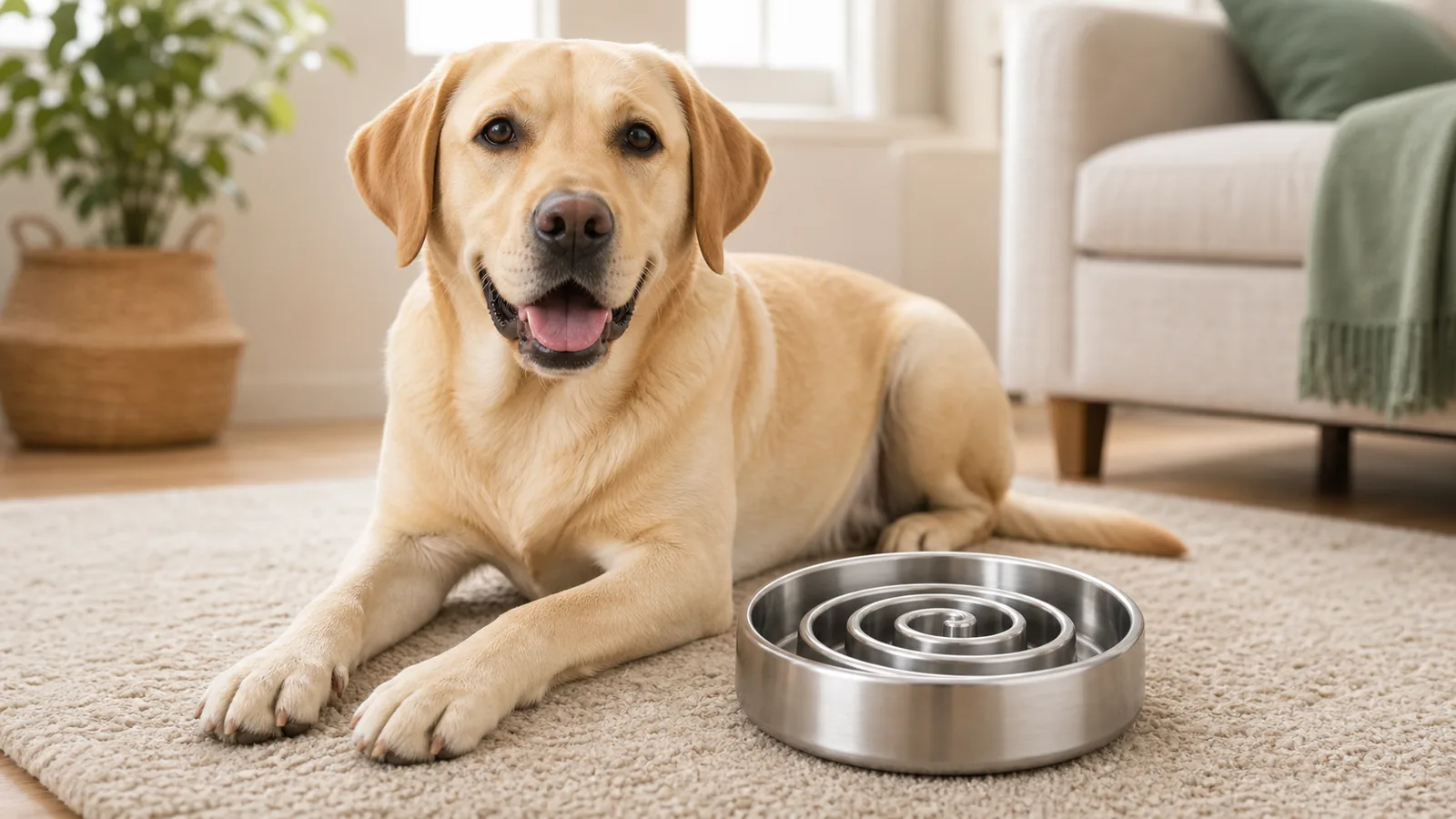
Which slow feeder material is safest?
Material decides hygiene, durability and whether the bowl itself becomes a hazard.
| Material | Safety & hygiene | Watch out for | Best for |
|---|---|---|---|
| Stainless steel | Non-porous, doesn't scratch easily, dishwasher-safe | Can be noisy; needs a non-slip base | Daily use, wet or raw food, chewers |
| Hard plastic | Fine when new | Scratches trap food residue; some dogs chew it; replace once scratched or cracked | Trying the concept cheaply |
| Silicone | Soft on mouths, flexible | Light enough to be carried off and chewed; holds grease and odours | Supervised use, travel |
| Ceramic | Heavy, smooth glaze | Chips and cracks; a chipped glaze harbours bacteria and has sharp edges | Calm dogs, careful households |
Our position is simple: for a bowl that touches food twice a day for years, food-grade stainless steel is the safest default. It's the reason we make a stainless steel slow feeder and not a plastic one. The full head-to-head is in stainless steel vs plastic slow feeders.
Whatever you buy, inspect it every so often. Deep scratches, cracks, chips, peeling rubber on the base or bite marks all mean it's time to replace it.
How do you choose a slow feeder that fits your dog?
A safe slow feeder is one your dog can use without strain. Check four things.
- Channel width versus muzzle. Your dog's nose and tongue should reach the bottom of every channel. Narrow-muzzled dogs cope with tighter patterns; broad or flat faces need wide, open ones.
- Depth. Shallow ridges suit puppies, small dogs, flat-faced dogs and beginners. Deep mazes are for long-muzzled, experienced gulpers.
- Capacity. The full meal should fit below the top of the ridges. If food is heaped over the pattern, the first half of the meal isn't being slowed at all.
- Stability. A non-slip base or enough weight that the bowl can't be shoved across the floor or flipped.
Also consider the food. Dry kibble works in almost any pattern. Wet and raw food smear into tight corners, so choose wider channels and a material that washes easily.
How do you introduce a slow feeder safely?
- Start easy. For the first few meals, put only part of the ration in the slow feeder and the rest in the usual bowl, or scatter some food on top of the ridges where it's simple to reach.
- Watch the first week of meals. You're looking for licking and nudging, not biting, pawing or flipping.
- Time it. A meal that now takes a few minutes is a good result. If it takes so long your dog quits, the pattern is too hard.
- Check the bowl is empty and check your dog's weight over the following weeks. A dog quietly leaving food will lose condition.
- Feed dogs separately. A slow feeder next to a rival dog just adds pressure.
- Wash it after every meal.
Stop and rethink if you see gum bleeding, a sore nose, repeated refusal to eat, growling over the bowl, or weight loss.
The bottom line
Slow feeder bowls are a good idea for a healthy dog that eats too fast, provided the bowl suits that dog: the right depth, wide enough channels, a material that stays clean, and an owner who watches the first few meals. They're the wrong idea for dogs who need every calorie, have sore mouths or get wound up by obstacles — and they're never a replacement for a vet when fast eating comes with vomiting, weight change or a swollen belly.
👉 See the Stainless Steel Slow Feeder Dog Bowl →
See how the main types compare in our best slow feeder dog bowls guide.
Frequently Asked Questions
Are slow feeder bowls good for all dogs? No. They suit most healthy dogs that eat quickly, but they are not a good choice for underweight dogs, poor eaters, dogs that are ill or have a sore mouth, and dogs that become frustrated or guard food. Dogs that already eat calmly do not need one.
Can a slow feeder bowl hurt my dog's teeth or gums? It is uncommon, but dogs that bite or scrape at hard, sharp-edged ridges can irritate their gums and, occasionally, damage a tooth. Choose a bowl with smooth, rounded ridges, make sure the pattern is not too difficult, and stop using it if you notice bleeding or soreness.
Do vets recommend slow feeder bowls? Slow feeders are widely suggested for dogs that gulp their food, regurgitate after eating or are at higher risk of bloat. Advice still depends on the individual dog, so ask your own vet if your dog has a health condition, is underweight or has dental problems.
Do slow feeder bowls prevent bloat? They are not proven to prevent bloat. Eating fast has been associated with a higher risk of GDV in large and giant dogs, so slowing meals is a sensible precaution, but it is only one factor. Know the emergency signs and follow your vet's advice for an at-risk dog.
What is the safest material for a slow feeder bowl? Food-grade stainless steel is the safest everyday choice because it is non-porous, resists scratching and can be washed at high temperatures. Plastic is fine when new but should be replaced once scratched, and ceramic should be thrown out if it chips or cracks.
Should puppies use a slow feeder bowl? Puppies that bolt their food can use one, as long as it is shallow, sized for a small muzzle and holds a puppy-sized portion. Avoid deep adult mazes, supervise meals and make sure your puppy finishes the whole ration, because growing dogs cannot afford to under-eat.
What should I do if my dog gets frustrated with a slow feeder? Make it easier. Scatter food on top of the ridges, split the meal between the slow feeder and a normal bowl, or switch to a shallower pattern. If your dog still refuses, bites the bowl or guards it, try a snuffle mat or scatter feeding instead.
Save this guide