Best Slow Feeder for Bulldogs & French Bulldogs
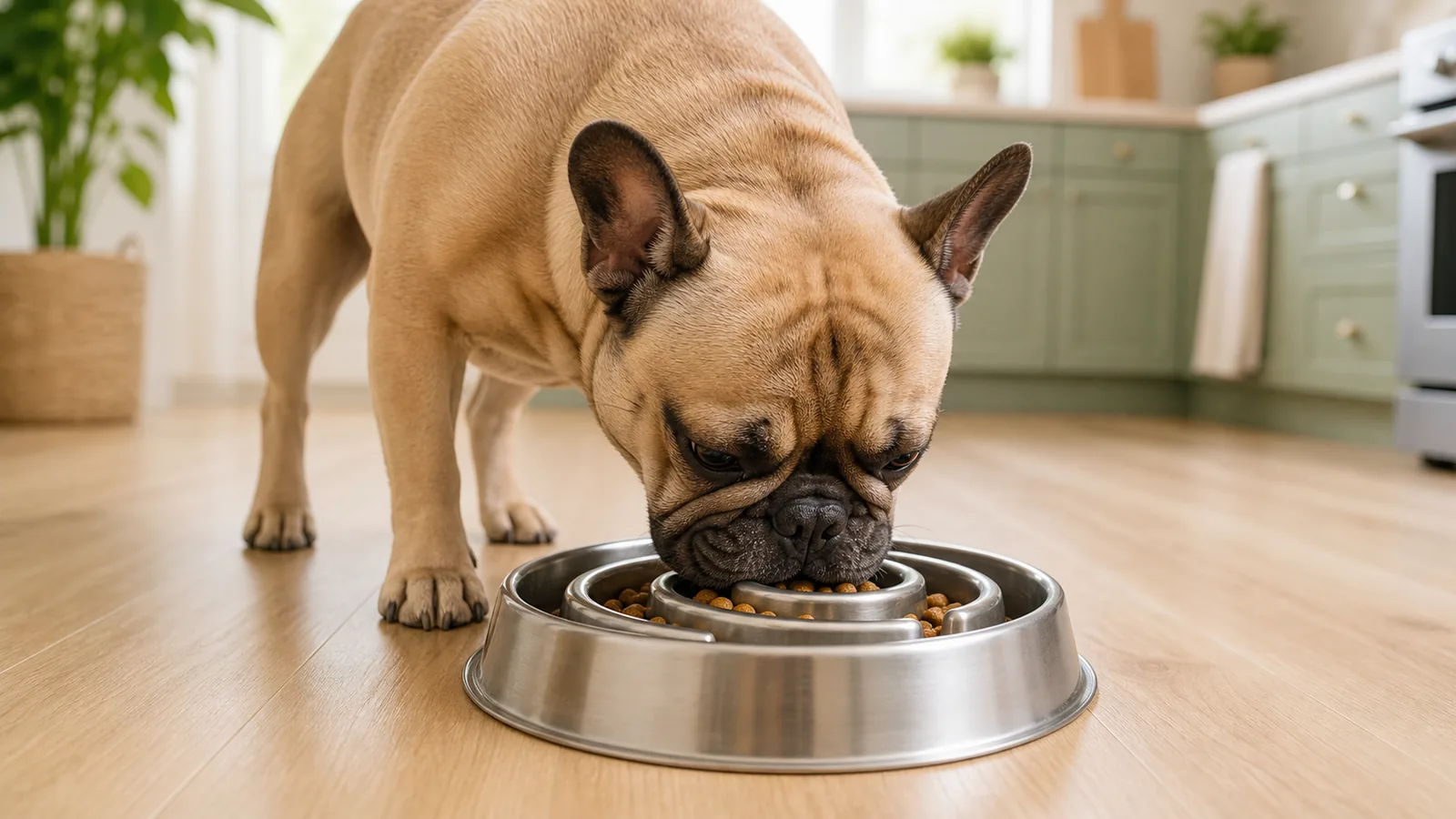
The best slow feeder for Bulldogs and French Bulldogs has wide, shallow channels with low, rounded ridges, a broad opening, and a heavy non-slip base. A flat face can't reach into a deep, narrow maze, and a bowl that makes a Bulldog hold its breath to eat does more harm than good.
That second point is what makes this breed group different. For most dogs, a harder maze just means a slower meal. For a brachycephalic dog — English Bulldog, Frenchie, Pug, Boston Terrier — the nose and mouth are doing two jobs at once, and many of these dogs already work to breathe. The right bowl slows the eating without making the breathing harder.
This guide covers the anatomy behind that, how to check a bowl fits a flat face, how to set meals up, and the signs that mean vet, not bowl. For a comparison of bowl types across all dogs, see best slow feeder dog bowls.
Why do Bulldogs and Frenchies struggle at mealtimes?
A flat-faced dog has the same amount of soft tissue as a long-nosed dog, packed into a much shorter skull. The result is often narrowed nostrils, a long soft palate, and a crowded throat, known together as brachycephalic obstructive airway syndrome (BOAS). It varies a lot: some dogs are mildly affected, others struggle daily.
At the bowl, this shows up in a few ways:
- They can't easily breathe and eat at once. With the face buried in food, the nostrils are partly blocked, so the dog gulps, lifts its head to gasp, and gulps again.
- They swallow a lot of air. Mouth-breathing and snatching at food mean air goes down with it. That's widely thought to be part of why these breeds are so gassy.
- They pick food up with difficulty. An undershot jaw and a wide, flat muzzle are poor tools for collecting kibble. Many Bulldogs shovel food with the lower jaw and scatter half of it.
- Regurgitation and reflux are common. Veterinary studies of dogs with BOAS report digestive signs, such as regurgitation, vomiting, and reflux, in a large proportion of them. The airway and gut problems appear to be linked, each making the other worse.
So a Bulldog that eats fast isn't only being greedy. It may be trying to get the job over with between breaths.
What makes a slow feeder suitable for a flat face?
| Feature | Look for | Avoid | Why |
|---|---|---|---|
| Channel width | Wide enough for the whole muzzle front | Narrow slots and tight spirals | A flat face can't fit into a slot built for a long nose |
| Ridge height | Low, rounded | Tall walls | The dog must reach food without pressing its nostrils into the bowl |
| Overall depth | Shallow, dish-like | Deep bucket shapes | Deep bowls block airflow and press on the throat |
| Opening | Broad | Narrow rim | Bulldogs have wide heads; Frenchies have wide jaws |
| Base | Heavy, non-slip | Light bowls on bare floor | Bulldogs push hard with their chest and face |
| Difficulty | Easy to moderate | "Expert" mazes | The aim is steadier eating, not a workout |
| Material | Smooth, non-porous, washable | Rough or scratched surfaces | Facial folds and chins sit in the food |
Size differs across the group. An adult English Bulldog is commonly 40–50 lb with a very wide head; a French Bulldog is typically under 28 lb with a smaller but still broad muzzle; a Pug is smaller again. An English Bulldog needs a wider bowl than its meal size alone would suggest, simply so its head fits.
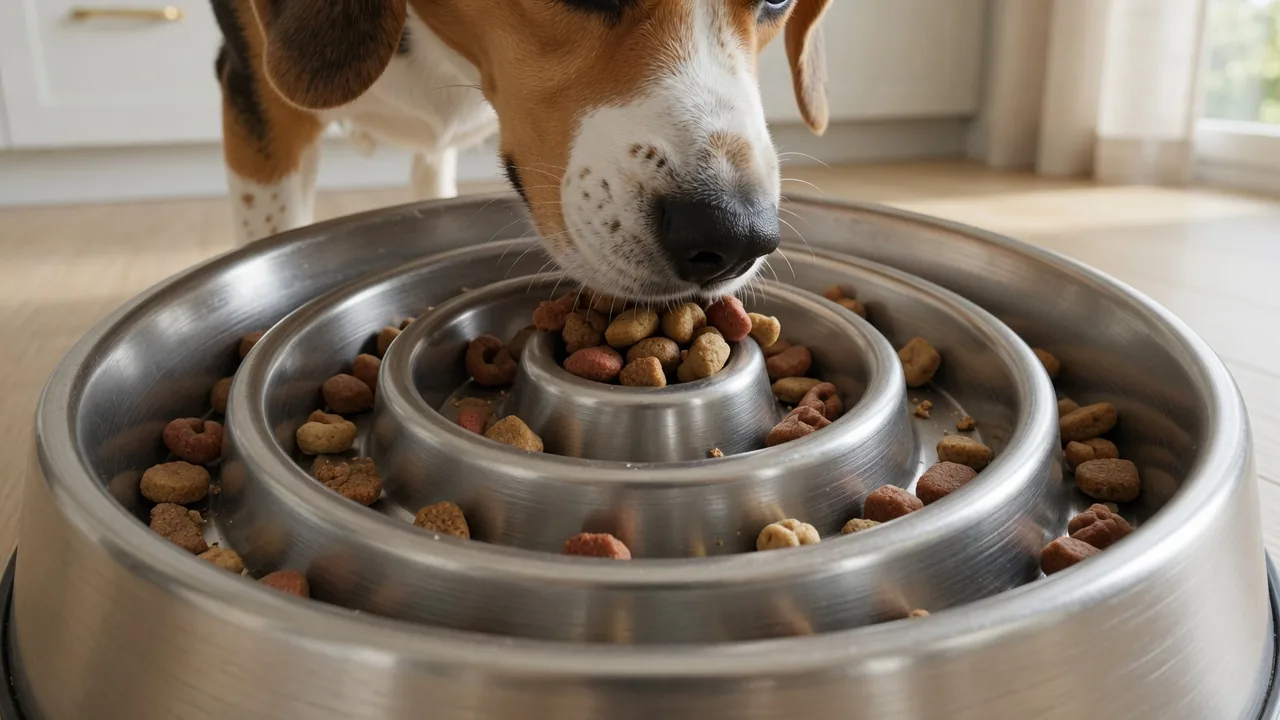
Our stainless steel slow feeder dog bowl has a raised maze and a non-slip base, and steel is easy to keep clean. Before buying any maze bowl for a flat-faced dog, ours included, compare the channel width in the photos and dimensions with your dog's muzzle, and run the fit check below at the first meal.
How can you tell if the bowl fits your dog?
Watch the first two or three meals closely. A bowl that fits looks like this: the dog eats steadily, breathes through the meal, reaches every part of the pattern, and walks away relaxed.
Signs it's too difficult or the wrong shape:
- Louder snorting or gasping than at a normal bowl
- Lifting the head repeatedly to catch breath
- Pawing, flipping, or barking at the bowl
- Food left stranded in channels the dog can't reach
- Gagging, or bringing food back up afterwards
- A red, rubbed nose or chin
- Giving up before the meal is finished
If you see these, don't wait for the dog to "get used to it." Switch to something shallower and more open. A slower meal is the goal; a struggle isn't.
Should Bulldogs use a tilted or raised bowl?
Tilted bowls, angled at around 15 degrees or so, are marketed heavily at flat-faced breeds. The logic is reasonable: the food slides towards the front, so the dog doesn't have to press its face flat into the base. Plenty of owners find their dogs eat more comfortably from one. There's little formal research on them, so treat it as a comfort preference worth trying, not a medical fix.
Raised feeding is a different matter. Some specialist BOAS clinics advise feeding dogs with reflux or regurgitation with the front feet higher than the back, so gravity helps food stay down. If your dog regurgitates, ask your vet whether that would help and how high to go, because it's advice for a medical problem, not a general rule. Raised bowls have their own debate in large breeds, which we cover in raised bowl vs slow feeder.
Is a slow feeder always the best choice for a flat-faced dog?
No, and for the flattest faces it may not be the first thing to try.
- Lick mats work well for wet or softened food. They're completely flat, so nothing blocks the nose. Our lick mats for dogs guide explains how to use one.
- A snuffle mat suits dry kibble and many Frenchies love it. Use a low-pile, loosely packed mat, and watch at first: a dog that buries its face deep in fleece is in the same position as one in a deep bowl. Keep sessions short and supervised.
- Scatter feeding on a clean floor or a baking tray costs nothing and keeps the airway clear.
- A wide, shallow slow feeder is the tidy everyday option for kibble once you know your dog manages the pattern comfortably.
Many owners end up alternating: a shallow slow feeder for breakfast, a mat for dinner. Broader methods are in how to stop your dog eating too fast.
How should you set up meals for a Bulldog or Frenchie?
The bowl is one part of it. These habits matter as much:
- Feed smaller meals, more often. Three or four small meals instead of one or two large ones is standard advice for flat-faced dogs with reflux or regurgitation, and it reduces urgency for the rest.
- Feed when the dog is calm and cool. Not straight after a walk, play, or excitement, when it's still panting. Give it time to settle first.
- Keep the room cool. These breeds overheat easily, and a hot, panting dog eats badly.
- Feed separately from other pets. Competition speeds every dog up.
- Consider texture. Some flat-faced dogs manage a slightly softened or smaller-kibble food more easily. Ask your vet before changing diet, especially if there are digestive signs.
- Keep things quiet for a while afterwards. A rest after eating gives food the best chance of staying down.
- Hold a healthy weight. Extra weight makes brachycephalic breathing worse; keeping these dogs lean is one of the most useful things an owner can do. Measure food and count treats.
How do you keep the bowl and the face clean?
A Bulldog eats with its whole face. Food and moisture end up in the nose rope, lip folds, and chin, and damp folds are prone to irritation and infection.
- Wash the bowl after every meal with hot soapy water or in the dishwasher. A smooth, non-porous bowl makes this far easier; the differences are in stainless steel vs plastic slow feeders.
- Wipe the folds and chin after eating with a soft damp cloth, then dry them properly. Drying matters as much as wiping.
- Check the chin. Bumps or spots on the chin are common in these breeds. Clean bowls and a clean, dry chin are sensible first steps; persistent or sore spots need a vet.
- Replace anything scratched or rough that could rub the skin.
When should you see a vet?
Noisy eating is so normal in these breeds that real problems get missed. Talk to your vet if your dog:
- Regurgitates or vomits regularly, or brings up white foam
- Gags, retches, or chokes during most meals
- Snores or snorts heavily at rest, tires quickly, or struggles in mild heat
- Seems to have trouble swallowing
- Coughs after eating or drinking, or has a wet-sounding cough (food or fluid going the wrong way can cause a chest infection)
- Is losing weight or avoiding food
These can be signs of BOAS and related digestive problems, which are treatable, sometimes with medication and sometimes with surgery. A bowl can make meals easier, but it can't correct anatomy.
Go to an emergency vet immediately if your dog has laboured breathing that doesn't settle, blue or grey gums or tongue, collapses, is choking, or shows signs of overheating. For general guidance on which dogs slow feeders suit and which should avoid them, see are slow feeder bowls good for dogs.
Frequently Asked Questions
What is the best slow feeder for a French Bulldog? A shallow bowl with wide channels and low, rounded ridges, a broad opening, and a non-slip base, in a smooth material such as stainless steel. Avoid deep, narrow mazes made for long-nosed dogs. Your Frenchie should be able to reach all the food while breathing comfortably.
Are slow feeders safe for Bulldogs? Yes, if the design suits a flat face. A wide, shallow pattern is safe for most Bulldogs. A deep or complicated maze can force the dog to bury its nose and struggle for breath. Watch the first few meals and switch to an easier bowl if breathing gets noisier.
Why does my Bulldog gulp its food? Partly appetite, partly anatomy. Flat-faced dogs find it hard to breathe with their face in a bowl, so they snatch food between breaths and swallow air with it. Smaller, more frequent meals, a calm setting, and a shallow slow feeder or flat mat usually help.
Do slow feeders reduce gas in Bulldogs? They may. Swallowed air is thought to contribute to the gas these breeds are known for, and eating more steadily can reduce it. Diet plays a large part too, so persistent or foul gas, especially with loose stools, is worth discussing with your vet.
Is a tilted bowl better for a Bulldog? Many owners find flat-faced dogs eat more comfortably from a tilted bowl, because food slides forward and the dog doesn't press its face into the base. There's little formal research, so it's a comfort choice worth trying, not a treatment.
Can French Bulldogs use a snuffle mat? Yes, with some care. Choose a low-pile, loosely packed mat, scatter kibble near the surface, and supervise, since burying a flat face deep in fabric restricts breathing in the same way a deep bowl does. Keep sessions short at first.
Why does my Frenchie throw up after eating? Regurgitation and reflux are common in flat-faced breeds and are linked to their airway anatomy, and eating too fast can add to it. Occasional episodes may improve with smaller, slower meals. Regular regurgitation or vomiting needs a vet, because it is treatable and can lead to chest infections.