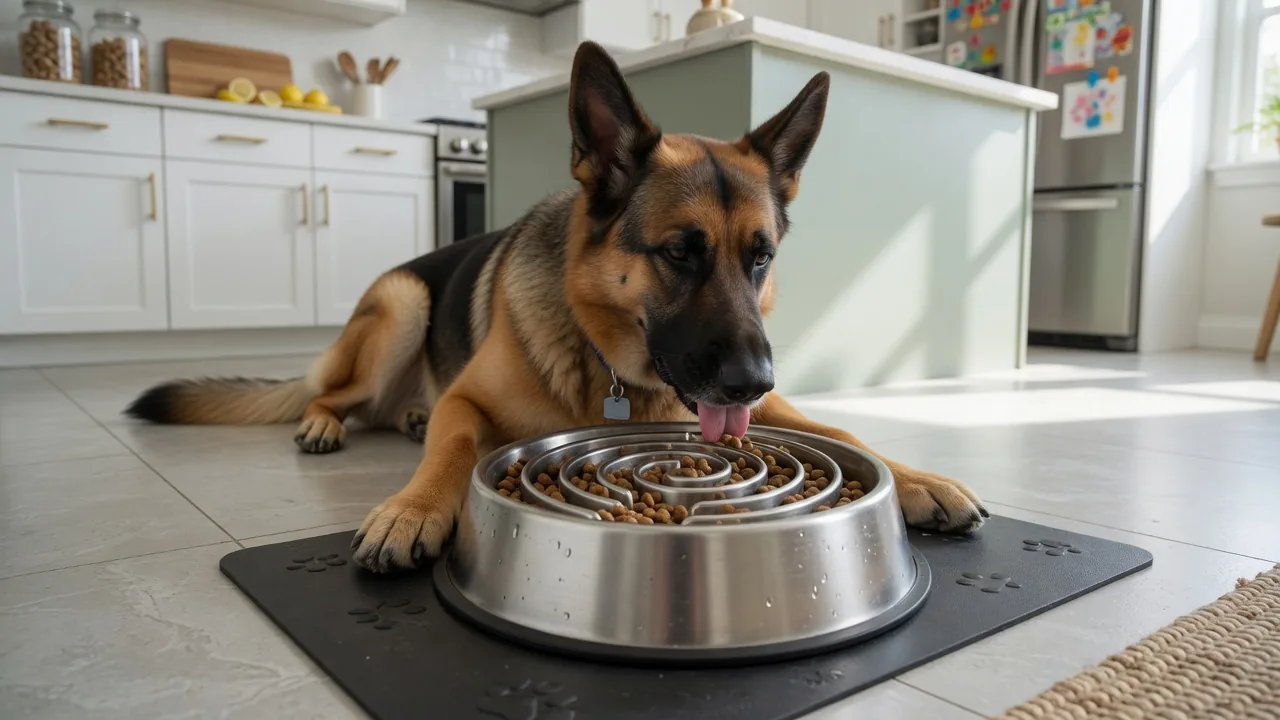
Best Slow Feeder for German Shepherds
A good slow feeder for a German Shepherd is a large, stable bowl that holds the whole meal inside the maze (often around 1.5 to 2.5 cups for an adult, depending on the food), with channels wide enough for a long muzzle and a non-slip base, used at floor level unless your vet advises otherwise. It slows gulping, which is one known bloat risk factor. It does not prevent bloat on its own, and a bowl is only the right answer if your dog is a fast eater without a medical cause.
Most people shopping for a slow feeder for a German Shepherd are thinking about bloat, and they're right to. But the bowl also has to fit the actual dog: a 50–90 lb animal with a long, narrow muzzle, a famously touchy digestive system, and a habit of taking mealtimes very seriously. This guide covers what the bowl should look like, how to set it up, what to feed in it, and where its usefulness ends.
Why do German Shepherds need to eat slowly?
Three breed traits make eating speed matter more for a Shepherd than for the average dog.
A deep, narrow chest. German Shepherds are one of the breeds consistently listed as higher-risk for gastric dilatation-volvulus (GDV, or bloat), where the stomach fills with gas and can twist. Research on large and giant breeds from Purdue University identified eating rapidly as one of several feeding-related risk factors, alongside one large meal a day, a large volume per meal, and eating from a raised bowl. Age and having a close relative who bloated matter too. So speed is a real factor, and also only one of several.
A sensitive gut. Shepherds have a reputation among vets and owners for loose stools, gas and food intolerances. A dog that swallows kibble whole along with a lot of air is more likely to burp, regurgitate or have an unsettled stomach afterwards.
Drive. This is a working breed that does everything at full intensity, eating included. Many Shepherds aren't greedy so much as efficient: food appears, food is dealt with.
A slow feeder addresses the first two by reducing mouthful size and swallowed air. For many dogs it stretches a meal of under a minute to several minutes, though results vary by dog and bowl. For the full picture on symptoms and emergency signs, read our dedicated guide to dog bloat (GDV) symptoms and prevention — every Shepherd owner should know those signs by heart.
What size slow feeder does a German Shepherd need?
The AKC breed standard puts males at 24–26 inches at the shoulder and females at 22–24 inches. Typical adult weights run about 65–90 lb for males and 50–70 lb for females. That's a large dog, though not a giant one, and the bowl should match.
| Dog | Typical weight | Rough kibble per meal (2 meals/day) | Bowl capacity to look for |
|---|---|---|---|
| Puppy, 3–6 months | 20–50 lb | ¾–1½ cups (3 meals/day) | Medium, shallow maze |
| Adolescent, 6–18 months | 50–75 lb | 1½–2½ cups | Large, moderate maze |
| Adult female | 50–70 lb | 1¼–2 cups | Large (holds 2+ cups in the maze) |
| Adult male | 65–90 lb | 1½–2½ cups | Large to extra-large |
| Senior | varies | 1¼–2 cups | Large, shallower maze |
These portions are rough ranges for typical dry food. Calorie density varies widely between brands, so use the feeding guide on your own food and your vet's advice on body condition; our guide to how much to feed your dog explains how to adjust.
The practical rule: the whole meal should sit inside the maze channels, not heaped on top of the ridges. If kibble is piled above the pattern, the first half of the meal gets gulped exactly as before. If your Shepherd's portion doesn't fit, either go up a bowl size or split the meal into two servings ten minutes apart.
What maze design fits a Shepherd's long muzzle?
German Shepherds have a long, fairly narrow muzzle, which changes what works.
- Wide channels beat tight ones. Aim for channels wide enough to fit the front of the muzzle, roughly two fingers across. Very narrow slots designed for small dogs force a Shepherd to scrape with their teeth and tongue, and that's where frustration and bowl-flipping come from.
- Moderate depth, not extreme. A long muzzle can usually reach further into a channel than a short one, so a very shallow pattern may barely slow a Shepherd. Aim for ridges the dog has to work around without jamming the muzzle against them; if kibble gets stranded out of reach, the pattern is too deep.
- Smooth, rounded ridges. Shepherds eat with force. Sharp plastic edges can rub the nose and gums. Rounded, pressed-steel ridges are kinder.
- A heavy base with real grip. A 75 lb dog leaning into a bowl will push a light one across the room. Weight plus a rubber ring matters more here than on almost any other feature.
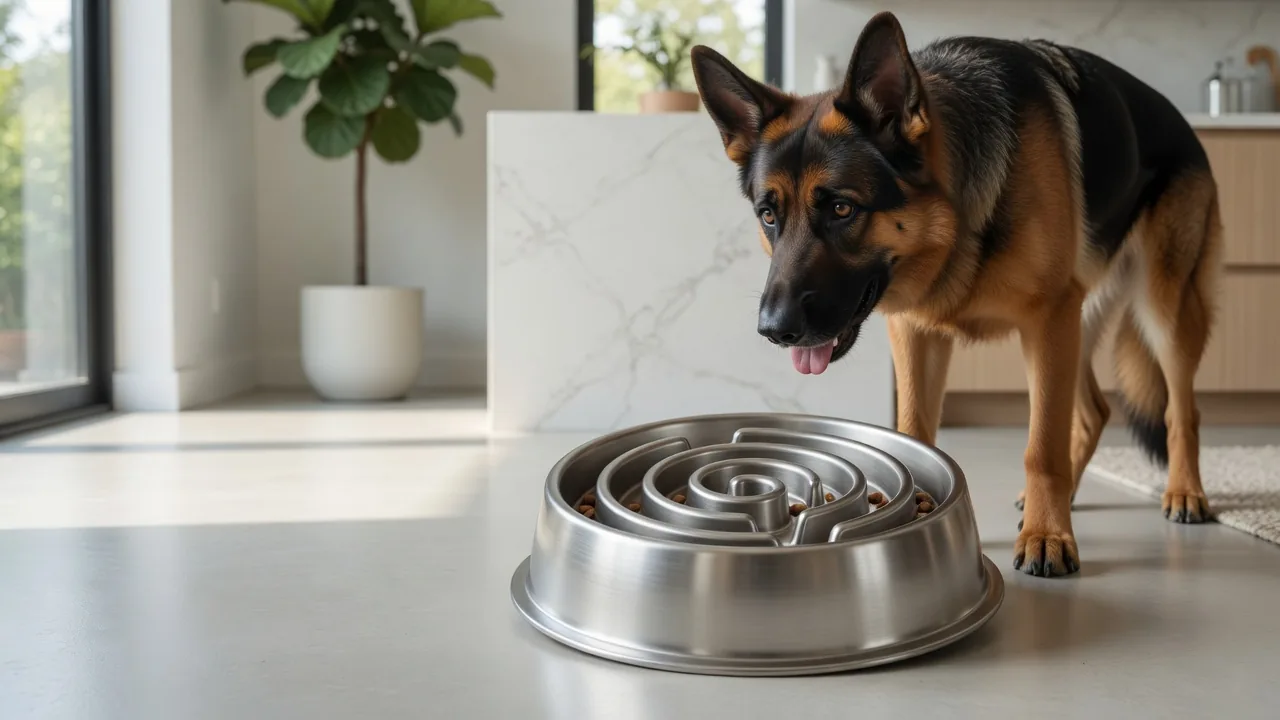
Our Stainless Steel Slow Feeder Dog Bowl is a raised-maze steel bowl with a non-slip base that is listed as dishwasher-safe. We have not published its capacity or ridge depth, so we can't tell you it holds a 2-cup Shepherd meal: check the dimensions on the retailer listing against your dog's portion before you buy, and treat a bowl that can't hold the meal inside the pattern as too small. If you're comparing bowls purely by size class rather than breed, see our best slow feeders for large dogs.
Should a German Shepherd's slow feeder be raised or on the floor?
On the floor, unless your vet has told you otherwise.
Raised feeders were recommended for years as a bloat precaution. Then the Purdue research found the opposite association in large and giant breeds: dogs fed from raised bowls had a higher rate of GDV. The evidence isn't perfect, and it's one study population, but nothing since has shown raised bowls to be protective. For a breed already on the higher-risk list, floor level is the cautious default. We go through the research properly in raised dog bowls and bloat risk.
There's one honest complication with Shepherds. The breed is prone to hip dysplasia, arthritis and, in older dogs, degenerative myelopathy, all of which can make lowering the head and bracing on the back legs uncomfortable. If your older Shepherd is visibly struggling to eat from the floor, that's a conversation with your vet about the trade-off for your particular dog, not something to decide from a blog post. A small lift of a few inches and a non-slip mat for the paws is often the compromise.
How should you set up mealtimes around the bowl?
The bowl is one part. The routine around it does as much work.
- Feed at least two meals a day. One big daily meal is a recognised risk factor. Two or three smaller ones are easier on the stomach.
- Keep exercise and meals apart. A common vet guideline is to avoid hard exercise for about an hour before and one to two hours after eating. Calm walking is fine.
- Don't restrict water, but watch for tanking. Fresh water should always be available. If your Shepherd drains the bowl in one go after eating, offer smaller amounts more often; see what to do when a dog drinks water too fast.
- Feed in a calm spot. A Shepherd on guard duty at the front door, or eating next to another dog, eats faster. A quiet corner helps. Feed multiple dogs in separate rooms.
- Use meals for training. A handful of the portion can be hand-fed for a sit, down or wait. Shepherds love a job, and it takes the edge off the main bowl.
- Wash the bowl after every meal. Food residue in maze channels turns quickly, and a sensitive-stomach breed doesn't need the extra bacteria. A dishwasher cycle or hot soapy water and a brush is enough.
Can a slow feeder prevent bloat in a German Shepherd?
No, and anyone who tells you it can is selling something. Including us, if we said it.
A slow feeder reduces one risk factor: eating speed. It does nothing about chest shape, genetics, age or temperament. Dogs who eat slowly from floor-level bowls still get GDV. What the bowl gives you is a cheap, sensible reduction in one contributor, and fewer everyday problems like regurgitation and gas.
If you want to talk about real prevention, ask your vet about prophylactic gastropexy, a surgery that tacks the stomach to the body wall so it can't twist. It's often done at the same time as spay or neuter in high-risk breeds. It doesn't stop the stomach filling with gas, but it greatly reduces the chance of the life-threatening twist. Whether it's right for your dog depends on family history and your vet's judgement.
Emergency signs, briefly: a tight, swollen belly, retching with nothing coming up, drooling, pacing and obvious distress. That's an immediate trip to an emergency vet, any hour. Don't wait to see if it passes.
When is a fast-eating Shepherd a vet problem, not a bowl problem?
German Shepherds are the breed most associated with exocrine pancreatic insufficiency (EPI), where the pancreas doesn't produce enough digestive enzymes. The classic picture is a dog who is ravenous all the time and eats frantically, yet loses weight, with large, pale, greasy stools. A slow feeder will not help that dog. Enzyme supplements prescribed by a vet will.
Book a vet visit if your Shepherd:
- eats desperately but is thin or losing weight
- has ongoing loose, bulky or pale stools
- regurgitates undigested food regularly, even when eating slowly (the breed is also over-represented in megaesophagus)
- has suddenly become much hungrier than normal
- vomits repeatedly or seems painful after meals
Speed that comes with a healthy weight, normal stools and a bright dog is behaviour. Speed that comes with weight loss is a symptom.
The bottom line
If your German Shepherd gulps, a large steel or other stable slow feeder with wide channels, moderate depth and a grippy base is a reasonable tool, after you have ruled out a medical cause. Put it on the floor, split the food into at least two meals, keep exercise away from mealtimes, and learn the signs of bloat. That combination is a meaningful, low-cost precaution. It isn't a guarantee, and a dog who's starving-hungry and thin needs a vet, not a maze.
👉 See the Stainless Steel Slow Feeder Dog Bowl →
Frequently Asked Questions
Can a slow feeder prevent bloat in German Shepherds? No. A slow feeder reduces one risk factor, eating speed, but bloat (GDV) is also linked to chest shape, genetics, age and meal size. Dogs that eat slowly can still bloat. Treat the bowl as one sensible precaution and ask your vet about your dog's overall risk, including preventive gastropexy.
What size slow feeder does a German Shepherd need? A large bowl that holds the whole meal inside the maze channels, usually 2 cups or more for an adult. If kibble is heaped above the ridges, the bowl is too small and your dog will gulp the top layer. Large males on big portions may need an extra-large bowl.
Should I raise my German Shepherd's slow feeder bowl? Floor level is the cautious default. Research on large and giant breeds found raised bowls were associated with a higher rate of bloat, not a lower one. If an older Shepherd with hip or spine problems struggles to eat from the floor, ask your vet about a modest lift.
How long should a German Shepherd take to eat a meal? With a slow feeder, most take roughly five to ten minutes for a kibble meal. Under a minute from a plain bowl is gulping. If your Shepherd gives up, or takes much longer than 20 minutes and seems frustrated, the maze may be too tight or too deep for their muzzle.
Why is my German Shepherd always starving and eating frantically? Often it's just a driven, food-keen dog. But German Shepherds are prone to exocrine pancreatic insufficiency, which causes ravenous hunger with weight loss and large, pale stools. If frantic eating comes with a thin body or ongoing loose stools, see your vet for testing.
Is stainless steel or plastic better for a German Shepherd's slow feeder? Stainless steel is a sensible choice for a strong, sensitive-stomached dog. Steel bowls are often heavier than plastic ones, which helps them stay put, doesn't scratch into grooves that hold bacteria, and survives a strong dog's teeth. That matters for a breed known for sensitive digestion. Plastic is lighter and cheaper but scratches and gets chewed.
Can a German Shepherd puppy use a slow feeder? Yes, once they're eating solid food confidently, with a shallower maze sized for their portion. Shepherd puppies grow fast, so expect to move up a bowl size by around six months. Keep puppy meals to three a day until your vet suggests dropping to two.