How Much Should I Feed My Dog?
Most adult dogs eat somewhere between ¼ cup and 4½+ cups of dry food a day, depending on size, activity and the food's calorie density. The reliable method is calories: estimate your dog's daily need, check your food's kcal per cup, and adjust every few weeks by body condition. Your vet sets the final number.
Portion advice online usually stops at a weight chart. Charts are fine as a sanity check, but they can't know that your food has 330 kcal per cup and your neighbour's has 440. This guide gives you rough cup ranges, then the calorie method that actually adapts to your dog, and finally how to tell, from the dog itself, whether the amount is right. For puppies, use the puppy feeding schedule; for dogs past middle age, see the senior dog feeding guide.
Why does the label amount differ between foods?
Foods are packed with different amounts of energy per cup. Fat-rich or high-protein recipes and small, dense kibble can pack far more calories into the same cup than a light, bulky diet. The same 40 lb dog may need noticeably different cup counts on two bags that both say "adult".
The rest depends on the dog:
- Body weight and condition. A lean dog and an overweight dog of the same weight need different amounts.
- Age. Growing puppies need more per pound than adults; many seniors need less.
- Activity. A dog that runs daily needs more than a mostly indoor one.
- Neutering. Many dogs need fewer calories after spaying or neutering.
- Breed and individual metabolism. Two dogs the same size can differ by a lot.
- Health conditions. Some need a vet-set plan.
The feeding chart on the bag is a starting point written for an average dog. Your dog is not average.
What are typical portion ranges by size?
For healthy adult dogs on a standard dry food, daily totals are roughly:
| Dog size | Weight | Typical dry food per day |
|---|---|---|
| Small | under 20 lb | about ¼-1 cup |
| Medium | 20-50 lb | about 1-2¾ cups |
| Large | 50-90 lb | about 2¾-4½ cups |
| Giant | 90 lb+ | often 4½ cups or more |
These are ballparks, and the spread is wide because foods vary. Use them to catch an obvious mistake, such as a bag recommending double what you'd expect, then switch to the calorie method below. Split the total across meals: two for most adults.
How do I calculate my dog's calories?
Veterinary nutrition uses two steps.
Step 1: resting energy requirement (RER). The common estimate is 70 × (body weight in kg)^0.75 kcal per day. Convert pounds to kilograms by dividing by 2.2.
Step 2: multiply by a life-stage factor. Typical factors used in veterinary references:
| Situation | Approx. multiplier |
|---|---|
| Neutered adult, typical activity | about 1.6 |
| Intact adult | about 1.8 |
| Weight-loss plan | about 1.0 × ideal weight RER (vet-led) |
| Very active or working | higher, vet-guided |
Example results for a neutered adult at about 1.6 × RER (rounded):
| Weight | RER | Approx. daily kcal |
|---|---|---|
| 10 kg (22 lb) | ~394 | ~630 |
| 20 kg (44 lb) | ~662 | ~1,060 |
| 30 kg (66 lb) | ~897 | ~1,435 |
| 40 kg (88 lb) | ~1,113 | ~1,780 |
These are starting estimates, and real dogs vary widely around them, sometimes by 20-30% either way. Treat the result as a first guess to test, not a prescription. Then convert: daily kcal ÷ kcal per cup of your food = cups per day. The kcal per cup is printed on the bag, usually in the calorie statement, often as "kcal/kg" and "kcal/cup". If only kcal/kg is listed, ask the manufacturer or use a kitchen scale and feed by grams.
Should I measure by cup or by weight?
A kitchen scale is more accurate than a scoop. Depending on how you scoop and how kibble settles, a "cup" of the same food can vary noticeably, and a small error repeated daily compounds into slow weight change. Weigh a typical measure once, write the gram weight on the container, and use it. Wet and fresh foods are usually fed by weight anyway.
How do treats and extras count?
A common guideline is that treats and extras should make up no more than about 10% of daily calories. Chews, training rewards, lick-mat toppings, a spoonful of wet food and dental chews all count. If your dog gets a lot of treats, take that amount out of the bowl, not on top of it. See dog food toppers for how to add extras sensibly, and note that food in a snuffle mat or puzzle should come from the meal allowance.
How do I know the amount is right?
The dog gives better data than any chart. Check these every two weeks:
- Ribs. You should feel them easily under a thin covering of fat, without having to press.
- Waist. From above, there should be an hourglass tuck behind the ribs.
- Side view. The belly line should rise toward the hind legs.
- Weight. Weigh at the same time, on the same scale. Many vets will let you pop in for a free weigh-in.
- Energy and coat. Steady energy and a healthy coat suggest the amount is about right.
- Stools. Consistently very loose or very hard stools are worth mentioning to the vet.
Adjusting. If your dog is gaining, reduce the daily amount by roughly 10% and recheck in two to three weeks. If they're losing without trying, increase by about 10% and book a vet check, since unexplained weight loss can be a health sign. Change one thing at a time.
How do I split the daily amount into meals?
Two meals a day suit most adult dogs. It avoids a long, empty stretch followed by a big stuffed meal. Some dogs, particularly large deep-chested ones, are often advised to eat smaller, more frequent meals, so ask your vet. How often should I feed my dog covers schedules in detail.
Free-feeding, leaving food out all day, makes portion control hard and hides appetite changes. If you do it, measure the day's allowance in the morning.
What if my dog still seems hungry?
Don't just add food. First work through the causes:
- Eating speed. A dog that finishes in 30 seconds hasn't had time to feel full. That is a pace problem, not a portion problem; see why is my dog always hungry and why does my dog eat so fast.
- Low-bulk food. Some foods are calorie dense but small in volume. Adding water or a spoonful of plain canned pumpkin can add volume without many calories; check with your vet.
- Boredom. Many dogs beg out of habit. Foraging for the same meal takes longer and often settles them.
- Medical causes. A sudden big increase in hunger, particularly with more drinking or weight loss, deserves a vet visit.
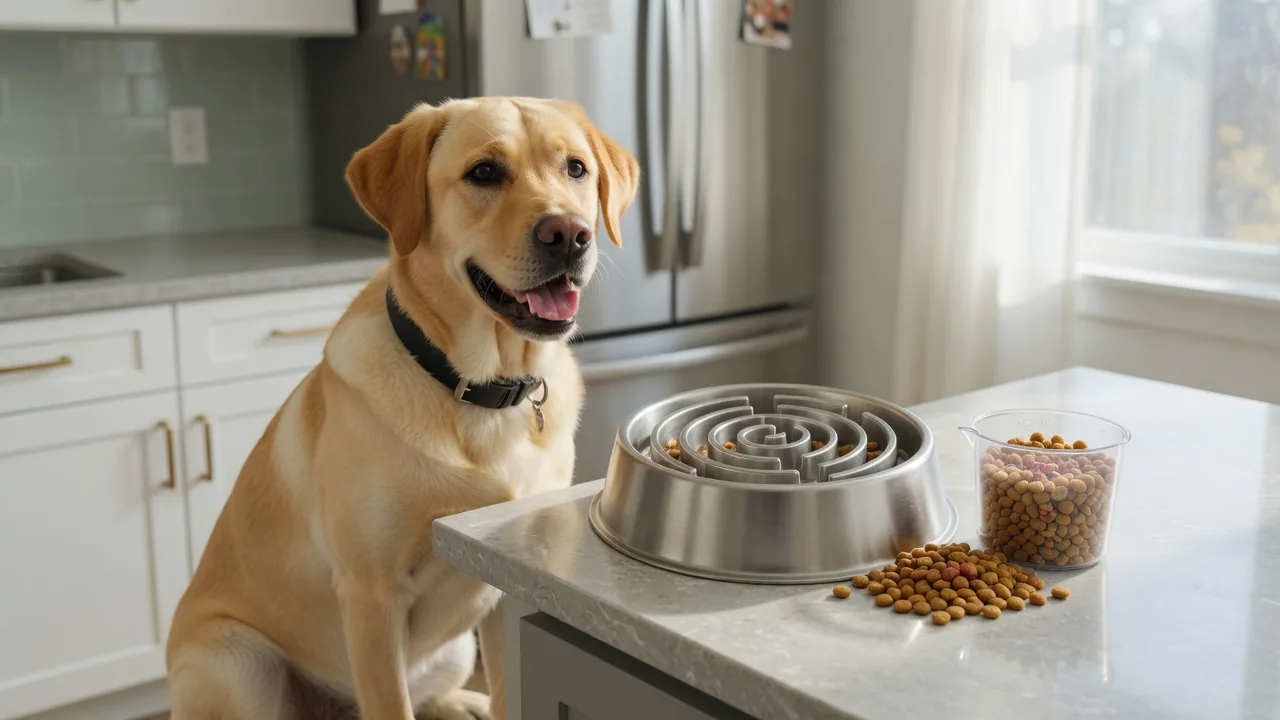
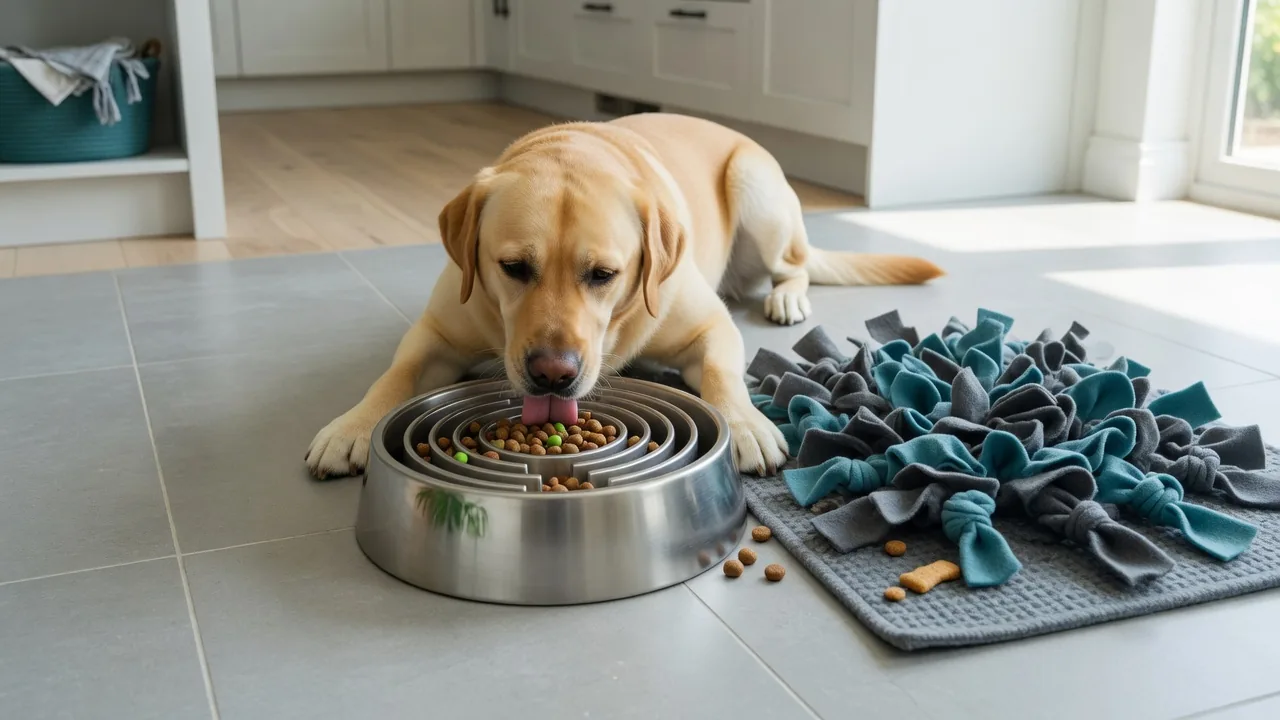
A stainless steel slow feeder doesn't change the amount, only the pace, and a snuffle mat turns part of the same portion into a sniffing job.
When should I ask my vet?
- Your dog is clearly over- or underweight and you're unsure how to adjust
- You feed a puppy, a senior or a dog with a medical condition
- Hunger or weight changes appear suddenly
- You're changing foods and want to compare calories
- You're considering home-cooked or raw feeding, which needs a balanced recipe
A short call to the clinic can turn a generic formula into a number for your dog.
Worked examples: from weight to cups
Here is the whole method end to end, using made-up foods so the maths is easy to follow. Swap in the kcal per cup from your own bag.
| Dog A | Dog B | |
|---|---|---|
| Weight | 10 kg (22 lb), neutered adult | 30 kg (66 lb), neutered adult |
| RER (70 × kg^0.75) | about 394 kcal | about 897 kcal |
| × 1.6 (neutered adult) | about 630 kcal/day | about 1,435 kcal/day |
| Food on the bag | 380 kcal per cup | 350 kcal per cup |
| Cups per day | about 1.7 | about 4.1 |
| Per meal, two meals | about ⅚ cup | about 2 cups |
| Treat budget (roughly 10%) | about 63 kcal | about 143 kcal |
If Dog B gets 143 kcal of treats and chews a day, the bowl should drop by that much, which is about 0.4 cup. Then watch the body for two to three weeks and adjust. The numbers are a starting guess, and your vet can refine them.
What does a healthy body condition look like?
Vets often use a nine-point body condition score, where 4 to 5 is ideal. You don't need the formal scale, but this table is a good translation:
| Look and feel | Roughly means | What to do |
|---|---|---|
| Ribs, spine and hip bones easy to see; no fat felt | Underweight | Book a vet check, then increase food as advised |
| Ribs easy to feel, visible waist, tucked belly | Ideal | Keep going; recheck every few weeks |
| Ribs felt with pressure; waist faint or absent | Overweight | Reduce food by about 10%, cut extras, recheck |
| Can't feel ribs; no waist; rounded belly; fat over the back | Obese | Vet-led weight plan; don't crash-diet |
Even a small amount of excess weight matters for joints and long-term health, which is why vets ask owners to measure rather than eyeball. Don't try rapid weight loss without a vet's plan.
Dry, wet and mixed feeding
Dry food, wet food and fresh food contain different amounts of water, so you can't swap them cup for cup. Convert by calories instead: work out the total daily kcal, decide what share comes from each food, and divide each share by that food's kcal per cup or per can. If you add wet food as a topper, take its calories out of the dry portion rather than adding to it. Kibble vs wet food compares the two, and dog food toppers shows how to add extras without creeping up the totals.
Wet food and soft toppers also suit a lick mat. Remember to count the lick mat filling as part of the meal.
How feeding changes through life
| Life stage | What changes | Where to read more |
|---|---|---|
| Puppy | Needs more calories per pound and more frequent meals; the breed-size matters for growth | Puppy feeding schedule |
| Adult | Stable needs; adjust for activity and neutering | This guide |
| Senior | Often less energy needed, but some seniors need to maintain muscle | Senior dog feeding guide |
| Pregnant or nursing | Needs rise substantially | Vet-led |
| Medical condition | Diet often prescribed | Vet-led |
Large and giant puppies in particular should not be overfed to grow quickly. Ask your vet for a growth plan for your breed.
Common portion mistakes
- Using a coffee mug or a random scoop instead of a measuring cup or scale.
- Forgetting treats, chews and table scraps, which can quietly add up to a large share of the day.
- Feeding to the empty bowl rather than to the body condition.
- Changing foods without recalculating, because the new bag may have a different calorie density.
- Following the bag exactly for a neutered, indoor dog, since the bag is written for an average dog.
- Skipping reweighs. A scale or a monthly vet weigh-in catches small changes before they become large ones.
The bottom line
Start with the calorie estimate, divide by your food's kcal per cup, weigh the portion, count treats, and then let your dog's body condition correct the number. Expect to adjust. The right amount at three years old may not be the right amount at seven.
👉 See the Stainless Steel Slow Feeder Dog Bowl → 👉 See the Snuffle Mat for Dogs →
Frequently Asked Questions
How do I know exactly how much to feed my dog? Estimate daily calories (70 × kg^0.75 × a life-stage factor), divide by your food's kcal per cup, then adjust by body condition every few weeks. Confirm the number with your vet, especially for puppies, seniors or health conditions.
How many cups of food should my dog eat a day? Roughly ¼-1 cup for dogs under 20 lb, 1-2¾ for 20-50 lb, 2¾-4½ for 50-90 lb, and more for giants. Calorie density varies a lot, so use your food's kcal per cup rather than the range alone.
Is it better to feed my dog once or twice a day? Most adult dogs do well on two meals a day, which suits digestion and energy. Puppies need more frequent meals, and some large dogs are advised to have smaller, more frequent ones. Ask your vet.
Why does my dog always seem hungry after the recommended amount? It may be eating speed, low-bulk food, boredom or occasionally a medical issue. A slow feeder or snuffle mat can slow the meal without changing the amount. If hunger is new and extreme, see your vet.
Does the amount change after spaying or neutering? Often yes. Many dogs need fewer calories afterward, so watch the weight and body condition in the weeks after surgery and adjust with your vet's advice.
Do treats count toward the daily amount? Yes. A common guideline is to keep treats and extras to roughly 10% of daily calories and reduce the meal to match.
How do I know if my dog is overweight? You can't easily feel the ribs, there's no waist from above, and the belly doesn't tuck up. Your vet can score body condition and set a target weight.
Can I just follow the feeding chart on the bag? Use it as a starting point and then adjust. The chart is written for an average dog, so a neutered, indoor or senior dog often needs less, and a very active dog may need more. Check the body condition every couple of weeks.
How much wet food should I feed instead of dry? Work from calories, not cups. Find the kcal per can or per serving on the label, work out your dog's daily total, and divide. If you mix wet and dry, split the calories between them. Your vet can help if you are unsure.
Should I feed my dog more on days they exercise more? A little more on genuinely heavy-exercise days can be reasonable, but day-to-day swings are usually small for pet dogs. Track body condition over weeks instead of changing the bowl daily.
How do I weigh a large dog at home? Weigh yourself holding a small dog and subtract, or ask your vet clinic if you can use their scale for free. For large dogs, a clinic or pet-store scale is easiest.