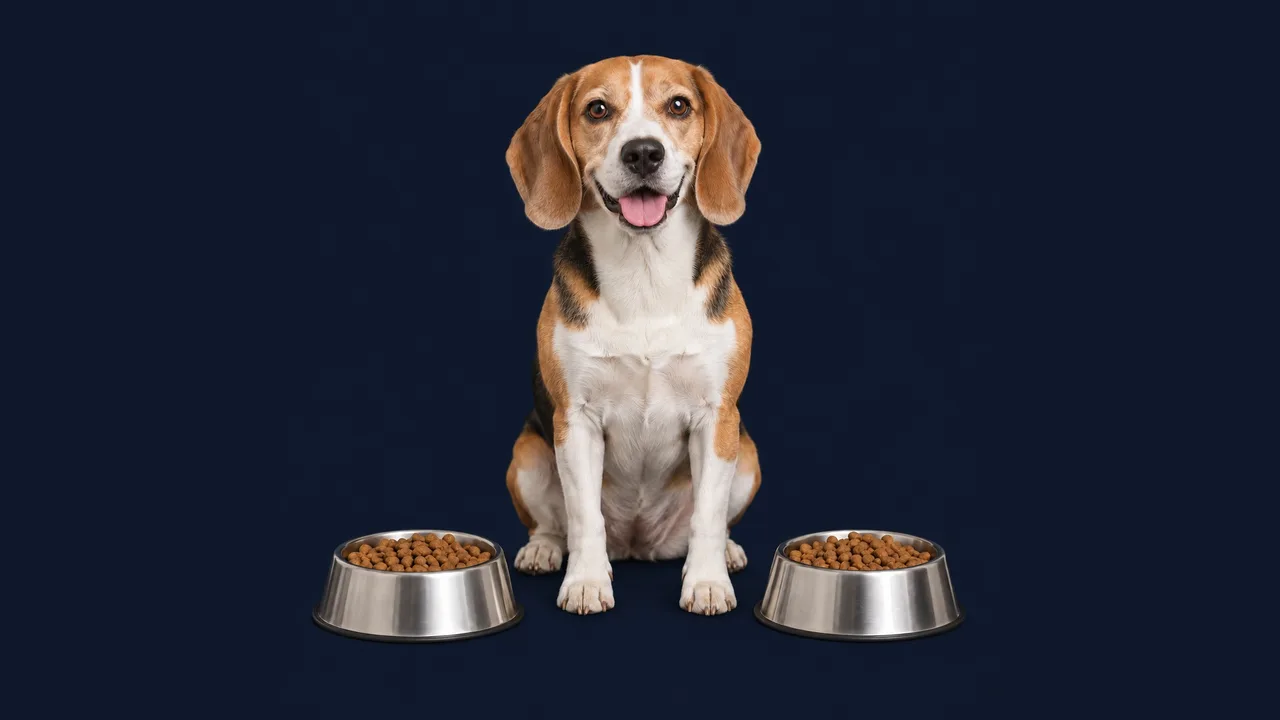
How to Switch Dog Food Safely
To switch dog food safely, mix the new food into the old one gradually over 7 to 10 days, starting at about 25% new and stepping up every few days until the bowl is all new food. Keep the daily total the same, change nothing else at the same time, and slow down if stools soften. Sensitive dogs often do better over 14 days or more.
The rest of this page is the detail that makes it work in a real kitchen: which schedule to pick, how to measure two foods with different calories, what "normal" looks like on the lawn, and when to stop and phone your vet.
Why does a gradual switch matter?
A dog's gut gets used to the food it eats every day. Change the food overnight and the stomach and intestines are suddenly handling a different mix of protein, fat and fiber. A sudden change is a common cause of stomach upset in dogs, with vomiting, diarrhea, gas or a dog who simply won't eat.
Mixing the two foods over a week or more gives the digestive system time to adjust. It also has a second benefit that owners often overlook: if something does go wrong, you catch it at 25% new food rather than 100%, and you can step back easily.
It isn't a guarantee. Some dogs get soft stool even with a slow switch, and some could switch overnight with no trouble. You can't tell in advance which dog you have, so the slow route is the safe default.
How long should a dog food transition take?
Most healthy adult dogs do well over 7 to 10 days. Choose a slower plan of 14 days or more if any of these apply:
- Your dog has had an upset stomach after food changes before
- You're making a big change, such as kibble to wet food or to a fresh or home-cooked diet
- Your dog is a senior, a picky eater, or has a known sensitive stomach
- You're switching to a very different protein or a much richer food
If you're unsure, go slower. Nothing bad happens from taking an extra week, while rushing is the most common reason a perfectly good food gets blamed for an upset. If your dog has a history of tummy trouble and you're still choosing the food itself, start with our guide to the best dog food for a sensitive stomach.
What does the day-by-day schedule look like?
Three schedules cover nearly every situation. The percentages are the share of the daily total that comes from each food.
The 7-day plan (quick)
| Days | Old food | New food |
|---|---|---|
| 1–2 | 75% | 25% |
| 3–4 | 50% | 50% |
| 5–6 | 25% | 75% |
| 7 | 0% | 100% |
The 10-day plan (standard)
| Days | Old food | New food |
|---|---|---|
| 1–3 | 75% | 25% |
| 4–6 | 50% | 50% |
| 7–9 | 25% | 75% |
| 10 | 0% | 100% |
The 14-day plan (slow and steady)
| Days | Old food | New food |
|---|---|---|
| 1–3 | 80% | 20% |
| 4–6 | 60% | 40% |
| 7–9 | 40% | 60% |
| 10–12 | 20% | 80% |
| 13–14 | 0% | 100% |
Treat the day numbers as a minimum, not a deadline. If stools soften at any step, stay there for two or three more days before moving on. If they're still loose after holding, go back one step until they firm up.
How do you work out the amounts in cups?
This is where most switches quietly go wrong. Two foods can look identical in the scoop and carry very different calories. A cup of a rich, high-fat kibble can hold noticeably more energy than a cup of a lighter recipe, and wet food is a different scale altogether.
So work in this order:
- Find the new food's daily amount from its own label, for your dog's weight. Don't carry over the old food's amount. If your vet has given you a calorie target, use that instead. The full method, including the calorie formula, is in how much should I feed my dog.
- Keep the daily total steady. You're swapping food, not adding it. On a 25% day, a quarter of the day's food is new and three quarters is old.
- Do the split. Multiply the daily amount by the percentage. A dog eating 2 cups a day gets 1/2 cup new and 1 1/2 cups old on a 25% day, 1 cup of each at 50%, and 1 1/2 cups new with 1/2 cup old at 75%.
- Divide by meals. Two meals a day? Halve each number.
If the two foods have very different calories per cup, the cleanest method is to work out each food's full daily amount from its own label, then take the percentage of each. On a 50% day, that's half of the old food's daily amount plus half of the new food's daily amount.
A kitchen scale makes all of this easier. Weigh one level cup of each food once, write the grams on the bin, and feed by weight for the rest of the switch.
Switching between kibble and wet? Measure by calories, never by volume. Our kibble vs wet food guide covers how the two formats compare and why stool often looks different afterwards simply because the moisture changed.
What should you keep the same during the switch?
A food switch is also a small experiment. If you change five things at once and your dog gets diarrhea, you won't know which one caused it. Keep everything else boring:
- Same meal times and number of meals. If you also want to change the feeding schedule, do it before or after, not during. Our guide on how often to feed your dog covers that separately.
- No new treats, chews or toppers. Use pieces of the day's food as training rewards instead. If you normally use toppers, hold off until the switch is done; see dog food toppers for adding them back sensibly.
- Treats under about 10% of daily calories, a widely used guideline, and come off the day's total rather than on top of it.
- No table scraps. And never anything toxic: xylitol (in some peanut butters and sugar-free products), grapes or raisins, chocolate, onion or garlic, and macadamia nuts.
- Fresh water at all times.
- A quiet week. Avoid starting a switch right before travel, boarding, a house move or a holiday with guests.
Mix the two foods together well so your dog can't eat around the old one, or around the new one.
What stool changes are normal during a transition?
Some change is expected. These are usually fine:
- Stool slightly softer than usual for a day or two
- A change in color or amount, because the ingredients and fiber are different
- A little more gas for the first few days
- Extra interest, or mild suspicion, at the bowl
A simple daily note helps a lot here. Memory is unreliable after a week, and "soft on day 4, back to normal by day 6" is exactly the kind of detail that tells you whether to hold, step back or carry on. A simple scale works: firm and formed, slightly soft, mushy, loose piles, watery. Write a score each day along with appetite and energy.
If gas is the main complaint, the dog gas remedies guide goes through causes beyond the food itself, including fast eating.
What if my dog won't eat the new food?
Picky refusal is common, especially when the new food is less rich than the old one. Try these, in order:
- Go back one step. A smaller share of new food is easier to accept.
- Mix more thoroughly so the two foods are evenly blended.
- Keep mealtimes short. Put the bowl down for 15 to 20 minutes, then pick it up until the next meal. Leaving food out all day teaches a dog that waiting pays.
- A splash of warm water on kibble can make it more appealing without adding anything new.
Don't solve it by piling on toppers or swapping to a third food. That turns one change into several. And there's a line between picky and unwell: a dog who refuses all food for more than a day, or who is also quiet, vomiting or has diarrhea, needs a call to your vet. Puppies, toy breeds and seniors should be seen sooner.
When should you pause the switch and call your vet?
We're not vets, and nothing here is a diagnosis. General veterinary guidance is consistent about which signs go beyond a normal transition.
Pause the switch and call your vet if you see:
- Vomiting more than once, or vomiting together with diarrhea
- Diarrhea lasting more than a day or two, even after stepping back
- Any blood in the stool, or black, tarry stool
- Refusing food for more than a day (sooner for puppies, small dogs and seniors)
- Lethargy, hiding, or signs of belly pain
- New itching, ear scratching or paw licking that began with the new food
"Pause" means going back to the last mix your dog did well on, or to the old food, while you wait for advice. If an itchy or reactive dog is the reason for the switch, a vet-guided diet trial is the right route; we explain why in best dog food for allergies.
Go to a vet or emergency clinic straight away for: repeated vomiting through the day, collapse or weakness, facial swelling or hives, or unproductive retching with a swollen, tight belly. That last combination can signal bloat, which is an emergency, most often in large deep-chested dogs; the signs are listed in our dog bloat and GDV guide. If your dog has eaten something toxic, call your vet or the ASPCA Animal Poison Control Center at (888) 426-4435 (a fee may apply).
Are there times you shouldn't use a gradual schedule?
Yes. The schedules above are for routine switches. Follow your vet instead when:
- Your vet prescribed a therapeutic diet. These often come with their own transition instructions, which may be faster or slower than the standard plan.
- The old food was recalled or seems to have made your dog ill. Mixing in more of it may not be appropriate, so ask your vet how to proceed.
- Your dog is unwell right now. Don't start a planned switch during an episode of vomiting or diarrhea.
- Puppies, pregnant or nursing dogs, and dogs with medical conditions. Get your vet's input first on both the food and the pace.
How do you handle common switches?
Puppy food to adult food. The timing depends on size. Small and medium breeds often switch around 12 months, while large and giant breeds usually stay on growth food longer, so make it a vet conversation. The method is the same 10-day schedule. Our puppy feeding schedule covers meal counts by age.
Adult food to senior food. Not every older dog needs a senior formula. If your vet suggests one, use the 14-day plan, since older digestive systems can be touchier. See the senior dog feeding guide for what changes with age.
Same brand, new flavor. It still counts as a switch. Different recipes in the same line can use different proteins and fat levels, so use at least the 7-day plan.
Running out of the old food mid-switch. Buy enough old food to cover the whole plan plus a few spare days before you start. If you do run out, don't jump straight to 100% new. Buy a small bag of the old food, or ask your vet for advice.
Does the bowl matter during a switch?
It can. A dog who gulps swallows air with the food, and a new, tastier food often makes a fast eater faster. Gulping alone can cause gas, burping or regurgitation that then gets blamed on the new food.
If your dog finishes a meal in under a minute, a stainless steel slow feeder spreads the food into channels so it gets eaten a few pieces at a time. Introduce a new bowl before or after the food switch, not on the same day. That way, if anything changes, you know which change caused it.
The bottom line
Switching dog food is mostly patience and arithmetic. Pick a pace, 7 days for an easy switch, 10 for most dogs and 14 or more for sensitive ones. Base the daily amount on the new food's label and your vet, keep the total steady, and change nothing else. Watch the stool, hold or step back when it softens, and call your vet when the signs go beyond a little softness.
If you'd like the whole process on paper, our printable Dog Food Transition Planner has the three schedules with fill-in amount columns, cup conversion grids, a label-reading checklist, a daily stool, appetite and energy tracker, and a when-to-call-the-vet page. It's in our printable guides.
👉 See the Stainless Steel Slow Feeder Dog Bowl →
Frequently Asked Questions
How long does it take to switch dog food? Most healthy adult dogs do well over 7 to 10 days, moving from about 25% new food to 100% in steps. Dogs with sensitive stomachs, seniors and big changes such as kibble to wet food often do better over 14 days or more. Stay at any step longer if stools soften.
Can I switch my dog's food without mixing? Some dogs cope with an overnight change, but many get an upset stomach, and you can't know in advance which group your dog is in. A gradual mix is the safer default. The exceptions are a recalled food or a vet's instruction, where you should follow your vet's advice.
Is diarrhea normal when switching dog food? Slightly softer stool for a day or two is common. Diarrhea that lasts more than a day or two, contains blood, or comes with vomiting, low energy or refusing food is not, and needs a call to your vet. Go back to the last mix that worked while you wait.
What do I do if my dog gets an upset stomach halfway through the switch? Go back one step to the last ratio your dog handled well and stay there until the stool is firm again, then move forward more slowly. If symptoms are more than mild softness, or last more than a day or two, pause the switch and call your vet.
Should I feed the same amount of new food as old food? Not necessarily. Foods differ in calories per cup, so start from the new food's feeding guide for your dog's weight and ask your vet to fine-tune it. Keep the daily total steady during the switch and only change the old-to-new ratio.
Do I need to transition when switching flavors of the same brand? Yes. Different recipes in the same brand can use different proteins, fats and fiber sources. Use at least a 7-day transition, and longer for a dog with a sensitive stomach.
What if my dog refuses the new food? Go back a step, mix the foods more thoroughly, and keep mealtimes to about 15 to 20 minutes. Avoid adding new toppers or switching to a third food. Refusing all food for more than a day, or refusing food along with other symptoms, is a reason to call your vet.