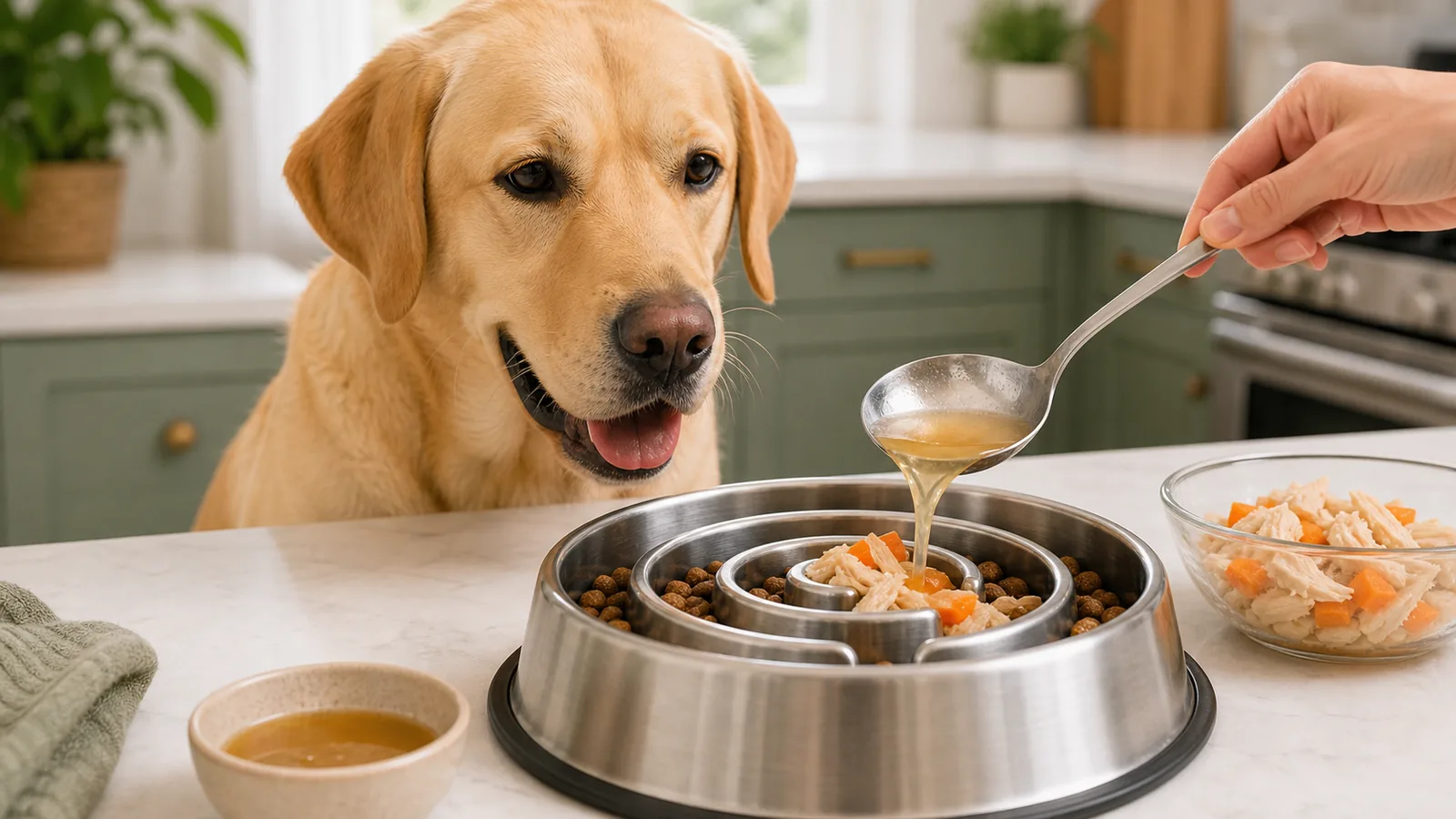
Dog Food Toppers Explained
A dog food topper is anything added on top of a regular meal, such as plain cooked meat, pumpkin, yogurt, broth or a store-bought mix, to boost flavor, aroma or moisture without replacing a complete, balanced diet. The usual rule of thumb is to keep toppers and other extras to roughly 10% of daily calories.
If your dog's regular bowl gets a lukewarm response, toppers are the fix most owners reach for. They work, but they come with three catches that rarely make it onto the product page: they add calories, they can upset a stomach if introduced carelessly, and a more exciting meal is a faster-eaten one. This guide covers all three, plus what to use, what to avoid, and how to serve a topped meal so it lasts longer than twenty seconds.
What counts as a dog food topper?
A topper is something added on top of, or mixed into, your dog's regular food. It ranges from products made for the purpose (freeze-dried crumbles, gravies, broths, meal mixers) to what is already in your fridge. A topper is meant to enhance a meal, not replace a complete and balanced diet. Think seasoning, not substitute.
There are two broad categories worth separating, because the label tells you which you have:
- Complete-and-balanced mixers. These say on the label they are formulated to meet a nutritional standard for a life stage, which means they can sit as a bigger share of the bowl.
- Supplemental toppers. These carry wording like "intended for intermittent or supplemental feeding only." Treat them as treats: small amounts, not the bulk of a meal.
If a bag doesn't make the distinction obvious, ask your vet before feeding it daily.
Common reasons owners use toppers:
- Picky eating. Bland kibble becomes more appealing with a stronger smell or softer texture.
- Variety. Even dogs on a consistent diet can enjoy occasional novelty.
- Hydration. Wet or liquid toppers add moisture to a mostly dry diet.
- Medication. A flavorful topper can help hide a pill. (Check with your vet first on whether the medication can be given with food or dairy.)
- Appetite support in a recovering or older dog, with your vet's guidance.
Which toppers are safe, and how do they compare?
A few commonly used, generally dog-safe options, plain and unseasoned, introduced in small amounts:
| Topper | What it adds | Watch out for |
|---|---|---|
| Plain cooked chicken, turkey or lean beef | Strong smell, protein | No skin, bones, seasoning or heavy fat; fat can upset some stomachs |
| Plain canned pumpkin | Moisture, a little fiber | Must say pumpkin only, not pie filling |
| Plain unsweetened yogurt | Creaminess, appeal | Dairy doesn't suit every dog; check no xylitol or sweetener |
| Unsalted bone broth | Aroma, hydration | No onion or garlic, low or no salt |
| A spoonful of wet food | Flavor, softer texture | Counts as calories, so cut back kibble |
| Plain scrambled or boiled egg | Protein, appeal | Cooked, no butter or salt |
| Steamed green beans or carrot, mashed or chopped | Volume, low calories | Chop small for small dogs |
| Freeze-dried dog toppers | Intense flavor, light | Read the label: complete or supplemental? |
Here's the honest part: most dogs respond to smell more than to nutrition. A teaspoon of warm broth over kibble can lift appetite more than a pricey mix, which is why a topper is rarely a nutrition fix. If your dog's diet is really missing something, that is a conversation for your vet, not a topper aisle.
For toppers that you spread thinly onto a textured mat rather than add to the bowl, our guide to what to put on a lick mat goes into the full list.
What to avoid
Skip toppers containing onion, garlic, chocolate, grapes or raisins, macadamia nuts, xylitol, heavy salt, or seasoning blends. Xylitol is the one that catches careful owners out, since it turns up in some sugar-free yogurts and peanut butters, and recipes change without announcement. Read the label every time you buy. Cooked bones are also out, because they splinter.
If you are unsure whether a specific human food is safe, check with your vet before adding it.
How much topper is too much?
Toppers add calories, and a "small spoonful" every day adds up faster than owners expect. The guideline most vets and nutritionists return to is that treats and extras, toppers included, should stay at around 10% of your dog's daily calories or less, with the other 90% coming from a complete and balanced food.
Two practical habits help:
- Subtract what you add. If a topper contributes about 30 calories, take roughly 30 calories out of the regular meal. You can usually find a topper's calories on the label. For home foods, ask your vet or use a pet-nutrition database.
- Weigh once, then eyeball. Weigh a typical scoop on a kitchen scale the first time so you know what "a spoonful" actually is.
This matters most for small dogs, for dogs already carrying extra weight, and for dogs on a prescription or managed diet. A topper that is 10% of a Great Dane's day is a lot of food; for a five-pound Chihuahua it can be a few bites. If your dog is on a medical diet for allergies, kidney, or pancreatitis, don't add anything without asking your vet, since the whole point of the diet is controlling what goes in.
How do you introduce a new topper?
Treat a topper like a new food, even when it seems harmless:
- Start tiny. A teaspoon or less for a small dog, a tablespoon for a large one.
- Try one new thing at a time. If you start broth and pumpkin on the same day and the stool goes soft, you won't know which one did it.
- Watch for the next day or two. Loose stools, gas, vomiting, itching, or swollen lips or face mean stop.
- Increase slowly if all is well, up to the amount you planned.
- Don't switch the main food at the same time.
If a topper is followed by ongoing digestive upset or signs of an allergic reaction, stop it and call your vet. Dogs with a history of pancreatitis, or those prone to it, usually need to avoid fatty toppers entirely, which is another reason to ask before adding rich foods.
Why do toppers make dogs eat faster?
A tastier meal tends to be a faster-eaten meal. A topper that makes the bowl more exciting gives an already quick eater more reason to inhale it, and a soft, topped meal needs no chewing at all. Fast eating brings the usual downsides: swallowed air, mess, gagging, and sometimes vomiting soon after, which cancels out whatever the topper was supposed to add. If this sounds familiar, our guide on why dogs eat so fast goes through the causes, and what to do if a dog eats too fast and throws up covers the vet red flags.
The fix isn't to skip toppers. Serve them in a way that takes effort.
How do you serve a topped meal so it lasts longer?
Match the method to the topper:
| Topper type | Best way to serve it |
|---|---|
| Dry or crumbled (freeze-dried, shredded meat) | Mix through kibble in a slow feeder so each bite is buried in the maze |
| Wet but thick (pumpkin, yogurt, wet food) | Press a thin layer into the ridges of a slow feeder, or onto a lick mat |
| Thin liquid (broth) | Pour over kibble just before serving, or freeze into cubes and drop into the bowl |
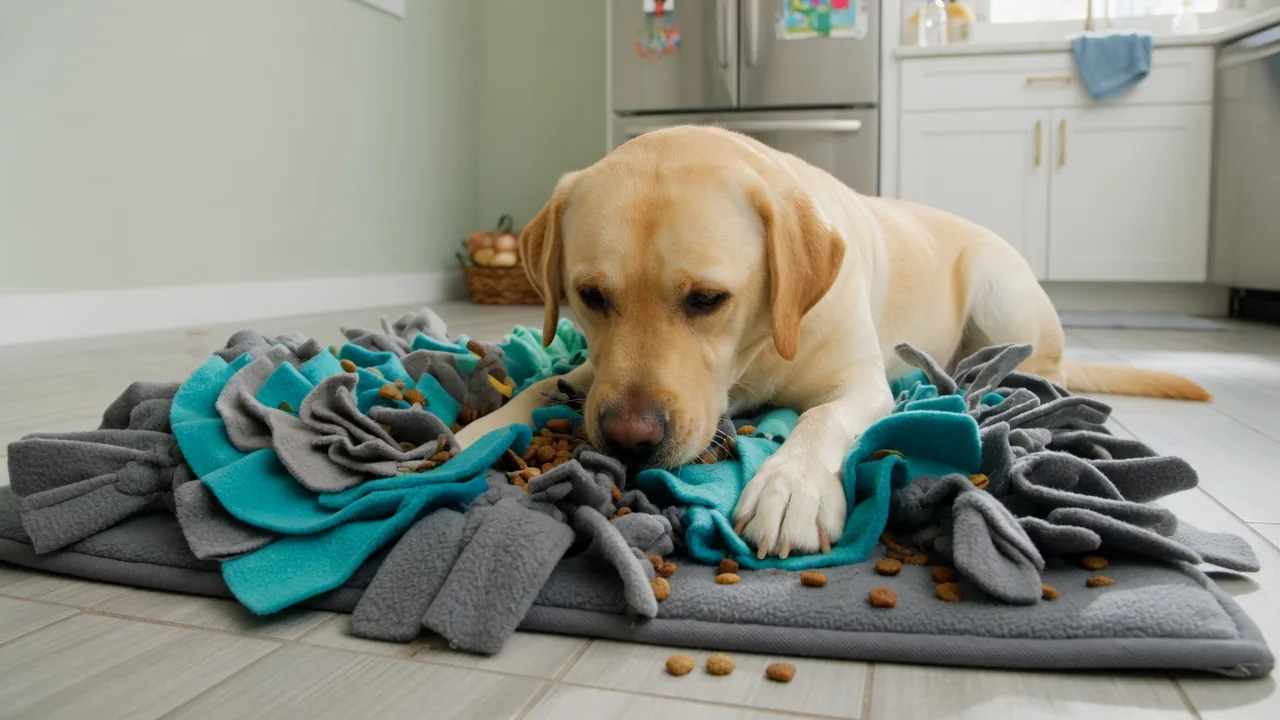
| Anything dry | Lightly coat kibble and scatter across a snuffle mat |
A stainless steel slow feeder works well here. The raised ridges keep your dog working pieces out one at a time rather than lapping up a soft topped meal in one motion, and a thin layer of a wetter topper pressed into the pattern gives something to lick at rather than slurp. Metal also rinses clean of broth and yogurt residue more easily than scratched plastic; see how to clean a slow feeder bowl for a routine.
Our Stainless Steel Slow Feeder Dog Bowl handles dry kibble with a topper mixed in and thinner wet toppers spread across the maze, since the raised ridges create texture and resistance either way.
A snuffle mat is the other option. Scatter kibble lightly coated in a dry or crumbled topper across the fleece and let your dog sniff each piece out. It stretches an exciting meal from a twenty-second event into a proper routine, and the fleece goes in the wash afterwards. For more ways to slow down a keen eater, see how to stop your dog eating too fast.
When are toppers a bad idea?
- Your dog is gaining weight. Cut the topper before cutting the meal.
- Your dog is on a prescription or elimination diet. Don't add anything without your vet's say-so.
- You're using one to coax a dog who has stopped eating. A dog who suddenly refuses food for more than a day should see a vet. Making the bowl more tempting can hide a problem.
- Your dog has a sensitive stomach. Fatty, rich or new toppers are the usual triggers for loose stools.
- Every meal has become a negotiation. If your dog refuses anything unflavored, you've trained a pattern. Go back to plain meals, a firm 15-20 minute window, and no extras for a while.
The bottom line
Dog food toppers are a low-risk way to add variety, moisture and appeal to a plain meal, as long as you keep to safe ingredients, hold extras to around 10% of daily calories, introduce one new thing at a time, and watch how fast the bowl empties. If a topper turns your dog into a speed-eater, pair it with a slow feeder or snuffle mat so the extra excitement doesn't come with gulping.
👉 See the Stainless Steel Slow Feeder Dog Bowl →
If your dog has itchy skin or a reaction to food, check the best dog food for allergies before adding any new topper.
Frequently Asked Questions
What can I use as a dog food topper? Plain cooked meat, plain canned pumpkin, plain unsweetened yogurt, unsalted bone broth, a spoonful of wet food, or a store-bought topper made for dogs are common safe options. Avoid onion, garlic, chocolate, grapes and raisins, xylitol, and heavily seasoned foods.
How much topper can I add to my dog's food? A common guideline is to keep toppers and other extras to around 10% of daily calories, with the rest from a complete and balanced food. If you top meals every day, reduce the regular portion slightly to compensate. Ask your vet if your dog is overweight or on a special diet.
Do dog food toppers add enough calories to matter? Yes, especially when used daily and for small dogs. A spoonful that looks trivial can add a noticeable share of a small dog's day. Take the calories out of the regular meal rather than stacking them on top.
Why does my dog eat faster with a topper on their food? Toppers make meals more appealing, which raises the urgency to eat quickly, and a soft topped meal needs no chewing. A slow feeder bowl or snuffle mat can slow it back down without removing the topper.
Can I use a slow feeder bowl with wet toppers? Yes. Thin wet toppers work best pressed into a thin layer across the raised maze pattern, rather than pooled, so your dog has to lick and work at it. Thicker toppers like pumpkin or wet food spread well.
Are toppers a good idea for a picky eater? They can help in the short term, but they can also teach a dog to hold out for something better. If your dog suddenly turns down food they normally eat, or refuses meals for more than a day, see your vet before reaching for a topper.