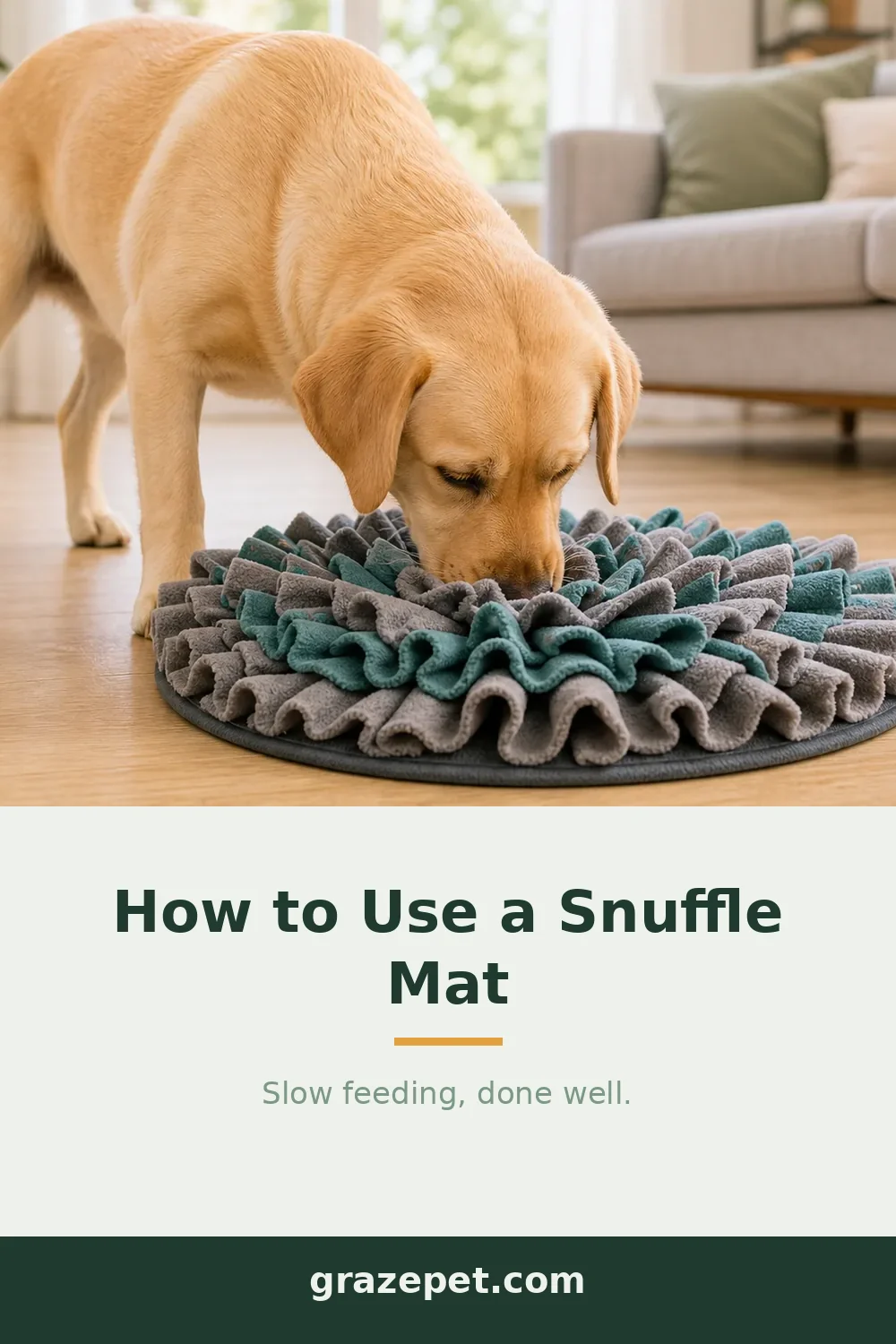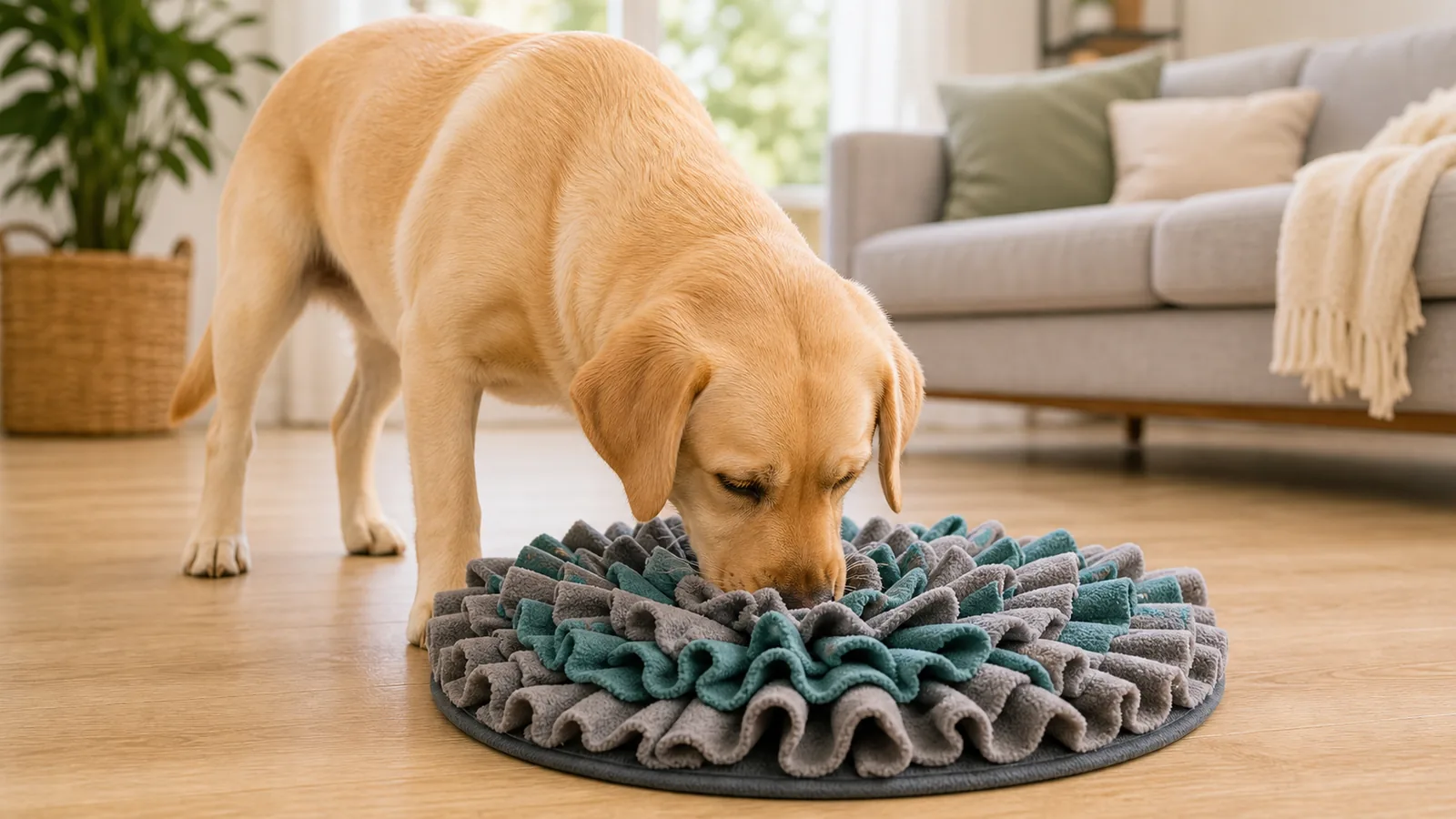
How to Use a Snuffle Mat: A Beginner's Guide
To use a snuffle mat, scatter a measured portion of dry kibble or treats over the fleece, leave it visible for the first few sessions, then tuck it deeper as your dog learns. Supervise, pick the mat up when the food is gone, shake it out, and wash and fully dry it regularly.
That's the method in two sentences. What separates a mat your dog loves from one that ends up in a cupboard is the detail: how much food, how hard to make it, what to do when your dog flips it over, and how to stop it smelling. This guide covers all of that in order.
If you're still deciding whether a mat is right for your dog at all, including the risks and which dogs should skip one, read are snuffle mats good for dogs first.
What do you need before you start?
- A snuffle mat sized for your dog, with securely attached strips and a non-slip backing. Ours is here: snuffle mat for dogs.
- Dry food. Your dog's normal kibble is ideal.
- A measured portion. Decide the amount before you start scattering.
- A suitable spot. A hard floor or low-pile carpet, away from other pets, with room for your dog to move around the mat.
- Five to fifteen minutes when you can stay in the room.
What food should you put in a snuffle mat?
| Food | Use it? | Notes |
|---|---|---|
| Regular dry kibble | Yes, best choice | Balanced, cheap, easy to count |
| Small dry training treats | Yes | Break large ones up; count the calories |
| Freeze-dried treats | Yes | Strong smell; good for beginners and seniors |
| Small pieces of dry biscuit | Yes | Crumbs mean more frequent washing |
| Air-dried or semi-moist treats | Sparingly | Can leave grease on the fleece |
| Fresh vegetables (carrot pieces) | Occasionally | Wash the mat afterwards |
| Wet food, raw food, pâté | No | Soaks into fabric and can't be cleaned out properly |
| Cheese, cooked meat, anything greasy | No | Leaves residue that turns rancid |
| Peanut butter, yogurt, spreads | No | Those belong on a lick mat |
Very small kibble falls to the base and is harder to find, which makes the mat more difficult. Large kibble is easier. Keep that in mind when you set the level.
How much food should go in the mat?
Whatever goes in the mat comes out of the day's food, not on top of it. Three sensible options:
- A full meal. Measure the normal portion and scatter all of it. Works well for dogs that bolt food from a bowl, provided the mat is big enough for the food to spread out.
- Part of a meal. Put a third or half in the mat and the rest in the bowl. A good compromise for large dogs with big portions.
- A treat session. A small handful, deducted from the day's ration.
For the first session, use just ten to twenty pieces. You're teaching a game, not serving dinner.
How do you introduce a snuffle mat?
Step 1: Let your dog watch you load it. Put the mat down and drop the food on while your dog looks on. Curiosity does half the work.
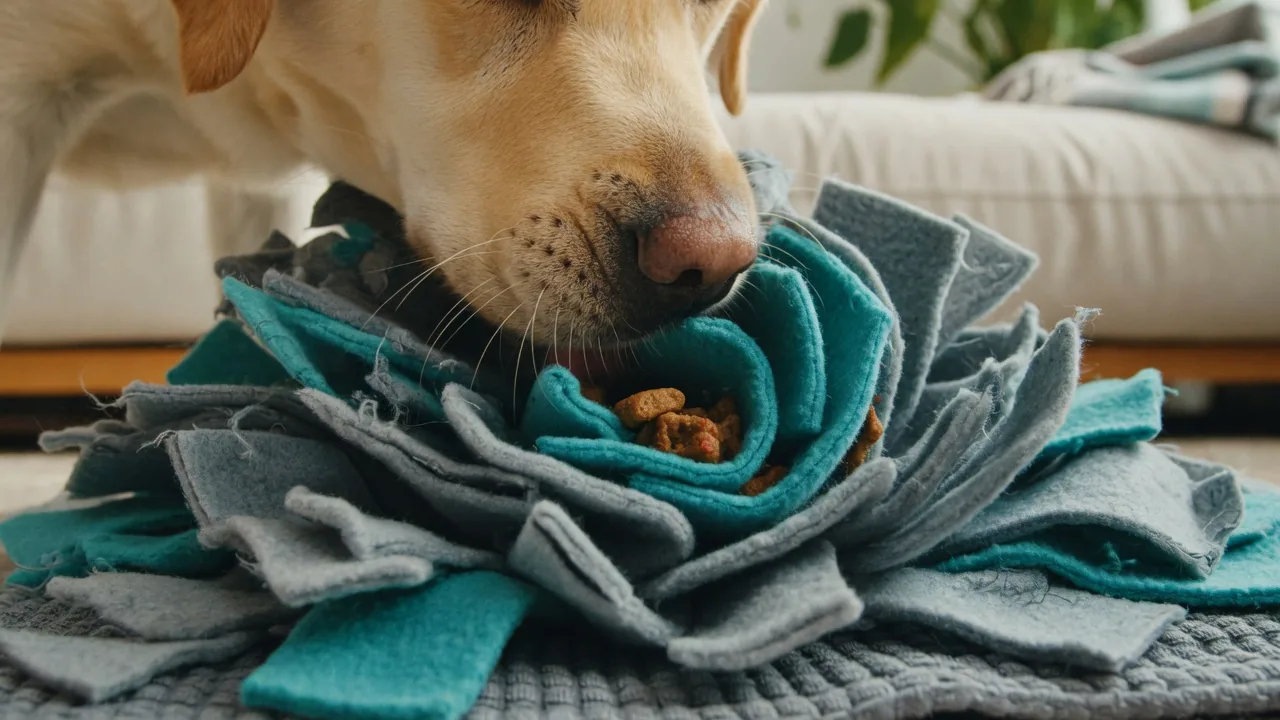
Step 2: Keep the food on the surface. For the first session, the pieces should sit on top of the fleece, clearly visible.
Step 3: Give a cue. Say "find it" (or any phrase you'll stick with) and let your dog start. If it hesitates, point to a piece or flick one so it moves.
Step 4: Step back. Let your dog work it out. Stay in the room but don't hover, and don't help unless it's stuck.
Step 5: End on success. When the food is gone, praise your dog and pick the mat up straight away. Putting it away keeps it special and stops chewing.
Most dogs understand the game within one or two sessions. A cautious dog may take a few days; keep it easy and don't rush.
How do you make a snuffle mat harder (or easier)?
Raise the difficulty one step at a time, and only when your dog is clearing the current level confidently.
Level 1: On top. Food scattered over the surface, visible. For first-timers, puppies, seniors, and nervous dogs.
Level 2: Tucked in. Run your hand over the mat after scattering so pieces drop between the strips. Most dogs live happily at this level.
Level 3: Buried. Part the fleece and push pieces down to the base, then fluff the strips back over them. Spread food right to the edges and corners.
Level 4: Extra challenge. Fold or roll the loaded mat so the dog has to open it, use smaller kibble, use fewer but more widely spaced pieces, or place the mat in a different room and send your dog to find it.
Signs it's too hard: pawing or digging at the mat, flipping it, barking at it, picking it up and shaking it, or walking away with food still in it. Drop back a level.
Signs it's too easy: the mat is cleared in under a minute and your dog looks at you for more.
How long and how often should a dog use a snuffle mat?
A session lasts as long as the food does, which is usually somewhere between two and fifteen minutes depending on the dog, the amount, and the level. There's no need to stretch it artificially; when the food is gone, the session is over.
Daily use is fine. Common patterns:
- One meal a day from the mat, the other from a bowl
- A few mat meals a week for variety
- A short session at a predictable time, such as while you eat dinner
- An activity for wet days, or for dogs on restricted exercise with the vet's agreement
Using it for every single meal works for some dogs, though many lose a little interest if nothing ever changes. Mixing it with other activities keeps it fresh; see dog enrichment ideas.
How do you clean a snuffle mat?
Fabric that holds food and saliva needs proper care. Check the care label on your mat first; the routine below suits machine-washable mats like ours.
After every use: take it outside or hold it over a bin and shake it hard to get crumbs out. Leave it somewhere airy, not folded up damp from saliva.
Regular wash: roughly weekly with daily use, sooner if it smells or looks grubby.
- Shake out all loose food.
- Put the mat in a laundry bag or pillowcase to protect the strips and your machine.
- Wash on a gentle cycle with a mild, fragrance-free detergent. Strong scents put some dogs off and mask the smell of the food.
- Skip fabric softener, which leaves a residue.
- Air dry completely, hung up or laid flat with the fleece fluffed apart. Avoid high heat, which can damage the backing.
The important part is drying. A mat that's put away or reused while still damp at the base will smell and can grow mould. Feel right down between the strips before you use it again.
If a mat still smells after washing, or you see mould, replace it.
What if your dog flips, chews, or ignores the mat?
Flipping or shaking the mat. Usually means it's too hard or the dog has learned that flipping dumps the food out. Go back to Level 1, use a larger mat or one with a better non-slip backing, and hold an edge down for a few sessions. Some owners clip or tie the mat to something fixed.
Chewing or pulling at the strips. Interrupt calmly, trade for a treat, and remove the mat. Try again with food at the surface so searching is more rewarding than tearing. If your dog keeps going for the fabric, a snuffle mat isn't a safe choice for that dog; a slow feeder bowl is the better tool. Swallowed fabric can cause a blockage, so call your vet if your dog eats a piece.
No interest. Use something smellier, such as freeze-dried treats, try when your dog is hungry, and make it very easy. Some dogs simply prefer other activities.
Finishing in seconds. Move up a level, use a denser or bigger mat, or spread the food more widely.
Guarding the mat. If your dog stiffens or growls when someone approaches, give it space and don't reach in. Feed it alone, and get advice; start with food aggression in dogs.
Two dogs, one mat. Don't. Give each dog its own mat in separate spaces.
Sneezing or snorting. A bit of snorting is normal with a nose in fleece. Frequent sneezing can mean dust or crumbs have built up, so wash the mat. Flat-faced breeds need food kept near the surface so they aren't burying their face.
What mistakes should beginners avoid?
- Starting too hard. The most common reason dogs give up.
- Leaving the mat down afterwards. It becomes a chew toy or a bed.
- Leaving the dog unsupervised. Stay in the room.
- Using wet or greasy food. It ruins the mat.
- Adding mat food on top of normal meals. Weight gain follows.
- Putting it away damp.
- Ignoring wear. Loose strips and peeling backing mean it's time for a new one.
- Using it on a slippery floor without a non-slip backing.
When is a different tool better?
A snuffle mat is for dry food and supervised sessions. For wet or raw meals, for a feeder you can leave down, or for a dog that eats fabric, a stainless steel slow feeder bowl is the practical option. Many households use both; snuffle mat vs slow feeder bowl explains how they divide the work, and how to stop your dog eating too fast covers the wider plan for gulpers.
A snuffle mat is one of the easiest indoor dog activities when the weather keeps you in.
Frequently Asked Questions
How do you use a snuffle mat for the first time? Put the mat on a non-slip surface, scatter ten to twenty pieces of dry kibble on top where your dog can see them, say "find it," and let your dog sniff them out. Keep it easy, stay nearby, and pick the mat up when the food is finished.
What food do you put in a snuffle mat? Dry food only: regular kibble, small dry training treats, or freeze-dried treats. Avoid wet food, raw food, cheese, and anything greasy or spreadable, because it soaks into the fleece and can't be cleaned out properly.
Can I feed my dog's whole meal in a snuffle mat? Yes, if the mat is large enough for the portion to spread out. Measure the normal amount and scatter all of it. For large dogs with big meals, put part in the mat and the rest in a bowl or slow feeder.
How long should a snuffle mat session last? As long as the food lasts, typically two to fifteen minutes depending on the dog, the portion, and how deeply the food is hidden. Remove the mat once the food is gone so your dog doesn't start chewing the fabric.
How often should I wash a snuffle mat? Shake it out after every use and wash it about once a week with daily use, or sooner if it smells. Use a gentle cycle and mild unscented detergent if the label allows machine washing, and make sure it is completely dry before using it again.
Why does my dog flip the snuffle mat over? Usually because the food is hidden too deeply or flipping has worked before. Go back to scattering food on the surface, use a mat with a non-slip backing, and hold or secure an edge for a few sessions until your dog learns to search instead.
Can I leave my dog alone with a snuffle mat? No. Some dogs chew the fleece once the food is gone, and swallowed fabric can cause an intestinal blockage. Use the mat while you're in the room and put it away afterwards.
Save this guide