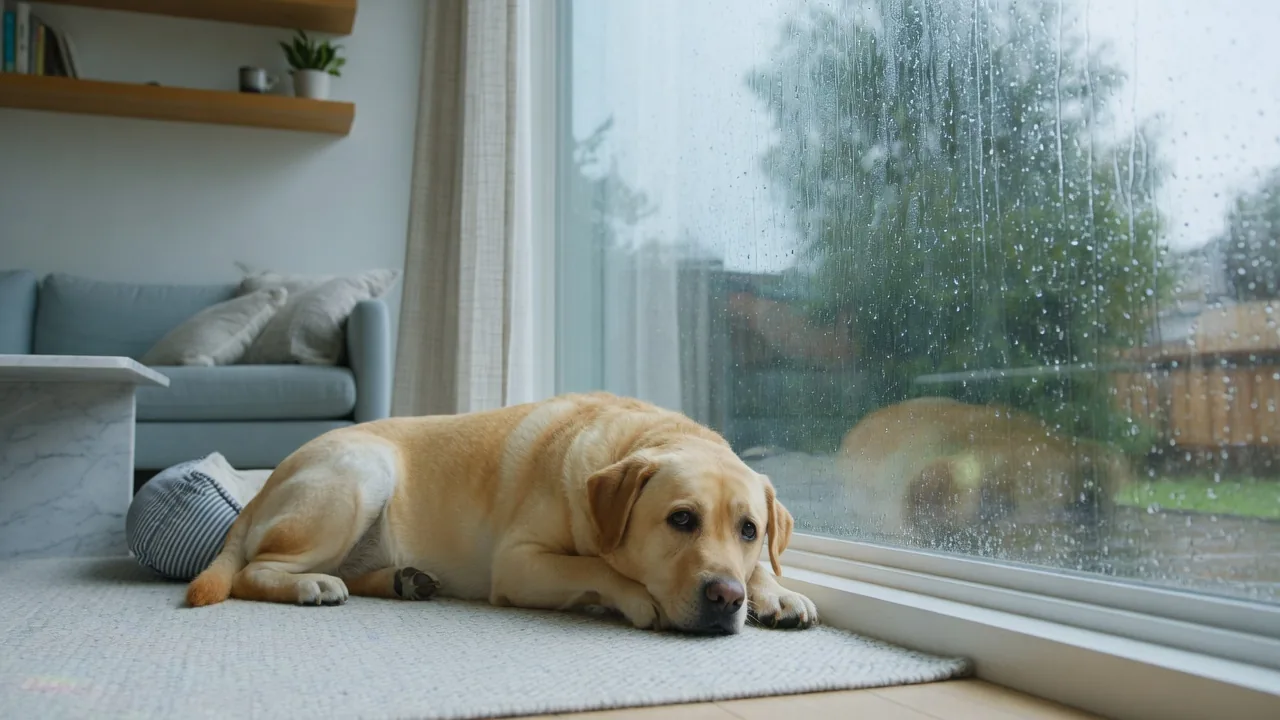
9 Indoor Dog Activities for Rainy Days
The best indoor activities for dogs on rainy days are nose and puzzle games — a snuffle mat search, a slow-feeder meal, hide-and-seek, a frozen stuffed toy — plus one or two controlled movement games like hallway tug. Three or four short sessions spread across the day keep most dogs settled without a walk.
Below are nine activities that work in an ordinary home, each with the space it needs, how noisy it is (useful if you have downstairs neighbours), and how to set it up in a couple of minutes. After that: how to plan a whole stuck-inside day, what to do about toilet breaks in the rain, and what to adjust for puppies and high-energy dogs.
This page is about the indoor-day problem specifically. For the broader toolkit you'd use year-round, sorted by enrichment type, see our dog enrichment ideas.
Which indoor activity fits your space and your dog?
| Activity | Space needed | Noise | Energy it burns | Prep time | Supervision |
|---|---|---|---|---|---|
| 1. Snuffle mat search | A corner | Silent | Mental | 1 min | Light |
| 2. Slow-feeder meal | A corner | Quiet | Mental (mild) | None | Light |
| 3. Treat hide-and-seek | One room | Quiet | Mental | 2 min | Light |
| 4. Hide-and-seek with you | Two+ rooms | Moderate | Mental + physical | None | You're playing |
| 5. Frozen stuffed toy | A mat or crate | Silent | Calming | Prep ahead | Light |
| 6. Trick training | 2 m of floor | Quiet | Mental | None | You're playing |
| 7. Hallway tug or fetch | Hallway / clear room | Loud | Physical | None | You're playing |
| 8. Cushion obstacle course | One room | Moderate | Physical + mental | 5 min | Full |
| 9. Cardboard box forage | A washable floor | Moderate | Mental | 2 min | Full |
If you live in a flat with someone underneath, activities 1, 2, 3, 5 and 6 are effectively silent. Save 7 and 8 for a rug and reasonable hours.
Why do nose games beat running around the living room?
A dog who has missed a walk has missed two things: the exercise and the hour of sniffing that went with it. Owners tend to replace only the first, with a frantic game of indoor fetch that leaves the dog more wound up than before.
Sniffing and problem-solving are tiring in their own right, and they end with a dog who lies down. That's why most of this list is brain work, with movement games in a supporting role. The longer case for it sits in our mental stimulation for dogs guide; here we'll get on with the games.
9 indoor dog activities
1. Snuffle mat scent search
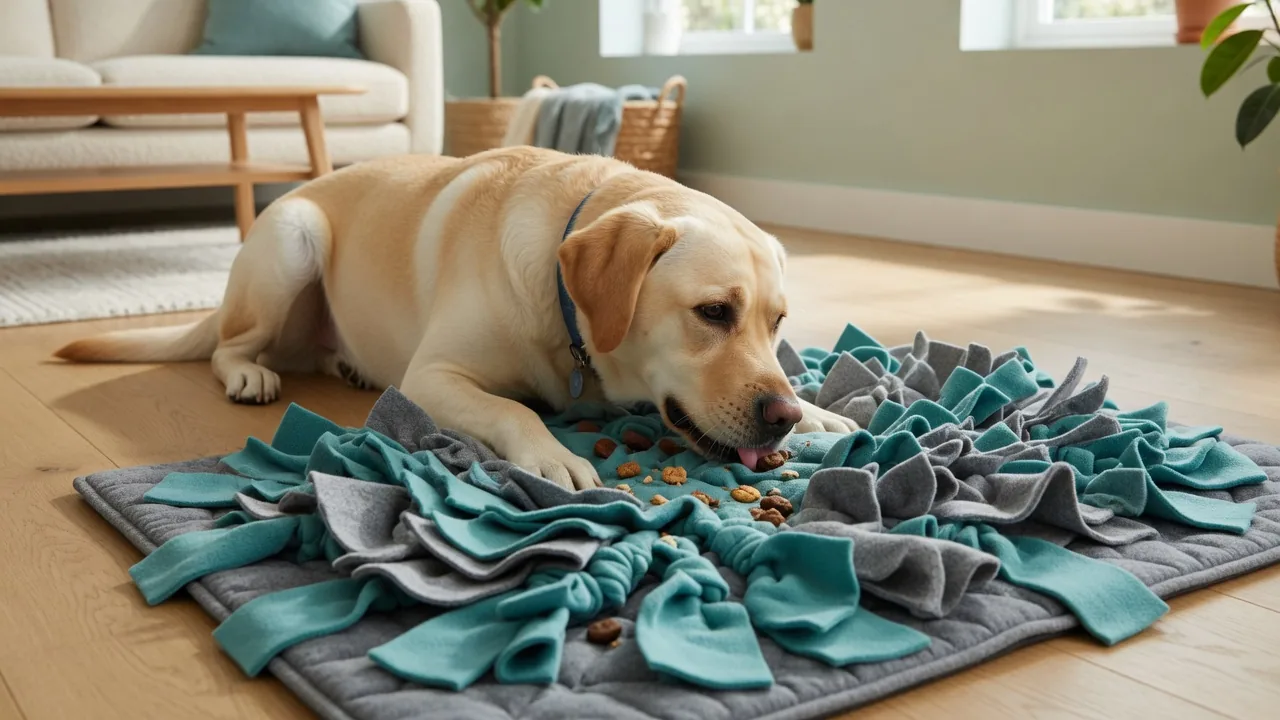
Sprinkle part of a meal into a snuffle mat and let your dog nose through the fleece for every piece. It's silent, contained to one square of floor, and the most reliable "settle down" activity on this list. Make it harder: push the kibble deep into the base, or fold the mat in half.
2. Slow-feeder meal
Serve breakfast and dinner in a stainless steel slow feeder instead of a flat bowl. It only adds a few minutes of light effort per meal, but those minutes are free: the meal was happening anyway. On an indoor day, never waste a meal on a plain bowl.
3. Treat hide-and-seek
Put your dog behind a door or in a sit-stay. Hide five or six pieces of kibble around one room — beside a chair leg, on a low shelf, under the edge of a rug — then release with "find it." Start easy: the first hides should be in plain sight. Make it harder: hide at nose height rather than on the floor, use two rooms, or hide a single high-value treat.
4. Hide-and-seek with you
The same game, except you're the prize. Ask for a stay (or have someone hold your dog), hide behind a door or curtain, and call once. Celebrate when you're found. It practises recall, burns a bit of physical energy, and children love running it. With two people, call the dog back and forth between rooms.
5. Frozen stuffed toy or lick mat
Pack a hollow rubber toy with soaked kibble or wet food, or spread a thin layer on a lick mat, and freeze it. This is the activity for the hour you have to be on a call. Prep several the night before a forecast wet day. A lick mat with suction cups stays put on the tile or tub wall, so it works even for a dog who pushes bowls around. Filling ideas are in what to put on a lick mat.
6. Trick training in short bursts
Three to five minutes, two or three times through the day. Good indoor-sized tricks: nose-touch to your hand, spin, "go to your mat," backing up, putting toys in a basket. Use kibble from the daily ration as rewards. Stop while your dog still wants more.
7. Hallway tug or fetch — with rules
Movement games are fine indoors if you control them. Use a soft toy, play on carpet or a runner (dogs slip and strain themselves on hard floors), and roll the toy along the ground rather than throwing it high. For tug, build in a "drop" every thirty seconds or so and restart the game as the reward. Keep it to five minutes. If your dog gets more frantic rather than less, switch to a nose game to bring them back down.
8. Cushion obstacle course
Lay a broom handle across two low books to step over, a row of cushions to walk along, a chair to go around, a blanket draped over two chairs to walk under. Lure your dog through slowly with a treat. Slow, deliberate movement over odd surfaces works balance and concentration far more than speed does. Keep everything low — nothing a dog could fall from — and skip jumping for puppies, seniors and long-backed breeds.
9. Cardboard box forage
Scrunch paper around a few treats, drop the lot into a delivery box and let your dog dig and shred. It's messy and noisy and many dogs adore it. Remove tape and staples first, supervise so the cardboard gets spat out rather than swallowed, and sweep up after.
How do you plan a full day stuck indoors?
The trick is spacing. One forty-minute blowout at 9 a.m. leaves you with a bored dog by noon. Short sessions with rest between them work better.
A sample day for a healthy adult dog:
- Breakfast: slow-feeder bowl, followed by a quick toilet trip outside.
- Mid-morning: treat hide-and-seek (10 minutes), then rest.
- Lunchtime: five minutes of trick training; frozen toy while you eat.
- Mid-afternoon: hallway tug or the cushion course (5–10 minutes), then a snuffle mat to wind down.
- Dinner: half in the slow feeder, half scattered in the snuffle mat.
- Evening: a calm chew, and a last toilet trip.
Always finish an exciting game with a calm one. Tug then snuffle mat; fetch then lick mat. The order matters more than the activities.
One accounting point: almost everything above uses food. Measure the day's ration in the morning and run the games out of that, so a rainy day doesn't become a double-dinner day.
Rainy-day checklist
- Measure the day's food ration in the morning and use it for the games
- Prep two lick mats or frozen toys the night before (a two-pack helps)
- Set up the snuffle mat and slow feeder for the two meals
- Clear a hallway and put down non-slip mats for tug
- Plan 3–4 short sessions of 5–15 minutes, with rest between
- End every lively game with a calm one
- Keep a towel and a covered route ready for toilet breaks
What about toilet breaks when it's pouring?
Indoor play doesn't remove the need to go out. Most adult dogs still need a toilet trip several times a day, and puppies far more often.
A few things that help with dogs who refuse to step outside in rain: go out with them rather than sending them (most will go faster with company), use a covered spot or stand over them with a large umbrella, keep the trip short and boring, and reward the moment they've finished. A lightweight dog coat helps short-coated and small dogs who genuinely get cold. Dry paws and belly when you come in — damp skin between the toes can get sore if it's left.
And if there's a dry half hour, use it. A short, sniffy walk in drizzle is still worth more than none.
How should you adjust for puppies, seniors and high-energy dogs?
Puppies. Keep sessions to a few minutes, use the easiest version of each game, and expect a nap afterwards. Skip the obstacle course jumps and the stairs. Every indoor game doubles as training, so it's time well spent.
Senior dogs. Nose work and lick mats are ideal; tug and obstacle work may not be. Put rugs down on slippery floors. We've got a full page on senior dog enrichment.
High-energy and working breeds. One rainy day is manageable; a wet week is harder. Lean on training (teach something genuinely new, not just rehearsals), increase the difficulty of scent games, and accept getting wet for at least one proper walk.
Dogs on restricted exercise. If your vet has ordered rest after surgery or injury, don't improvise from this list — movement games could set recovery back. Ask your vet what's allowed.
What mistakes make indoor days worse?
- Only doing high-arousal games. Chase and wrestling with no cool-down produce a dog who can't switch off.
- Playing fetch on hard floors. Sliding stops are a common way dogs tweak something. Use carpet or skip it.
- Laser pointers. Some dogs become fixated on chasing lights and shadows; it isn't worth the risk.
- One long session. Short and frequent beats long and rare.
- Free-pouring treats. Use the measured ration.
- Leaving a new chew or box unsupervised. Watch the first few times.
The bottom line
A wet day indoors goes well when you replace the sniffing your dog missed, not just the running. Feed both meals as activities, add two or three short nose or training sessions, allow one controlled movement game, and finish each burst with something calm.
👉 Snuffle Mat for Dogs → for silent indoor scent work 👉 Stainless Steel Slow Feeder Dog Bowl → to make both meals count 👉 Lick Mat for Dogs → for a calm, quiet cool-down
Frequently Asked Questions
What can I do with my dog indoors when it's raining? Run a snuffle mat search, feed meals in a slow feeder, play treat hide-and-seek, do a few minutes of trick training and give a frozen stuffed toy for quiet time. Add one short tug or hallway game on carpet. Spread them across the day rather than doing them all at once.
Can indoor activities tire a dog out as much as a walk? Scent games and training tire a dog mentally and often leave them calmer than a rushed walk would. They do not replace regular outdoor exercise over the long term, but they cover an occasional indoor day well for most healthy adult dogs.
What indoor dog activities work in a small apartment? Snuffle mats, slow feeders, frozen stuffed toys, lick mats, treat hide-and-seek in one room and trick training all need very little floor space and make almost no noise, so they suit flats with neighbours below.
Is it okay to skip walks on rainy days? An occasional skipped walk is fine for most healthy adult dogs if you replace it with mental activity and still take toilet breaks outside. Skipping walks for days in a row is harder on high-energy dogs, so try to fit in at least one short outing.
How do I tire out a high-energy dog indoors? Combine brain work with controlled movement: teach a brand-new trick, run harder scent searches across several rooms, then play five minutes of tug with regular drop-and-restart breaks. Finish with a snuffle mat or lick mat so your dog winds down instead of staying wound up.
Is it safe to play fetch inside the house? It can be, with limits. Play on carpet or a runner, roll a soft toy along the floor rather than throwing it high, clear the area of breakables and keep sessions short. Avoid indoor fetch on hard, slippery floors and with dogs who have joint problems.
What are good indoor activities for dogs? The best indoor activities for dogs are nose games (a snuffle mat search or treat hide-and-seek), puzzle meals in a slow feeder, a frozen lick mat, short trick-training sessions, and one controlled movement game such as hallway tug. Mix them across the day.
How can I keep my dog entertained inside all day? Space short sessions through the day and feed meals as activities. Pair a lively game with a calm one afterward, and give a lick mat when you need an hour of quiet. If your dog turns destructive, see why dogs destroy things.