Mental Stimulation for Dogs: Why and How to Do It
Mental stimulation for dogs is any activity that makes a dog think, sniff or solve a problem rather than just move. Most adult dogs do well with 20–40 minutes a day, split into short sessions: food puzzles at mealtimes, sniffing on walks, and a few minutes of training. It complements exercise; it doesn't replace it.
Plenty of dogs get two walks a day and still chew the skirting board. The walk worked the legs. Nothing worked the brain. This guide explains the different kinds of mental work, how much your particular dog is likely to need, how to fit it into an ordinary day, and how to tell when you've overdone it. If you just want a list of activities, our dog enrichment ideas page has that.
What counts as mental stimulation for a dog?
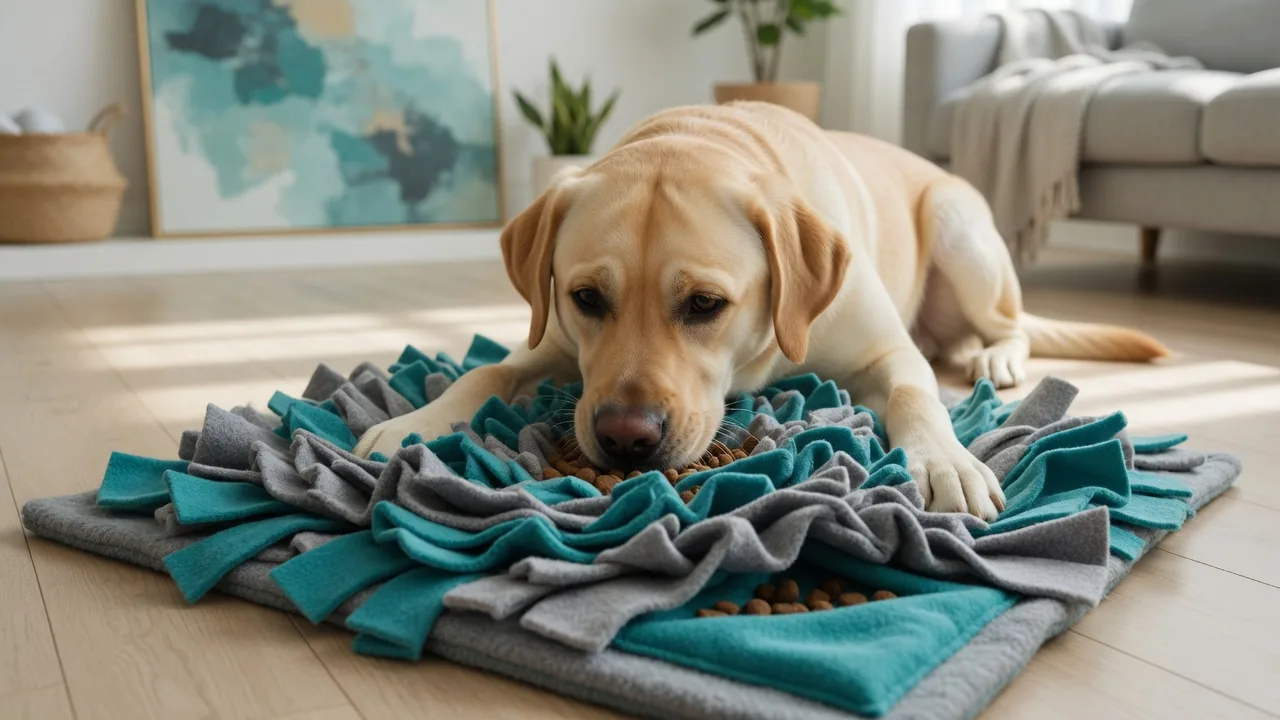
Anything where the dog has to make decisions. A useful test: could your dog do it on autopilot? Trotting beside you on a familiar route, yes. Finding twelve pieces of kibble in a fleece mat, no.
It helps to think in five types, because dogs need variety and most owners accidentally lean on just one.
| Type | What it is | Examples | Best for |
|---|---|---|---|
| Scent work | Using the nose to find things | Snuffle mat, scatter feeding, "find it", sniffy walks | Almost every dog; especially calming |
| Food problem-solving | Working out how to get food | Slow feeder, puzzle feeder, stuffed toys | Fast eaters, food-motivated dogs |
| Learning | Training new cues or polishing old ones | Tricks, recall, settle on a mat | Working and herding breeds, adolescents |
| Novelty | New places, surfaces, objects, sounds | A different route, a cardboard box, a new park | Confident dogs, puppies (gently) |
| Calming repetition | Licking and chewing | Lick mat, long-lasting chew | Anxious or over-aroused dogs |
Scent work deserves its top spot. Smell is a dog's primary sense, and sniffing is something they'll choose to do given any freedom at all. One 2019 study found that pet dogs given two weeks of nosework practice became more "optimistic" in a judgement test than dogs given heelwork practice instead. It was a small study, but it fits what trainers see daily: sniffing settles dogs.
Why does mental stimulation matter as much as exercise?
Because most dogs were bred to do a job, and most pet dogs are unemployed. Terriers were built to hunt, collies to control movement, retrievers to search and carry, hounds to follow a trail for hours. That drive doesn't vanish because the dog lives in a flat. If you don't give it an outlet, the dog finds one, and it's usually your sofa, your flowerbed or the delivery driver.
What regular brain work tends to do:
- Takes the edge off boredom behaviours such as chewing, digging, demand barking and pacing. Our guide to the signs your dog is bored covers how to recognise them.
- Produces a calmer kind of tired. Hard physical exercise can leave some dogs more wound up and, over months, simply fitter and needing more. Thinking work tends to end in a nap.
- Builds confidence. A dog that regularly solves small problems learns that trying things pays off.
- Keeps dogs occupied when exercise is limited — puppies with growing joints, seniors, and dogs on vet-ordered rest.
One honest correction. You'll often read that "15 minutes of sniffing equals an hour's walk." There's no research behind that number. Sniffing is genuinely tiring and satisfying, but it isn't cardio and doesn't replace movement. Dogs need both.
How much mental stimulation does a dog need each day?
There's no official figure, and anyone quoting one precisely is guessing. As a working starting point, most healthy adult dogs do well with 20–40 minutes of deliberate mental activity a day, in several short blocks, on top of their normal exercise. Then adjust to the dog in front of you.
| Dog | Starting point per day | Notes |
|---|---|---|
| Puppy (under 6 months) | Several sessions of 2–5 minutes | Short attention span; lots of sleep needed. Keep it easy. |
| Adolescent (6–24 months) | 30–45 minutes, split up | The most demanding stage. Training and scent work help most. |
| Adult, companion or toy breed | 15–30 minutes | Often happy with puzzle-fed meals and a sniffy walk. |
| Adult, working, herding or gundog breed | 40–60 minutes | Needs real problems: training, searches, harder puzzles. |
| Senior | 10–20 minutes, gentle | Favour nose and lick activities; watch for fatigue. |
| Dog on restricted exercise | Little and often, as your vet allows | Calm, stationary activities only. |
That sounds like a lot until you notice that two meals fed from a slow feeder or snuffle mat already cover 15–25 minutes of it. The simplest sign you've got the dose right: within a couple of weeks your dog settles more easily in the evening and the nuisance behaviours ease.
How do you fit it into a normal day?
Don't add tasks. Change how existing ones happen.
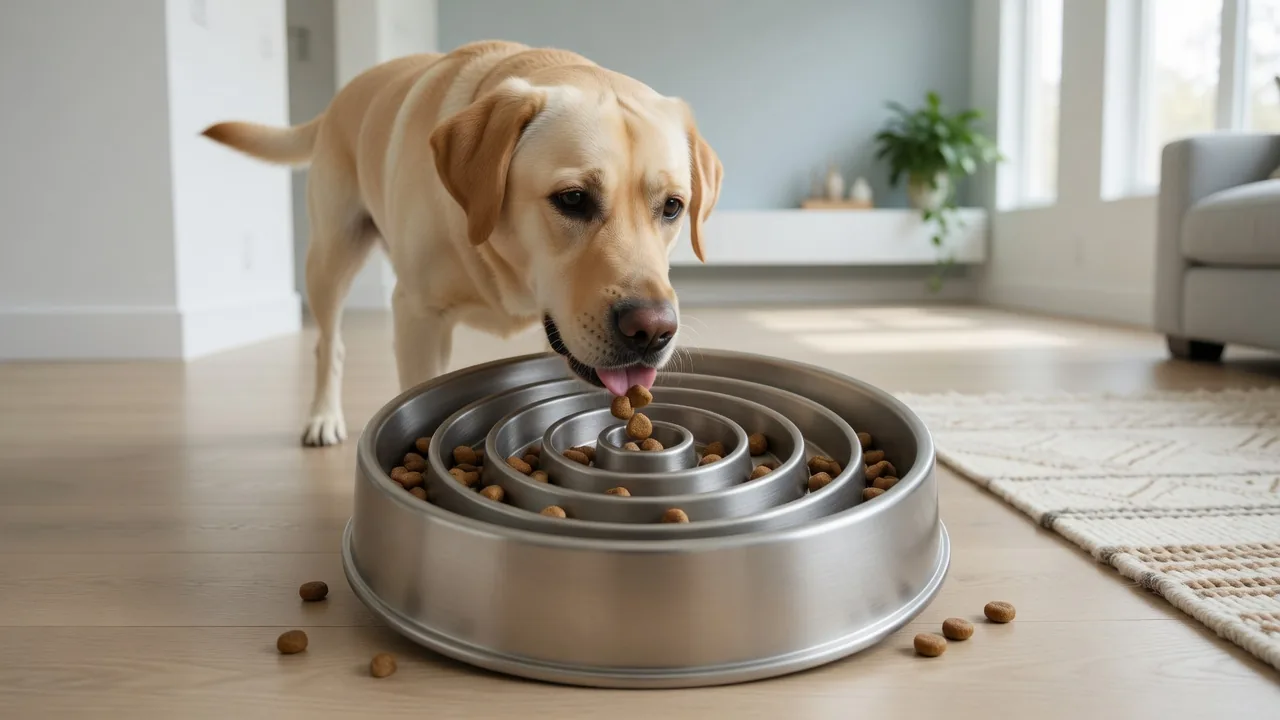
1. Feed meals as a job. This is the highest-value change, because it happens twice a day whether you're busy or not. A stainless steel slow feeder bowl turns a gulped meal into several minutes of working food out of a maze. A snuffle mat turns it into a search. Alternate them so neither becomes routine.
2. Give the first ten minutes of a walk to the nose. Long lead, slow pace, dog chooses the direction and how long to stand at each lamp post. Then walk normally.
3. Train for three minutes while the kettle boils. One behaviour, a handful of kibble from the daily ration, stop while the dog still wants more. Short and frequent beats one long session.
4. Rotate rather than accumulate. Keep most toys in a cupboard and swap two or three in each week. A toy that's been away for a fortnight is new again.
5. Finish the day with something calming. Licking and chewing lower arousal, which makes them a good last activity before bed. Our lick mat guide explains how to use one.
A sample week
| Day | Breakfast | Daytime | Evening |
|---|---|---|---|
| Mon | Slow feeder | Sniffy walk | 3 min training |
| Tue | Snuffle mat | Normal walk | Chew or lick mat |
| Wed | Slow feeder | "Find it" with 10 treats around one room | 3 min training |
| Thu | Snuffle mat | New walking route | Rest |
| Fri | Slow feeder, kibble dampened | Sniffy walk | Puzzle toy |
| Sat | Scatter feed in the garden | Longer outing somewhere new | Chew |
| Sun | Snuffle mat | Normal walk | 3 min training, a new trick |
Nothing in that table takes more than fifteen minutes, and most of it replaces something you'd do anyway.
How do you make it harder (or easier) over time?
A puzzle your dog solves instantly isn't stimulation any more; one they can't solve is just frustrating. Aim for the level where they succeed with effort.
- Start easy. First time on a snuffle mat, leave kibble visible on top. First time with a puzzle, leave compartments half open.
- Raise one thing at a time: bury food deeper, add water and freeze, hide treats in another room, ask for a longer "wait" before the search.
- Step back down if your dog quits, barks at the toy, or starts chewing it rather than solving it.
For purpose-built puzzles, our dog puzzle toy levels explained guide shows what each difficulty level involves.
Can you over-stimulate a dog?
Yes, and it's more common than people expect, particularly with young working-breed dogs whose owners keep adding activities to "tire them out". A dog with a packed schedule and no practice at doing nothing gets worse at settling, not better.
Signs you've overdone it:
- Frantic or grabby behaviour, zoomies, mouthing after a session
- Unable to settle for an hour or more afterwards
- Barking or pawing at a puzzle; giving up and walking away
- Guarding the food toy from people or other pets
- Sleeping noticeably less overall
Adult dogs commonly sleep and doze for well over half the day, and puppies for more. Rest isn't wasted time; it's part of the plan. If you see the signs above, cut the difficulty, shorten sessions, and swap exciting activities (tug, fetch, hard puzzles) for calming ones (sniffing, licking, chewing). Nervous dogs benefit from a gentler approach altogether, which we cover in enrichment for anxious dogs.
What are the common mistakes?
- Adding food instead of moving it. Everything in a puzzle or mat should come out of the daily ration, or the waistline pays.
- Leaving a dog alone with a new puzzle. Supervise until you know they won't chew pieces off.
- Using the same activity every day. Dogs get efficient. Efficient is the opposite of stimulated.
- Treating it as a cure for everything. Boredom is one cause of problem behaviour. Pain, anxiety and medical issues are others.
- Only using it when the dog is already bouncing off the walls. It works better as a routine than as a rescue.
When is it not a stimulation problem?
Speak to your vet if behaviour changes suddenly, if an older dog becomes restless at night or seems confused, if a dog licks, chews or spins compulsively, or if destruction only happens when they're left alone — that pattern points to separation distress rather than boredom, and more puzzles won't fix it. A vet can rule out pain and refer you to a qualified behaviourist if needed.
The bottom line
A dog's brain needs daily work as much as its legs do, and the cheapest way to provide it is to stop serving food in a plain bowl. Feed meals as a puzzle or a search, let the nose lead for part of every walk, train in three-minute bursts, and protect your dog's rest. Start with one change this week and watch the evenings.
👉 Snuffle Mat for Dogs → for daily scent work 👉 Stainless Steel Slow Feeder Dog Bowl → to turn meals into a puzzle
Without enough mental work, many dogs turn to chewing furniture; our guide on why your dog is destroying everything separates boredom from anxiety and other causes.
Frequently Asked Questions
What counts as mental stimulation for dogs? Any activity that makes a dog think, sniff or solve a problem rather than move on autopilot. The main types are scent work, food puzzles, training, new experiences, and calming activities like licking and chewing. A slow walk where the dog chooses what to sniff counts; a brisk march on a short lead mostly doesn't.
How much mental stimulation does a dog need per day? There's no official figure, but 20–40 minutes a day in short blocks suits most healthy adult dogs. Working, herding and gundog breeds and adolescents often need more; puppies and seniors need shorter, easier sessions. Feeding both meals from a slow feeder or snuffle mat covers a good share of it.
Is mental stimulation more tiring than a walk? It's tiring in a different way. Focused sniffing and problem-solving often leave a dog calmer than physical exercise does, but the popular claim that fifteen minutes of sniffing equals an hour's walk isn't backed by research. Dogs need both movement and brain work.
How do I mentally stimulate my dog at home? Feed meals from a slow feeder or snuffle mat, hide a few treats around a room and say "find it", do three minutes of trick training, rotate toys weekly, and offer a lick mat or chew in the evening. Use food from the daily ration so you aren't adding calories.
Can a dog have too much mental stimulation? Yes. Signs include frantic behaviour after sessions, being unable to settle, barking at or abandoning puzzles, and sleeping less. Cut back the difficulty and length, favour calm activities like sniffing and licking, and make sure your dog gets plenty of undisturbed rest.
How do I know if my dog needs more mental stimulation? Common signs are chewing, digging, demand barking, pacing and attention-seeking despite regular walks. If these ease within a couple of weeks of adding daily brain work, boredom was likely the cause. Sudden changes, compulsive behaviours or problems only when left alone need a vet's input.