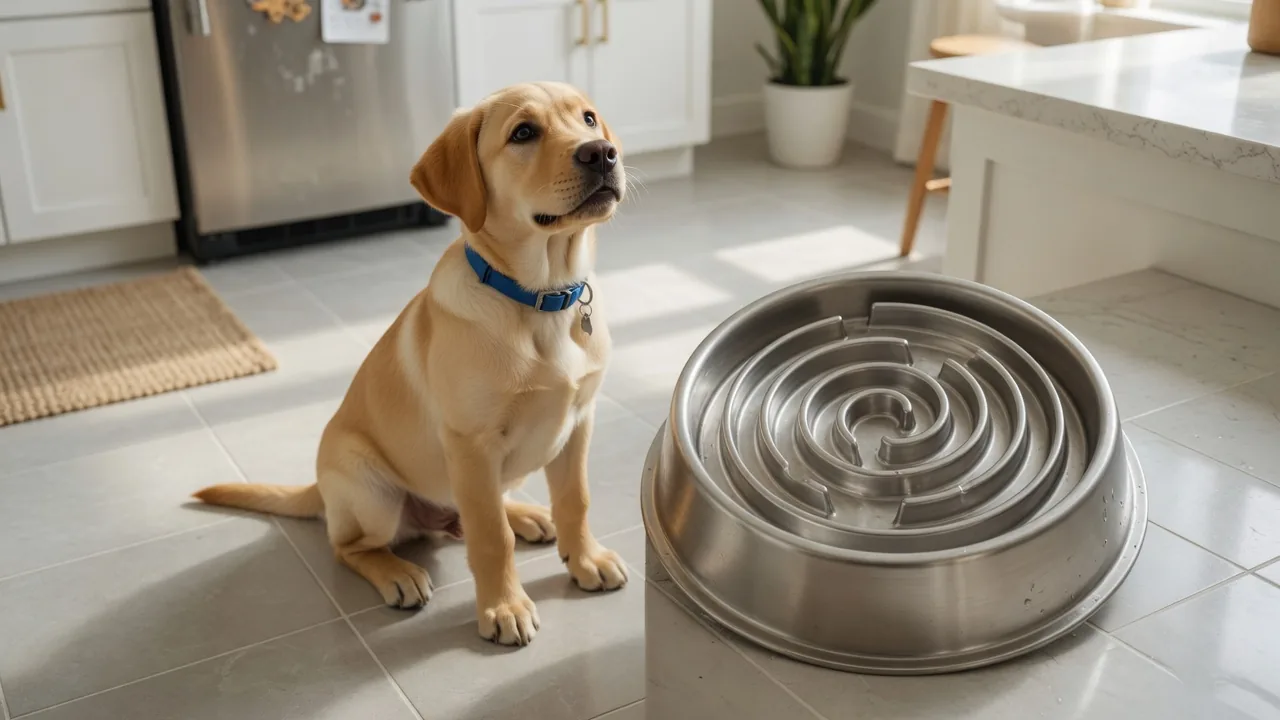
Puppy Feeding Schedule: A Guide By Age
A puppy feeding schedule generally starts at 4 meals a day at 8–12 weeks old, drops to 3 meals by 3–6 months, and moves to 2 meals a day by about 6 months. Most dogs settle into 1–2 adult meals around 12 months, though large and giant breeds often stay on puppy food longer. Exact amounts come from the food label and your vet.
The rest of this guide covers the part the label can't: how the routine actually works day to day. That means sample clock times, how to drop a meal without upsetting your puppy's stomach, what changes for large breeds, and what to do when a puppy gulps or refuses food.
How many times a day should a puppy eat, by age?
Puppies need smaller, more frequent meals than adult dogs because their stomachs are small and their energy needs, relative to body size, are high. Most veterinary and kennel-club guidance lands in roughly the same place:
| Age | Meals per day | Typical spacing | Notes |
|---|---|---|---|
| 8–12 weeks | 4 | Every 4–5 hours while awake | Often moistened or softened food at the youngest end, per the breeder or vet |
| 3–6 months | 3 | Morning, mid-afternoon, evening | Drop from 4 to 3 gradually, not overnight |
| 6–12 months | 2 | Morning and evening, 10–12 hours apart | Growth slows; many puppies show it by leaving the midday meal |
| 12 months+ | 1–2 | Same two times is fine | Two smaller meals suit most dogs better than one large one |
| Large and giant breeds | Often 3 until around 6 months, then 2 | Ask your vet | Stay on large-breed puppy food until your vet says to switch |
Treat the ages as a starting framework. A puppy who is plainly not hungry for the midday meal at 5 months is telling you something, and a puppy who is still ravenous and losing condition at 7 months is telling you something else. Your vet can sort out which is which, especially for large breeds where growth rate needs watching.
Puppies of 10 weeks, 11 weeks, 12 weeks or "about 2 months" all sit in the first row. Hold four meals until closer to 3 months before you start easing toward three.
What does a day on a puppy feeding schedule look like?
Clock times matter less than the pattern: roughly even gaps, same times daily, a potty break around each meal. Here are two samples you can adapt to your own working day.
4 meals a day (8–12 weeks)
- 7:00 a.m. — breakfast, then straight outside
- 11:30 a.m. — lunch
- 4:00 p.m. — dinner
- 8:00 p.m. — last meal, with the final potty trip just before bed
3 meals a day (3–6 months)
- 7:30 a.m. — breakfast
- 12:30 p.m. — lunch
- 5:30 p.m. — dinner, which leaves a few hours before bedtime for digestion and one more toilet break
2 meals a day (6 months+)
- 7:30 a.m. and 6:00 p.m. is a common pair. About 10–12 hours apart is the target; much longer than that and many dogs, especially smaller ones, get hungry enough to vomit bile.
If you work away from home, the midday meal is the awkward one. A neighbour or a dog walker can cover it, and it is worth sorting out before your puppy comes home rather than after.
Feed the last meal at least two to three hours before bedtime when you can. Puppies usually need to poop within a half hour or so of eating, so a meal at 10 p.m. becomes a 2 a.m. toilet trip.
How do you move from four meals to three, and three to two?
The schedule changes in steps, and puppies tell you when they are ready. Look for these signs:
- The midday meal is left half-eaten for several days in a row.
- Your puppy is eating the other meals eagerly and is not losing weight.
- Their energy and coat look good.
When you see them, use a gradual swap rather than a hard cut:
- For a week, make the meal you are dropping a little smaller and add the difference to the neighbouring meals.
- If appetite and stools stay normal, shrink it further.
- Drop it once it is a token amount. The daily total hasn't changed, only how it is divided.
If you are changing the food itself at the same time, don't. Change one variable per fortnight so a bout of loose stools has only one possible suspect. When you do switch foods, the usual advice is to blend old and new over about a week, increasing the new share a little each day.
Do large-breed puppies eat differently?
Yes, in two ways that matter.
Food choice. Large and giant breeds are generally advised to eat a food formulated for large-breed growth. These foods control calories and calcium so a puppy doesn't grow faster than the skeleton can cope with, which is associated with orthopaedic problems later. Ordinary puppy food is built for different needs. Your vet can tell you which formula fits your puppy.
Timing. Large-breed puppies often stay on three meals a day a bit longer, and they stay on growth food well past a year; the American Kennel Club guidance gives roughly 18–24 months for large and giant breeds compared with about 12 for small and medium ones. The adult switch is a vet conversation, not a birthday.
Large puppies are also the group where overfeeding does the most harm. A chubby Labrador or Great Dane puppy looks adorable and is being quietly set up for joint trouble. If you can feel ribs under a thin layer of padding and see a waist from above, the feeding is about right. If you're not sure, ask your vet to score your puppy's body condition at the next vaccination visit. Our guide to how much to feed your dog covers working out the daily amount.
Why do puppies need such frequent meals?
A young puppy's blood sugar can drop faster than an adult dog's, particularly in small and toy breeds. A long gap between meals can leave a puppy lethargic, shaky or wobbly, a mild version of what is sometimes called juvenile hypoglycaemia. Frequent meals smooth that out while the body builds the reserves to go longer.
Consistency also pays off elsewhere:
- Housetraining. Puppies tend to need to go shortly after eating, so a predictable schedule makes toilet breaks predictable too.
- Digestion. A steady rhythm tends to mean steadier stools.
- Behaviour. A puppy who knows when food is coming is generally calmer around the bowl than one who is guessing.
If a small-breed puppy ever seems weak, wobbly, or unresponsive between meals, treat that as urgent and call a vet rather than waiting for the next feed.
Should you leave food out, or feed at set times?
For most puppies, set meal times beat free-feeding. Measured meals let you see exactly how much your puppy eats, spot appetite changes early, and predict toilet breaks. Free-feeding makes all three harder and can encourage overeating.
The 15–20 minute rule is a sensible approach: put the bowl down, and lift it after about 15–20 minutes whether or not it's empty. Don't fuss and don't add toppers to coax them. A healthy puppy will usually learn quickly that meals appear on time and don't hang around. If a puppy repeatedly walks away from most of their food, though, that's a symptom, not a standoff. See the vet section below.
What if your puppy eats too fast?
Plenty of puppies inhale the bowl in under a minute, then cough, gag, or bring it straight back up. The usual fixes, roughly in order of effort:
- Smaller, more frequent meals. The same daily total split into one more meal puts less in the stomach at once.
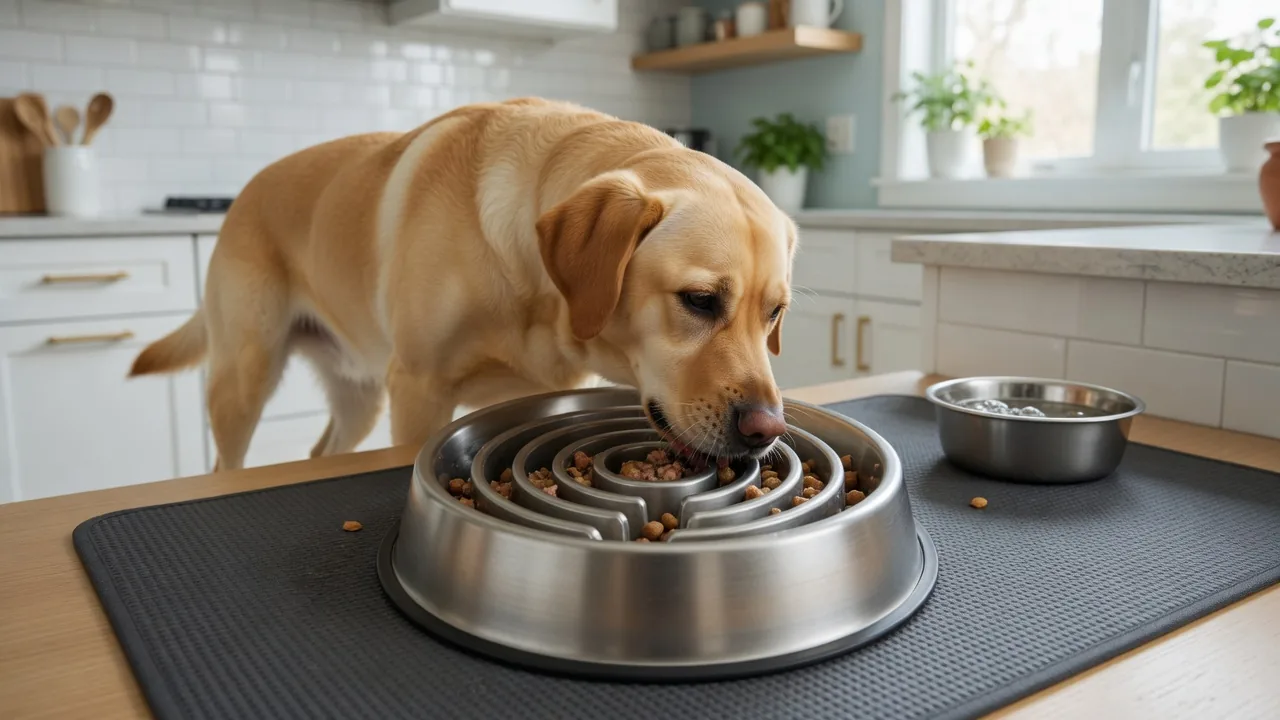
- A slower bowl. A stainless steel slow feeder breaks the meal into pockets between raised ridges, so your puppy has to work for each bite. It doesn't change how much they eat, only how fast. Check that the maze isn't too deep for a tiny muzzle; our roundup of the best slow feeders for puppies covers fit.
- A snuffle mat for one meal a day. A snuffle mat turns part of a meal into a sniffing job, which tends to calm excitable eaters. Count the food towards the daily total.
- Keep mealtime boring. An overexcited puppy gulps harder; feed in a quiet spot, and ask for a sit before the bowl goes down.
Our full guide on puppy eating too fast goes through the causes and the step-by-step training approach.
Our Stainless Steel Slow Feeder Dog Bowl has a non-slip base, so an enthusiastic eater doesn't send it skating across the kitchen floor.
What if your puppy won't eat, or is always hungry?
A puppy who skips meals. One missed meal in an otherwise bright, playful puppy, particularly around vaccinations, a move, or teething, is usually nothing. Don't pile on treats or toppers, which teaches them that holding out gets a better deal. If it lasts more than a day, or a toy-breed puppy skips more than one meal, call the vet.
A puppy who is always hungry. Puppies are growing quickly and often act starving. Check the amount against the food label and your puppy's body condition first; if both look right, a puppy who is lean, active and still ravenous deserves a vet check for worms or malabsorption. Our guide on why dogs are always hungry goes through the list.
When should you call the vet about your puppy's feeding?
A general schedule works for most healthy puppies. Contact your vet if you notice:
- Refusing meals, or seeming uninterested in food for more than a day
- Vomiting or diarrhoea lasting more than a day, or any blood
- Lethargy, shaking or weakness between meals, especially in a small or toy puppy
- A swollen, hard or painful belly
- Weight gain or loss that doesn't match what you would expect for their age and breed
Puppies can go downhill faster than adult dogs, so a call is better than waiting and guessing.
Puppy feeding schedule checklist
- Feed at the same times every day, spaced evenly
- Measure portions with a scoop or scale, not by eye
- Take up the bowl after 15–20 minutes
- Keep the last meal at least a couple of hours before bed
- Change foods over 7–10 days, one change at a time
- Slow gulping with a slow feeder or snuffle mat
- Ask your vet before dropping a meal, especially for large breeds
Once your puppy eats soft foods, a lick mat can give them a calm activity between meals; see when puppies can have lick mats.
The bottom line
A good puppy feeding schedule starts frequent, about four meals a day for very young puppies, and tapers to two by around six months and an adult routine by about a year, later for large and giant breeds. Amounts come from the food label and your vet. What you control is consistency, spacing meals evenly, keeping the last one well before bedtime, and changing one thing at a time. If your puppy gulps, the bowl you serve it in is the easiest fix.
👉 See the Stainless Steel Slow Feeder Dog Bowl →
Frequently Asked Questions
How many times a day should I feed my puppy? Roughly 4 meals a day for puppies 8–12 weeks old, 3 meals from about 3–6 months, and 2 meals from around 6 months onward. Large and giant breeds sometimes stay on 3 meals a little longer. Confirm portion size with your vet and your food's feeding label.
What time should I feed my puppy? There is no single correct time. Consistency matters more. Space meals evenly through the waking day, for example around 7 a.m., noon and 5 p.m. for a three-meal puppy, and feed the last meal two to three hours before bedtime so there is time for a final toilet trip.
When can I switch my puppy to fewer meals? Most puppies move from 4 to 3 meals around 3 months and from 3 to 2 meals around 6 months. Do it gradually: shrink the meal you are dropping over about a week and move that food to the others. Ask your vet if you have a large or giant breed.
When do puppies switch from puppy food to adult food? It varies by size. Small and medium breeds are often ready at around 12 months or a bit earlier; large and giant breeds usually stay on large-breed puppy food until roughly 18–24 months. Ask your vet before switching.
Should I wake my puppy up to feed them? Generally no, unless your vet has told you to. A healthy puppy that sleeps through a mealtime will wake hungry. The exception is very small or toy puppies, where long gaps can drop blood sugar; check with your vet about how to handle night and gaps for your puppy.
My puppy eats too fast. What can I do? Try splitting the same daily amount into one more meal and serve it in a slow feeder bowl with a raised maze pattern, which limits how much your puppy can grab in a mouthful. Keep mealtime calm. See our guide on puppy eating too fast for more.
How long should a puppy eat before I take the bowl away? Around 15–20 minutes is a sensible window. Pick it up whether or not it is empty and offer the next meal at the usual time. If your puppy regularly leaves most of the food, mention it to your vet.
What is a good feeding schedule for an 8-week-old puppy? At 8 weeks, most puppies eat four small meals a day, spaced evenly, for example around 7 a.m., noon, 5 p.m. and 9 p.m. Follow the portion on the food label and your vet's advice.
Can a puppy use a lick mat at mealtime? Many puppies can once they eat soft food and are supervised. Count anything you spread on the mat toward the daily total, and see when puppies can have lick mats.