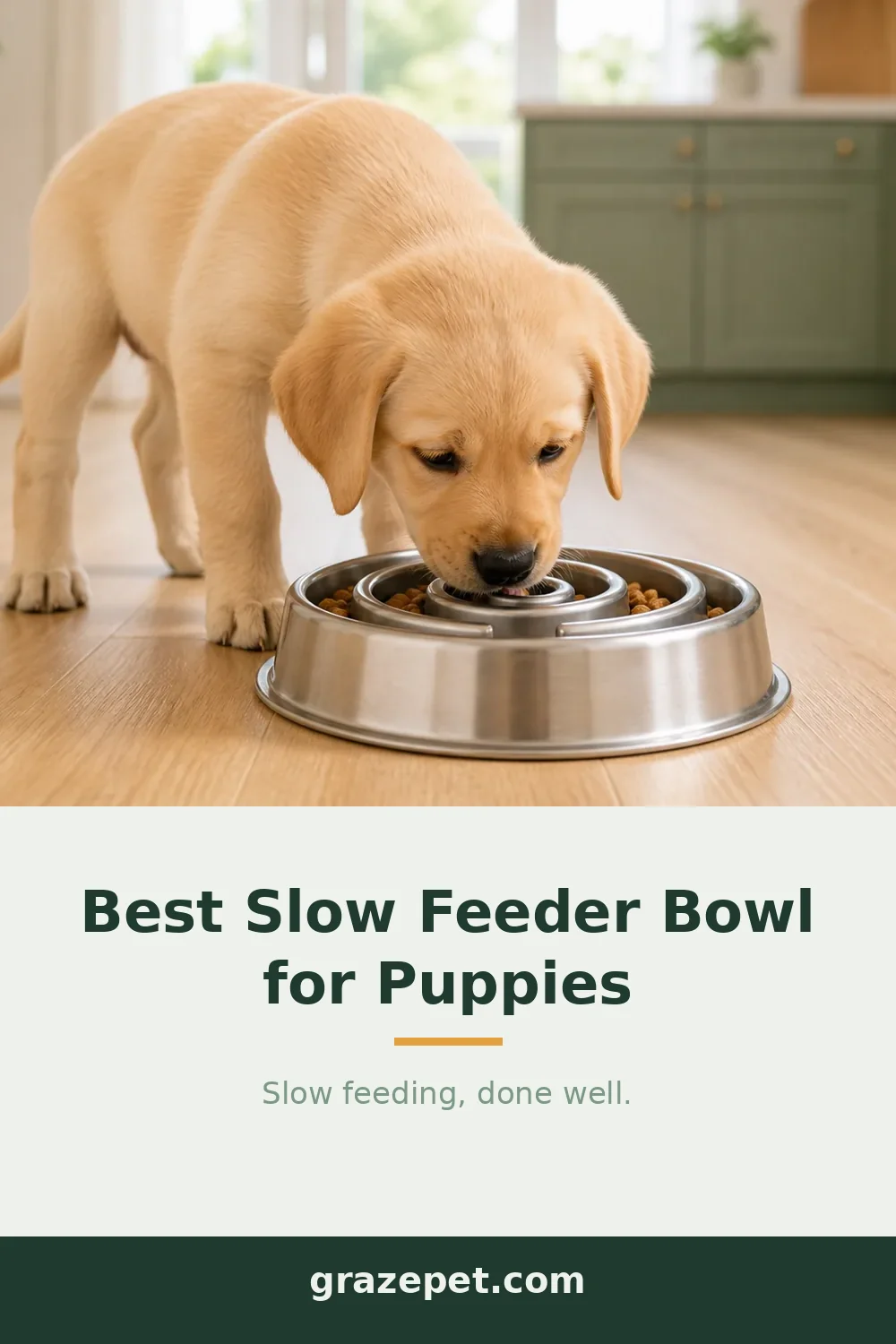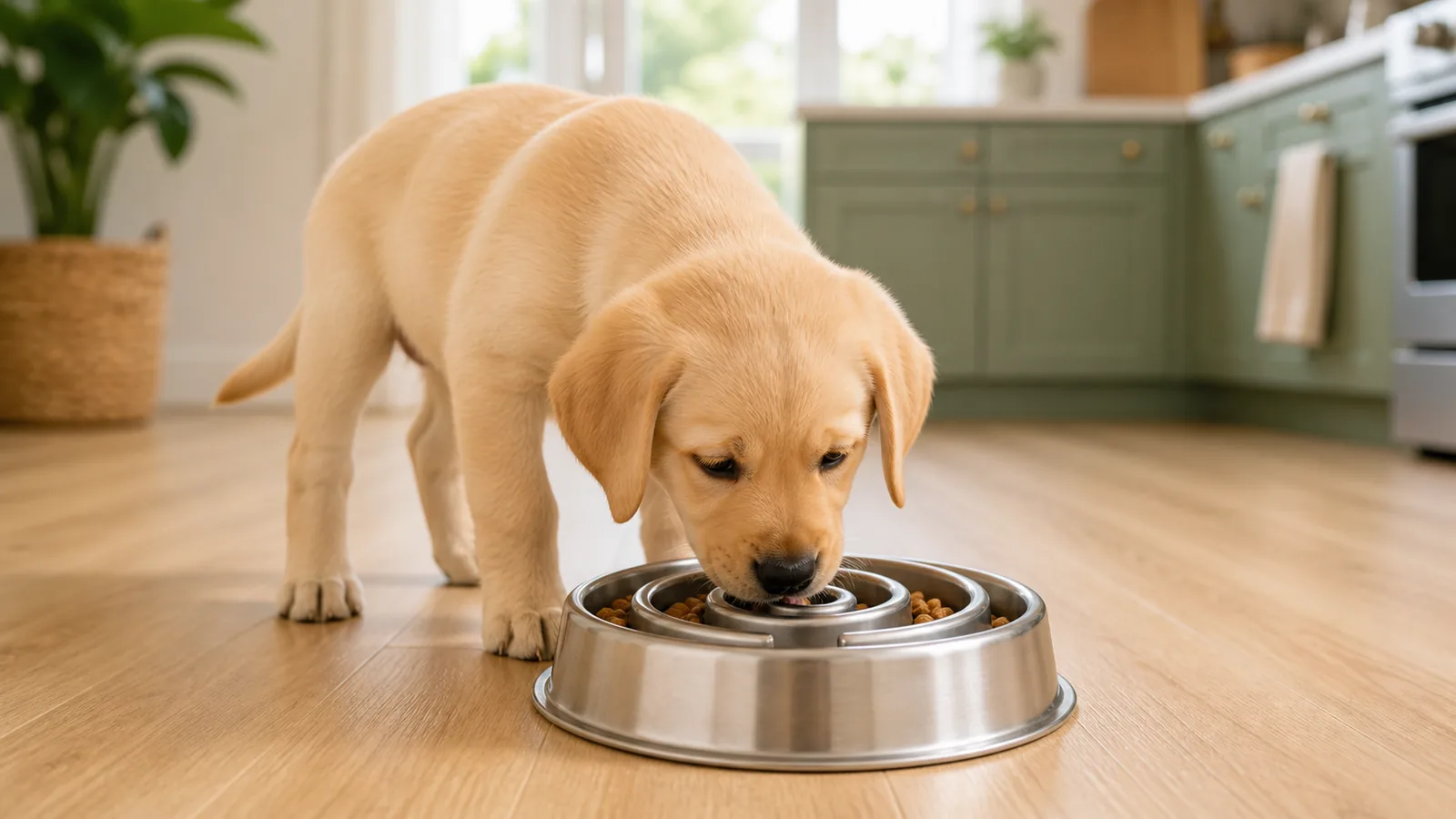
Best Slow Feeder Bowl for Puppies
The best slow feeder bowl for puppies is a small, shallow one: wide channels, low rounded ridges, a non-slip base, and a material that can't be chewed apart, such as stainless steel. Puppies can start from about 8 weeks. The bowl should slow them down a little, never stop them finishing the meal.
That last point is what separates puppies from adult dogs. With an adult gulper you want the hardest maze they'll tolerate. With a puppy, getting every calorie in matters more than the pace, so you pick an easy pattern and move up as they grow. This guide goes through when to start, which bowl suits which stage, what to check at every meal, and when a puppy shouldn't use one at all.
Does a puppy need a slow feeder at all?
Not every puppy does. Time a meal first.
- Gone in under 30 to 60 seconds, with gagging, coughing, hiccups or food coming back up: a slow feeder is worth using.
- Finished in a couple of minutes, calmly: a plain bowl is fine. You could still use an easy slow feeder for enrichment.
- Picks at food, walks away, or has to be coaxed: don't add an obstacle. Talk to your vet if a puppy isn't keen to eat.
Most puppies do eat fast. They've come from a litter where the quickest eater got the most, they're growing, and food is thrilling. Our guide to a puppy eating too fast explains the reasons and when it's a concern.
When can a puppy start using a slow feeder?
Most puppies can use an easy slow feeder from around 8 weeks, which is when they typically go to their new homes and are eating solid food confidently.
Before that, puppies are being weaned onto softened food and are still learning to eat from a dish at all. A flat plate or shallow bowl is the right tool then.
Three conditions matter more than the exact age:
- Your puppy eats solid or softened food eagerly from a normal bowl.
- Their muzzle and tongue can reach the bottom of the channels.
- They finish the whole meal from the slow feeder in a reasonable time.
If any of those isn't true yet, wait a couple of weeks and try again.
Which slow feeder suits which puppy stage?
| Age | What's happening | Bowl to use | Notes |
|---|---|---|---|
| Under 8 weeks | Weaning, learning to eat | Flat dish or shallow plain bowl | No slow feeder yet |
| 8–12 weeks | Tiny mouth, baby teeth, 3–4 small meals a day | Small, shallow bowl with low, wide-spaced ridges or a single dome | Kibble may be softened; easy pattern only |
| 3–6 months | Rapid growth, teething, chewing everything | Small to medium, moderate ridges, chew-proof material | Check bowl size monthly |
| 6–12 months | Adult teeth in, portions near adult size | Medium to large, standard maze | Move up in difficulty if still gulping |
| 12 months+ (later for giant breeds) | Adult | Size and maze for adult weight | See breed and size guides |
How often to feed at each age is covered in our puppy feeding schedule.
A common question is whether to buy the adult-sized bowl straight away for a puppy who'll grow into it. For small and medium breeds, one well-chosen bowl often works throughout. For large breeds, an adult bowl is usually too deep and too big for a 10-week-old: a quarter-cup meal gets lost in it and the ridges are taller than the puppy's muzzle is long. A small bowl first, then a large one from about 5 or 6 months, works better.
What should you look for in a puppy slow feeder?
Shallow depth and wide channels
A puppy's muzzle is short and their tongue is small. They should be able to reach the floor of the bowl without pressing their face into the ridges. If you can fit two of your fingers side by side in the channels of a small-breed puppy's bowl, that's about right.
Low, rounded ridges
Puppy teeth and gums are delicate, particularly during teething. Smooth, rounded shapes are kinder than thin or sharp-edged fins.
Capacity that matches a tiny portion
Puppy meals are small: often a quarter to a half cup for small breeds and up to a cup or so for large-breed puppies, split across three or four meals. Follow your food's puppy feeding guide and your vet. The portion should cover the channels in a thin layer. In an oversized bowl it won't.
A material that survives teething
Between roughly 3 and 6 months, puppies lose their baby teeth and chew anything in reach, including the bowl. Soft plastic gets gnawed, and chewed plastic can be swallowed and leaves rough edges that are hard to clean. Stainless steel can't be chewed apart. It's also easy to clean thoroughly, which matters for a young animal whose immune system is still developing.
A base that grips
Puppies climb into bowls, paw at them and push them along the floor. A rubber base, plus a mat underneath, keeps the bowl where you put it.
Easy to wash
Puppy food is often softened or mixed with wet food, which sticks in grooves. Dishwasher-safe is a real advantage.
Our Stainless Steel Slow Feeder Dog Bowl has a rounded raised maze, a non-slip base and dishwasher-safe steel. It suits puppies who are big enough to reach the channels comfortably; check the size against your puppy's muzzle, and for a very small or very young puppy start with a shallower dish and move to it later.
👉 See the Stainless Steel Slow Feeder Dog Bowl →
How do you introduce a slow feeder to a puppy?
- Start with one meal a day in the slow feeder and the others in the normal bowl.
- Make the first tries easy. Put a few pieces of kibble on top of the ridges and the rest in the channels.
- Keep the portion the same. Measure it as usual.
- Feed somewhere quiet, away from other pets and children.
- Stay and watch. You're checking that they can reach the food, aren't getting frustrated, and aren't chewing the bowl.
- Give it 10 to 15 minutes. If food is left because they couldn't get it, tip the rest into a plain bowl so they still eat the full meal.
- Move to every meal once they're finishing comfortably, usually within a few days.
- Take the bowl away when it's empty so it doesn't become a chew toy.
A good result for a puppy is a meal that takes roughly 3 to 8 minutes. That's long enough to stop gulping without wearing out a young dog's patience.
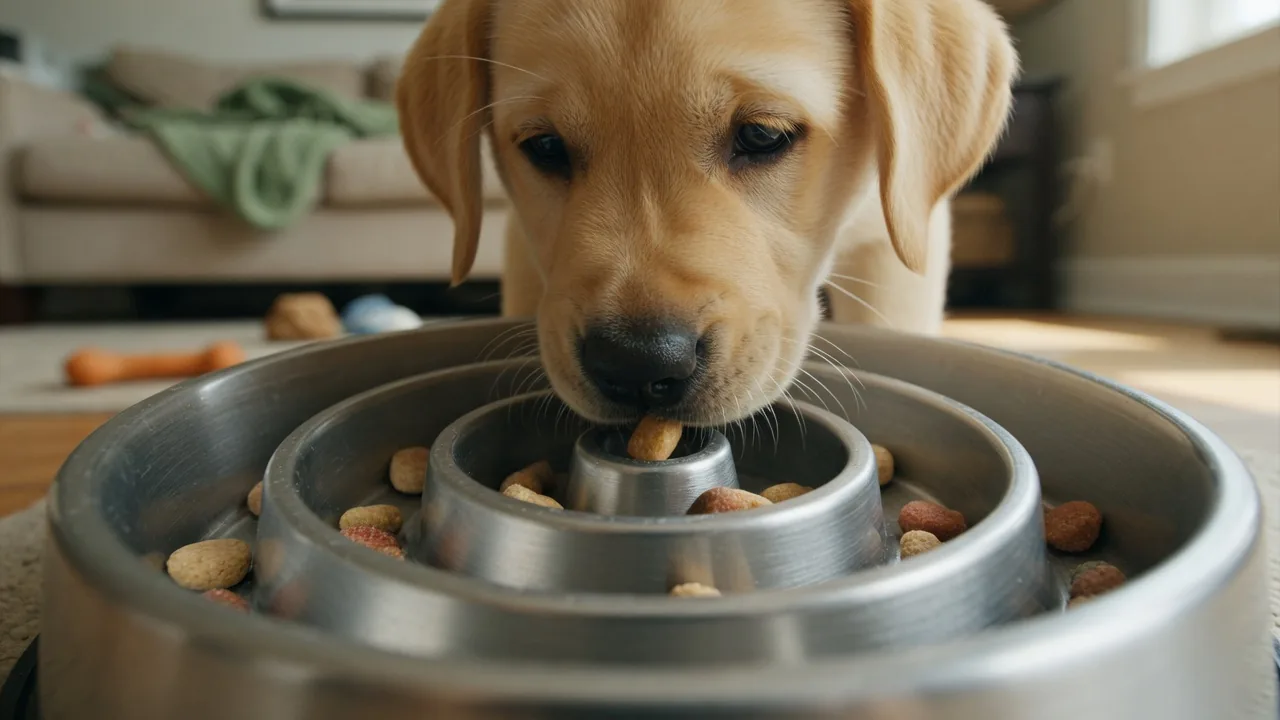
How do you make sure your puppy is eating enough?
This is the check that matters most.
- The bowl should be empty at the end, or nearly. Count what's left.
- Weigh your puppy regularly. Weekly at home, or at vet visits. Puppies should gain steadily.
- Watch energy and mood. A puppy who's bright, playful and growing is getting enough.
- Check the bowl for hidden leftovers. Softened food can pack into corners where a small tongue can't reach.
Take extra care with toy and very small breeds. Tiny puppies have little energy in reserve and can develop low blood sugar if they miss meals. Signs include weakness, wobbliness and unusual sleepiness, and it needs urgent veterinary attention. For these puppies, use only the easiest pattern, make sure every meal is finished, and ask your vet before using a slow feeder at all.
When should a puppy not use a slow feeder?
- Under 8 weeks or still weaning.
- Underweight, unwell, or recovering from illness. Every mouthful should be easy.
- A poor or fussy eater.
- Toy-breed puppies who don't reliably finish meals.
- Flat-faced puppies in a deep maze. Pugs, French bulldogs and similar breeds need a very shallow, wide design. See our slow feeder guide for bulldogs for what works with short muzzles.
- A puppy who chews the bowl, if the bowl is plastic or silicone.
See your vet if your puppy vomits repeatedly, has a swollen belly, has diarrhoea, isn't gaining weight, or loses interest in food.
What else slows a puppy down?
A bowl isn't the only option, and variety is good for a developing brain.
- Hand-feed part of the meal as training rewards. Sits, name recall and handling practice, paid for with dinner. This is the best use of a puppy's kibble.
- Scatter feeding on a clean floor.
- A snuffle mat, supervised, so your puppy sniffs out each piece. Take it away afterwards so it isn't chewed.
- A lick mat for soft food, again supervised. See when puppies can have lick mats.
The bottom line
For a puppy, choose an easy slow feeder: shallow, wide channels, rounded ridges, non-slip, and made of something teething can't destroy. Start from about 8 weeks if they're gulping, watch the first meals, and check the bowl is empty at the end. Size up as they grow. If your puppy is tiny, underweight or not keen on food, skip the slow feeder and speak to your vet.
👉 Stainless Steel Slow Feeder Dog Bowl →
Frequently Asked Questions
What is the best slow feeder bowl for puppies? A small, shallow bowl with wide channels, low rounded ridges and a non-slip base, made from a material a teething puppy can't chew apart, such as stainless steel. Choose an easy pattern. A puppy should be slowed slightly but still finish every meal.
At what age can a puppy use a slow feeder? Most puppies can start around 8 weeks, once they're eating solid or softened food confidently from a normal bowl. Younger puppies who are still weaning should eat from a flat dish or shallow plain bowl.
Are slow feeders safe for puppies? Yes for most, if the pattern is easy and you watch the first meals. The main risks are a puppy not finishing their food and a teething puppy chewing a plastic bowl. Toy-breed, underweight or unwell puppies should only use one with a vet's agreement.
How long should a puppy take to eat from a slow feeder? Roughly 3 to 8 minutes is a good range. Under a minute means the bowl isn't slowing them. If your puppy can't finish in 10 to 15 minutes, the maze is too hard, so put the rest in a plain bowl and switch to an easier design.
Should I buy a puppy-sized slow feeder or one they'll grow into? For small and medium breeds, one bowl often lasts. For large breeds, an adult bowl is usually too deep for a young puppy and their small meals get lost in it. Start small and move to a large bowl at around 5 to 6 months.
Can I put softened or wet puppy food in a slow feeder? Yes. Spread it into the channels in a thin layer. Choose a shallow, smooth design, because soft food packs into deep corners where a small tongue can't reach, and wash the bowl after every meal.
Is stainless steel or plastic better for a puppy slow feeder? Stainless steel is the safer choice during teething because it can't be gnawed into pieces and it cleans thoroughly. Plastic is lighter and comes in more puppy-sized shapes but scratches and gets chewed, so it needs checking often and replacing when damaged.
Save this guide