Enrichment for Senior Dogs: Gentle Ways to Keep Them Sharp
Somewhere between the last long hike and the current routine of short garden loops, a lot of senior dogs quietly get retired. Not on purpose. The walks get shorter because the hips complain, the fetch stops because the sprinting stopped, the puzzle toy goes in the cupboard because it seemed frustrating. Each decision makes sense on its own. Added together, they leave an older dog with a very comfortable, very empty day.
Senior dog enrichment is about scaling activities down to match what your dog's body can still do, not cutting them out — because mental engagement is one of the few needs that doesn't shrink with age, even as exercise tolerance does. A ten-minute sniff around a familiar yard can give an older dog's brain something close to what a long walk used to give their body.
Quick answer: aim for two or three short, low-impact sessions a day (5 to 10 minutes each), built around scent and soft food rather than running or jumping. A slow feeder or snuffle mat at mealtime, a lick mat on the bed and a sniff-led walk cover most of it. Any sudden change in behaviour, appetite or balance is a job for your vet first.
Below: why that still matters, how to spot a senior dog who isn't getting enough of it, and the low-impact ideas that work around arthritis, fading eyesight, sore teeth, and a shorter battery life. This is the activity side only — for portions, meal timing, and diet changes, our senior dog feeding guide covers that ground separately.
Why enrichment still matters as dogs age
Dogs slow down cognitively as well as physically. Some older dogs develop canine cognitive dysfunction (CCD), a dementia-like condition associated with disorientation, disrupted sleep cycles, and fading interest in things they used to love. Research into CCD is still developing, and it's genuinely a diagnosis — only a vet can make it, and the signs overlap heavily with pain, hearing loss, and other conditions common in older dogs. What can be said fairly is that regular mental stimulation is widely believed by veterinary behaviorists to support cognitive health in aging dogs, broadly the way staying mentally active is encouraged in aging humans. That's a reason to keep your dog's brain busy. It is not a treatment, and no snuffle mat is going to reverse cognitive decline.
The physical side is simpler. Arthritis and reduced stamina mean the exercise that used to empty a dog's tank isn't available anymore — but the drive to sniff, forage, and work for food doesn't retire alongside the legs. When that drive has nowhere to go, it resurfaces in less convenient forms: pacing in the evening, restlessness at 2am, following you room to room, barking at nothing. Plenty of owners read that as "she's just getting old and anxious." Sometimes it's closer to a dog with a working brain and an empty schedule.
The useful reframe is this: you're not replacing the walk. You're replacing the job the walk used to do.
Signs your senior dog could use more stimulation
There's no clean test for this, and almost every sign below can also be a medical one, which is exactly why this section comes with a caveat attached rather than a checklist you can act on alone. Still, the patterns owners tend to notice first are:
- Restlessness or pacing, particularly in the evening and overnight
- Losing interest in toys and games they used to seek out
- More vocalizing than usual, without an obvious trigger
- Sleeping heavily through the day but seeming unsettled at night
- Disorientation — staring at walls, getting stuck behind furniture, looking lost in a room they've known for a decade
That last one deserves its own sentence: disorientation in a familiar space is a vet conversation, not an enrichment problem. The same goes for a sudden drop in interest in toys, which can just as easily point to dental pain or failing vision. Rule out the medical explanations first. If your vet finds nothing pressing and the restlessness is still there, then it's fair to treat it as under-stimulation and start filling the day back in.
Start with meals, because they're already happening
The best enrichment for a senior dog is the kind you don't have to remember to do. Meals arrive twice a day whether you're motivated or not, which makes them the highest-leverage thirty seconds of the routine to change.
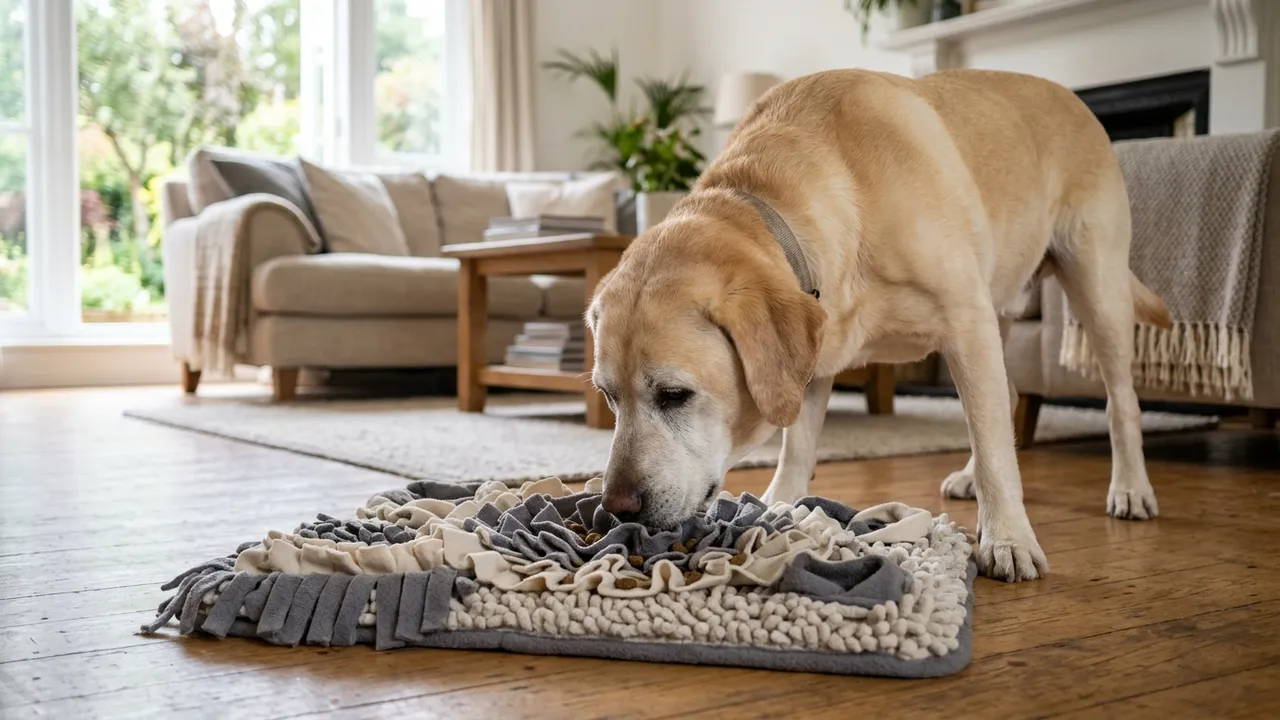
A stainless steel slow feeder is the simplest version. The raised maze pattern turns a bowl that gets inhaled in half a minute into several minutes of deliberate nose-and-tongue work, done standing in one spot with nothing asked of the joints.
A snuffle mat goes further in the same direction. Scatter a portion of kibble into the fleece and your dog has to find every piece by scent — more mentally demanding than it looks, and possible lying down if standing is uncomfortable. Scent work is the most senior-friendly category of enrichment there is, and this is the easiest way in.
Both work with the food you already feed. Neither adds calories, which matters for senior dogs whose weight is being watched — see the senior dog feeding guide for the portion side of that.
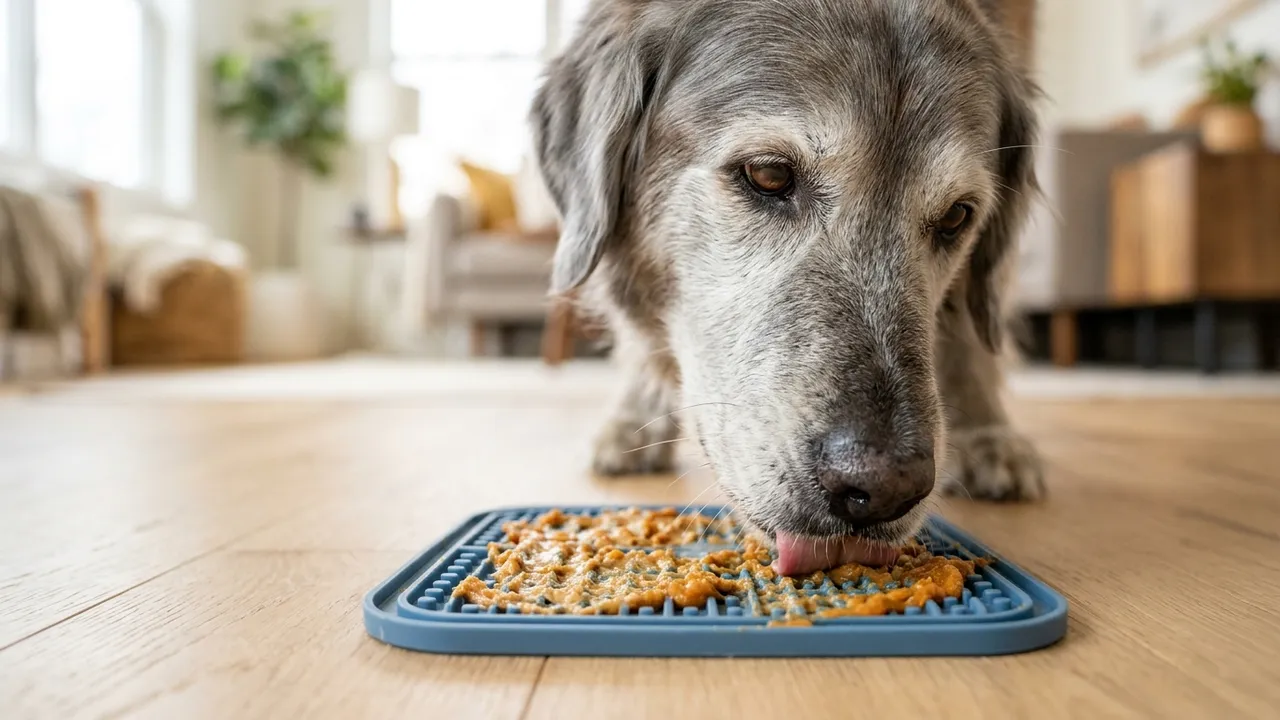
Then there's the lick mat (the lick mat guide covers how to use one), which is the one to reach for when your dog has almost no mobility to spare. Spread a soft, vet-approved topping across the grooves — our guide to what to put on a lick mat covers safe options — and your dog gets a calming, repetitive activity that can be done lying flat on their bed. It's also gentle on worn or missing teeth in a way that most chew-based enrichment isn't.
Ideas for the rest of the day
Outside of mealtimes, keep the bar low and the sessions short. Five to ten minutes is a real session for a senior dog, and two short ones beat one long one almost every time.
Let walks become sniff walks. This is the biggest mindset change most owners need to make, and it costs nothing. Stop treating the walk as exercise your dog is failing at and start treating it as a sniffing appointment. Let the nose lead, let them read a patch of grass for two minutes, and accept that you might cover fifty metres in ten. That's more mentally satisfying for an older dog than a brisk route they can't comfortably keep up with.
Play "find it" at floor level. Toss a few treats a short distance across the carpet or lawn and let your dog hunt them down at their own pace. No fetching, no chasing — just scent work and slow movement, which is the combination senior joints tolerate best.
Keep puzzle toys at level one. Multi-step puzzles needing paw dexterity or a shove into a stiff lid aren't a challenge for a senior dog so much as a frustration. A treat ball that dispenses generously is plenty. Our puzzle toy levels guide explains how to judge where a given toy sits.
Change the smell, not the gear. Novelty is enrichment in itself and doesn't require buying anything. The same snuffle mat used on the patio instead of the kitchen floor is a new experience. So is a treat hidden in a room your dog doesn't usually forage in.
Adjusting for what's actually limiting your dog
Generic enrichment advice falls apart on contact with a real senior dog. Match the activity to the specific limitation:
- Arthritis or joint pain — favor stationary activities. Lick mats and slow feeders ask nothing of the joints; repeated bending, standing for long stretches, and anything with a jumping or pawing component should go.
- Vision loss — lean hard on scent. Snuffle mats and "find it" games don't require sight at all, and keeping the activity in a familiar, unrearranged space lets your dog navigate by memory and smell without stress.
- Dental issues — skip hard chews and anything that requires gnawing. Soft lick mat toppings and low-resistance fleece foraging are much kinder to sore teeth and gums.
- Reduced stamina — shorten before you simplify. A dog who's tiring quickly usually needs a five-minute version of the same activity, not a less interesting one.
- Possible cognitive decline — go the other way on novelty. A dog who seems confused or anxious often does better with the same familiar activity in the same spot every day than with constant variety, which can be one more thing to feel lost in.
A simple daily routine for a senior dog
Nothing here needs to be rigid. It's a pattern to adapt around your dog's good and bad hours.
| Time of day | Activity | Effort for your dog | Why it works |
|---|---|---|---|
| Morning meal | Slow feeder bowl or snuffle mat | Low, can be done lying down on a mat | Turns a gulped meal into several minutes of nose work |
| Mid-morning | Short sniff walk, nose leads | Low to moderate | Scent is the main way dogs read their world |
| Afternoon | Lick mat on the bed | Very low | Calming, repetitive, easy on worn teeth |
| Early evening | "Find it" treats on the floor | Low | Gentle hunting and movement |
| Evening meal | A different feeder from the morning | Low | Variety without new gear |
| Before bed | Quiet settle time, no new games | None | Helps wind down; ask your vet if night restlessness persists |
Cheap homemade ideas that suit stiff joints
You don't have to buy anything to start. These cost almost nothing and stay low to the ground:
- Towel roll. Lay a thin towel flat, scatter a few treats on it and roll it up loosely. Your dog nudges and unrolls it. It's also a good use for a snuffle mat if you already own one; our how to use a snuffle mat guide has beginner setups.
- Muffin tin shuffle. Put a treat in some cups of a muffin tin and cover them with tennis balls or crumpled paper. Keep the tin on the floor on a non-slip mat.
- Cardboard box forage. An open cardboard box with kibble scattered inside. Remove it afterwards so nothing gets chewed and swallowed.
- Scent trail. Drag a treat along the floor for a short route and leave it at the end.
Choose non-slip flooring or a rug wherever your dog is working. A senior dog scrambling on a polished floor is a fall waiting to happen, and a few cheap rugs or yoga mats make enrichment safer.
Which activity for which limitation
| Limitation | Best activities | Skip or change |
|---|---|---|
| Arthritis or sore joints | Lick mat, slow feeder, lying-down snuffle mat | Pawing puzzles, repeated bending, jumping games |
| Poor eyesight | Scent games in a familiar room | Moving furniture, fast-moving toys |
| Hearing loss | Hand signals, scent trails, visual cues | Recall games that rely on voice alone |
| Sore or missing teeth | Soft lick mat fillings, fleece foraging | Hard chews and tough rubber toys |
| Low stamina | Shorter versions of the same game | Long sessions; stop while your dog still wants more |
| Possible cognitive changes | Same familiar activity in the same spot daily | Constant new gear or room changes |
Our broader mental stimulation guide covers the five kinds of mental work if you want to add variety, and indoor dog activities has more options for bad-weather days.
When to talk to your vet instead
Enrichment is not a substitute for medical care. Book a vet visit if you notice:
- Getting lost or standing in corners in rooms your dog knows well
- Sleeping through the day and pacing or crying at night
- A sudden loss of appetite, interest in food or a change in drinking
- New limping, trouble getting up or reluctance to climb stairs
- Accidents indoors in a previously house-trained dog
Many of these have treatable causes, including pain, dental disease, thyroid and kidney problems, and your vet can also discuss whether a cognitive condition is a possibility. If boredom does look like part of the picture, our signs your dog is bored page separates it from medical causes, and enrichment for anxious dogs helps if the restlessness looks like worry. If your senior is on restricted movement after surgery or an injury, see crate rest enrichment.
The bottom line
Senior dog enrichment isn't a program, and it definitely isn't a shopping list. One meal through a slow feeder or snuffle mat, plus one short sniff session somewhere in the day, is a genuinely adequate routine for most older dogs — and it asks almost nothing of you beyond changing which bowl you reach for.
Keep an eye on the response, though. If your dog stops engaging with activities they were enjoying a month ago, or seems more disoriented and unsettled than they used to, that's worth raising with your vet rather than filing under "just getting old."
👉 See the Snuffle Mat for Dogs → for gentle, low-impact scent work 👉 See the Stainless Steel Slow Feeder Dog Bowl → to build enrichment into every meal 👉 See the Lick Mat for Dogs → for calm, lying-down licking
For low-impact ideas on wet days, see our list of indoor dog activities.
Frequently Asked Questions
Do senior dogs still need mental stimulation? Yes — mental enrichment doesn't reduce with age the way physical exercise tolerance often does. Gentle activities like slow feeders, snuffle mats, and short sniff walks can help keep a senior dog engaged without stressing joints.
What is the best enrichment for a dog with arthritis? Stationary, low-impact activities work best — lick mats and slow feeders in particular, since they don't require standing for long periods or moving around. Avoid puzzle toys that require pawing, jumping, or repeated bending.
Can enrichment help with dog dementia (CCD)? Regular mental stimulation is widely believed to support cognitive health in aging dogs, though it isn't a treatment or cure for canine cognitive dysfunction. Any suspected signs of disorientation or confusion should be evaluated by a vet.
How much enrichment does a senior dog need per day? There's no fixed number, but one or two short sessions a day (5-10 minutes each) plus enrichment built into mealtime (a slow feeder or lick mat) is a reasonable, low-effort routine for most senior dogs.
At what age is a dog considered a senior? It varies with size. Large and giant breeds are often treated as seniors from around 6 to 8 years, while small breeds are usually seniors from about 10 to 12. Your vet can tell you when to switch to senior care for your dog.
What if my senior dog has no interest in toys? Try food-based options before concluding they're not interested, because scent and taste often work when toys don't. If the loss of interest is sudden, mention it to your vet, since pain or dental problems can be behind it.
Are snuffle mats safe for older dogs? Generally yes, because they ask for sniffing rather than athletic effort. Supervise to make sure your dog isn't swallowing fleece, and place the mat on a non-slip surface. If your dog has dental problems or eats in a hurry, scatter the kibble loosely rather than pressing it deep into the fleece.
Can I give a senior dog a lick mat every day? Usually yes, as long as the filling fits within the day's calories and suits your dog's health. Ask your vet if your dog has pancreatitis, diabetes, kidney problems or weight concerns. Our guide to what to put on a lick mat lists safe fillings.
Should I still walk a dog with arthritis? Most vets favour regular, gentle, controlled movement over rest, but the right amount depends on your dog. Ask your vet for a plan, and let your dog set the pace on sniff-led strolls.