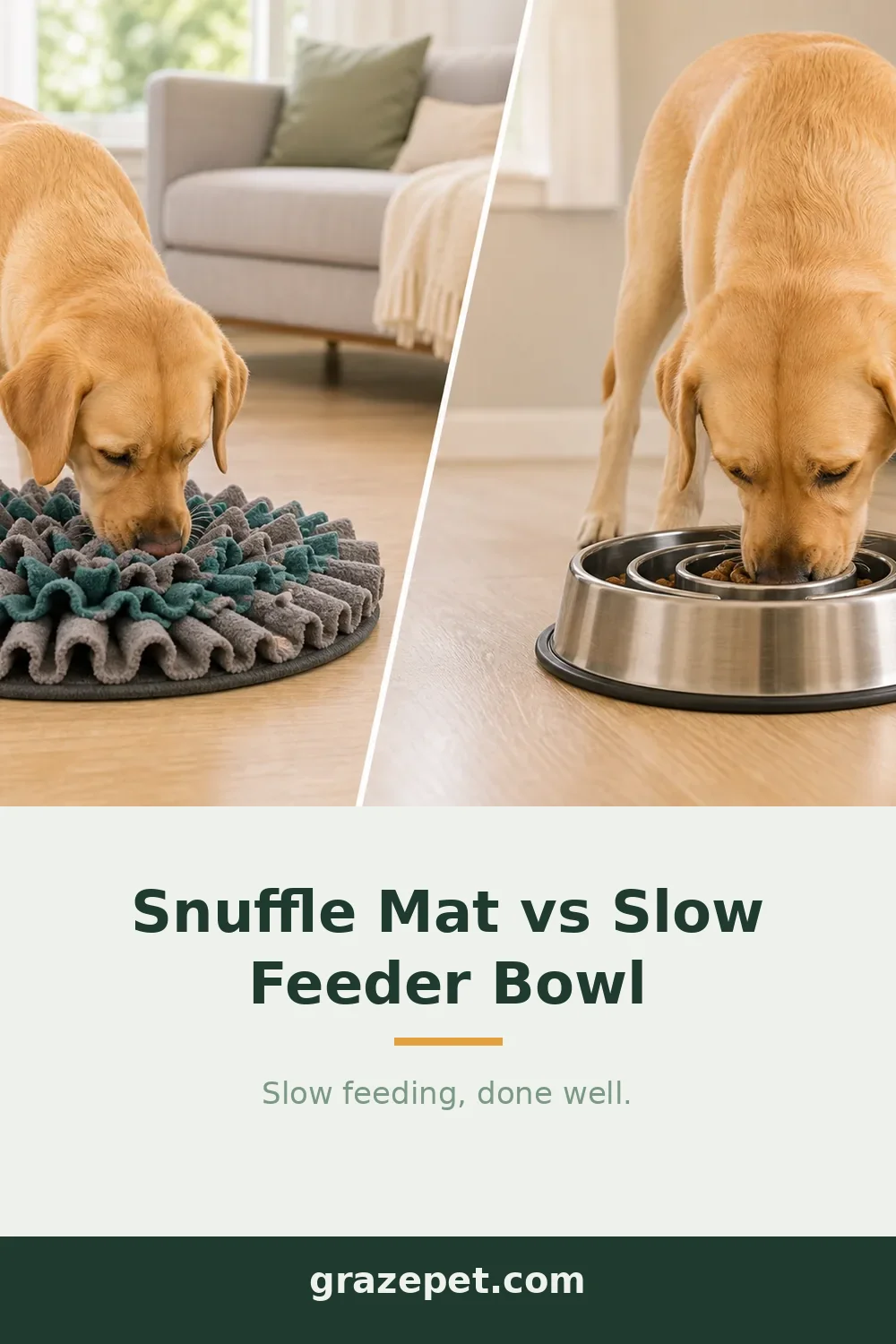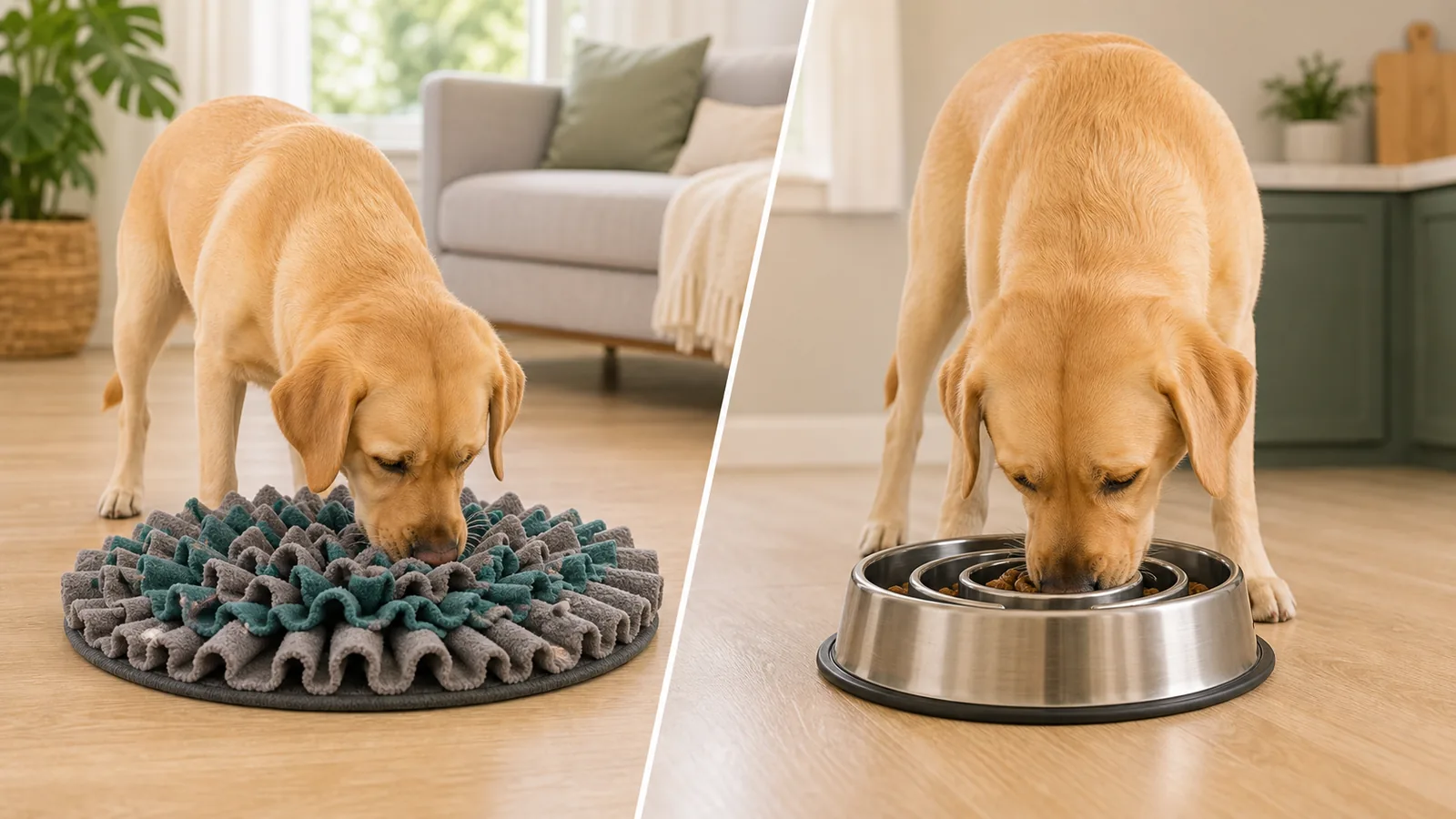
Snuffle Mat vs Slow Feeder Bowl: Which Is Better?
A slow feeder bowl is better for pacing every meal with minimal effort, and it's the only one of the two that handles wet food. A snuffle mat is better for mental enrichment and calming, because the dog has to find each piece by smell. For a fast eater, start with the bowl; for a bored or anxious dog, start with the mat.
We sell both, so we have no reason to push you toward one. What we can do is be specific about where each is strong, where each is annoying to live with, and which dogs do badly with one or the other. If you end up wanting both, there's a simple weekly routine near the end.
How do a snuffle mat and a slow feeder bowl compare at a glance?
| Factor | Snuffle mat | Slow feeder bowl |
|---|---|---|
| How it slows eating | Food is hidden; each piece must be sniffed out | Ridges block the mouth; food is licked and nudged out |
| Main strength | Mental work and calming | Fast, reliable pacing at every meal |
| Typical meal length | Often 10–15 minutes | Often 5–10 minutes |
| Mental stimulation | High | Low to moderate |
| Food types | Dry kibble and dry treats only | Kibble, wet, raw, soaked |
| Time to load | A minute or two | Seconds |
| Cleaning | Shake out; machine wash weekly or so | Wash after each meal; dishwasher (steel) |
| Mess | Some kibble escapes | Contained |
| Chew risk | Fabric can be torn and swallowed | Steel: essentially none |
| Supervision | Recommended | Minimal once introduced |
| Stays put | Light; some dogs flip or drag it | Non-slip base |
| Travel | Rolls or folds flat | Rigid |
Meal times vary a lot with the dog, the amount of food and how the mat is loaded, so read those as typical, not guaranteed.
Which one slows eating more?
It depends on the dog, and this is where most comparisons oversimplify.
A slow feeder bowl creates a physical limit. The ridges mean the dog can't take a full mouthful, so the pace drops for every dog, at every meal, from day one. Its weakness is that it's a fixed problem. Most dogs develop a technique within a few weeks and get somewhat quicker, though rarely back to open-bowl speed. We go through what the evidence does and doesn't show in do slow feeder dog bowls work.
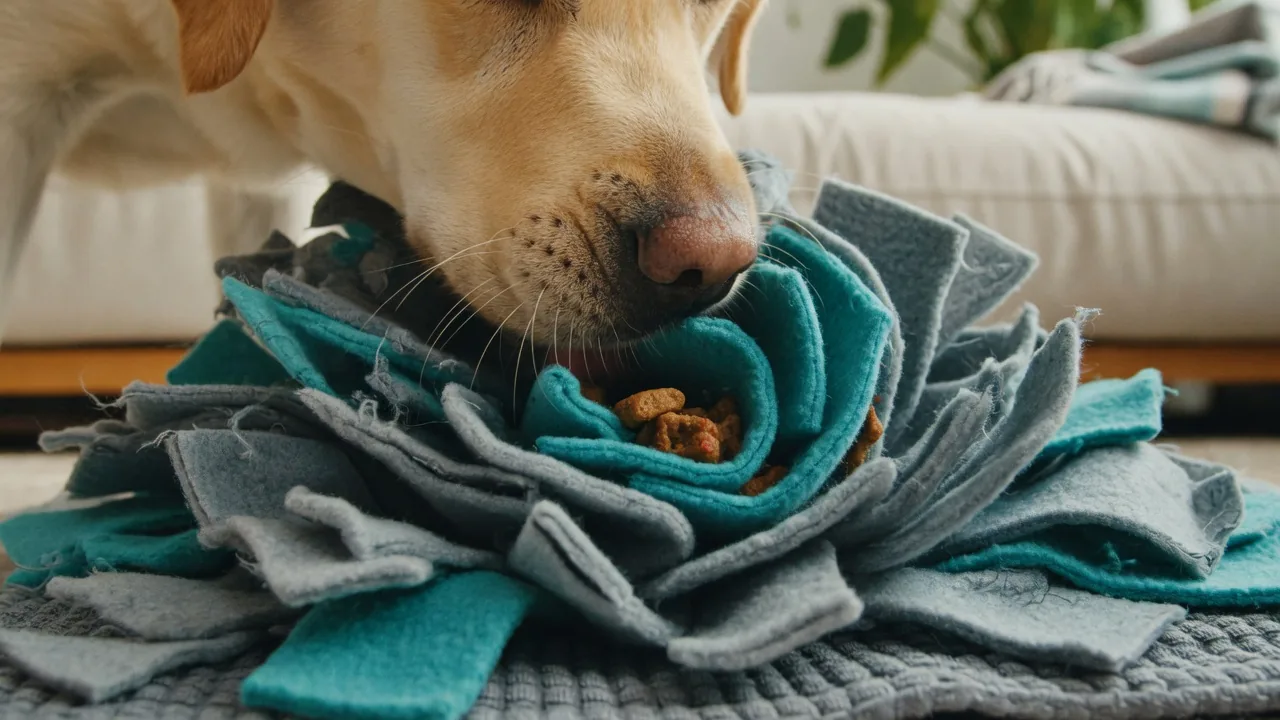
A snuffle mat creates a search. There's no ridge stopping the mouth; the food simply isn't visible. For a dog who settles into sniffing, this is slower than a bowl, because each piece has to be located first. For a dog who learns to shovel their nose through the fleece or flip the mat over to dump the kibble, it can be barely slower than a plate.
So: the bowl has the more predictable effect; the mat has the higher ceiling. If your one goal is making sure a dangerous gulper can't inhale dinner, the bowl is the safer bet.
Which gives more mental enrichment?
The snuffle mat, clearly. Smell is a dog's main sense, and foraging by nose is something dogs are strongly motivated to do. Working a mat combines searching, decision-making and a steady stream of small rewards, and sniffing itself tends to lower arousal. That's why mats are recommended for nervous dogs, dogs on restricted exercise, seniors, and wet-weather days. Our guide to whether snuffle mats are good for dogs covers the benefits and limits in more detail.
A slow feeder bowl is a puzzle only for the first few meals. After that it's mostly a mechanical obstacle. That's fine — it's what it's for — but if you're buying to tire out a bored dog, a bowl alone will disappoint you. If it's puzzle toys you're weighing against a mat, that's a different decision, covered in snuffle mat vs puzzle feeder.
What about food type, cleaning and mess?
This is the practical section, and it decides more purchases than enrichment does.
Food type. A snuffle mat is for dry food. Wet, raw or soaked food works into the fleece, smells, and is unpleasant to wash out. If you feed wet food, or mix it with kibble, you need the bowl; see slow feeders for wet food for how to load one.
Cleaning. A stainless steel slow feeder gets washed like any dish and goes in the dishwasher. A mat doesn't need washing after every meal, but kibble dust, crumbs and drool build up in the fabric. Shake it out after each use and machine-wash it roughly weekly with daily use, more often if your dog drools heavily. Let it dry completely before the next meal. A damp mat with food residue is a good place for mould.
Mess. Bowls contain food. Mats don't: kibble gets flicked off the edges, and enthusiastic dogs push the whole mat across the floor. Using it on a rug or in a corner helps.
Time. Filling a bowl takes five seconds. Loading a mat properly, working food down between the strips, takes a minute or two. At 7am on a workday, that matters.
Which dogs do badly with each?
Neither tool suits every dog.
A snuffle mat is a poor fit for:
- Fabric shredders. A dog who destroys soft toys may rip off and swallow fleece strips, which is a blockage risk. Supervise every session, or skip the mat.
- Dogs on wet-only diets.
- Dogs with dust or storage-mite sensitivities, unless you wash it frequently.
- Heavy droolers, where it gets soggy quickly.
A slow feeder bowl is a poor fit for:
- Easily frustrated dogs given too hard a pattern. They paw, bark or flip it.
- Flat-faced breeds with deep, narrow mazes. They need shallow, wide ridges — or a snuffle mat, which is often easier for short muzzles.
- Underweight or reluctant eaters. Don't put obstacles in front of a dog who needs encouraging to eat.
- Dogs with painful mouths or worn teeth.
In both cases: if a dog is gulping because of a medical problem, or is vomiting regularly, a feeding tool isn't the answer. See your vet.
Which should you choose?
| Your situation | Pick | Reason |
|---|---|---|
| Dog finishes meals in seconds | Slow feeder bowl | Predictable slowing, every meal |
| Large or deep-chested dog who gulps | Slow feeder bowl | Reliability matters most here |
| Wet, raw or mixed feeding | Slow feeder bowl | A mat can't take wet food |
| Bored, destructive or under-exercised dog | Snuffle mat | Real brain work |
| Anxious or reactive dog | Snuffle mat | Sniffing is calming |
| Crate rest or restricted exercise | Snuffle mat | Low-impact occupation |
| Senior with stiff neck or few teeth | Snuffle mat | Gentle, no hard ridges |
| Flat-faced breed | Snuffle mat, or a shallow-ridged bowl | Easier access |
| Dog who shreds fabric | Slow feeder bowl | Nothing to tear off |
| You want one thing with the least hassle | Slow feeder bowl | Quick to fill and clean |
| Fast eater who is also bored | Both | They solve different problems |
If you can only buy one and your dog is a fast eater on dry food with no other issues, buy the bowl first. It fixes the more urgent problem and asks less of you. Add the mat when you want mealtimes to do more.
Can you use both, and how?
Yes, and they complement each other better than either does alone. Alternating also stops your dog getting too efficient at one.
A routine that works for most households:
- Weekday breakfast: slow feeder bowl. Fast to fill when you're short of time.
- Evening meal: snuffle mat, when you're home to supervise and your dog benefits from winding down.
- Wet food days: bowl only.
- Rainy days or a missed walk: split one meal, half in each, a few minutes apart.
- Very fast eaters: bowl for the full meal, then a tablespoon of kibble held back and scattered in the mat as a calm finish.
Whatever the split, the total stays the same as your dog's normal daily ration. For loading techniques that make a mat easier or harder, see how to use a snuffle mat.
What mistakes should you avoid?
- Buying a mat to fix dangerous gulping, then finding your dog shovels through it. Check it actually slows your dog.
- Leaving a mat down after the meal. It becomes a chew toy. Pick it up.
- Never washing the mat. If it smells stale, it's overdue.
- Overfilling the bowl so kibble sits above the ridges.
- Starting too hard. First sessions should be easy: kibble on top of the fleece, kibble resting on the ridges.
- Adding treats on top of meals to "fill" the mat. Use the regular ration.
The verdict
In snuffle mat vs slow feeder bowl, the bowl is the better everyday feeder and the mat is the better enrichment tool. Choose by your dog's main problem — speed or boredom — and by what you feed. Plenty of dogs have both problems, which is why plenty of owners end up with both.
👉 Stainless Steel Slow Feeder Dog Bowl → 👉 Snuffle Mat for Dogs →
Frequently Asked Questions
Is a snuffle mat or a slow feeder better? They're better at different things. A slow feeder bowl is better for reliably pacing every meal and works with wet food. A snuffle mat is better for mental enrichment and calming a bored or anxious dog. For a fast eater, start with the bowl; for a bored dog, start with the mat.
Does a snuffle mat slow eating as much as a slow feeder bowl? It can slow eating more, but less predictably. A dog who sniffs out each piece often takes longer on a mat than at a bowl. A dog who learns to shovel through the fleece or flip the mat may barely slow down. A slow feeder bowl's ridges slow every dog to some degree.
Can I use a snuffle mat for wet food? No. Snuffle mats are designed for dry kibble and dry treats. Wet, raw or soaked food works into the fleece, smells quickly and is hard to wash out. Use a slow feeder bowl, ideally stainless steel, for wet food.
Should I buy both a snuffle mat and a slow feeder? If your dog eats fast and also gets bored, yes. They solve different problems and alternating them stops your dog mastering either one. A common routine is the bowl for quick weekday breakfasts and the mat for supervised evening meals. Keep the total food the same.
Can a snuffle mat replace a food bowl completely? For a dog fed only dry kibble, it can, as long as you supervise, wash the mat regularly and let it dry fully. Most owners find it more practical to use a mat for some meals and a bowl for others, because loading and washing a mat takes more time.
Are snuffle mats safe for dogs that chew everything? Only with close supervision. A dog who shreds soft toys may tear off and swallow fleece strips, which can cause a blockage. Stay with your dog during every session and remove the mat when the food is gone. If they keep chewing it, a stainless steel slow feeder is the safer choice.
Save this guide