How Often Should I Feed My Dog? (Puppy to Senior)
Most healthy adult dogs should be fed twice a day, about 8 to 12 hours apart. Puppies need three to four meals until around six months, toy breeds often stay on three, and large deep-chested breeds do better with two or three moderate meals than one big one. Seniors usually stay on two unless a vet advises otherwise.
That covers most households. The rest of this guide handles the questions that come up once you try to apply it: what times, whether once a day is fine, whether you can leave food down, how meals fit around walks, and when a medical condition changes the answer. Your vet's advice for your individual dog always outranks a general guide, including this one.
One note on scope. This page is about frequency and timing. For portion sizes, see how much should I feed my dog.
How many meals a day does a dog need at each age?
| Life stage | Typical meals per day | Notes |
|---|---|---|
| Puppy, weaning to ~4 months | 4 | Small stomach, high energy needs |
| Puppy, ~4 to 6 months | 3 | Drop the midday meal last |
| Puppy, ~6 to 12 months | 2 (3 for toy breeds) | Large breeds mature later, up to 18–24 months |
| Adult, small and medium | 2 | Some toy breeds do better on 3 |
| Adult, large and giant | 2 to 3 | Avoid one large meal |
| Senior | 2 (sometimes 3 smaller) | Depends on appetite, teeth, health |
| Pregnant or nursing | Vet-directed | Needs rise sharply; often fed more frequently |
These are typical patterns, not rules. Two dogs of the same age can legitimately be on different schedules.
Why are puppies fed so often?
A puppy's stomach is small and its energy needs per kilo are much higher than an adult's, so the daily ration has to be split to fit. Frequent meals also keep blood sugar steadier, which matters most in toy breeds. Very small puppies can become hypoglycaemic if they go too long without food; signs include weakness, wobbliness, and trembling, and that warrants an urgent call to a vet.
There's a practical bonus too. Puppies usually need to toilet shortly after eating, so fixed mealtimes make house-training far more predictable.
When you reduce the number of meals, keep the daily total the same and redistribute it; you are changing the split, not cutting food. The age-by-age timetable, with suggested clock times, is in our puppy feeding schedule.
Why is twice a day the standard for adult dogs?
Two meals is a compromise that works for most dogs and most owners:
- It limits the empty stretch. A dog's stomach empties within hours of a meal. Some dogs that go too long between meals vomit yellow bile or foam, typically early in the morning. Vets often suggest a later evening meal or a small bedtime snack for these dogs, so mention it if you see it.
- It keeps each meal a manageable size. Half the daily ration is easier on the stomach than all of it at once.
- It reduces frantic eating. A dog that's been waiting 24 hours tends to eat like it.
- It gives you two daily appetite checks. A skipped meal is one of the earliest signs that a dog is unwell, and you only notice it if meals are a defined event.
Aim for meals 8 to 12 hours apart. An exact 12-hour split isn't necessary.
Is feeding a dog once a day OK?
Plenty of healthy adult dogs are fed once daily without obvious problems, and you may have seen headlines about it. A large owner-survey study from the Dog Aging Project, published in 2022, found that dogs fed once a day had lower odds of several health conditions and scored better on a cognitive measure than dogs fed more often.
It's worth reading that carefully. The study was observational: it showed an association, and the researchers themselves cautioned that it doesn't prove once-daily feeding causes better health, nor did they recommend owners change their routine because of it. Dogs with existing health problems may simply be more likely to be fed more often on veterinary advice.
Against that, there are solid practical reasons most vets still suggest two meals:
- One large meal is generally discouraged for large, deep-chested breeds because of concerns about bloat (GDV).
- Toy breeds and puppies shouldn't go that long without food.
- Dogs prone to bile vomiting tend to do worse.
- Diabetic dogs need meals timed around insulin.
If your healthy adult dog thrives on one meal and your vet is happy, there's no need to panic. If you're thinking of switching to it, ask first.
Can you leave food out all day (free-feeding)?
Free-feeding means keeping the bowl topped up so the dog eats when it likes. It's convenient, and a minority of dogs do self-regulate. For most households it causes more problems than it solves:
- Weight creeps up, because nobody knows how much was eaten.
- You lose the appetite signal. A dog that's off its food for a day goes unnoticed.
- House-training gets harder, since unpredictable eating means unpredictable toileting.
- Multi-dog homes become unmanageable. One dog eats double; the other gets less.
- Wet and fresh food spoils at room temperature.
A middle path that works well is timed meals: put the measured food down, give your dog 15 to 20 minutes, then pick up whatever is left until the next mealtime. Most dogs learn the routine within a few days. A healthy dog skipping the odd meal this way isn't a concern; a dog refusing food for more than a day, or a puppy or small dog skipping meals, is a reason to call the vet.
What time should you feed your dog?
Regularity beats precision. Dogs settle into a routine quickly, and digestion, toileting, and even behaviour become more predictable when meals arrive at roughly the same times each day. Within an hour either way is fine.
Typical adult schedule (two meals)
- 7:00–8:00 am: breakfast
- 5:30–7:00 pm: dinner, with a toilet trip before bed
Shift workers or late risers: slide both meals; keep the gap between them in the 8-to-12-hour range.
Three meals (toy breeds, some large breeds, some seniors)
- 7:00 am, 1:00 pm, 7:00 pm
Young puppy (four meals)
- 7:00 am, 11:00 am, 3:00 pm, 7:00 pm
Try not to make the evening meal too late. A dog fed at 10 pm will probably need to go out in the night.
Should you feed before or after a walk?
For a gentle stroll or a toilet break, it barely matters. For anything vigorous, it's worth leaving a gap. Common veterinary advice, particularly for large and deep-chested breeds at higher risk of bloat, is to avoid hard exercise for around an hour before a meal and one to two hours afterwards. The evidence behind exact timings isn't strong, but the precaution costs nothing.
A simple morning order that works: exercise first, 20 to 30 minutes to cool down and stop panting, then breakfast. Our bloat (GDV) symptoms and prevention guide covers the warning signs in detail.
When should the schedule be different?
Some dogs need a feeding plan set by a vet, not a blog:
- Diabetes: meals are usually tied to insulin injections, at consistent times and amounts.
- Bile vomiting on an empty stomach: often helped by a late snack or more frequent meals.
- Pancreatitis, chronic gut disease, or megaoesophagus: commonly managed with smaller, more frequent meals and sometimes special positioning.
- Flat-faced breeds with regurgitation: smaller, more frequent meals are often recommended.
- Underweight, pregnant, or nursing dogs: higher needs, often split across more meals.
- Working and sporting dogs: timing is planned around exertion.
- Seniors with poor appetite or dental pain: see our senior dog feeding guide.
If your dog has any diagnosed condition, check before changing frequency.
Does how fast they eat change how often to feed?
It can. A dog that bolts a large meal in under a minute may gulp air, cough, or bring food back up, and one easy adjustment is to split the same daily amount into more, smaller meals. That lowers the stakes of each meal but doesn't change the habit.
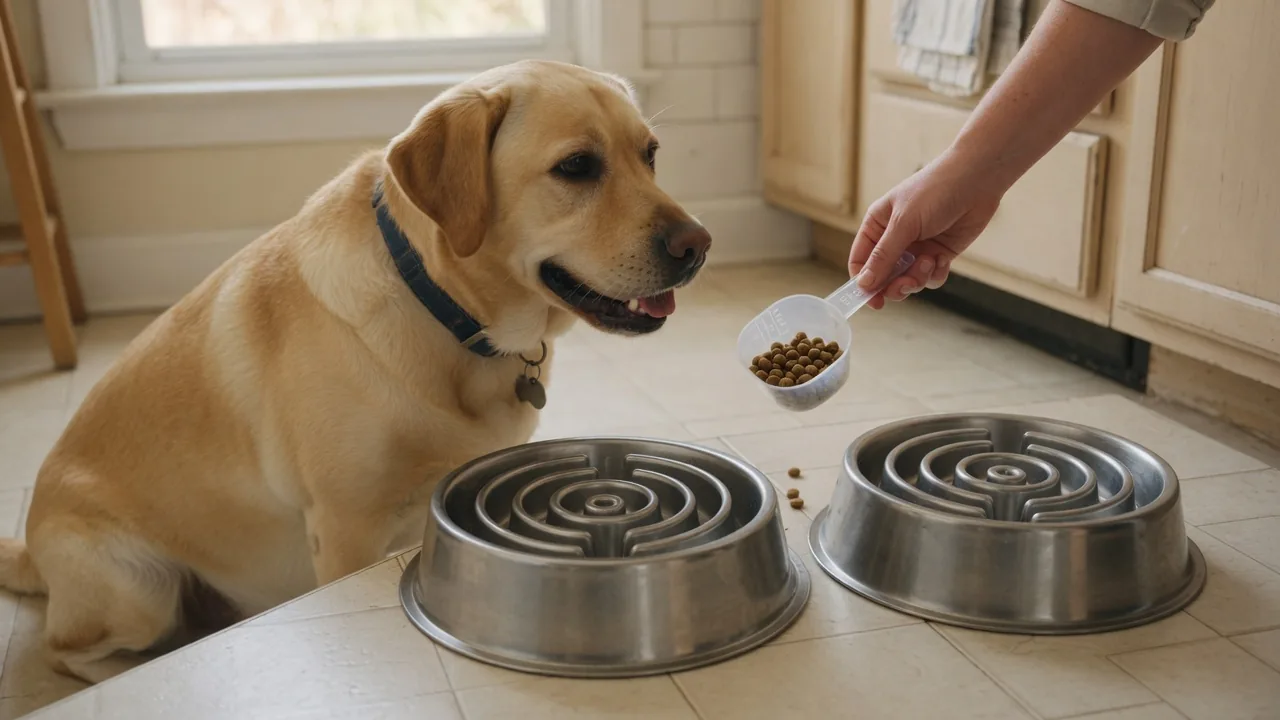
Pacing the meal itself does. A stainless steel slow feeder bowl makes a dog work food out of a pattern instead of scooping it, and a snuffle mat turns a dry meal into a few minutes of sniffing. Neither changes how often you feed; they change what each meal is like. If you're not sure what a normal pace looks like, see how long it should take a dog to eat, and for a full plan, how to stop your dog eating too fast.
Whatever tools you use, food from mats, toys, and training treats counts toward the daily total.
How do you change a feeding schedule safely?
- Keep the daily amount the same. Only the split changes.
- Move gradually. Shift meal times by 15 to 30 minutes a day, or shrink the meal you're dropping over a week while growing the others.
- Watch for a week or two. Appetite, energy, stools, and any vomiting tell you how it's going.
- Back up if needed. Morning bile vomiting or obvious hunger distress after dropping a meal means the gap is too long for that dog.
Don't change food and schedule in the same week. If something goes wrong, you won't know which change caused it.
When should you talk to your vet?
Get advice if your dog refuses food for more than 24 hours (sooner for puppies, toy breeds, and diabetic dogs), vomits repeatedly, loses or gains weight without explanation, becomes suddenly ravenous, or drinks far more than usual. A swollen, tight abdomen with unproductive retching after a meal is an emergency: go straight to a vet.
For dogs with suspected food allergies, feed the same trial food on a fixed schedule; see the best dog food for allergies.
Frequently Asked Questions
How many times a day should I feed my dog? Most healthy adult dogs do well on two meals a day, roughly 8 to 12 hours apart. Puppies under about four months usually need four meals, dropping to three and then two as they grow. Toy breeds, giant breeds, and dogs with medical conditions may need a different pattern from their vet.
Is it OK to feed a dog once a day? Many healthy adult dogs cope with one meal a day, but twice daily remains the usual recommendation. One large meal means a long empty stretch, tends to encourage gulping, and is generally discouraged for large deep-chested breeds because of bloat concerns. Ask your vet before switching.
What are the best times to feed a dog? Consistency matters more than the clock. A common pattern is a morning meal between 7 and 8 am and an evening meal between 5 and 7 pm, leaving time for a toilet trip before bed. Keep the times within about an hour from day to day.
Should I feed my dog before or after a walk? Many vets suggest avoiding hard exercise for around an hour before and one to two hours after a meal, especially for large deep-chested breeds. A gentle toilet walk is fine. If you run or play fetch in the morning, do that first, let your dog settle, then feed.
Is it bad to leave food out all day for my dog? Free-feeding suits a few dogs that self-regulate, but it makes it hard to notice appetite changes, control weight, house-train a puppy, or manage a multi-dog home. Wet food also spoils when left out. Measured meals at set times are the safer default for most dogs.
How often should I feed a puppy? As a general guide: four meals a day from weaning to about four months, three meals from four to six months, and two meals from around six months onward. Toy breeds often stay on three or four meals for longer because small puppies are prone to low blood sugar.
Do small dogs need to eat more often than large dogs? Often, yes. Toy and small breeds have small stomachs and fast metabolisms, so many do better on three small meals even as adults. Large and giant breeds are usually fed two or three moderate meals instead of one big one.