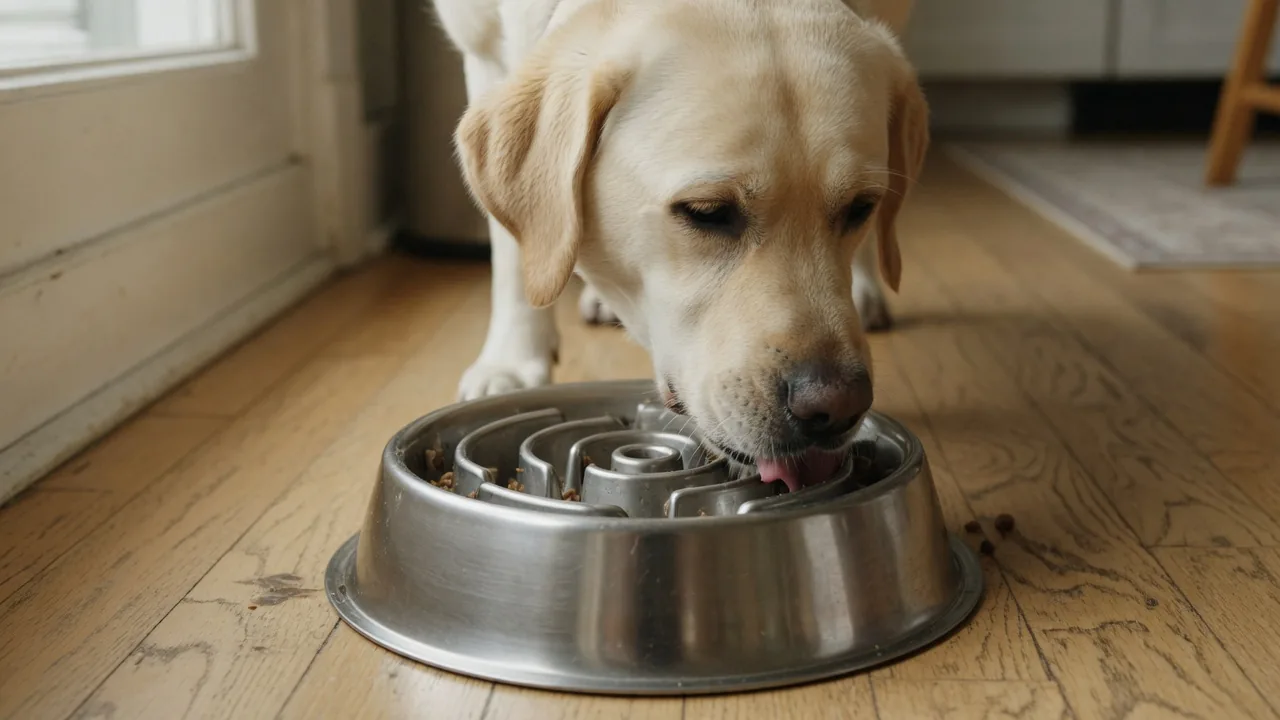
How Long Should It Take a Dog to Eat a Meal?
Most healthy dogs take about 2 to 5 minutes to eat a meal of dry food from a regular bowl. Under 60 seconds is gulping and worth slowing down. Longer than 15 to 20 minutes, or walking away from food, is slow eating, which matters most when it's a change from your dog's normal.
There's no official veterinary standard for meal length, so treat every number on this page as a working range, not a pass mark. What's useful is knowing roughly where your dog sits, whether that's changed, and which end of the scale needs attention.
What's a normal eating time for a dog?
The 2-to-5-minute range holds for an average adult dog eating a measured kibble meal from a plain bowl. But "a meal" is very different for a Chihuahua and a Rottweiler, and food type changes things a lot. This table gives rough, realistic ranges.
| Situation | Typical time | Notes |
|---|---|---|
| Dry kibble, plain bowl | 2–5 minutes | The baseline most advice refers to |
| Wet or fresh food, plain bowl | 1–4 minutes | Soft food needs less chewing, so it often goes faster |
| Kibble in a slow feeder bowl | 5–10 minutes | The goal of a maze bowl; some take up to 15 |
| Kibble in a snuffle mat or puzzle | 10–20 minutes | Sniffing and searching, not just eating |
| Frozen lick mat or stuffed toy | 10–30 minutes | Depends heavily on how hard it's frozen |
| Puppy, 8–16 weeks | 1–5 minutes | Often frantic; small portions disappear quickly |
| Senior dog | 5–15 minutes | Slower is common with age, dental wear or lower appetite |
Small dogs often look slower than they are because their kibble is big relative to their mouth. Large dogs can clear two cups in the time it takes you to put the scoop away.
A rule of thumb that's widely repeated by vets and trainers: if a small dog finishes half a cup in under 30 to 45 seconds, or a large dog finishes two cups in under a minute, that's too fast. It's not a clinical cut-off, but it's a handy line.
How do you time your dog's meal properly?
One meal tells you very little. Dogs eat faster when they're extra hungry, when there's another dog nearby, or when dinner is late. To get a real number:
- Measure the portion so each timed meal is the same size.
- Use the same bowl in the same spot.
- Start the timer when the bowl touches the floor and stop it when the last piece is gone, not when they finish licking the empty bowl.
- Time five or six meals across a week, both morning and evening.
- Write down the times and take the middle value. One 20-second breakfast among several 3-minute meals isn't a problem. Six 20-second meals is a pattern.
While you're watching, notice how they eat, not just how long. Is there chewing, or is food going down whole? Any coughing, gagging, or a big burp at the end? Does your dog lift their head and look around, or stay head-down and rigid? The stopwatch and the behaviour together tell you more than either alone.
How fast is too fast?
Under a minute for a full meal is the practical definition of a fast eater. Under 30 seconds is the kind of gulping most owners describe as "inhaling."
Speed on its own isn't a diagnosis. Plenty of dogs eat in 45 seconds their whole lives without trouble. It becomes worth fixing when you also see any of these:
- food coming back up within minutes of eating, often still whole
- coughing, gagging or choking at the bowl
- a lot of burping or gas after meals
- a visibly tight belly after eating
- a large, deep-chested breed, where fast eating is one of the recognised risk factors for bloat (GDV)
If food regularly comes back up, read why dogs eat too fast and throw up, which explains the difference between regurgitation and vomiting. If you want to understand the reason behind the speed, why does my dog eat so fast covers the causes.
How slow is too slow?
This half of the question gets ignored, and it's often the more important one.
A dog who has always been a leisurely eater, taking 10 or 15 minutes and finishing the bowl, is fine. Some dogs, especially small breeds and seniors, simply aren't in a hurry.
Slow eating matters when it's new. A dog who normally clears the bowl in three minutes and now takes twenty, leaves half, or sniffs and walks off is telling you something. Common reasons, roughly from mild to serious:
- They're not hungry. Too many treats, a big chew earlier, hot weather, less exercise.
- They don't like the food. A new bag, a stale bag, or a formula change.
- Stress or distraction. Visitors, a new pet, a house move, a noisy feeding spot.
- Mouth pain. Dropping kibble, chewing on one side, or preferring soft food points to teeth or gums.
- Nausea or illness. Lip-licking, drooling, eating grass, or turning away from the bowl.
One slow meal in an otherwise bright, normal dog is not an emergency. A healthy adult who eats little or nothing for more than about 24 hours should be seen by a vet. For puppies, very small dogs, seniors and dogs with conditions like diabetes, call sooner.
How long should you leave food down?
For most dogs on set meals, 15 to 20 minutes is the usual advice. Put the bowl down, and if there's food left after that, pick it up and offer the next meal at the normal time. No extras in between.
That routine does three useful things. It makes appetite changes obvious the same day. It stops food sitting out, which matters for wet and fresh food in particular; those shouldn't stay at room temperature for more than a couple of hours. And it teaches picky dogs that meals are an event, not an open buffet.
Free-feeding, where dry food is left out all day, works for some self-regulating dogs but makes it hard to know how much or how fast your dog eats at all. If you're unsure which schedule fits your dog, see how often you should feed your dog.
What should you do if your dog eats too fast?
The aim is modest: turn a 30-second meal into a 5-to-10-minute one. You don't need to go further than that.
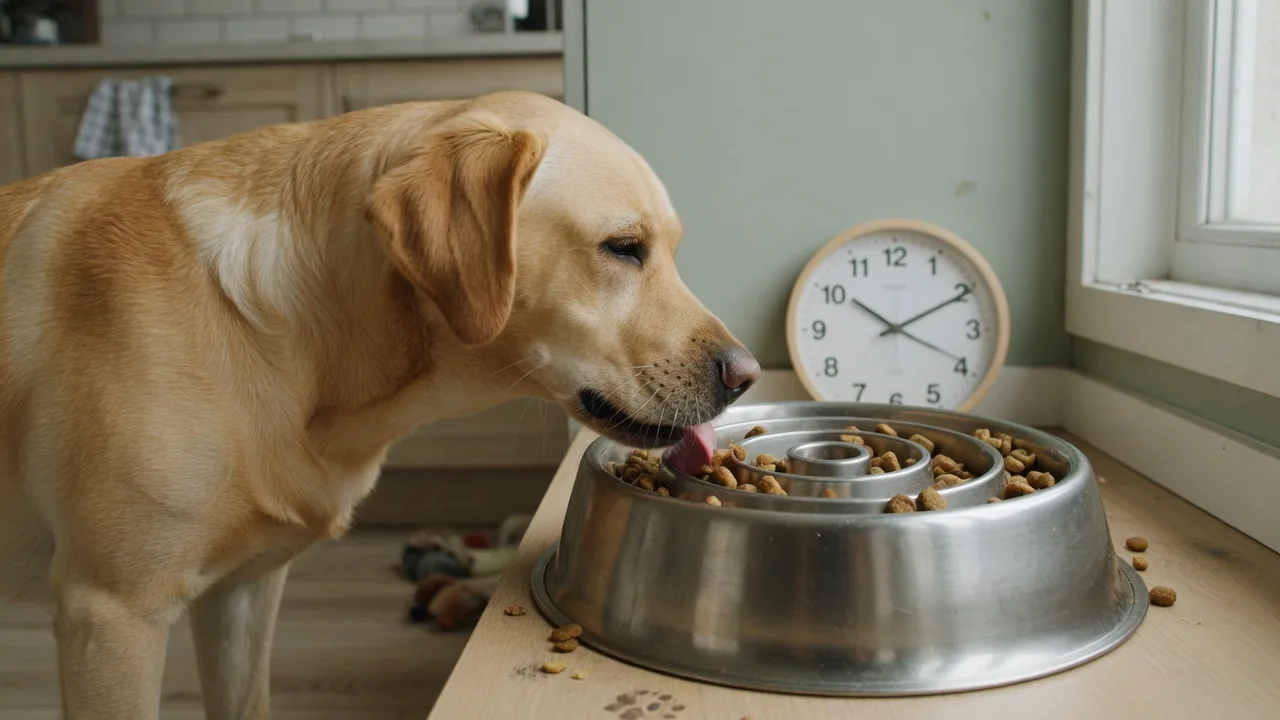
The simplest tool is a slow feeder bowl, which uses raised ridges to break the meal into small mouthfuls. A stainless steel slow feeder dog bowl does this at every meal with no extra effort, and steel doesn't scratch or hold smells the way plastic can. Scatter-feeding, snuffle mats and splitting the meal in two also work.
After you switch, time meals again for a week:
- 5–10 minutes, relaxed: that's what you were after.
- Still under 2 minutes: the maze is too easy or the bowl is overfilled. Food piled above the ridges gets gulped as before.
- Over 20 minutes, pawing or giving up: too hard. Use a simpler pattern, or mix a little wet food in so it's more rewarding.
For the full list of methods and how they compare, see how to stop your dog eating too fast.
👉 Stainless Steel Slow Feeder Dog Bowl →
What should you do if your dog eats too slowly?
Assuming your dog is otherwise well:
- Cut back on treats and chews for a few days and see if mealtime appetite returns. Treats are commonly advised to stay under about 10% of daily calories.
- Check the food. Smell it. Check the date. Kibble goes stale a few weeks after opening, faster if stored warm.
- Feed somewhere quiet, away from other pets and foot traffic.
- Warm wet food slightly or add a spoonful of warm water to kibble to lift the smell. Our guide to dog food toppers has gentle options.
- Keep to the 15–20 minute window and don't swap in something tastier when they refuse. That teaches refusing.
- Don't use a slow feeder. A reluctant eater doesn't need an obstacle.
If slow eating comes with weight loss, drooling, bad breath, vomiting, diarrhoea or low energy, skip the home fixes and book a vet visit.
How long after eating should a dog wait to exercise?
Timing questions don't end when the bowl is empty. A common vet guideline is to avoid hard exercise for about an hour before and one to two hours after a meal, particularly for large and deep-chested dogs, because vigorous activity around mealtimes is one of the factors associated with bloat. A calm walk or a toilet trip is fine.
On that point: many dogs, and nearly all puppies, need to go out within about 5 to 30 minutes of eating. That's normal and handy to know for house training.
When should you call the vet?
Call your vet if your dog:
- suddenly eats much faster or much slower than their normal
- is ravenous all the time, especially while losing weight
- eats little or nothing for more than a day
- drops food, chews oddly or cries when eating
- vomits or regurgitates repeatedly
Go to an emergency vet immediately if your dog has a swollen, tight belly, retches without bringing anything up, drools heavily or seems distressed after a meal. Those are signs of bloat, and it can't wait until morning.
The bottom line
Two to five minutes is normal for a bowl of kibble. Under a minute is fast, and worth slowing if your dog also coughs, gags, brings food back up or is a deep-chested breed. Slow eating is only a concern when it's new. Time a week of meals so you know your own dog's normal, because a change from that tells you far more than any average.
For young dogs, see our puppy feeding schedule by age.
Frequently Asked Questions
How long should it take a dog to eat a meal? Most dogs take about 2 to 5 minutes to eat a kibble meal from a regular bowl. Wet food often goes a little faster, and a slow feeder stretches it to 5–10 minutes. There's no official standard, so compare your dog with their own usual time.
How fast is too fast for a dog to eat? Finishing a full meal in under a minute counts as fast. A common rule of thumb is a small dog eating half a cup in under 30–45 seconds, or a large dog eating two cups in under 60 seconds. It matters most if your dog also gags, burps a lot or brings food back up.
Is it normal for a dog to take 20 minutes to eat? It can be, if your dog has always eaten slowly and finishes the meal. Seniors and small dogs are often unhurried. If your dog used to eat in a few minutes and now takes 20 or leaves food, look for causes like too many treats, stale food, stress or mouth pain.
How long should I leave my dog's food out? For set meals, 15 to 20 minutes is the usual guideline. Pick up what's left and offer the next meal at the normal time. Wet and fresh food shouldn't sit at room temperature for more than a couple of hours.
How long should a dog take to eat from a slow feeder bowl? Around 5 to 10 minutes for a kibble meal, sometimes up to 15. If your dog still finishes in under 2 minutes, the maze is too easy or overfilled. If it takes over 20 minutes with pawing or giving up, the pattern is too difficult.
How long after eating can I walk my dog? A gentle walk or toilet trip straight after eating is fine. For running, fetch or rough play, a common guideline is to wait one to two hours after a meal, especially with large, deep-chested breeds that are more prone to bloat.
When should I worry about how long my dog takes to eat? Worry about change, not the number. A sudden shift to much faster or slower eating, constant hunger with weight loss, refusing food for more than a day, or pain while chewing all deserve a vet visit. A swollen belly with retching is an emergency.