Dog Puzzle Feeders: Types, Benefits & Best Picks
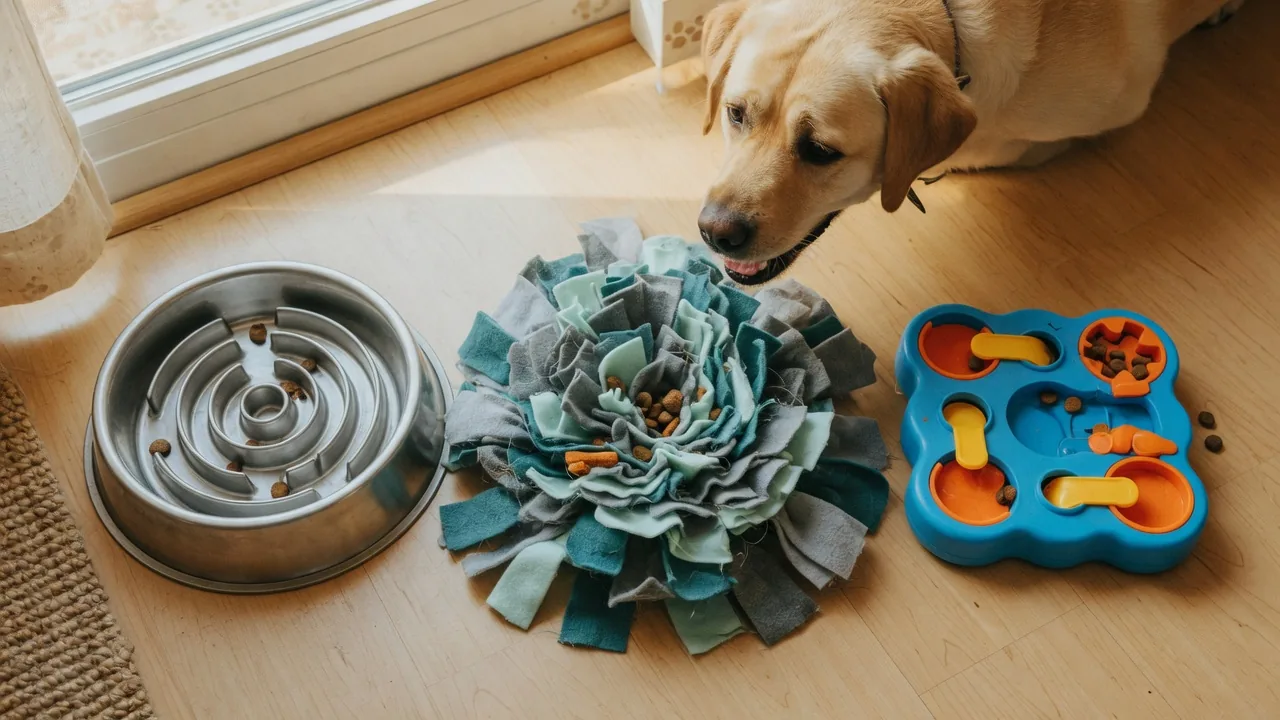
A dog puzzle feeder is any feeding tool that makes a dog work for food instead of eating from an open bowl. There are six main types: slow feeder bowls, snuffle mats, puzzle boards, treat-dispensing toys, stuffable toys and lick mats. For daily meals, a slow feeder bowl or snuffle mat is the most practical; the rest are best as extras.
"Puzzle feeder" gets used for everything from a ridged bowl to a three-step sliding board, which makes shopping confusing. This guide sorts the category into its types, says plainly what each is good and bad at, and helps you match one to your dog. A note on bias: we make a slow feeder bowl and a snuffle mat, and we don't make the other four types. We've tried to be fair to all of them.
What is a dog puzzle feeder, and what does it actually do?
It's a way of delivering food that adds an obstacle. The dog has to nudge, sniff, lick, paw, roll or slide something to get each mouthful. That one change does three useful things:
- Stretches the meal. A portion that vanished in thirty seconds takes several minutes or more.
- Gives the brain a job. Dogs are natural foragers. Searching and problem-solving is satisfying in a way a bowl isn't.
- Occupies time. Ten quiet minutes while you take a call or cook dinner.
What it doesn't do: reduce calories, fix a medical cause of fast eating, or replace exercise and company. It's a feeding method, not a treatment.
What are the main types of dog puzzle feeder?
| Type | How the dog gets food | Works with | Daily meals? | Cleaning | Main drawback |
|---|---|---|---|---|---|
| Slow feeder (maze) bowl | Tongue and nose around raised ridges | Kibble, wet, raw | Yes | Easy (steel: dishwasher) | Clever dogs learn the pattern |
| Snuffle mat | Sniffing through fleece strips | Dry kibble, dry treats | Yes | Machine wash | Not for wet food; some dogs chew fabric |
| Puzzle board | Sliding, lifting, spinning parts | Treats, small kibble portions | Rarely | Fiddly | Needs supervision; holds little food |
| Treat-dispensing toy (ball, wobbler) | Rolling or knocking it so kibble falls out | Dry kibble | Often | Moderate | Noisy; kibble under furniture |
| Stuffable toy | Licking and chewing food out of a hollow | Wet, soaked kibble, pastes | Sometimes | Moderate | Prep time; hard to clean inside |
| Lick mat | Licking spread food off a textured surface | Wet food, yogurt, pastes | Sometimes | Easy to moderate | Tiny portions; not for dry food |
Slow feeder bowls
The workhorse. It looks like a bowl, sits where the bowl sits, takes the whole meal and needs no prep, which is why it's the type people actually keep using. It suits fast eaters best. Its weakness is that it's the least "puzzle-like": after a few weeks most dogs have a technique. If you're not familiar with how the ridges and patterns differ, what is a slow feeder dog bowl explains the anatomy.
Material matters with this type, because the ridges take daily scraping. We make ours in stainless steel so it goes in the dishwasher and doesn't scratch the way plastic does.
Snuffle mats
A fleece mat that hides dry food among fabric strips, so the dog finds each piece by smell. Of all the types it's the closest to natural foraging, and sniffing is calming for most dogs, which makes it a good choice for nervous, elderly or recovering dogs as well as bored ones. It can take a full kibble meal. It can't take wet food, and a dog who shreds soft toys needs supervising. Our snuffle mat for dogs is machine-washable; the how to use a snuffle mat guide covers loading it at different difficulties.
Puzzle boards
The classic image of a "dog puzzle": a plastic or wooden board with sliders, flaps, drawers and spinners. These are the most mentally demanding type and the only one that teaches a dog a genuine sequence. They're also the least practical for feeding. Compartments are small, pieces can be chewed off, and they need you there. Treat them as a ten-minute game, not a dinner plate. They come in difficulty grades, which we break down in dog puzzle toy levels explained.
Treat-dispensing toys
Balls, cubes and weighted wobblers with a hole that drops kibble as the dog rolls or bats them. Great for active dogs, since they add movement to a meal, and many have an adjustable opening. Downsides: they're loud on hard floors, they send kibble under the sofa, and some dogs get frustrated or simply pick the toy up and drop it.
Stuffable toys
Hollow rubber toys you pack with wet food, soaked kibble or a paste, then usually freeze. They last a long time and combine licking with chewing, which makes them a strong choice for dogs who need to settle. The cost is your time: they need preparing in advance and scrubbing inside afterwards.
Lick mats
A flat textured mat spread with soft food. Licking is repetitive and soothing, so lick mats shine for distraction during nail trims and baths more than for feeding. Portions are small. We cover them in the lick mat guide.
Puzzle feeder or ordinary slow feeder: which is better?
Here "ordinary slow feeder" means a ridged or maze bowl, and "puzzle feeder" means a toy or board with moving parts, such as a dispenser ball, wobbler or sliding board. These comparisons are general, not test results: how long a meal takes depends on your dog, the food and the design.
| Ordinary slow feeder (maze bowl) | Puzzle feeder (dispenser or board) | |
|---|---|---|
| Eating time | Usually stretches a meal from seconds to a few minutes; clever dogs speed up with practice | Can last longer, but varies widely; some dogs solve it fast or give up |
| Mess | Low; food stays in the bowl | Higher; kibble can scatter, roll under furniture or end up on the floor |
| Difficulty | Low and fairly fixed by the pattern | Adjustable on many models, from easy to very hard |
| Cleaning | One surface to scrub; steel can go in the dishwasher | More parts, hidden corners and openings, and fiddly to dry |
| Prep and supervision | Fill and put down | Often needs loading, a watch for chewed parts and a bit of coaching |
| Wet food | Works if spread thin | Rarely suits wet food |
| Who it suits | Fast eaters, multi-dog homes, busy owners, dogs who chew or push toys | Bored or high-energy dogs, dogs who love problem-solving, owners happy to supervise |
How to choose. If your main problem is gulping, start with the slow feeder, because it works every meal with no learning curve. If your dog finishes it quickly or seems bored, add a puzzle feeder for part of the day's food rather than replacing the bowl. Anxious or easily frustrated dogs usually do better with the simpler tool first. For a stronger challenge, our dog puzzle toy levels guide breaks down the difficulty grades.
A caution for both: fast eating that is sudden, comes with vomiting, or is paired with weight loss is a reason to ask your vet before buying anything.
Which puzzle feeder suits your dog?
Choose by the problem you're solving first, then by the dog.
| If your dog... | Start with | Why |
|---|---|---|
| Bolts meals in seconds | Slow feeder bowl | Works at every meal with no prep |
| Is bored, restless or destructive | Snuffle mat, then a puzzle board | Scent work tires the brain |
| Is anxious or easily frustrated | Snuffle mat or lick mat | Easy wins, calming actions |
| Needs to settle alone for a while | Frozen stuffable toy | Lasts longest |
| Has energy to burn indoors | Treat-dispensing toy | Adds movement |
| Loves a challenge and you'll supervise | Puzzle board | Hardest thinking |
| Eats wet or raw food | Slow feeder bowl, lick mat or stuffable toy | Fabric and mechanisms don't suit wet food |
| Destroys soft or plastic toys | Stainless steel slow feeder | Nothing to chew off |
Other things to check before you buy:
- Size. Compartments and channels must fit the muzzle. A toy-breed dog can't reach the bottom of a deep maze; a large dog can swallow small detachable pieces.
- Face shape. Flat-faced breeds do better with shallow, wide designs and snuffle mats than with narrow channels.
- Age. Puppies and seniors need easier puzzles and softer options. Older dogs with stiff necks or poor teeth often prefer sniffing and licking.
- Your patience. A feeder that takes ten minutes to prep and clean gets used twice. Be honest about this one.
Stuck between a snuffle mat and a puzzle toy? Snuffle mat vs puzzle feeder compares nose work with paw work. If the choice is between a mat and an everyday maze bowl, read snuffle mat vs slow feeder bowl instead.
How do you introduce a puzzle feeder?
Most failures happen in the first three sessions, when the puzzle is too hard and the dog decides it isn't worth it.
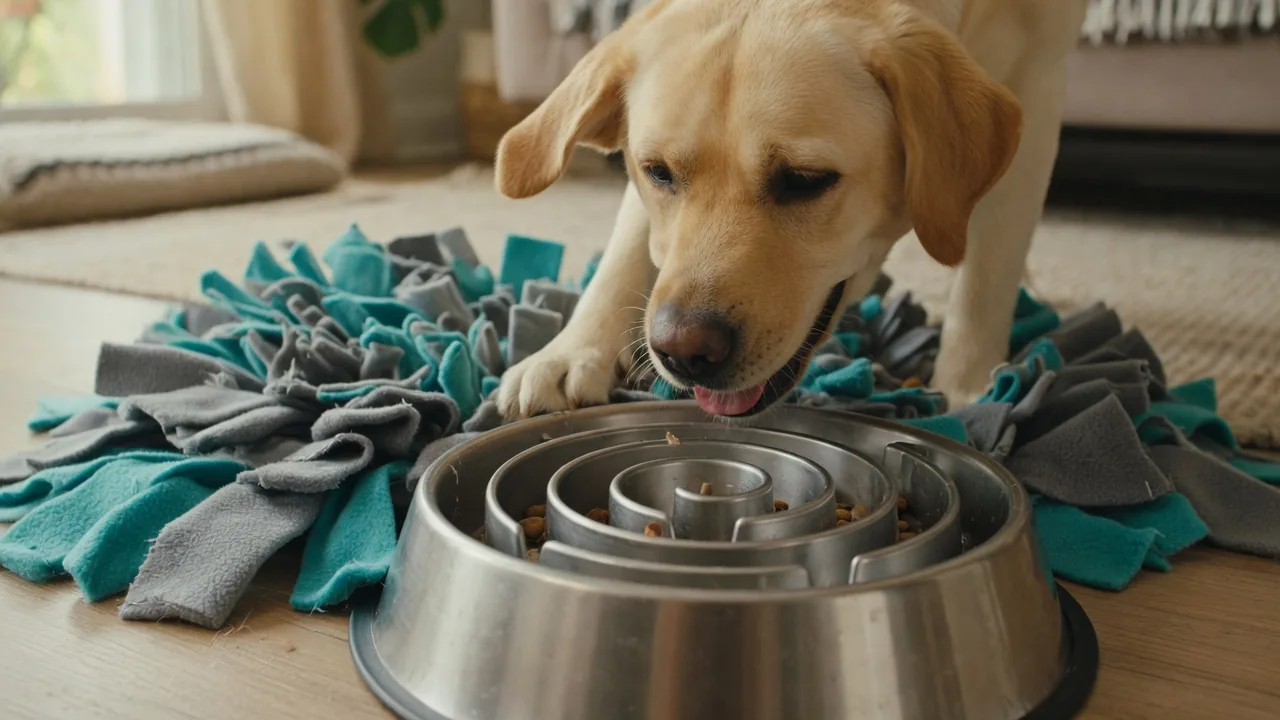
- Make the first go nearly free. Kibble on top of the ridges, treats visible on the mat, sliders left open.
- Use something worth working for, especially with a hesitant dog. A few smelly treats mixed into the kibble helps.
- Stay close and stay quiet. Don't point or solve it for them unless they're stuck for more than a minute or so; then help once and step back.
- Raise difficulty slowly, one notch every few sessions.
- Lift it when it's empty. An empty puzzle left on the floor becomes a chew toy.
If your dog walks away, barks at it, or starts biting the feeder itself, it's too hard. Go back a step.
How much of a dog's food should go in a puzzle feeder?
As much as you like, up to all of it, provided it comes out of the daily ration and not on top. A sensible pattern for most households is main meals from a slow feeder bowl or snuffle mat, with a small measured handful held back for a puzzle board, dispenser or training later in the day.
If you use treats or spreads rather than the dog's normal food, keep them to a small part of the day's calories (around 10% is the usual guide) and reduce the meals slightly to match. Dogs on prescription or weight-loss diets should stick to their prescribed food in the feeder; ask your vet before adding anything else.
How do you keep puzzle feeders clean and safe?
- Wash food-contact surfaces after every wet meal, and at least every few days for dry kibble. Dried saliva and kibble dust build up fast in corners.
- Check for damage weekly. Chewed edges, loose sliders, cracked plastic and torn fleece strips all mean retire or repair.
- Supervise anything with small or detachable parts, and anything fabric until you know your dog won't eat it.
- Feed dogs separately. A puzzle feeder holds a valuable resource for a long time, which can provoke guarding between dogs.
- Pick up when finished.
Puzzle feeders aren't right for every situation. Hold off and speak to your vet if your dog is underweight or off their food, has dental pain, is recovering from surgery with specific feeding instructions, or guards food aggressively from people.
What are our best picks by situation?
No star ratings or invented test scores here; these are recommendations by use.
- Best everyday feeder for a fast eater: a stainless steel slow feeder bowl. Whole meal, no prep, dishwasher.
- Best for mental enrichment and calm: a snuffle mat. Whole dry meal, real scent work, machine wash.
- Best for a serious problem-solver: a puzzle board at the right level, used a few times a week under supervision.
- Best for time alone: a frozen stuffable toy.
- Best simple setup for most homes: a slow feeder bowl for meals plus a snuffle mat to alternate with. Two tools, both easy to clean, covering eating speed and boredom.
For a full comparison of bowl designs and sizes, see our best slow feeder dog bowls guide.
👉 Stainless Steel Slow Feeder Dog Bowl → 👉 Snuffle Mat for Dogs →
Frequently Asked Questions
What is a dog puzzle feeder? A dog puzzle feeder is any feeding tool that makes a dog work for food rather than eat it from an open bowl. The main types are slow feeder bowls, snuffle mats, puzzle boards, treat-dispensing toys, stuffable toys and lick mats. All of them stretch out eating time and add mental activity.
Are puzzle feeders good for dogs? For most dogs, yes. They slow down fast eaters, relieve boredom and let dogs use their natural foraging behaviour. Choose a difficulty your dog can succeed at, supervise chewers, and take the food from the daily ration. Underweight, unwell or food-guarding dogs should be assessed by a vet first.
What is the best type of puzzle feeder? It depends on the goal. A slow feeder bowl is the most practical for everyday meals and fast eaters. A snuffle mat is best for scent-based enrichment and calming. Puzzle boards give the hardest mental challenge but suit short supervised sessions, not full meals.
Can a puzzle feeder replace my dog's bowl? A slow feeder bowl or snuffle mat can replace a regular bowl for every meal. Treat-dispensing toys can for dry kibble. Puzzle boards, stuffable toys and lick mats hold too little or need too much preparation to be a daily bowl replacement for most owners.
Can I use a puzzle feeder with wet food? Yes, but only certain types. Slow feeder bowls, lick mats and stuffable toys handle wet or raw food and can be washed properly afterwards. Snuffle mats, treat-dispensing balls and most puzzle boards are designed for dry kibble or dry treats.
How long should a puzzle feeder take a dog? Anywhere from about five to twenty minutes, depending on the type and difficulty. A slow feeder bowl often takes five to ten minutes, a snuffle mat ten to fifteen, and a frozen stuffable toy longer. If your dog finishes in under two minutes, increase the difficulty; if they give up, reduce it.