How High Should a Raised Dog Bowl Be?
A raised dog bowl should sit at about lower-chest height, so your dog eats with a roughly neutral neck. A common rule is to measure the withers (top of the shoulders) and subtract about 4 inches for smaller dogs or about 6 inches for larger ones. Typical results are 4-8 inches for small dogs, 8-12 for medium, and 12-19 for large and giant breeds. Treat those as starting points and adjust by watching your dog eat.
Height is only half the decision, though. Whether to elevate at all matters more for some dogs, and that's a separate question with its own caveat for deep-chested breeds. This guide covers how to measure, how to size by dog type, how to test the fit, and what to do if the height is wrong.
Why does bowl height matter?
A raised bowl reduces how far your dog has to lower its head and neck to reach food. For some dogs that means less strain on the neck and shoulders, and a more comfortable meal. But the benefit holds only if the height suits the dog's body:
- Too low, and the stand does almost nothing; the dog still bends nearly as far as it would at floor level.
- Too high, and the dog has to reach up and extend its neck, which can be as awkward as bending down, especially for short-legged dogs.
Elevation can help dogs with neck or back stiffness, arthritis, or tall frames, and is commonly suggested by vets for certain medical conditions such as megaesophagus, which needs veterinary direction on feeding position. It is not automatically better for a healthy young dog that is comfortable at floor level.
How do you measure for the right height?
- Stand your dog naturally on a flat floor, relaxed, with all four feet square.
- Measure floor to withers. The withers are the highest point of the shoulder blades, just behind the neck. Use a tape or a ruler against a wall, with a book flat across the withers.
- Subtract 4 inches for small dogs, up to about 6 inches for large dogs. That's your starting bowl height, measured from the floor to the top of the bowl rim.
- Cross-check against the chest. The rim should land around lower-chest height or a little below the point of the chest, not above it.
- Measure the bowl, not just the stand. A stand's listed height may be to the top of the frame, while the bowl sits inside and changes the effective height. Measure the finished setup, floor to rim.
- Round down if you're between options. A slightly lower setting is easier for most dogs to adapt to.
Worked example: a dog that is 24 inches at the withers. Subtract 6 inches and the target is about 18 inches to the bowl rim. A dog that is 14 inches at the withers, minus 4, gives roughly 10 inches. Those are examples of the arithmetic, not guarantees, so confirm with the eating test below.
What height suits each dog size?
Use this table to sanity-check your measurement, not replace it. Individual dogs vary in leg length and neck length, and breed averages don't capture that.
| Dog size | Typical shoulder height | Suggested bowl height |
|---|---|---|
| Toy / very small (Chihuahua, Yorkie) | 6-12 in | 2-4 in, or none |
| Small (Dachshund, Beagle, French Bulldog) | 10-16 in | 4-8 in |
| Medium (Border Collie, Cocker Spaniel, Bulldog) | 16-20 in | 8-12 in |
| Large (Labrador, Golden Retriever, German Shepherd) | 21-26 in | 12-18 in |
| Giant (Great Dane, Mastiff, Irish Wolfhound) | 26-32+ in | 16-22 in |
Short-legged, long-backed dogs such as Dachshunds and Corgis break the pattern. Their shoulder height is low relative to body length, and their necks are often positioned differently, so go lower and watch carefully. Dogs with short muzzles may find a bowl that's too high awkward in a different way, because they have to angle their face to reach it.
How do you test the fit by watching your dog eat?
A tape measure gets you close. Your dog's body tells you the rest. Watch a full meal and a few swallows of water.
Signs it's about right
- Neck roughly in line with the body, or tilted slightly down
- Front legs planted, no splaying
- Eats steadily, then walks away relaxed
Signs it's too high
- Head tilts up or back to reach the food
- Back legs shift or the dog stands on its toes
- Food is knocked out over the rim
- Reluctance to approach, or eating in short bursts
Signs it's too low (or not raised enough)
- Crouching, splayed front legs or a hunched back
- Stiffness getting up after eating
- Pawing or pushing the bowl to tilt it
If you see the wrong signs, change the height before you decide the whole idea doesn't work. Adjustable-height stands make this much easier than fixed ones. Several quick attempts using stacked books or sturdy boxes under a bowl can give you an idea before buying a stand, as long as the stack is stable and the dog can't topple it.
Should your dog use a raised bowl at all?
Height guidance doesn't settle whether elevation suits your dog. Some research has linked raised bowls to a higher rate of bloat (GDV) in large and giant deep-chested breeds, which are the dogs that might benefit most from a raised stand for comfort. The evidence is mixed and debated, and bloat is multi-factorial. Our guide to whether raised dog bowls cause bloat explains the research, and our bloat symptoms and prevention guide explains what to watch for.
A practical decision guide:
| Your dog | Sensible approach |
|---|---|
| Healthy, comfortable at floor level | Floor bowl is fine; elevation isn't required |
| Large or giant deep-chested breed | Ask your vet before elevating; floor bowl is the cautious default |
| Arthritis, neck or back stiffness | Raised bowl may help; ask your vet about the right height |
| Megaesophagus or swallowing issues | Feeding position is a veterinary decision; follow your vet's instructions |
| Senior dog slowing down | Try a modest raise; see our senior dog feeding guide |
| Small or toy dog | Often little or no elevation needed |
Never raise a bowl on the strength of this article alone if your dog has a medical condition. Your vet knows the dog.
Raised bowl or slow feeder: which problem are you solving?
These fix different problems and are often confused:
- A raised bowl changes posture and reach.
- A slow feeder changes eating speed.
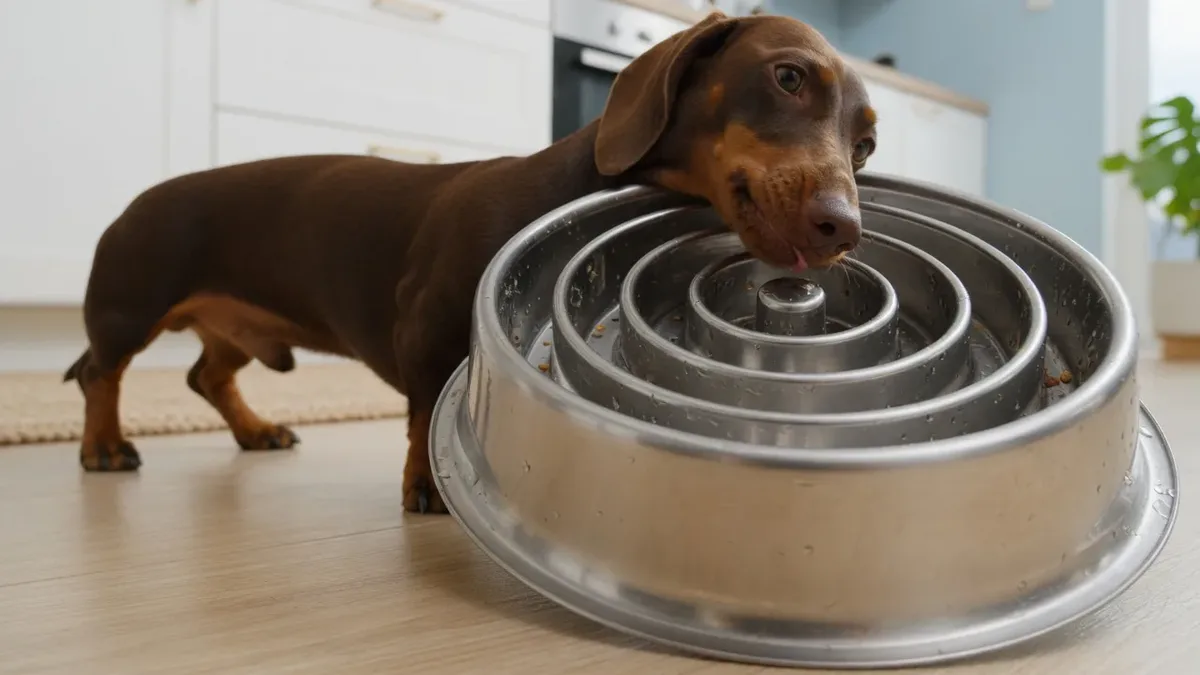
If your dog gulps, height won't help; pacing will. If your dog is stiff or struggles to bend, a slow feeder won't help; height might. Plenty of owners use a flat slow feeder on the floor, and some use a slow-feeder insert on a stand. Our raised bowl vs slow feeder guide helps you decide, and the Stainless Steel Slow Feeder Dog Bowl sits flat on the floor and paces meals with a raised maze, so you can slow a gulper without solving the height question. It's not a replacement for elevation when a vet recommends it for comfort.
What features should you look for in a raised stand?
- Adjustable height, ideally in small steps. A dog's right height changes as a puppy grows, as a senior stiffens, or when you swap bowls.
- Stability. A wobbly stand gets knocked over or makes a nervous dog avoid eating. Look for a wide base and non-slip feet.
- A snug bowl fit. The bowl should sit securely, with no gap for it to tip out or slide.
- Easy cleaning. Food collects in corners where the bowl meets the frame. Removable bowls and smooth joins make life simpler.
- Weight capacity for large dogs. A big dog leaning on a flimsy frame is a collapse risk.
- Two-bowl layouts. Check the spacing; a water bowl too close gets splashed or used as a food catch.
What mistakes do people make with raised bowls?
- Going too high "to be safe." Higher isn't better. A rim above the chest forces an upward reach.
- Using breed averages instead of measuring. Two dogs of the same breed can differ by several inches.
- Never rechecking. Puppies outgrow settings quickly, and seniors change posture.
- Raising a deep-chested giant breed without asking the vet about the bloat question.
- Treating height as a fix for gulping. It isn't one.
- Forgetting the water bowl. If food is raised, check whether the water should be too, and that it stays easy to reach.
- Switching suddenly. Introduce a raised bowl calmly, and give your dog a few meals to adjust before judging it.
The bottom line
Measure your dog at the withers, subtract about 4-6 inches, and aim for the rim to land at lower-chest height, then watch a meal and adjust. Round down when unsure. Before elevating at all, decide whether it suits your dog, particularly if you own a large deep-chested breed, and ask your vet when health issues are involved. Height solves reach, not speed, so keep a slow feeder in mind if gulping is the actual problem.
👉 See the Stainless Steel Slow Feeder Dog Bowl →
Frequently Asked Questions
How high should a raised dog bowl be? About lower-chest height, so the neck stays roughly neutral. A common method is to measure the withers and subtract about 4 inches for smaller dogs or about 6 inches for larger dogs, then adjust by watching your dog eat.
How high should a raised dog bowl be for a large dog? Large breeds like Labradors, Golden Retrievers and German Shepherds commonly land around 12-18 inches, and giant breeds such as Great Danes 16-22 inches, depending on measured shoulder height. For deep-chested breeds, ask your vet whether to elevate at all.
How high should a raised dog bowl be for a small dog? Often only 2-8 inches, and many small and toy dogs need little or no elevation. Too high a stand can make eating harder for a short-legged dog, so measure the withers and lean toward the lower option.
What happens if a raised bowl is too high? Your dog has to tilt its head up and back, which can be as uncomfortable as bending too far down. Signs include head-tilting, eating in short bursts, food spilling over the rim, and hesitation at the bowl.
Should I get an adjustable-height bowl stand? Often yes. It lets you fine-tune the height to your dog, and re-adjust as a puppy grows or an older dog's posture changes, instead of committing to one guess with a fixed stand.
Are raised dog bowls bad for dogs? Not for every dog. They can help dogs with stiffness or certain medical conditions, but some research links raised bowls to higher bloat rates in large deep-chested breeds, and the evidence is mixed. Ask your vet if your dog is a large, deep-chested breed.
Does a raised bowl slow down a fast eater? No. A raised bowl changes posture and reach, not eating speed. For a dog that gulps, a slow feeder bowl paces the meal, and the two can be used together if your vet agrees elevation suits your dog.
Save this guide