DIY Slow Feeder vs Buying One: Which Is Worth It?
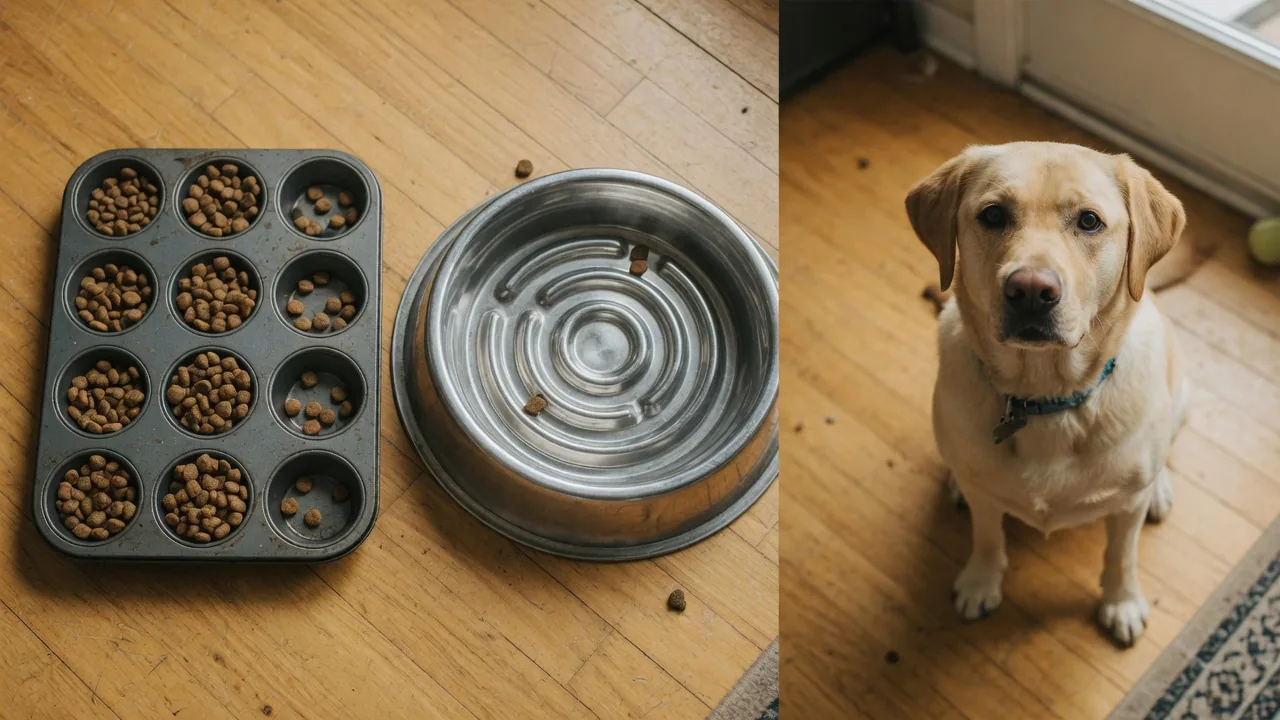
A DIY slow feeder dog bowl works. A muffin tin, a bundt pan or a rolled towel will slow most dogs for free, and they're ideal for testing whether slower meals help. For twice-daily feeding over months, a purpose-built bowl is usually worth buying because it's faster to set up, easier to clean and more consistent.
So the short version is: start with DIY, and buy only if you find yourself doing it every day. Below are six homemade options with exact setup, the household items you shouldn't use, a one-week trial to see if it's working, and an honest comparison with a bought bowl.
What makes any slow feeder work?
Every slow feeder, homemade or bought, does one of three things:
- Splits the food up so your dog can't take a big mouthful.
- Puts something in the way so they have to eat around it.
- Hides the food so they have to find each piece.
That's all there is to it. If your homemade version does at least one of these and your dog can't simply tip it over, it'll work. For a fuller explanation of the designs, see what a slow feeder dog bowl is.
Which DIY slow feeders work?
1. Muffin tin
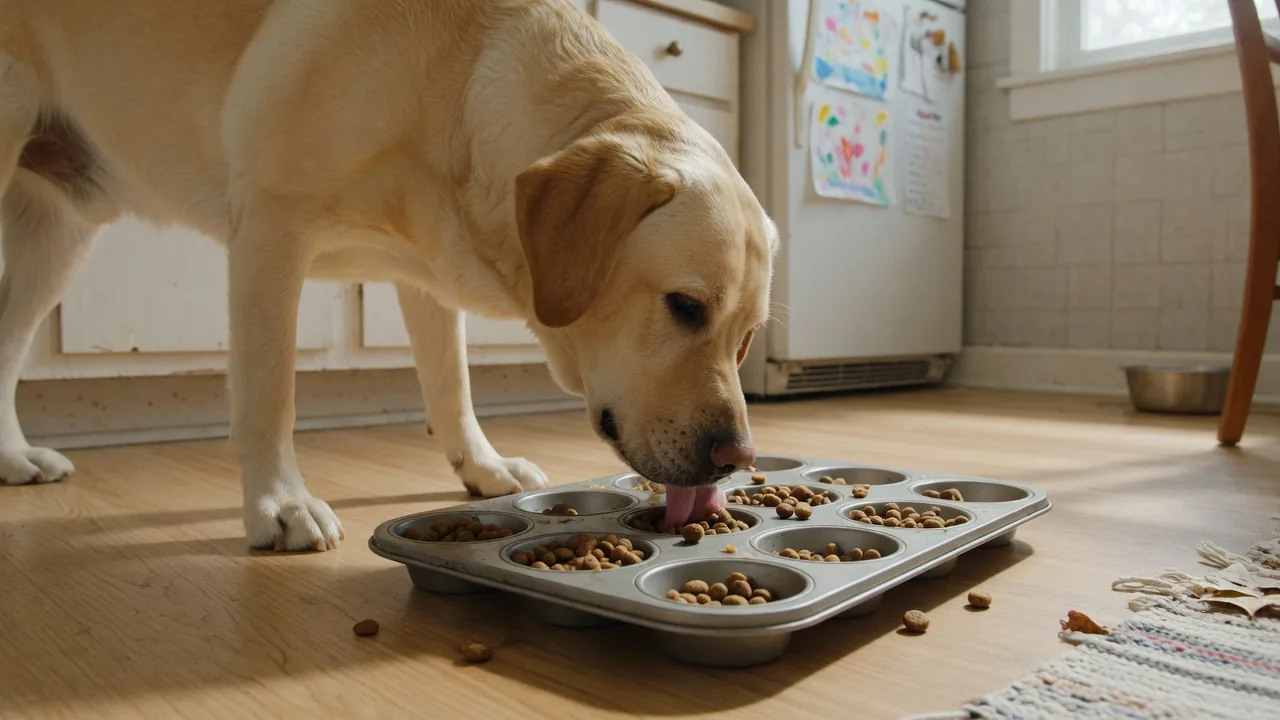
You need: a 6- or 12-cup metal or silicone muffin tin. Setup: divide the meal evenly between the cups. For small dogs, use a mini-muffin tin so the portions stay tiny. Works because: your dog has to move from cup to cup and can only get a little at a time. Watch for: light tins getting flipped. Put it on a damp towel or non-slip mat. Avoid tins with flaking non-stick coating. Best for: almost any dog. This is the one to try first.
2. Bundt pan
You need: a ring-shaped cake tin with a centre tube. Setup: pour the kibble into the ring. Works because: it's the closest thing in your kitchen to a real slow feeder. The centre post and fluted sides stop your dog getting their whole muzzle in. Watch for: it holds a lot, so measure the portion first. Too wide for very small dogs. Best for: medium and large dogs.
3. Bowl inside a bowl
You need: a large bowl and a smaller, heavy bowl or ramekin. Setup: put the small bowl upside down in the centre of the large one and pour food into the ring around it. Works because: the gap is too narrow for big mouthfuls. Watch for: the inner bowl getting pushed aside. It needs to be heavy, such as ceramic or steel, and smooth-edged. Best for: medium dogs, and a good test of whether a maze bowl would suit yours.
4. Rolled towel
You need: an old towel with no loose threads. Setup: lay it flat, scatter kibble along it, roll it up loosely. For more challenge, tie the roll in a loose knot. Works because: your dog has to unroll it with nose and paws to find the food. Watch for: dogs who eat fabric. Supervise every time, and wash the towel after each use because it gets soaked in saliva. Best for: dry food only, and dogs who enjoy problem-solving.
5. Scatter feeding
You need: a clean floor or a lawn. Setup: throw the meal across a wide area. Works because: eating one piece at a time is as slow as it gets, and sniffing for food is good mental work. Watch for: lawns treated with fertiliser, pesticide or slug pellets. Not for wet food. In multi-dog homes, feed dogs separately. Best for: dry kibble, energetic dogs, good weather.
6. Ice cube tray or frozen meal
You need: an ice cube tray, or any shallow dish. Setup: press wet food or soaked kibble into the compartments. Serve as is, or freeze for a couple of hours. Works because: your dog has to lick it out, which takes far longer than gulping. Watch for: brittle plastic trays with a chewer. Silicone is safer. Best for: wet and fresh food, hot days.
What shouldn't you use as a DIY slow feeder?
Some popular suggestions are bad ideas.
- Rocks or stones. An old tip that still circulates. Dogs break teeth on them and some swallow them.
- Tennis balls. Fine for fetch, wrong for a food bowl. They can be compressed and lodged in a large dog's throat, and the felt gets soggy and dirty.
- Any ball that could fit in your dog's mouth. If you use a ball as an obstacle, it has to be solid, washable and clearly too big to get behind their front teeth. For a large dog, that's bigger than most balls you own.
- Golf balls, marbles and small toys. Choking and blockage risks.
- Thin or brittle plastic. Takeaway tubs and plastic bottles crack into sharp pieces.
- Cardboard as a daily feeder. Egg boxes are fine as an occasional supervised game with dry food. They can't be cleaned, so they're single-use.
- Anything with flaking coating, rust or sharp seams.
- Glass.
If you're unsure about an object, ask whether you'd be comfortable if your dog chewed it for a minute unsupervised. If not, it doesn't belong in the bowl.
How do you know if your DIY feeder is working?
Run a one-week trial.
- Time a normal meal in the usual bowl before you start.
- Use the same DIY method for seven days, same portion.
- Time each meal and note any coughing, gagging, burping or food coming back up.
You're aiming for a meal that takes somewhere around 5 to 10 minutes, where it used to take under a minute. If your dog is slower and the after-meal problems have eased, slowing down helps your dog. If they've flipped the tin three times or you've stopped bothering by Thursday, that's useful information too.
Our guide to how long a dog should take to eat has the normal ranges to compare against.
Where does DIY fall short?
DIY feeders slow eating perfectly well. Their weak points are practical ones.
- Cleaning. A 12-cup muffin tin has 12 sets of corners. Towels need a wash after every meal. Feeding twice a day, that's 14 washes a week.
- Stability. Kitchen tins weren't built to be pushed around by a dog. Many dogs learn to flip them, which dumps the whole meal in one pile.
- Consistency. The difficulty changes depending on how you set it up that day.
- Wear. Non-stick coatings scratch under claws and teeth. Towels fray.
- Wet food. Most DIY methods only suit dry kibble.
- Supervision. Towels, balls and cardboard all need you watching.
- Giving up your bakeware. A muffin tin that's now the dog's is no longer yours.
None of that matters for a week. Over a year of two meals a day, which is about 730 meals, it adds up.
DIY vs buying: how do they compare?
| Factor | DIY slow feeder | Bought stainless steel bowl |
|---|---|---|
| Upfront cost | Free, if you own the items | A one-off purchase |
| Setup per meal | 1–3 minutes | Pour food in |
| Slows eating | Yes | Yes |
| Consistency | Varies meal to meal | Same every time |
| Stays put | Often flipped or pushed | Non-slip base |
| Cleaning | Fiddly, or laundry | Dishwasher |
| Wet food | Limited | Fine |
| Supervision | Needed for towels, balls, cardboard | Not once your dog is used to it |
| Lifespan | Until scratched, frayed or reclaimed | Years |
| Best for | Trials, travel, variety, tight budgets | Everyday meals |
When should you stick with DIY?
- You're testing the idea. Don't buy anything until you know slower meals help.
- It's temporary. A foster dog, a holiday, a dog staying for the weekend.
- Money is tight. A muffin tin does the job. A bought bowl is a convenience, not a necessity.
- You want variety. Scatter feeding and towel rolls are enrichment in their own right, and worth keeping even if you own a slow feeder.
- Your dog is a mild case. Slightly quick, no symptoms, happy with a muffin tin. Leave it there.
When is buying a slow feeder worth it?
- You've done the trial and it helped, and you're now setting up a muffin tin 14 times a week.
- Your dog flips or carries off whatever you improvise.
- You feed wet or fresh food.
- You have a large or deep-chested dog and want something reliable at every meal.
- Other people feed the dog and need it to be foolproof.
If you buy, the material matters more than the pattern. Plastic bowls scratch, and scratches hold bacteria and smells. Steel doesn't scratch the same way and goes in the dishwasher. Our stainless steel slow feeder dog bowl has a raised maze and a non-slip base, and our comparison of stainless steel vs. plastic slow feeders explains the difference in detail.
A sensible setup for many homes is both: a bought bowl for the daily routine, and DIY or a snuffle mat a few times a week for variety. For every method side by side, see how to stop your dog eating too fast.
The bottom line
Try a muffin tin or bundt pan tonight. Time the meals for a week. If your dog slows down and you don't mind the washing-up, you're done, and it cost nothing. If it works but the daily setup and cleaning wear thin, that's the point to buy a bowl, and stainless steel is the one that lasts.
👉 Stainless Steel Slow Feeder Dog Bowl →
Frequently Asked Questions
How do you make a DIY slow feeder dog bowl? The easiest way is to divide the meal between the cups of a muffin tin. A bundt pan, a small heavy bowl turned upside down inside a larger bowl, kibble rolled in a towel, or scattering food across a clean floor all work too. Each one stops your dog taking big mouthfuls.
Are DIY slow feeders as good as store-bought? For slowing a single meal, yes. The differences are practical: homemade versions take longer to set up and clean, get flipped more easily, vary from meal to meal and mostly suit dry food. A bought bowl is more convenient for everyday use.
Is it safe to put a ball in my dog's bowl? Only if the ball is solid, washable and far too big to fit in your dog's mouth. Tennis balls, golf balls and small toys are choking risks, and rocks can break teeth. A muffin tin or bundt pan gives the same effect with less risk.
What can I use instead of a slow feeder bowl? A muffin tin, a bundt pan, an upturned bowl inside a larger bowl, a rolled towel, scatter feeding, a snuffle mat or a frozen ice cube tray of wet food. All of them split the food up or make your dog search for it.
How do I make a DIY slow feeder for wet food? Press wet food into a silicone ice cube tray or muffin tin so your dog has to lick it out, and freeze it for a couple of hours to make it last longer. Towel rolls and scatter feeding don't suit wet food.
Is it cheaper to DIY a slow feeder? Yes, if you already own the items. The cost of DIY is time: a few minutes of setup and cleaning at every meal. If you feed twice a day for years, a one-off bowl purchase often works out as the easier option.
How long should a dog take to eat with a DIY slow feeder? Aim for roughly 5 to 10 minutes for a meal that used to take under a minute. If your dog still finishes in under two minutes, use more compartments or a harder method. If they give up, make it easier.