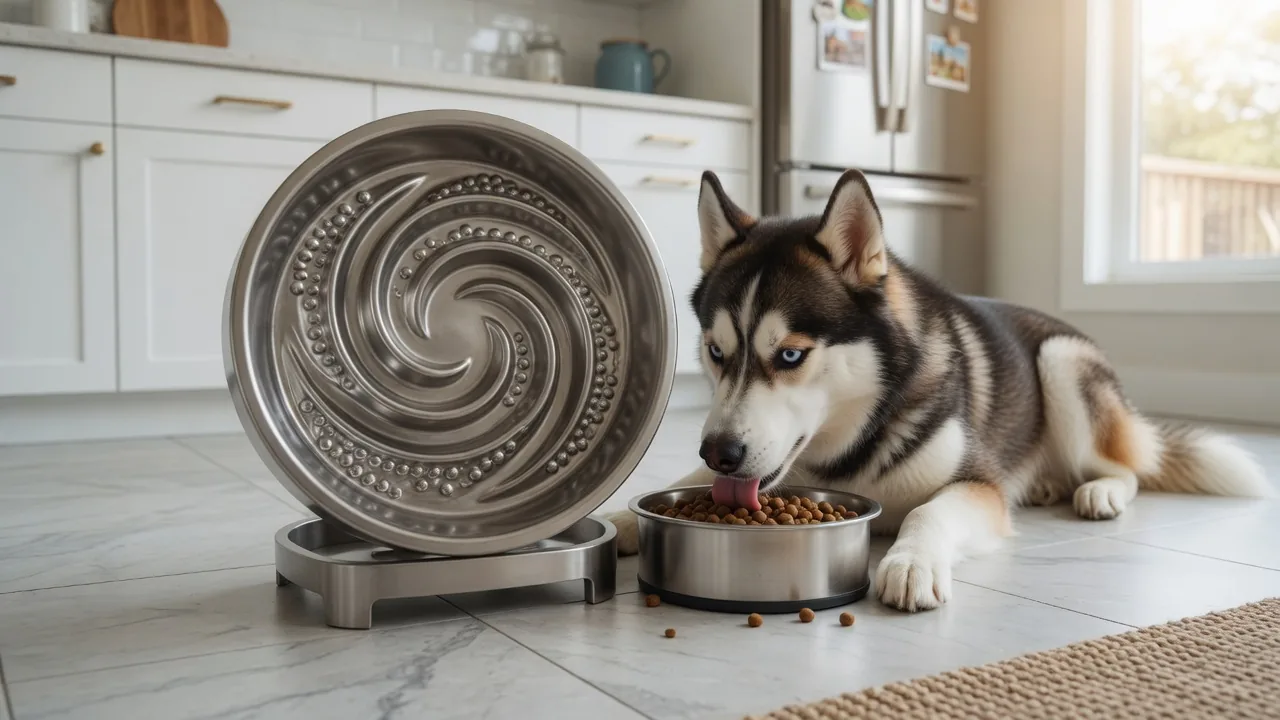
Best Slow Feeder for Huskies
The best slow feeder for a Husky is a medium stainless steel bowl with a raised maze and a non-slip base — but only if your Husky actually gulps. Many Huskies are picky, light eaters, and a hard maze can make them skip meals. Match the bowl to the dog in front of you: gulper, grazer, or bowl-flipper.
That last sentence is the whole article in miniature. Huskies are a strange breed to buy a feeding bowl for, because the breed splits into two camps that need opposite things. Some vacuum a meal in under a minute. Others sniff the bowl, wander off, and come back three hours later. Below: how to tell which Husky you have, what size and depth of slow feeder fits a 35–60 lb dog with a thick coat and a talent for mischief, the setups that work for each type, and the mistakes Husky owners make most often.
Is your Husky actually a fast eater?
Before buying anything, time a normal meal. Put down the usual portion in the usual bowl and start a stopwatch.
- Finished in under a minute, with coughing, gagging or a big burp afterwards — you have a gulper. A slow feeder is a sensible fix.
- Finished in one to three minutes, calmly — that's a normal pace for a medium dog eating kibble. A slow feeder is optional; enrichment might be the better reason to use one.
- Walks away with food left, comes back later, or eats only when you're watching — you have a picky or "grazing" Husky. A difficult maze is more likely to cause skipped meals than solve anything.
This matters more for Huskies than for most breeds. Owners of Labradors or Beagles can assume food obsession and be right nearly every time. Husky owners can't. The breed has a long-standing reputation — repeated constantly on Husky forums and in breed-club writing — for eating less than people expect for their size and for going off food when bored with it. Sled dogs were bred to work hard on modest rations, and plenty of modern pet Huskies still eat like they're budgeting.
If you're not sure what "normal" looks like, our guide to how long it should take a dog to eat gives rough timings by food type.
Why do some Huskies eat so fast?
When a Husky does gulp, it's usually one of four things:
Competition. Huskies are pack-minded and often live in multi-dog homes. A dog that thinks a housemate might reach the bowl first eats fast. This is the most common cause in Husky households, and a slow feeder alone won't fix it — separation at mealtime does.
Big appetite after big exercise. A young Husky that's just done a long run or a session in harness can come in genuinely hungry. Feeding 30–60 minutes after hard exercise, rather than straight away, often slows things down on its own.
Boredom and frustration. A Husky that doesn't get enough to do treats dinner as the most interesting event of the day. Speed is excitement, not hunger.
A recent diet change. A food the dog finds far more appealing than the last one can turn a picky eater into a gulper overnight. Often this settles in a few weeks.
Fast eating can mean swallowed air, burping, and food coming back up a few minutes later. For the general mechanics of that, see why dogs eat too fast and throw up. If a Husky vomits regularly, loses weight, or has ongoing loose stools, that's a vet visit, not a bowl problem.
What size and depth of slow feeder suits a Husky?
Huskies sit in the medium-to-large range. The AKC breed standard puts males at 21–23.5 inches at the shoulder and 45–60 lb, females at 20–22 inches and 35–50 lb. That gives you a fairly narrow target.
Capacity. Most adult Huskies eat somewhere around 1.5–3 cups of kibble a day, depending on the food's calorie density, age and activity — check your food's label and your vet, because working Huskies and couch Huskies differ hugely. Split into two meals, that's usually under 1.5 cups per serving. A medium slow feeder holds that comfortably; a giant-breed bowl isn't needed and gives a lightweight eater more empty maze to give up on.
Maze depth. Moderate. Deep enough that a gulper can't take a full mouthful, shallow enough that a hesitant eater can still reach food without scraping. If your Husky's muzzle is pressing on the bowl's floor and still not reaching kibble, the maze is too deep.
Height. A Husky's mouth is roughly elbow height when standing, so a floor-level bowl means a slight head drop, which most dogs manage fine. Raised feeders are a separate decision with its own trade-offs — our raised bowl vs. slow feeder comparison covers it. Don't stack a slow feeder on a raised stand without checking it can't tip.
Weight and grip. This is where Huskies differ from calm breeds. A light plastic maze is a toy to a bored Husky: pushed across the floor, flipped to dump the kibble, carried into the garden. A heavier bowl with a rubberised base survives this; a light one doesn't.
Which slow feeder setup suits which Husky?
| Your Husky | Best setup | Why |
|---|---|---|
| Gulper, eats alone | Stainless steel maze bowl, non-slip base | Paces each mouthful; durable against pushing and pawing |
| Gulper in a multi-dog home | Maze bowl plus feeding in separate rooms or crates | Speed is competition-driven; the bowl only treats the symptom |
| Picky eater / grazer | Plain bowl, fixed mealtimes, 15–20 minute window | A hard maze adds friction to a dog already reluctant to eat |
| Bored, destructive, high energy | Snuffle mat or scatter-feeding for one meal a day | Gives the nose and brain a job, not just a slower bowl |
| Bowl-flipper / bowl-carrier | Heavy stainless bowl in a corner, or a bowl holder | Weight and position stop the game before it starts |
| Senior or dental issues | Shallow maze or plain bowl, softened food | Comfort first; deep ridges can be hard on sore mouths |
Notice that two of the six rows don't involve a slow feeder bowl at all. That's deliberate. A slow feeder is the right tool for a fast eater. It's the wrong tool for a dog who isn't eating enough.
Why stainless steel suits Huskies in particular
Material matters for every dog, but three Husky traits push the decision toward steel:
They chew and play with gear. A bored Husky will happily gnaw the rim of a plastic bowl. Chewed plastic edges are sharp and harder to clean. Steel doesn't give them anything to work on.
They shed — a lot. Twice a year a Husky "blows" its undercoat, and fur gets into everything, including the food bowl. Hair sticks to wet residue in scratched plastic grooves. A smooth steel surface rinses clean faster.
They live outdoors part-time. Many Huskies spend long stretches in the garden. Plastic left in the sun degrades and gets brittle; steel doesn't care.
Our Stainless Steel Slow Feeder Dog Bowl has a raised maze to pace a gulper, a non-slip base so it isn't pushed across the kitchen, and dishwasher-safe steel that rinses clean of fur. We haven't published its capacity or ridge depth, so check the retailer listing against your Husky's measured meal. For the wider material comparison, see stainless steel vs. plastic slow feeders.
One honest caveat: steel is noisy. A Husky pushing a steel bowl against a tiled floor makes a racket, and some sound-sensitive dogs dislike it at first. Putting a rubber mat underneath fixes both the noise and any remaining slide.
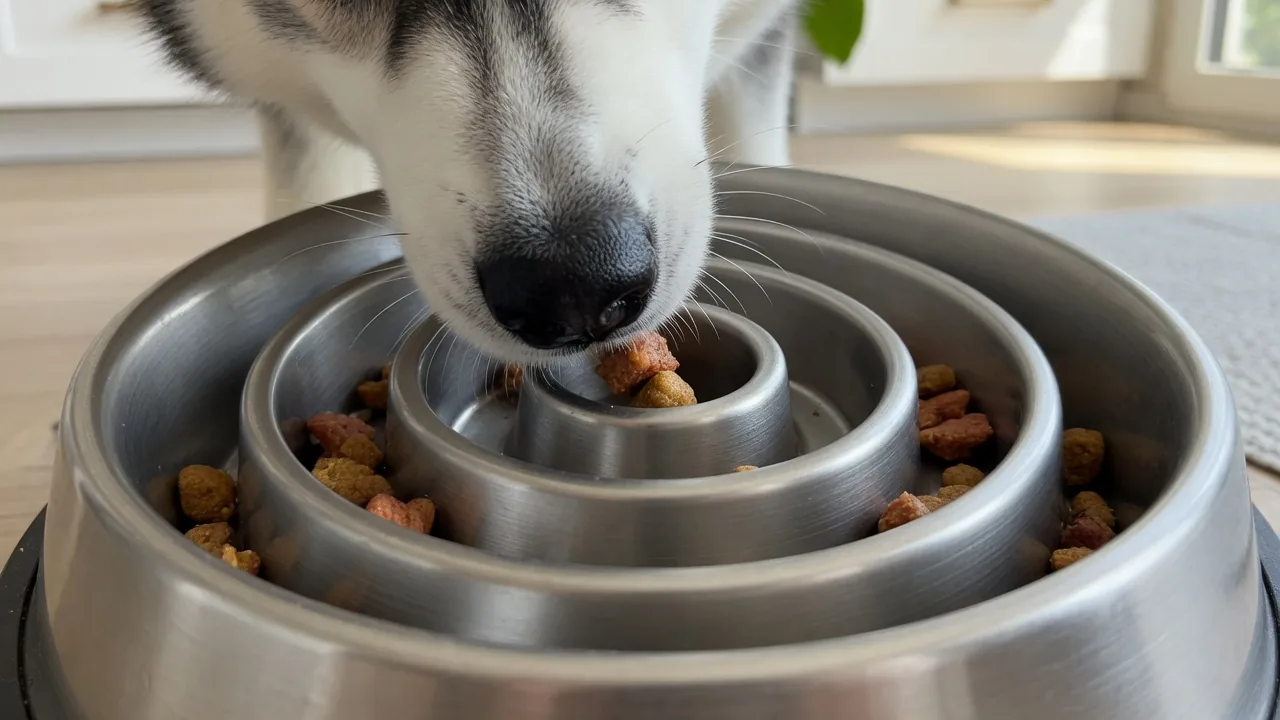
How do you switch a Husky to a slow feeder without a meal strike?
Huskies are clever and occasionally dramatic. Some solve a maze in one meal. Others decide the new bowl is beneath them. A gradual switch avoids a standoff:
- Start with high-value food in the maze. Mix a spoonful of wet food or a few favourite treats into the first few meals so the new bowl is immediately rewarding.
- Keep the portion identical. Only the bowl changes. Don't add extra food to "make up" for the effort.
- Use the old bowl for the second meal at first. One maze meal a day for the first several days, then both meals.
- Set a time limit. Leave the bowl down 15–20 minutes, then pick it up. Free-feeding a picky Husky in a slow feeder teaches them they can ignore it.
- Don't hover. Many Huskies eat less with an audience. Put the bowl down and leave the room.
- Watch the clock, not just the bowl. If meals go from 40 seconds to 4–6 minutes with no frustration, the bowl is right. If your Husky gives up after a minute or paws the bowl over, the maze is too hard for this dog.
If your Husky skips more than a meal or two in a row after a bowl change, go back to the old bowl and try again more gradually. A dog that keeps refusing food in any bowl should see a vet.
What mistakes do Husky owners make with slow feeders?
Buying for the breed instead of the dog. "Huskies eat fast" is only true of some Huskies. Time the meal first.
Using a slow feeder to fix competition. Two Huskies side by side with maze bowls still race each other — the bowls just slow the race. Separate them. If there's guarding or growling over food, our guide to food aggression in dogs covers safer setups.
Leaving food down all day. Free-feeding a grazing Husky in any bowl makes it harder to notice appetite changes, which are often the first sign something is off.
Changing the food to "fix" pickiness. Rotating foods constantly can make pickiness worse, since the dog learns that refusing a meal brings something better. Check any diet change with your vet — northern breeds like Huskies are among those prone to zinc-responsive skin problems, and diet decisions are worth getting right rather than improvising.
Letting a dirty maze build up. Ridges trap wet residue and fur. Wash after every meal; our guide on how to clean a slow feeder bowl has the routine.
When is a snuffle mat better than a slow feeder for a Husky?
For a lot of Huskies, the real problem isn't eating speed — it's a working dog with too little work. A snuffle mat turns a meal into a sniffing job: kibble hidden in fleece strips that the dog has to hunt for with their nose. That uses the brain in a way a maze bowl mostly doesn't, and it tends to suit bored, energetic dogs well.
A sensible Husky routine is a slow feeder bowl for one meal and a snuffle mat for the other, or the snuffle mat on days with less exercise. Snuffle mats need supervision with a dog who shreds things — a Husky left alone with one may treat it as a chew toy. For the side-by-side, read snuffle mat vs. slow feeder bowl.
The bottom line
Time your Husky's meal before you buy anything. If they gulp, a medium stainless steel slow feeder with a moderate maze and a grippy base is the right call — heavy enough to survive a bored Husky, easy enough to clean during shedding season. If they're picky, skip the maze and focus on routine. And if mealtime speed comes from a housemate, separate the dogs first.
👉 See the Stainless Steel Slow Feeder Dog Bowl →
Frequently Asked Questions
Do Huskies need a slow feeder bowl? Only the ones that gulp. Time a normal meal: if your Husky finishes in under a minute, especially with coughing or burping, a slow feeder helps. Many Huskies are picky or light eaters, and for them a difficult maze can lead to skipped meals rather than better eating.
What size slow feeder is best for a Husky? A medium bowl usually fits. Adult Huskies weigh roughly 35–60 lb and typically eat under 1.5 cups of kibble per meal when fed twice daily, so a giant-breed bowl isn't necessary. Choose a moderate maze depth and a heavy, non-slip base.
Why does my Husky eat so fast? The most common causes are competition with other dogs, eating straight after hard exercise, boredom, or a new food they find very appealing. Separating dogs at mealtime and waiting 30–60 minutes after exercise often slows things down even before you change bowls.
Will a slow feeder make my picky Husky eat less? It can. A maze adds effort, and a reluctant eater may give up. For picky Huskies, a plain bowl, fixed mealtimes and a 15–20 minute window usually work better. If your Husky refuses food in any bowl for more than a day, see a vet.
My Husky flips or carries the bowl away. What should I do? Use a heavier stainless steel bowl with a rubber base, put it in a corner, or use a bowl holder or rubber mat. Light plastic mazes are easy for a bored Husky to push or flip. Extra exercise and enrichment before meals often reduces the game too.
Is stainless steel or plastic better for a Husky? Stainless steel is usually the better choice. It resists chewing, doesn't trap shed fur and food residue in scratches, survives time outdoors, and is dishwasher-safe. The main drawback is noise on hard floors, which a rubber mat underneath solves.