Best Slow Feeder Bowl for Labradors (Fast Eaters)
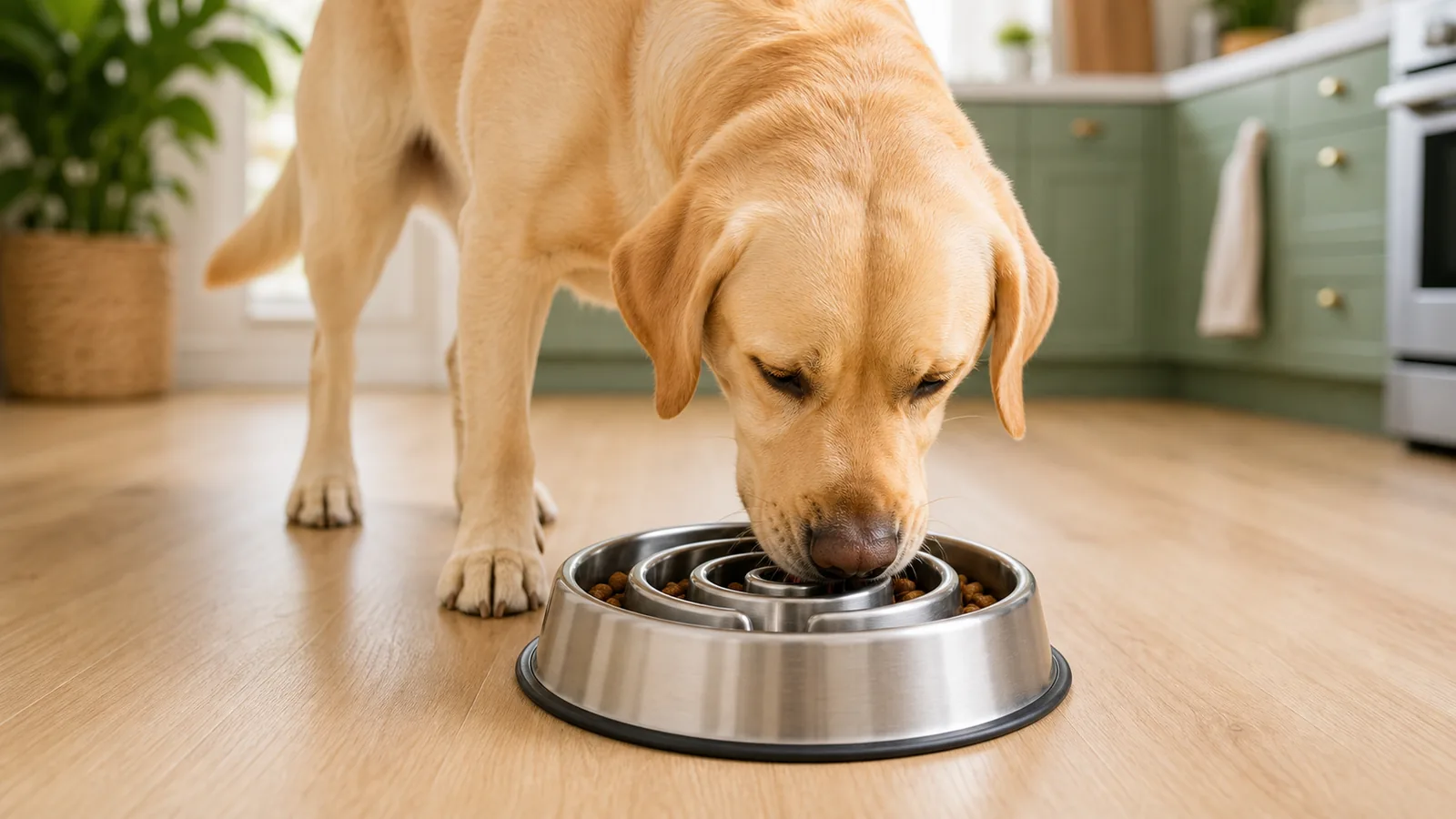
The best slow feeder bowl for a Labrador is a large, heavy stainless steel maze bowl that fits a full 1½ to 2 cup meal inside its channels and has a non-slip base. Labs are strong, clever and unusually food-driven, so thin plastic and shallow patterns get chewed, flipped or beaten within days.
Labradors are the breed slow feeders might as well have been invented for. They eat fast, they eat anything, and a good share of them are hungry for reasons that have nothing to do with how much you feed. This guide covers why, what bowl stands up to a Lab, how to set it up, and the part most guides skip: a slow feeder changes how fast your Lab eats, not how much, and with this breed you need to manage both.
Disclosure: we sell the products linked here, and the links lead to Amazon, where we earn a commission on qualifying purchases at no extra cost to you. See our affiliate disclosure.
Why do Labradors eat so fast?
Partly temperament, and partly genetics that have been studied properly.
Researchers at the University of Cambridge found that around a quarter of Labrador retrievers carry a mutation in a gene called POMC, which is involved in hunger and energy use. Their follow-up work found that dogs with the mutation feel hungrier between meals and burn roughly 25% less energy at rest. In other words, a sizeable minority of Labs are both hungrier and need fewer calories than other dogs. The mutation also turns up in flat-coated retrievers.
That explains a lot of everyday Lab behaviour. The dog who finishes dinner and stares at you as if nothing happened is often not being greedy. They don't feel as satisfied as another dog would.
The other three-quarters of Labs don't carry the mutation and many still gulp. The breed was developed as a working retriever, selected for drive and keenness, and that enthusiasm gets applied to food. Add another dog in the house, a long gap since the last meal, or a habit formed in a big litter, and you get 30-second dinners.
One caution. Constant hunger in a Lab is usually just a Lab. But if the appetite is new, or comes with weight loss, heavy drinking or other changes, it needs a vet. Our guide to why your dog is always hungry covers the medical causes.
What does fast eating do to a Labrador?
Day to day, mostly unpleasant things, not dangerous ones: burping, gas, and food coming back up a few minutes later because it went down whole. Some Labs cough or gag on dry kibble.
Two points are more serious. Labs are large and moderately deep-chested, so they sit in the group of breeds where bloat (GDV) is a recognised risk, though they're not at the top of the list the way Great Danes are. Eating fast is one of several risk factors. And older Labradors are prone to laryngeal paralysis, a condition affecting the airway that can make coughing and choking at meals more likely. A senior Lab who starts coughing while eating or drinking, or whose bark changes, should see a vet.
A slow feeder helps with the everyday problems and reduces one bloat risk factor. It isn't a guarantee against bloat.
What size slow feeder does a Labrador need?
The AKC breed standard puts males at 22.5–24.5 inches and 65–80 lb, and females at 21.5–23.5 inches and 55–70 lb. Many pet Labs weigh more than that, which is a separate problem covered below.
| Labrador | Typical weight | Rough kibble per meal (2 meals/day) | Bowl to look for |
|---|---|---|---|
| Puppy, 3–6 months | 25–50 lb | ¾–1½ cups (3 meals/day) | Medium, shallow maze, chew-proof |
| Adolescent, 6–18 months | 50–70 lb | 1½–2 cups | Large, moderate maze |
| Adult female | 55–70 lb | 1¼–1¾ cups | Large |
| Adult male | 65–80 lb | 1½–2 cups | Large |
| Senior or on a diet | varies | 1–1½ cups | Large, so food spreads thin |
Portions are rough and depend on your food's calorie density and your dog's body condition, so go by the feeding guide on the bag and your vet. See how much to feed your dog for how to adjust.
Two sizing rules matter for Labs:
- The whole meal must sit down in the channels. Kibble heaped over the ridges is just a normal bowl with a bump in it. A Lab will clear the top layer in ten seconds.
- When in doubt, go bigger. A larger bowl spreads the same portion thinner across more maze, which is slower. There's no downside to spare capacity with a dog who never gives up on food.
What maze and material stand up to a Lab?
Labradors have a broad muzzle, a wide tongue and total commitment. That changes what works.
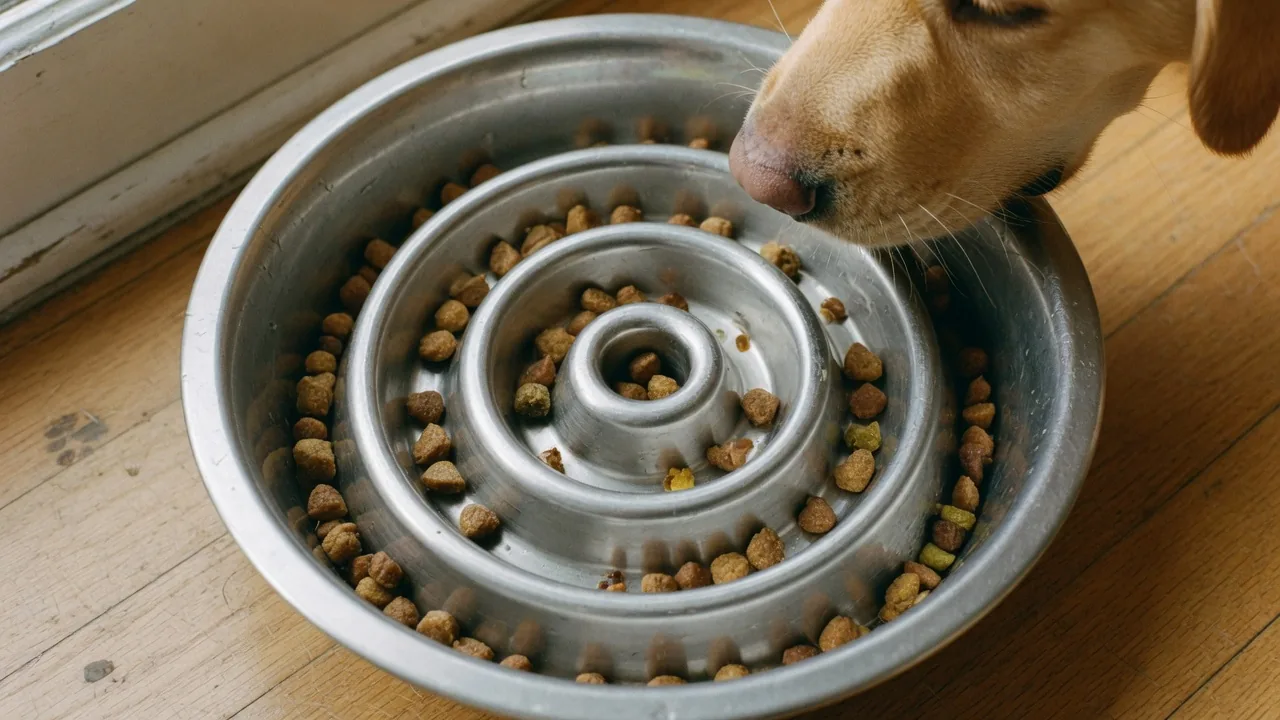
- Channels wide enough for a broad muzzle, ridges tall enough to matter. Roughly an inch or more of ridge height. Low bumps do nothing. Very narrow slots frustrate a wide-faced dog and invite flipping.
- A base that grips. A 70 lb dog pushing forward with their whole body slides a light bowl straight across the floor. Weight plus a rubber base, ideally on a mat.
- Nothing that can be chewed off. This is the Lab-specific issue. Labs are famous for swallowing things they shouldn't: socks, toys, stones, and pieces of plastic bowl. A chewed plastic feeder is a foreign-body risk and its rough edges hold bacteria. Stainless steel removes the problem.
- Easy to wash. Labs drool into their food. A smooth surface that goes in the dishwasher is worth a lot twice a day.
Our Stainless Steel Slow Feeder Dog Bowl is food-grade stainless steel with a raised maze pattern, a non-slip base and dishwasher-safe cleaning, which covers the base, material and washing points. Its capacity, ridge height and weight aren't published on the product page, so check the listing against one full measured meal before you order. For a full comparison of materials, see stainless steel vs. plastic slow feeders.
👉 See the Stainless Steel Slow Feeder Dog Bowl →
Which feeder type fits a Labrador best?
This compares the options by what each is built from and who it suits. Where a figure isn't published for our products, the table says so rather than guessing.
| Option | Bowl capacity | Ridge depth | Material | Who it suits |
|---|---|---|---|---|
| Stainless Steel Slow Feeder Dog Bowl | Not published on the product page; check it holds one full measured meal | Raised maze pattern; height not published, so look for roughly an inch or more | Food-grade stainless steel, non-slip base, dishwasher-safe | Everyday meals for chewers and gulpers; the default Lab pick |
| Generic plastic maze bowl | Varies widely by brand | Often shallow | Plastic; scratches and chew damage over time | Light gulpers who don't chew; replace at the first rough edge |
| Snuffle Mat for Dogs | Spreads a full dry meal across the fabric | Fleece strips, not ridges | Machine-washable fabric | Dry kibble variety and sniffing work; supervise a Lab who eats fabric |
| Lick Mat for Dogs | Small; part of a meal or a treat | Textured surface | Silicone, suction cups | Wet food, yogurt or pumpkin puree for calm time; not a full Lab dinner |
For a Lab, the steel bowl is the daily driver, and the mats are rotation tools. If your Lab is a confirmed chewer, skip the plastic row entirely.
How do you introduce a slow feeder to a Labrador?
Easily. This is the one breed where you rarely need a gentle transition.
- Same food, same amount, new bowl. Don't add extra to make up for the effort.
- Put it on a non-slip mat in a corner so pushing gets them nowhere.
- Stay for the first few meals. You're watching for flipping, pawing or picking the bowl up, not for whether they'll eat. They'll eat.
- Time it. A Lab who took 30 seconds from a plain bowl should take around 5 to 10 minutes. Under 2 minutes means the bowl is too easy or too full.
- Take the bowl away when it's empty. Labs will lick, chew and carry an empty bowl out of habit. Pick it up, wash it, put it away.
What if your Lab beats the slow feeder?
Most Labs get quicker over the first couple of weeks as they learn the pattern. That's normal, and they'll still be far slower than with a plain bowl. If your dog is back under two minutes:
- Add water. Pour in enough warm water to float the kibble. Your Lab has to lap and chase pieces around the maze. It also adds volume without calories.
- Mix in wet food and press it into the channels. Sticky food can't be scooped. Our guide to slow feeders for wet food explains how.
- Freeze it. Soaked kibble or wet food pressed into the maze and frozen for an hour or two turns dinner into a 15-minute job.
- Split the meal. Half now, half ten minutes later.
- Rotate methods. Bowl for breakfast, snuffle mat for dinner. Labs are scent-driven retrievers and take to sniffing out kibble in fleece very naturally. Supervise, since a Lab may try to eat the mat as well.
If they flip the bowl, that's about weight and placement: heavier bowl, corner, rubber mat.
Will a slow feeder help a Labrador lose weight?
Not by itself. It's the same calories, eaten more slowly.
It does help in a practical way. Labs are among the most obesity-prone breeds, and a well-known 14-year Purina study of Labrador retrievers found that dogs kept lean lived a median of about 1.8 years longer than their heavier littermates. For a breed where a quarter of dogs are wired to feel hungry, keeping weight down is the hard part of ownership, and a slow feeder makes a measured portion last. Five to ten minutes of working for food is more satisfying than 30 seconds, and it cuts the begging that leads to top-ups.
What actually controls weight:
- Weigh the food on kitchen scales. Scoops are surprisingly inaccurate.
- Count treats inside the daily allowance, commonly advised to stay under about 10% of calories.
- Use meals as rewards. Take training treats out of the dinner portion.
- Check body condition monthly. You should feel ribs easily under a thin layer and see a waist from above.
- Ask your vet for a target weight if you can't feel ribs. Don't cut food drastically on your own.
The bottom line
For a Labrador, buy a large, heavy stainless steel slow feeder with a real maze and a grippy base. Fill it so the food sits in the channels, add water or wet food when your Lab gets too good at it, and take the bowl away when it's empty. Then weigh the portions, because slowing a Lab down is the easy half. For bowls compared across all breeds, see our best slow feeder dog bowls guide.
👉 Stainless Steel Slow Feeder Dog Bowl →
Frequently Asked Questions
What is the best slow feeder for a Labrador? A large stainless steel maze bowl with ridges around an inch high, channels wide enough for a broad muzzle, room for a full 1½ to 2 cup meal inside the pattern, and a heavy non-slip base. Labs chew and flip light plastic bowls, so weight and durability matter most.
Why does my Labrador eat so fast? Labs are bred for drive and are highly food-motivated. Research from the University of Cambridge also found that about a quarter of Labradors carry a POMC gene mutation that makes them feel hungrier between meals. Competition with other dogs and long gaps between meals add to it.
What size slow feeder bowl does a Labrador need? A large bowl. Adult Labs typically eat 1¼ to 2 cups of kibble per meal, and the whole portion should sit down in the maze channels, not piled above the ridges. If in doubt, choose the bigger bowl, since spreading food thinner slows eating more.
Will a Labrador just figure out the slow feeder and beat it? Most Labs get faster with practice but still eat far more slowly than from a plain bowl. If yours is back under two minutes, add warm water to float the kibble, press wet food into the channels, freeze the meal, or alternate with a snuffle mat.
Can a slow feeder help prevent bloat in a Lab? It reduces one risk factor, eating speed, by cutting mouthful size and swallowed air. Bloat (GDV) also depends on build, genetics, age and meal size, so a slow feeder is a sensible precaution and not a guarantee. A tight swollen belly with unproductive retching is an emergency.
Will a slow feeder help my Labrador lose weight? Not directly, because the calories are the same. It makes a measured portion last longer and feel more satisfying, which helps you stick to it. Weight loss comes from weighing food, counting treats and following a target set with your vet.
Is stainless steel or plastic better for a Labrador's slow feeder? Stainless steel. Labs are known for chewing and swallowing things, and a gnawed plastic bowl can shed pieces and develops rough grooves that hold bacteria. Steel can't be chewed apart, is heavy enough to stay put and goes in the dishwasher.